Sunday, June 12, 2011

The Church of Jesus Christ of Latter-day Saints Temple Symbols - Starstones - 6 Pointed Stars

I am again writing about temple symbols and this time about 6 pointed starstones.  Five pointed starstones get a lot of attention because critics misinterpret the symbolism and use that misinterpretation to falsely characterize the temple and the church.  Since six pointed stars are harder to interpret sinisterly, they are conveniently overlooked by critics.  I am not a critic and will tell you about six pointed starstones.

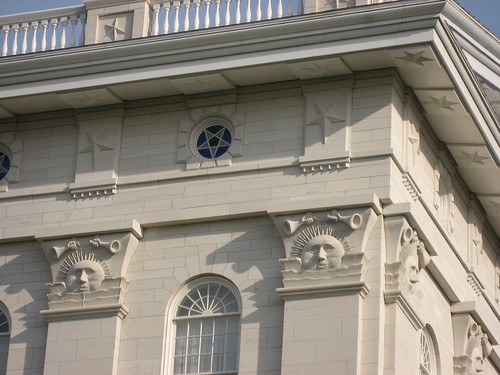
Nauvoo Temple detail showing starstones (original)
The Nauvoo Illinois Temple was the first to have six pointed starstones.  These were found in several places.  The first are just above the inverted five pointed stars under the roof overhang.  This makes these stars literally overhead, which fits as six-pointed stars often depict the actual stars in heaven.  In this context, these stars can simply be a symbol for heaven or the heavens.  They can also remind us that as the stars are above this earth, God and his ways are greater and higher than this earth.  The temple then is an elevated place, a place where things greater than just this earth happen.

More six-pointed stars are also found further up on a railing surrounding the roof line (they are five sided point up stars near the tower).

What else do these stars represent?  Well, in my earlier posts on sunstones, moonstones, and five pointed starstones, I pointed out that one meaning was to represent the vision of John in Revelation 12:1 where he saw a woman with the moon at her feet, clothed with the sun, and with a crown of 12 stars.  This is part of the six pointed star meaning.  They can also have other meanings as discussed later on.

Salt Lake Temple big dipper (original)
Several temples were built after the Nauvoo Temple without six pointed starstones.  Then, the Salt Lake Temple was built with a few six pointed stars.  There are 7 of them (which is a symbolic number) and they are laid out to represent the big dipper constellation, which is the constellation used to find the north star, the one star that is fixed in the sky.  This makes these stars symbols of eternity, guidance, and finding our way (they help us find the north star which helps us find our way).  They represent the true direction possible through the temple and the priesthood.  An early trial version of these starstones is found inside one of the towers where there is a six pointed star cut into the stone rather than projecting out of it.  Apparently the builders didn't like the look and changed to the current design, but kept the trial stone for an interior block.

Washington D.C. Temple big dipper (original)
The next temple with six pointed stars was the Washington D.C. Temple.  Here the stars were again used to represent the big dipper.  In this case the stars were on the doors and are made out of metal.  A good image is found here.  A close up image of the big dipper panel is found here.  You will notice that not all of the stars are six pointed, but clearly they all represent the actual stars that make up the big dipper.

Portland Oregon Temple stars on spires (original)
The Portland Oregon Temple was the next to use six pointed stars.  Here they have several uses.  Most of the stars are on the eastern three spires (the west spires lack stars which confused me until I realized they were referencing the Salt Lake Temple symbolism).  These stars represent John's vision in Revelation 12:1 (being above the sunstones).  Additionally, they may represent the Melchizedek Priesthood guiding us and the noble and great ones foreordained to be the leaders in the church (read my 5-pointed starstone post for that explanation) The Salt Lake Temple has the same symbolic use of many stars (40) on the east towers that aren't on the west towers; whereas, the Portland Oregon Temple has 120 stars on the eastern spires.  Both numbers, 40 and 120, are symbolic.  Additionally, these six pointed stars can represent the heavens or heavenly things.  They may also represent the star of Bethlehem due to the elongated bottom point (as I also discussed in my 5-pointed star post). In the same way that the Star of Bethlehem pointed to where Christ was, these stars point down to the temple, where Christ can be found today.  The doors of the Portland Temple also have the same stars on them in beautiful wood.  Neither the wood door stars, nor the fiberglass spire stars are stone, so I guess these aren't really starstones, but they are close enough, and a beautiful variation on this symbol.

Las Vegas Nevada Temple Starglass
The Las Vegas Nevada Temple (a fraternal twin of the Portland Oregon Temple) has six pointed stars in art glass windows.  These are above the sunstones and represent John's vision and the heavens.  Additionally, the stars represent the 12 apostles.  This is because in the celestial room there are 12 star windows and one giant cut glass sunburst mandala (see manufacturer's website).  These combine to reference Lehi's vision in 1 Nephi 1 where he sees one like the sun followed by 12 like the stars.  So through clever placement of this star window, the star was able to have multiple meanings simultaneously.


The St. Louis Missouri Temple also features a six sided star glass window.  You can see it here.  You'll notice that there are also moons in the window, but I'm not going to get into the symbolism now.  The star portion of the window is a Star of David.  While this symbol is most commonly used to represent Judaism these days, on the temple it instead refers to God's covenant people, the restoration and gathering of the 12 tribes of Israel, God's covenants with us, etc.  Thus, it is not odd to see this symbol on this Christian Temple.  Similar Star of David windows are found on the Assembly Hall on Temple Square in Salt Lake City.

I believe those are all of the six pointed stars on temples.  If I missed some, please tell us about them in the comments.  Also, please comment and let us know what you think about these stars and their use (symbolically and artistically) on temples built by The Church of Jesus Christ of Latter-day Saints.

Wednesday, June 8, 2011

The Church of Jesus Christ of Latter-day Saints - Temple Symbols - Starstones - 5 Pointed Stars

I've already written about sunstones and moonstones on temples built by The Church of Jesus Christ of Latter-day Saints.  Now I'd like to write about starstones.  I'll begin with five pointed stars and gradually progress through the various types of stars on Latter-day Saints temples.

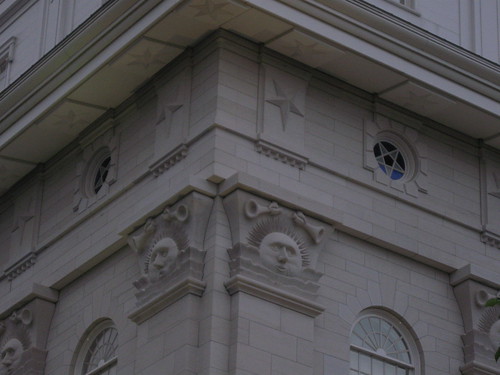
Nauvoo Temple corner with various symbolic stones
The Nauvoo Illinois Temple was the first to use symbolic sun, moon, and star stones.  As I pointed out earlier, these were meant to represent the vision of John in Revelation 12:1

 And there appeared a great wonder in heaven; a woman clothed with the sun, and the moon under her feet, and upon her head a crown of twelve stars:
In this context, the stars would not represent the Telestial Kingdom of God, or lowest heaven.  This makes sense, as the stars are above the sunstones on the Nauvoo Temple.  There are several types of stars on the Nauvoo Temple.  In the photo (original here) you can see the five pointed stars are directly above the sunstones.  These stars are also upside down and have an elongated bottom point.  First off, they have no satanic meaning.  Upside down stars were first used to represent evil things decades after the temple was built (see FAIR article).  Inverted stars have been (and still are) used by many churches and organizations worldwide.  When I visited Illinois I noticed that buildings built in the 1800s often had inverted five pointed stars, even ones built far away from the saints.  I like how the inverted stars look on the Nauvoo Temple.  Notice that there are also red, white, and blue inverted star windows on the temple as well.  There are also right side up stars on the Nauvoo Temple on the tower and just below the tower.  You can see them in this picture.  I count 2 sets of 40 stars on the tower (possibly 40 more on the overhang for a symbolic 120 or 3X40) and a bunch more lower down along the railing.  In the Salt Lake Temple discussion I'll talk more about what right side up stars can mean, especially on towers and related to the number 40.

St George Temple celestial room
The St. George Utah Temple doesn't have exterior stars, but it does have some stars in the terrestrial and celestial rooms as well as the assembly hall.  These are not inverted.  I think they are used simply to represent heaven or the heavens, which is a common way to interpret a star.  This would explain how they can be used in a room representing the celestial kingdom.


Logan Temple Starstone
There is some added symbolism in the inverted star, particularly with an elongated point.  When the Logan Utah Temple was being built, the saints again added inverted five pointed stars.  They said that it represented the Star of the Morning, a symbol of Christ (see aforementioned FAIR article).  This makes sense as the morning star, actually the planet Venus, looks elongated because it is lit by the sun.  It is the bright morning and evening star, the first and last star in the sky, another way of saying the alpha and omega, the beginning and the end.  The symbol can also have another meaning and represent us getting our light from Jesus Christ as the morning and evening star gets its light from the sun.  The Logan Temple has two of these star stones (one on the west center tower and one on the east center tower) and they are almost the only symbol on the temple (the towers, keystones, and scroll stones are the other symbols).  You can see the original photo I've used here.

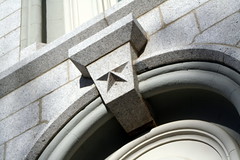
Salt Lake Temple Starstone (original)


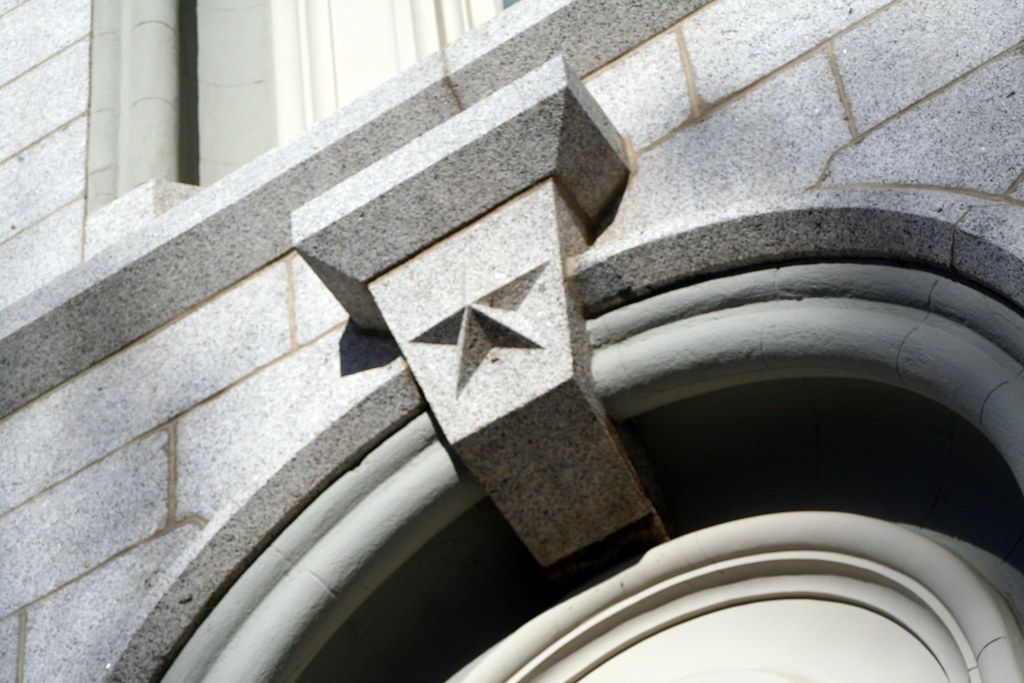
The Salt Lake Temple includes many star stones.  Among the five pointed stars represented are both point up and inverted stars.  Most are found on keystones above windows and doors.    The inverted stars represent Jesus Christ and the Morning Star and the other symbolism discussed above on the Logan Temple.  These stones are between the moon and sun stones so they do not relate to John's vision.  Original plans were going to have the inverted stars with an elongated bottom point, but the completed temple has equal length points on all stars.

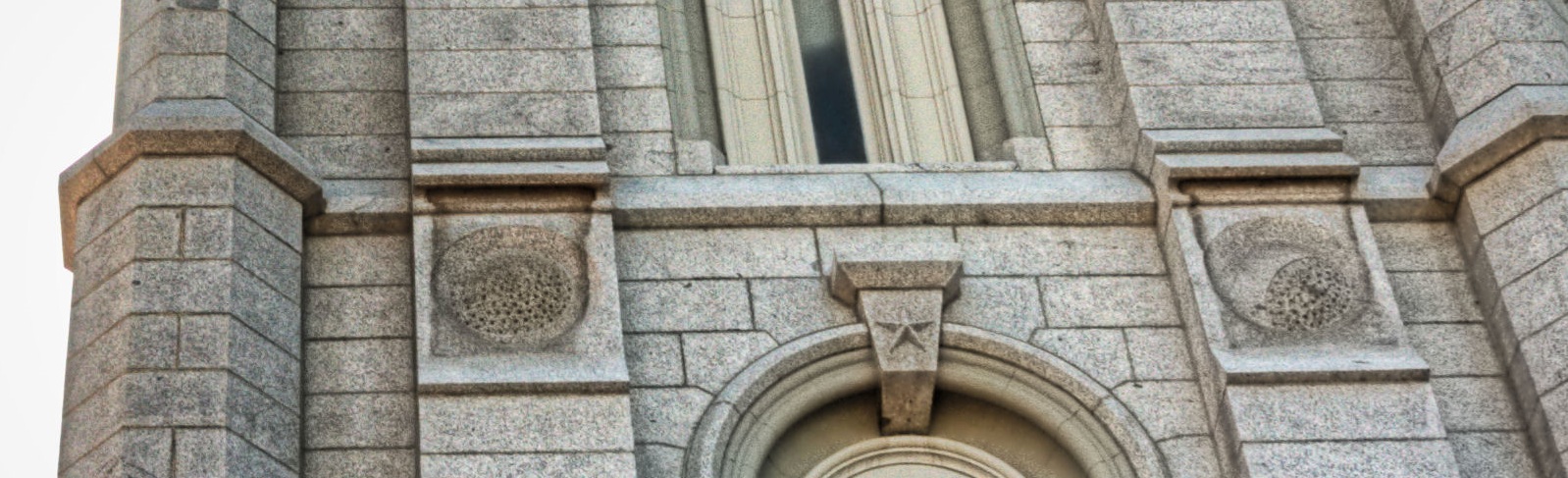
Salt Lake Temple Starstone (original)
The use of point side up and inverted stars may also imply that some stars have an additional meaning.  It is likely that the point side up stars represent the heavens in general.  The point up stars are found on the east and west ends of the temple, and the point down stars are found on the main body of the temple.  Many point up stars are above the level of the sunstones and are used to represent John's vision as was done on the Nauvoo Temple.  You might notice in the north visitor's center on Temple Square that there are planter boxes near the Christus statue that have upside down five pointed stars with elongated points.  For a short while the north visitor's center was a temporary annex to the Salt Lake Temple while the current annex was being built.

On the east towers there are an additional forty point side up stars.  Some can be seen in this photo between the cloud stones (also known as trumpet stones).  The absence of these stars on the west towers (a similar absence on west towers has been copied in other temples) implies that they have special meaning to the Melchizedek Priesthood that the east towers represent.  In the book Sacred Walls: Learning From Temple Symbols by Gerald E. Hansen Jr., it states:
According to scholar Richard Oman, the forty five-pointed stars, found only on the three eastern towers, may refer also to God's gift of priesthood to guide us, in that they may represent the great and noble spirits of premortality whom God assigned to be rulers in His kingdom.
I'm not sure how this symbolism is derived, but it sounds interesting.  The number forty is also symbolic.  It is worth noting that the east towers have these forty point side up five-pointed stars forming a sort of constellation, while the west side has the big dipper constellation made out of six-pointed stars.  So the towers representing each priesthood have their own unique stars.

The Laie Hawaii Temple also has a five pointed star.  It is not really a starstone, but rather a part of the relief sculptures that surround the top of the temple.  I believe this one was meant to represent the Star of Bethlehem, which is a common meaning of starstones.  I didn't mention before, but the inverted stars on temples may also refer to the Star of Bethlehem that looked down on Jesus Christ's location.  On a temple then, it can mean that as the Star of Bethlehem pointed to where Christ was, these starstones are signifying that He can be found in this temple.

Washington D.C. Temple Star
The Washington D.C. Temple used stars again.  In this case they were metal star medallions on the doors.  You can see the full image on the left here.  Another great view of these doors is here.   In this usage, the stars clearly can refer to the Telestial Kingdom, or the lowest heaven, as they are at the bottom of the doors.  They can also have the meanings for inverted and point side up stars, as both are in the star.  You might also notice that the stars are inscribed in pentagons with smaller stars within larger stars, possibly symbolizing growth and progression and infinity (as the pattern could be repeated without end).  I like the new and interesting use of the star in this temple.
Mount Timpanogos Temple Starstones (see original)
The Bountiful Utah Temple and Mount Timpanogos Utah Temple (almost identical) each have starstones on their single towers.  The general arrangement of sun, moon, and starstones is the same as the Salt Lake Temple and they carry essentially the same meaning.  Here the stones have the stars cut into the spire (rather than projecting out of it).  Apparently this was tried in the Salt Lake Temple, but not used in the completed temple.  A single cut in star stone is found on the interior of a tower in the Salt Lake Temple.  There are 24 star stones on the Bountiful and Mount Timpanogos Temples.  In case you don't know, 24 is a symbolic number related to the priesthood.  For instance, one plan for the future temple at Independence, Missouri actually calls for 24 temples in a large complex.

The Preston England Temple uses starstones to represent the Telestial Kingdom and a starting point on our eternal progression.  The stone actually has a new moon as its center.  I go into a lot more detail in my post on moonstones.  I like that this starstone is unique.  There are only 2 starstones on this temple.

Albuquerque New Mexico Temple starstones (see original)
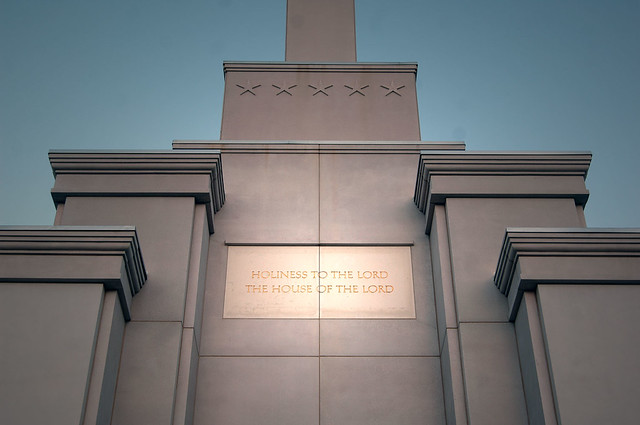
The Albquerque New Mexico Temple has star stones around its single spire (above the sunstones) suggesting the same symbolism of John's vision from the Nauvoo Temple and of the priesthood from the Salt Lake Temple east towers.

Palmyra New York Temple starstones.
The Palmyra New York Temple also has starstones on its spire.  In this case there are 12 of them with the number twelve used symbolically.  This may refer to the twelve apostles symbolized by stars in Lehi's vision in 1 Nephi 1:9-10 in The Book of Mormon (the symbolism especially works because the sunstones in this temple represent Jesus Christ).  The stars are also arranged with 3 on each of the 4 sides which adds symbolism from the number 3 (related to the Godhead) and 4 (related to man and this earth and its four corners).  It is nice that they added extra symbolism to this small temple.

I think those are all of the five-pointed stars used on Latter-day Saints' Temples with the exception of some in stained glass windows.  I hope this has been informative.  Remember, these symbols have deep and varied symbolism and usually represent heavenly things and only occasionally the Telestial Kingdom.  They represent Christ, his apostles and other laborers and the church of Christ and other holy things.  They can also represent creation as God's creation of the stars is recorded in the scriptures and the temple.

Please comment with your insights, information on other places these have been used, and anything else you'd like to discuss.

In future posts I will discuss 4, 6, 8, and 12 pointed stars and how they are used on temples.

Sunday, June 5, 2011

Latter-day Saint Temple Symbols - Moonstones

Earlier I wrote a post on Latter-day Saint temple sunstones.  Now I want to discuss a related symbol - moonstones.

Nauvoo Temple Moonstone
Symbolic moonstones are used on many temples built by The Church of Jesus Christ of Latter-day Saints and first appeared on the Nauvoo Illinois Temple.  These were crescent moons and you may notice that the stones include the silhouette of a face.  If you read my sunstone post, you will remember that the sunstone face had apparently been shown to Joseph Smith in a vision and represented some actual person.  I don't know if the same is true for the moonstone, but it too has a face.  Also in my sunstone post I discussed that the sun, moon, and star stones in this and many other temples primarily represent the vision of John in Revelations 12:1.  The moonstones are also located just above the ground level (or in later temples above the earth stones) and can thereby represent things above the earth, or greater than just this earth.  I once read in Sunstone magazine that the Nauvoo Temple moonstones represented feminism and the divine feminine.  I don't buy that argument.  I'm not going to go more into this, but I think it is a horribly wrong interpretation of this symbol.  Women have a valued, equal place in the church, but the moonstones aren't on the Nauvoo Temple to teach late 20th and early 21st century feminism.

Salt Lake Temple Moonstones (see original photo)
The Salt Lake Temple was the next to use moonstones.  These moonstones are now round and are more realistic representations of the moon.  The moons go through various phases, carved as the moon appeared on various days in the year 1878.  An observatory on temple square was used to get these phases drawn correctly.  The New Era says this about the Salt Lake Temple moonstones:
The moon stones, above the promenade, close under the second string course on each buttress, and directly above the earth stones, represent the moon in all its phases. Elder Angell’s architectural drawing of the moon stones describes them as “Buttress Blocks Commencing with Course M2 Representing the Moon in all its Phases. During the year 1878. 13 New Moons. 13 First Quarters. 12 Full Moons. 12 Last Quarters.” The moon stone representing the first quarter of the moon in January 1878 is located midway along the north wall of the temple, with the other phases of the moon being represented in a clockwise pattern around the temple, thereby locating the moon in its phases for the month of April on the central east tower. The moon stones are sometimes thought to represent the terrestrial kingdom.  
You can see that time is being represented by the moonstones as they go through the months of a year.  It is also interesting to note that April (on the east towers) is significant for the reorganization of the church, which occurred after the Melchizedek priesthood was restored.  The east side is also the front of the temple and if the temple represents the church, the month of its organization was a fitting date for the front of the temple.  The moonstones going through cycles can also symbolize one eternal round.  There may also be symbolism in the dates corresponding to the west towers as the September moonstones are on the west side of the temple and the Angel Moroni first appeared to Joseph Smith on September 21, 1823 in preparation for the restoration of the church and for The Book of Mormon to be given to Joseph Smith.  Moonstones also represent time increasing to eternity as the earthstones originally would have gone through days of a month, moonstones through months in a year, and the sunstones represent the sun going through seasons and years.   Finally, the big dipper symbol points to the north star, which is unchanging.  Thus, the moonstones represent progression towards infinite and eternal things.

Washington D.C. Temple Moon (original)
The Washington D.C. Temple was the next temple with moonstones, or rather bronze moon medallions on the doors.  These are at the top of the doors opposite the sun medallions.  The moon has a crescent reminiscent of the Nauvoo Temple while being a circle like the stones on the Salt Lake Temple.  I like the moon as a symbol of the Terrestrial Kingdom of God, the second highest heaven.  It also can represent this world in a Terrestrial state as it must be before it becomes the Celestial Kingdom.  I mentioned earlier that I don't buy that moonstones are meant to represent the feminine.  The Washington D.C. Temple uses the moonstones alongside the sunstones (at the same level of each door).  Because of this, if you interpret moonstones to relate to feminine divine nature or something like that, on this temple the symbol would at least imply equality among the sexes.  I repeat, I do not think the moonstones are meant to represent the feminine, divine or otherwise.

Portland Oregon Temple Moonstone
The Portland Oregon Temple and Las Vegas Nevada Temple both use moonstones arranged like those on the Salt Lake Temple.  These go through phases and have the same general meaning as the stones on the Salt Lake Temple.  On the Portland Temple the moonstones are made of thinly cut stone that acts as translucent stone windows.  During the day, the stones glow on the interior of the temple, and at night they glow on the exterior from the interior light.

Las Vegas Temple Moonstone
The Las Vegas Nevada Temple Moonstones are slightly different, but appear on the temple in the same basic place.  They are not translucent in this version.


Bountiful Utah Temple Moonstone (original photo)
The Bountiful Utah Temple and Mount Timpanogos Utah Temple each contain moonstones.  These are meant to match those on the Salt Lake Temple.  As you can see, they are at the tops of windows (the sunstones are at the base of the spire).  I like the use of this symbol, although I don't find these moonstones as aesthetically pleasing as those on other temples.

The St. Louis Missouri Temple has a large art glass window with many moons, but a discussion of this will have to wait until I post on sun/moon/star stained glass.  Several other temples have used similar art glass.
Preston England Temple Moonstones

The Preston England Temple uses moonstones in a unique way.  The 12 moonstones are oriented with six on the north side and six on the south side.  The stones are all at the same level and are combined with the two star stones and two sun stones.  The moon stone closest to the front door of the temple on each side is a new moon and forms the center of a star stone.  Moving westward (towards the celestial room) there are four moonstones waxing towards a full moon.  Then, the moonstone closest to the celestial room on each side is a full moon and forms the center of the sunstones.  The Preston moonstones can be read in many ways and may represent:

The three heavens or degrees of glory with the moon as the Terrestrial Kingdom of God
Progression towards the Celestial kingdom as the moon waxes from new to full.
An eternal round, as the moon will wax and wane through its phases if you follow the pattern as you walk around the temple.  This can continue endlessly, so it is a symbol for time and eternity.
If the sun stone is seen as representing Jesus Christ or God, the source of light, then the moonstones can symbolize us and that as we approach them we increase in light as the moon increases in light in its phases.  Similarly, as we increase in the temple, we increase in light and knowledge 
The use of twelve moonstones can also have symbolic meaning.
The Preston England Temple is the only temple I've seen with the moonstones displayed in this way.  I love it and would like to see similar displays on other temples.

The Bogota Columbia Temple also includes moonstones seen here.  This temple shares many architectural characteristics from the Bountiful and Mount Timpanogos Temples.


Albuquerque N.M. Temple Moonstone
The Albuquerque New Mexico Temple has moonstones.  You can see the original of the photo on the left here.  Here is another good photo.   Notice that the moons wax as they approach the single sunstone on the back of the temple or the single sun stained glass window at the front of the temple. The use of these symbols is then similar to that on the Preston England Temple, although with the moonstones at differing heights.  I count 14 moonstones on this temple (6 on the back, 4 on the front, 2 on each of the other two sides).


Palmyra New York Temple Moonstones
The Palmyra New York Temple also has moonstones as a unique extra symbol for a temple of its size.  These stones are used in the same way as those on the Salt Lake Temple.  You can see another photo of them here.

Although I wasn't going to mention moons in glass, you can see how they are used in the Winter Quarters Nebraska Temple here.

The Columbia River Washington Temple includes many circles that I think are meant to represent moonstones, although these don't have phases on them.  The main indication that they are moonstones is the presence of a sunstones on the spire.

Those are the temples that I have identified with moonstones.  Several others have moons in the stained glass.  To recap (and in some cases explain for the first time), moonstones can represent:

The Terrestrial Kingdom
A Terrestrial or Zion society as we prepare for the future Celestial Kingdom
Time extending towards eternity
Progression
Light
The creation (God created the sun, moon and stars as recounted in the scriptures and temple)
John's vision in Revelation 12:1
Heavenly things
One eternal round
April as the month the church was organized
Degrees of glory

Please comment and let us know what you think about moonstones, symbolism not discussed, architectural use of these stones and how well they are used on each temple or how aesthetically pleasing each use it, or anything else you want to discuss.  If you know of any that I've missed, you can also mention that.

I love the rich symbolism that moonstones impart to temple architecture and hope I've helped you see how deep their meanings can run.

Sunday, May 29, 2011

The Church of Jesus Christ of Latter-day Saints Temple Symbols - Sunstones

The Sun has been used as a temple symbol from the second Latter-day Saint temple, the Nauvoo Temple.  This symbol has a lot of meaning, and that meaning varies depending on how it is used on a particular temple.  Sometimes the symbol may have multiple meanings on a given temple adding a rich depth of symbolism.  I'm going to focus on sun stones mainly and skip over sun symbols in glass.


The first sunstone was on the Nauvoo Illinois Temple.  Three of the original thirty sunstones have survived and can be seen in the Nauvoo Church of Jesus Christ of Latter-day Saints visitor's center, Nauvoo Community of Christ visitor's center, and in the Smithsonian Museum of American History in Washington D.C. right next to the original star spangled banner.  The rebuilt temple has sunstones matching the originals.

These sunstones in the Nauvoo Temple had a face on them.  This was apparently supposed to represent an actual person.  Joseph Smith was asked by a builder "Is this like the face you saw in vision?" and Joseph replied "Very near it" (See FAIR article).  So apparently the face had some added significance.
The suns on the sunstones were rising above either waves or clouds (there are conflicting accounts from the builders).  Early plans also had the sun rising above acanthus leaves, something that was worked into the rebuilt temple's interior (see photo on the right).  The sunstones formed the capitols of exterior pilasters together with the clouds/sea and the trumpet stones just above the sunstones.  The trumpet stones are what I named this blog after.  Some sources call them cornucopias, but the Salt Lake Temple plans show them clearly as trumpets (later the Salt Lake Temple trumpets were removed).  On the Nauvoo Temple, the sunstone's strongest intended meaning was not the celestial kingdom.  Wandel Mace, one of the temple foremen, said:
The order of architecture [on the Nauvoo Temple] was unlike anything in existence; it was purely original; being a representation of the Church, the Bride, the Lamb's wife. John the Revelator, in the 12[th] chapter [and] first verse of [the book of Revelation] says, 'And there appeared a great wonder in heaven; a woman clothed with the sun, and the moon under her feet, and upon her head a crown of twelve stars.' This is portrayed in the beautifully cut stone of this grand temple. (See FAIR article)
The next temple with sunstones was the Salt Lake Temple.  The symbolic stones on the Salt Lake Temple follow the general arrangement of those on the Nauvoo Temple and therefore have similar meaning.  So the sunstones primarily refer to the vision of John in the Revelation.  They do have some additional meaning as well.  Time seems to be used as a symbol on the temple with earthstones (originally to be detailed going through hours of a day), moonstones in different phases representing days, weeks, and months.  The sunstones could then represent the seasons and years as the sun moves north and south in the seasons.  Each sunstone has 40 points and 40 is often used to represent a long period of time.  The big dipper then would imply Polaris which never changes.  So in this case the sunstones would also represent progression towards eternity.

Early plans for the Salt Lake Temple show faces on the sunstones, similar to those used on the Nauvoo Temple sunstones.  This was probably changed when the temple material was switched to granite, making carving faces difficult.  I like how the Salt Lake Temple sunstones include the whole sun instead of only showing the Nauvoo Temple rising sun (for variety, I like the Nauvoo version a lot).  Originally the Salt Lake Temple's sunstones were intended to be gilded.  It would have been cool to see them covered in gold.  (See New Era article)

The Washington D.C. Temple was the next to include the sun, although in this case it was a sun metal door detail.  This sun is clearly inspired by the sunstones on both the Nauvoo Temple and Salt Lake Temple.  The Salt Lake Temple's round shape is combined with the face from the Nauvoo Temple.  The sun also appears to be rising.  For more information on the Washington D.C. Temple doors you can read my post and accompanying links here.  The arrangement of symbols on these doors, although clearly borrowing from the earlier temples, implies that in this temple the sun (highest on the doors) is being used to represent the celestial kingdom with glory compared to that of the sun as in 1 Corinthians 15:40-42.  This is how I think most members interpret the sunstone's symbolism, and for a lot of the later temples this is the primary intended meaning.  Another way to interpret the symbolism on this temple (and others) is that the sun is a part of the heavens (along with the moon and stars) and so sunstones represent heavenly things and the temple is a heavenly place.

I think that the next temple with sunstones was the Portland Oregon Temple.  These can be seen glowing brilliantly (they are thinly cut translucent stone) in the picture (you can see the full image in this link).  In this temple the sunstones are along the top of the temple and therefore line the top of the celestial room.  This shows that they represent the celestial kingdom.  At the same time, on the exterior of the temple, the symbols match those of the Salt Lake Temple and stars cover the spires above the sunstones meaning that the stones also are representing John's vision as in the Nauvoo and Salt Lake Temples.  The style is clearly copying the Salt Lake Temple sunstone design.  The way these stone windows glow also points out that sunstones can simply be used to represent light.

The Las Vegas Nevada Temple uses the same general floorplan as the Portland Temple.  In Las Vegas, the sunstones are moved down slightly so the starstones can be on the main body of the temple instead of the spires.  The sunstones are made out of precast concrete in this case.  The use of the sunstone in this temple implies John's vision.  Inside the celestial room there is also a brilliantly cut crystal sun mandala used to represent Jesus Christ (see my Las Vegas Temple post for more information on the symbolism).  The sun mandala can be seen on the manufacturer's website.  Additionally, above many doors in this temple there are rising suns similar to the Nauvoo Temple suns, but semicircles and without faces.

The Bountiful Utah Temple and Mount Timpanogos Utah Temple both contain sunstones.  There are 12 on each temple and they are at the base of each temple's spire.  The photo to the right shows the stones on the Mt. Timpanogos Temple and the original photo can be found here.  A picture of the Bountiful Temple with visible sunstones can be found here.  On these temples the sunstones follow the Salt Lake and Nauvoo Temple pattern and most clearly refer to John's vision.  Each temple also has suns on the doors seen on the Bountiful Temple here, and on the Mount Timpanogos Temple here, and here and here.  These door suns are more stylized and look similar to flowers.  I like that the spire suns have the rays going all the way to the center of the suns, making them different from previous temples' sun stones.  The Bountiful Temple also includes Native American sun designs throughout the temple.  Some can be seen in the main lobby on the top of wood columns.  The largest is in the celestial room stained glass window and therefore probably also represents the celestial kingdom.

The Bogota Columbia Temple also includes sunstones that can be seen here. They are at the base of the spire and as far as I can tell there are 16 of them.  This temple is similar to the Bountiful and Mount Timpanogos Temples.

The Preston England Temple has 2 sunstones.  They are arranged alongside starstones and moonstones.  The 2 starstones are closest to the front doors and the center of each is a new moon.  Then there are 4 moonstones increasing towards a full moon.  Then there are the sunstones which are closest to the celestial room and sealing rooms.  The center of each sunstone is actually a full moon.  Clearly these stones are meant to represent progression.  The sunstones represent the celestial kindgom.  I like how the orientation and style of the sunstones are different than previous temples.

The Albuquerque New Mexico Temple again follows the Salt Lake Temple's symbolism.  This time a single sunstone is placed among moonstones implying progression and the celestial kingdom.  Starstones higher on the temple link the sunstone symbol to John's vision.  Suns also appear in the stained glass windows.  Here is a link to the original of the picture at the left.


Palmyra New York Temple Sunstone
The Palmyra New York Temple is one of the first small temples.  Unlike other temples of this style which simply use circles as a decorative pattern (with circle in square symbolism), this temple has moonstones and sunstones and starstones.  In Chad Hawkins' book The First 100 Temples it states:
The sun and star stones of the temple are on the spire.  There are four sunstones, each one facing a cardinal direction of the compass.  Each sunstone has thirty-three rays of light, representing the number of years of the Savior's mortal experience.  Higher on the spire are three stars adorning each of its four sides, totaling twelve stars.  This design refers to the symbolic meanings represented by the numbers three and twelve.
If you read my post on the Las Vegas Nevada Temple, you'll remember that when a sun is paired with 12 stars it references Lehi's vision in 1 Nephi 1 and thereby makes the sun represent Jesus Christ.  In the Palmyra Temple this is doubly emphasized by the 33 rays.

The Columbia River Washington Temple includes the symbols from the Salt Lake Temple but has moved the sunstones to the top of the spire.  They look similar to those on the Bountiful and Mt. Timpanogos Temples.

The Newport Beach California Temple also used sunstones.  In this case there are a lot of them along the top of the temple.  I'm not sure what other symbols are present except that if you look carefully you can see stars cut into the top of the spire which may imply a John's vision interpretation of the symbols.


When the Soa Paulo Brazil Temple was recently remodeled they added suns to the tops of the Celestial Room columns.  These are based on the rebuilt Nauvoo Temple's sun-rising-out-of-acanthus-leaves capitals, without faces, but with gilding.  I like seeing this detail in a remodel and hope to see similar details in new temples.


Those are the sunstones I've been able to identify.  10-15 more temples include the sun symbolically in their stained glass, but that will have to wait for another post.  To review, the sun as a temple symbol represents:


John's Vision in Revelation 12:1
The Celestial Kingdom as described in 1 Corinthians 15:40-42
Eternal Progression
Time approaching eternity
Jesus Christ (especially when paired with 12 stars symbolizing his apostles).
Light
The Heavens

Please comment and let us know what you think, or if you know of any sunstones I may have missed.

Tuesday, May 24, 2011

The Oakland California Temple Tree of Life Motif

The Tree of Life is used as a symbol on many temples built by The Church of Jesus Christ of Latter-day Saints.  Sometimes the tree is realistically depicted.  Other times a stylized version of the Tree of Life is used.  The Oakland California Temple uses a stylized version of the Tree of Life that I really like.  I have found this symbol in two prominent locations.

Each of the five towers of the Oakland Temple have the stylized Tree of Life pattern running up the middle of each of their four sides.  Pictures of this are found in the following links: 1, 2, 3.

The same stylized version of the Tree of Life is found on the temple doors.  You can see a picture of them here.

I like this symbol and especially this particular stylized version of it.

Sunday, May 22, 2011

The Church of Jesus Christ of Latter-day Saints' Temple Symbols - A Circle in a Square


Circle in Square, Las Vegas Nevada Temple
One common symbol found in temples of The Church of Jesus Christ of Latter-day Saints is that of a circle inscribed in a square.  This is a very simple symbol with a neat meaning.

The circle in the square represent heaven and earth coming together (a great temple symbol).  The heavens are often described as a bowl and often symbolized by a circle.  In paintings, God is often depicted as laying out the heavens with a compass and the earth with a square.  The square is made with a square and represents the earth which is often described as having four corners.  The temple is a place that represents the union of heaven and earth, and where heavenly beings (Angels & Jesus Christ) literally come. 


The circle in the square can remind us of our temple covenants.  I don't want to elaborate on this, but those who have been endowed hopefully have picked up on or will pick up on how a circle and a square represent other symbols that represent other things.

The original Nauvoo Temple had a flying angel weather vane with a symbol above related to the circle in the square.  Here is an excerpt explaining the symbol.
Above the angel was the symbol of the square and compass, and surmounting that was a stylized flame of fire. . . . There exists no account for reason of the placement of the square and compass on the weather vane. One scholar has suggested that, since the compass, which is used to draw circles, points towards the bowl of the sky, and that the square, which is used to draw squares, points towards the earth, that the combination of the two symbols represent the powers of God in creating the bowl of the starry heavens and the four corners of the earth (Brown and Smith, Symbols in Stone, p. 105). Since the symbol is associated with "the angel flying through the midst of heaven" (D&C 133:36), it may suggest that the gospel will be "declared by holy angels" (Moses 5:58) from above to the four corners of the earth, even "unto every nation, and kindred, tongue and people" (D&C 133:37). (source site)
The Salt Lake Temple used the circle in square symbol (and didn't just hint at it).  The symbol can be seen in two places.  The first is here and is actually the earth stones (they just didn't receive the details of continents when the temple materials were changed to granite.  In this case, the symbol may be unintentionally a circle in a square.  The other location is high on the temple, near the top.  In this photo the circle in the square symbol is repeated above the inscription stone and below the cloud stones (which originally were planned with trumpets and would have been trumpet stones, which is where I got the name for this blog).  I've heard people claim that this symbol is the Saturn stone.  Originally the temple was planned to include stones sculpted like the planet Saturn; however, John Taylor had them removed from the temple design at the same time he instructed the architects to stop doing everything the way the Masons did as this was not a Masonic temple.  The circle in the square symbol is definitely NOT the planned Saturn stone symbol.  If you look in the book The Salt Lake Temple: A Monument to a People 1893-1993 you can see the original elevations of the temple and they include both the Saturn stones AND the current tower circle in square symbols on the same drawing.  These two symbols are distinctly different symbols.  I hope I've cleared that up, because a lot of people claim otherwise (online and elsewhere) and it is flat out wrong.  The Salt Lake Temple would also have originally had the compass and square symbols next to the earth stones, but later designs eliminated the symbols.

Many other temples include the circle in a square symbol, so many that I'm not even going to attempt to list them.  You'll find them in stone, on doors, in glass, on fences, cast into the concrete for sidewalks, and many other places.  Here are some examples - 1, 2, 3, 4, 5, 6, 7, 8, 9. The original Ogden Utah Temple and the current Provo Utah Temple contain this symbol when viewed from the top.  The upper portion of each temple was rounded and is where the endowment and sealings are performed.  The base of the temples is square (or nearly so).

I like the circle in square symbol, its simplicity, and its beautiful symbolism of heaven and earth united.  Please comment and let us know what you think about this symbol or other places it has been used.

If you want to read more, here is an article by Hugh Nibley on the subject from BYU's website.

Thursday, May 19, 2011

Latter-day Saint Temple Baptismal Font Staircases

This is another post on staircases in The Church of Jesus Christ of Latter-day Saints' Temples.  Today I'll be briefly discussing baptismal font stairs.

Above from left to right are pictures of the baptismal font stairs in the Nauvoo Illinois Temple, St. George Utah Temple, Logan Utah Temple (original), Salt Lake Temple, Laie Hawaii Temple, and the Cardston Alberta Canada Temple.  These staircases are typical of many temple stairs where one walks up to the font.  Many have beautiful decorative railings.  I like these staircases.  I really like the intricate railing and step details used in the St. George Temple, Logan Temple and Salt Lake Temple.  I also like that patrons get to use the stairs.

There are many temples with stairs around the font which only lead to the area around the oxen and which are only used for maintenance and cleaning.  These can be seen in the Jordan River Utah Temple, Ogden Utah Temple (at least before remodeling started), Provo Utah Temple, remodeled Logan Utah Temple, and many others.  Most of these are really plain, but one stands out.  The Washington D.C. Temple font has two curved staircases that have obviously been planned to work with the look of the font and I think they add a lot to the temple and enhance the baptistry.
Washington D.C. Temple Baptistry

Those are a few baptistry staircases.