Showing posts with label Oakland Temple. Show all posts

Saturday, December 26, 2020

Jesus In Latter-day Saint Temples - Sculptures

My wife was looking at Light The World posts and saw that someone was using that hash tag to claim that members of The Church of Jesus Christ of Latter-day Saints aren't christian because our temples don't have pictures of Jesus in them. The post was of course ridiculous (we have pictures of Jesus hanging everywhere in temples) and I think it is an internet troll trying to take the good that came from Light The World and twist it into evil. The claim was ridiculous as the temple ceremonies feature Jesus Christ and his teachings. As a response, I would like to highlight some art in temples that depicts Jesus Christ. I'll start with this post which shows Jesus in sculpture. Of course copies of The Christus, a statue of Jesus Christ are found in temple visitors centers and on the grounds of temples, but I'm going to highlight sculptures that are a part of the temples. 

Laie Hawaii Temple


The Laie Hawaii Temple has relief sculptures on the 4 sides of the temple and smaller reproductions of these sculptures in the waiting area so patrons can have time to study and ponder the sculptures. These depict the Old Testament, New Testament, Book of Mormon, and Doctrine and Covenants / church history. I'm not sure if Jesus is shown in the Old Testament sculpture, but he is in the other 3. In the New Testament panel he is shown teaching and healing. Jesus is shown appearing to the Nephites after his resurrection in the Book of Mormon panel. Finally, in the Doctrine and Covenants panel, Jesus is shown next to God the Father in the First Vision. In each case Jesus Christ is shown in the center of the panel as the focus.

Cardston Alberta Temple

The Cardston Alberta Temple in Canada has a low relief sculpture of Jesus talking with the woman at the well. Originally this was at the temple entry, just outside the temple, but with additions it is now inside the temple.

Oakland California Temple

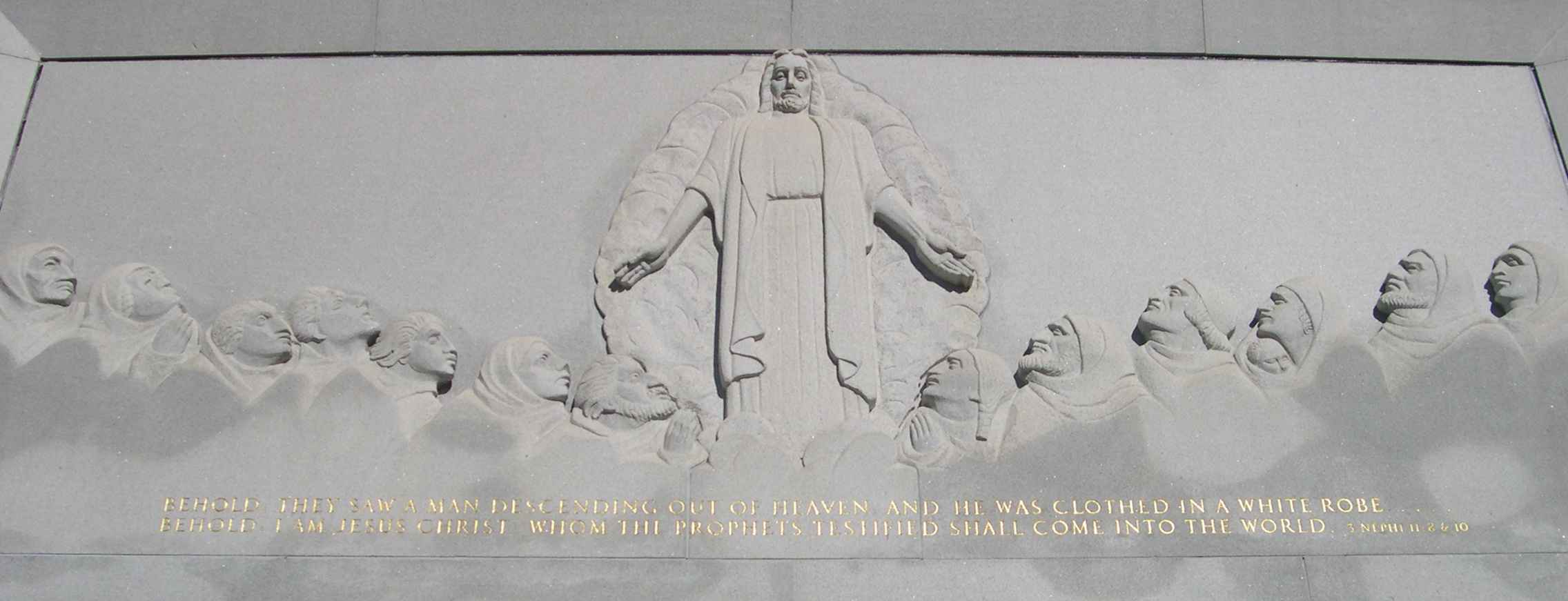
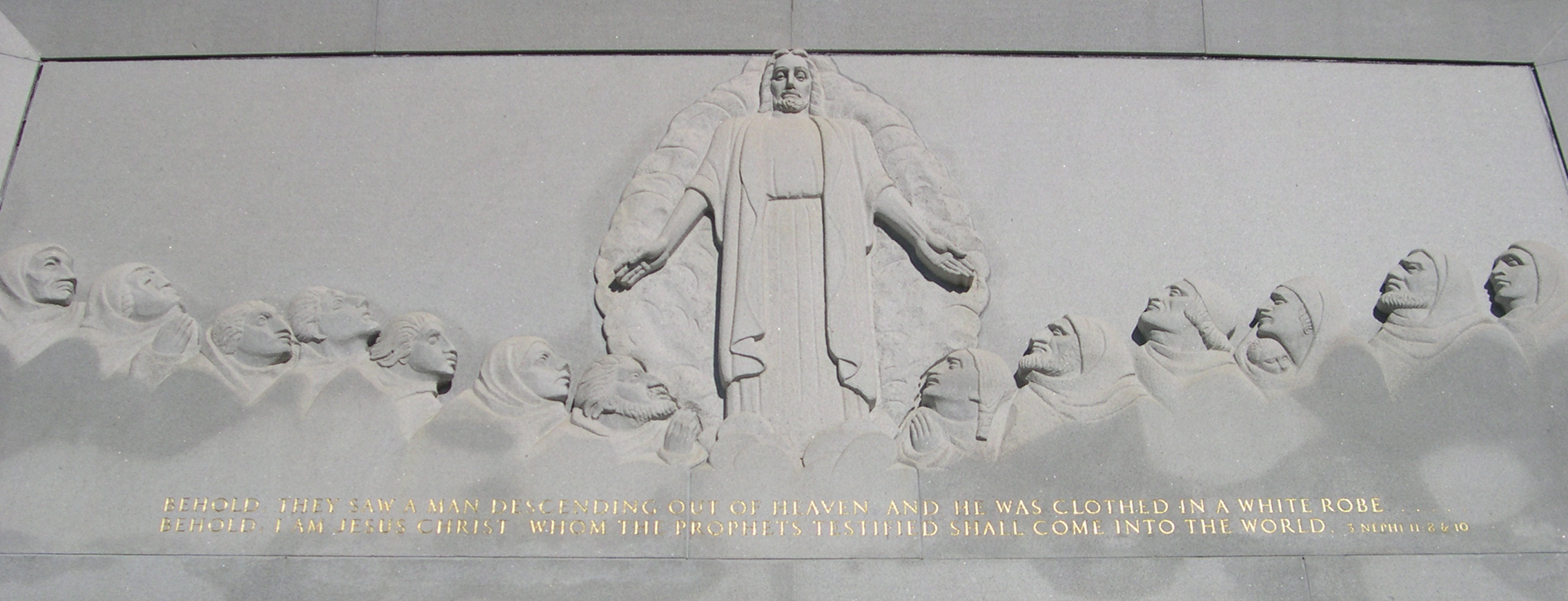
The Oakland California Temple has 2 large granite sculptures on the north (main entry) and south sides of the temple. The sculpture on the north depicts Jesus teaching in the Holy Land. He is teaching a group of men, women, and children. The sculpture on the south shows the resurrected Jesus Christ appearing to the Nephites in the Americas.

Sao Paulo Brazil Temple

The next sculpture looks like a painting, but I classified it as a sculpture because it is a mosaic, and I already have plenty of paintings to write about. The Sao Paulo Brazil Temple baptistry has a mosaic sculpture of the baptism of Jesus Christ on the wall.

Newport Beach California Temple

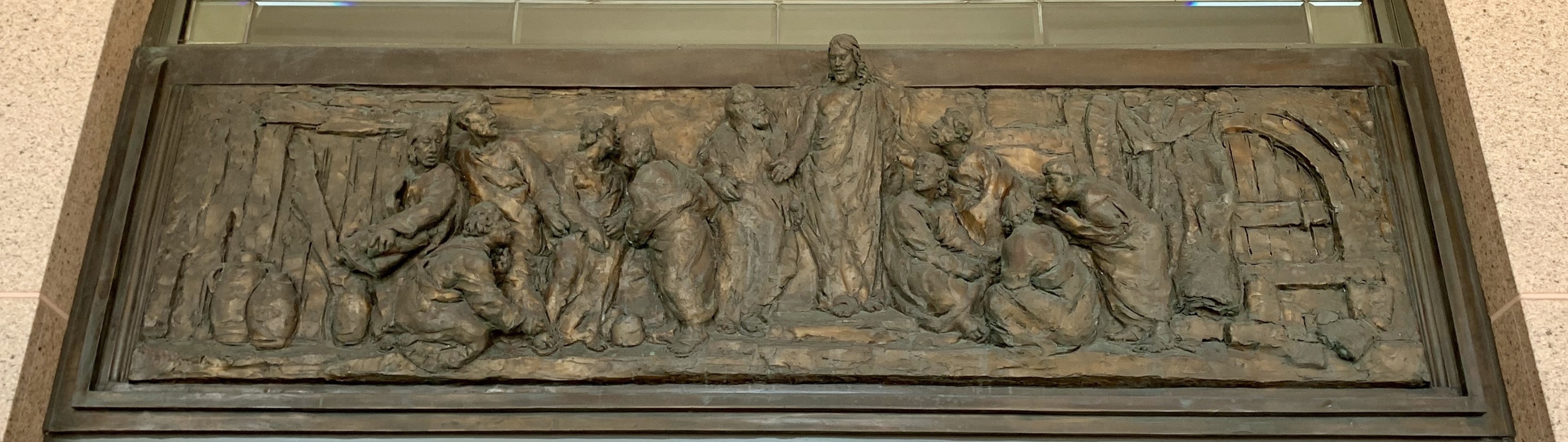
 Newer temples have included sculptures of Jesus as well. The Newport Beach California Temple has a bronze relief sculpture above the doors. This sculpture shows Jesus appearing to the apostles after his resurrection.

Indianapolis Indiana Temple

The Indianapolis Indiana Temple has a relief sculpture of the baptism of Jesus Christ in the baptistry.

Each of these sculptures adds to the focus on Jesus Christ which is so evident in latter-day saint temples. Sculptures as a part of temples, while still used, appear to be less common today than a hundred years ago. I suspect this is mainly because of the growing popularity of stained glass in temples. I do hope that we will continue seeing sculptures in temples, particularly sculptures of our Lord Jesus Christ.

Tuesday, May 24, 2011

The Oakland California Temple Tree of Life Motif

The Tree of Life is used as a symbol on many temples built by The Church of Jesus Christ of Latter-day Saints.  Sometimes the tree is realistically depicted.  Other times a stylized version of the Tree of Life is used.  The Oakland California Temple uses a stylized version of the Tree of Life that I really like.  I have found this symbol in two prominent locations.

Each of the five towers of the Oakland Temple have the stylized Tree of Life pattern running up the middle of each of their four sides.  Pictures of this are found in the following links: 1, 2, 3.

The same stylized version of the Tree of Life is found on the temple doors.  You can see a picture of them here.

I like this symbol and especially this particular stylized version of it.

Tuesday, April 12, 2011

Metal Clad Temple Towers, Domes, and Spires

The Church of Jesus Christ of Latter-day Saints' temple towers, spires, and domes have occasionally been clad in metal.  I want to talk a little about these.

Many historic Christian churches have metal clad spires.  Lead, Aluminum, Copper, Gold, and other metals have been used throughout history.  The metals serve a practical function of protecting the spire as they weather well.  Placing metals on churches was also a a way to make the church extra special, as many of the metals were hard to come by.


Orig. 1884 Salt Lake Temple Spire Sections
Truman Angel Sr.'s 1884 plans for the Salt Lake Temple had metal sheathed spires.  So the slanted portions of all six towers would have been covered in metal.  In 1887, Truman Angel Jr. changed the design to have the granite spires that the temple has today. (See Salt Lake Temple: A Monument to a People)  Today, the only metal on the spires are five copper finials and the gold leaf covered Angel Moroni statue.


The London England Temple has a metal spire.  You can see a photo here.  The spire is the most detailed portion of the temple's exterior and I like it.  I also served my mission in London so I'm biased.  According to ldschurchtemples.com
The original design of the London England Temple called for a spire of perforated aluminum, similar in appearance to the spires of the Oakland California Temple. The perforations were later removed from the design, however, in favor of a solid sheath of lead-coated copper.
The Oakland California Temple has five perforated gold colored spires.  They are apparently not metal, but rather reinforced concrete that is painted to look like metal.  I've read that the oriental look of the spires is not a coincidence, but rather was used because of the large number of Asian Americans in California and particularly the Bay Area.  You can see pictures of the spires here and here and here.  I love their complexity.  I also love how the lattice structure lets the spires glow.

The Ogden and Provo Temples were the next to have metal spires.  Theirs were originally an orange gold color seen here and here. They were meant to represent the pillar of fire by night that led the Israelites from Egypt.  The upper floors of the temple just below the spire was supposed to represent the cloud that led the Israelites by day.  This is neat symbolism with, in my opinion, horrible execution.  The temples ended up resembling rocket ships, birthday cakes, and other unintended things.  In the 2000s each temple had a statue of the Angel Moroni added (which was actually in the original plans, so we shouldn't think that destroyed the architectural vision of these temples).  At the same time, the spires were painted white, covering the original metal.

Next, the Washington D.C. Temple was built with 6 pointy metal spires.  Their length makes this temple the tallest temple.  The spires are made of steel overlaid with gold leaf.  Each spire has a lot more detail than you usually notice.

The Sao Paulo Brazil Temple was the next temple with a metal spire.  Originally the temple lacked an Angel Moroni statue, but made up for this with a detailed spire.

I think the Tokyo Japan Temple spire is metal.  The Stockholm Sweden Temple and Frankfurt Germany Temple also used metal on their spires.  Many have since used some metal in the spires.

The Houston Texas Temple uses a lot of copper to cover its prominent spire. I really like the style of this temple and feel that the weathered copper gives the modern classical architecture a dignified, mature look.

The Boston Massachusetts Temple was originally completed without a tower due to a lawsuit.  A few months after its dedication, a tower clad in metal was added to the temple.  I like the design.  It is modern, yet fits in with the New England architecture, partially due to the metal spire.

The Helsinki Finland Temple features a metal spire for the tower and a metal dome over the celestial room.

Orig. Oquirrh Mountain Temple Plan With a Copper Spire
The original plans for the Oquirrh Mountain Temple included a copper clad spire.  This would have been nice as Kennecott Copper donated the land for the temple and the Oquirrh Mountains have the largest copper mine (and largest open pit mine) in the world.  The final design has a stone clad tower.


A few temples have metal domes.  The Nauvoo Illinois Temple has a metal tower dome.  I think the Manti Temple towers are clad in metal, but they may use shingles. The Vernal Utah Temple has two copper domes.  The Newport Beach California also has two copper domes, one on the tower, the other above the celestial room.

Other temples have some metal cladding.  The Cochabamba Bolivia Temple was metal on top of its central and 4 side towers.  The Las Vegas Nevada Temple has a copper roof.  Other temples have metal used here and there.

I like metal spires, towers, and domes on temples.  They haven't been used as often as stone or fiberglass or painted spires.  That makes them unique and interesting.  Metal brings a certain dignity to these temples.  There are a wide variety of uses with numerous metals to choose from.  Different styles can and have been used such as perforating the metal, adding etchings, adding a textured pattern, using a smooth metal surface, using several metals, etc.  Metals can retain an untarnished glory or be allowed to develop a dignified patina.  The possibilities are great and so I expect to continue seeing metal temple spires, domes, and towers.  That is a good thing.

Please comment and let us know what you think.

Tuesday, April 5, 2011

Words as Temple Decoration

Several temples of The Church of Jesus Christ of Latter-day Saints use words to decorate the temple.  For example, at the entrance to the Cardston Alberta Temple there is this verse by Orson Whitney that I found here.  Here is the verse:

Where spreads a feast unknown to festive halls.
Freely partake, for freely God hath given
And taste the holy joys that tell of heaven.
Here learn of Him who triumphed o’er the grave,
And unto men the keys, the Kingdom gave;
Joined here by powers that past and present bind
The living and the dead perfection find.
 In other temples a verse of scripture is used.  In the Mesa Arizona Temple, above the celestial room doors (seen from the grand staircase) is part of D&C 93:36:
THE GLORY OF GOD IS INTELLIGENCE
I think it was also in the Mesa Temple (but may have been elsewhere) that the beatitude found in Matthew 5:8 is inscribed on a wall:

BLESSED ARE THE PURE IN HEART FOR THEY SHALL SEE GOD
The Idaho Falls Temple has  Habukkuk 2:20 on the wall in a foyer area:
BUT THE LORD IS IN HIS HOLY TEMPLE: LET ALL THE EARTH KEEP SILENCE BEFORE HIM.
Of course most temple exteriors contain the words:
HOLINESS TO THE LORD
THE HOUSE OF THE LORD
The Salt Lake Temple contains a scroll stone engraved with the words:
I AM ALPHA AND OMEGA
The original Nauvoo Temple had inscriptions in the lower assembly hall.  Above the Melchizedek Priesthood pulpits, following the arch of the ceiling in gilded letters were the words:
THE LORD HAS SEEN OUR SACRIFICE - COME AFTER US
Both the Kirtland Ohio and Nauvoo Illinois Temples had assembly halls with three initials on each of the 24 pulpits.  The Kirtland Temple had the Melchizedek Priesthood pulpits engraved with the following from top to bottom:

M.P.C. (Melchizedek Presiding Council)
P.M.H. (Presiding Melchizedek High Priesthood)
M.H.P. (Melchizedek High Priesthood)
P.E.M. (Presiding or Presidency Elders Melchizedek)
On the eastern Aaronic Priesthood side the initials are from top to bottom:

B.P.A. (Bishop Presiding over Aaronic Priesthood)
P.A.P. (Presiding or Presidency Aaronic Priests)
P.T.A. (Presiding or Presidency Teachers Aaronic Priesthood)
P.D.A. (Presiding or Presidency Deacons Aaronic Priesthood)
 This website claims that in the Nauvoo Temple the initials were, on the Melchizedek Priesthood side:

P.H.P. (President of the High Priesthood)
P.S.Q. (President of the Seventy Quorums)
P.H.Q. (President of the High priests Quorum)
P.E.Q. (President of the Elders Quorum)
 And on the Aaronic Priesthood side there were the initials:
P.A.P. (President of the Aaronic Priesthood)
P.P.Q. (President of the Priests Quorum)
P.T.Q. (President of the Teachers Quorum)
P.D.Q. (President of the Deacons Quorum)
The assembly hall in the Salt Lake Temple contains inscriptions above the pulpits on each end.  They are:
Aaronic Priesthood
and
Melchizedek Priesthood


The Manti Temple doorknobs contain what is claimed to be stylized Arabic (stylized to the point where the inscription cannot be interpreted today), a common art form used by Masons (the doorknob maker was a mason).  For more information, read the book The Manti Temple.  This book was printed to commemorate the centennial of the Manti Temple.

In Islam since images are often considered idol worship, their mosques and other buildings are often decorated with verses from the Koran, usually extremely stylized.  So using text to decorate religious architecture is not even unique to Christianity (which has many examples of using scriptures to decorate churches).  I also read a newspaper article a few years ago that featured an old Church of Jesus Christ of Latter-day Saints chapel with scriptures written on each of the roof trusses visible in the chapel.

The Oakland California Temple has relief sculptures of Christ in the New Testament and The Book of Mormon on the temple exterior.  On the New Testament Side the inscriptions are:
BLESSED ARE THE PURE IN HEART FOR THEY SHALL SEE GOD -Matt 5:8
SEEK YE FIRST THE KINGDOM OF GOD AND HIS RIGHTEOUSNESS -Matt 6:33
On The Book of Mormon side it reads:
BEHOLD, THEY SAW A MAN DESCENDING OUT OF HEAVEN AND HE WAS CLOTHED IN A WHITE ROBE
BEHOLD, I AM JESUS CHRIST WHOM THE PROPHETS TESTIFIED SHOULD COME INTO THE WORLD- 3 Ne 11:2&10

There is also a large plaque quoting 3 Nephi 17 in the courtyard of the Oakland Temple.

Surely there are many more examples of words being used to decorate temples.  Words can remind of of scriptures and easily put us in the right frame of mind.  Also, they are easier to understand than the hidden symbols frequently used in temples.  Scriptures can bring the spirit and remind us of things we should be focused on.

Although not decorative, when the Logan Temple was gutted they found a wall full of engravings in the plaster hidden beneath the surface.  The inscriptions (with spelling errors galore) had names, mentioned that they were being persecuted, and gave other historical information.

I hope some of you know of engravings on temples and can add a comment telling us how words are used to decorate temples.  We can also discuss how words could be used in future temple architecture, or what you think of the inscriptions I have highlighted so far.  Please comment.

Sunday, February 13, 2011

Unique Sealing Rooms

Today I'm just going to show some pictures and short commentary about what I consider are the most unique or interesting sealing rooms in Temples of The Church of Jesus Christ of Latter-day Saints.  These rooms are used for temple marriages where a man and woman are married for time and all eternity and where children can be sealed to them for eternity.

The pioneer temple sealing rooms:

The St. George Utah Temple has a number of unique sealing rooms.  One is up a small staircase in the celestial room (in the tower).  Most of the sealing rooms are on an upper floor and have a single round window going into each room.  To me, the round window just makes the room feel unique.

Orig. Logan Temple Sealing Rm
The original Logan Utah Temple interior had a sealing room (shown to the left) with gold leafed walls and a stained glass window.  It is extremely unfortunate that when the temple was remodeled the room and wall covering was lost.  I think the gold leaf was lost because it was applied to plaster walls and so it couldn't be removed and brought to the new temple (I know that is what happened to at least most of the Logan Temple murals).


Manti Temple Sealing Room
The Manti Utah Temple has many wonderful ornate sealing rooms.  My favorite is a small one off the celestial room (that isn't used any more).  I've been told that this room was the Holy of Holies until the Salt Lake Temple was completed.  Then it was a sealing room for decades.  Apparently President Hinckley wanted to preserve the room and thought it was extra special so he had the room stop being used for sealings.  This could be a rumor, although I think it was a sealer that told me this.  The room is beautiful with an arched ceiling and intricate gold patterns and detailed woodwork.  The door is left open, but roped off so you can see it but not go all the way in now.  It is also very small, with maybe room for 5 or 10 people to witness the sealing.

Salt Lake Temple SE Sealing Room
Salt Lake Temple SW Sealing Room
The Salt Lake Temple has many nice sealing rooms.  Originally it just had 3 sealing rooms.  Two were on either side of the Holy of Holies, just off the celestial room.  The last was up a small staircase on the east side of the celestial room.  The intricate craftsmanship in these rooms is wonderful to see.  The sealing rooms flanking the Holy of Holies have stained glass windows.  Still, my favorite of the three is at the top of the stairs off the celestial room, in the east center tower of the temple.  I love that the staircase leading to this room has a cupid statue on the bottom rail post.  This is a fitting symbol for the room where a man and a woman are married for time and all eternity.  These rooms definitely are unique.

The dark wood sealing rooms:

Cardston Alberta Temple Sealing Room
The Cardston Alberta Canada Temple is the first temple I know of with dark wood sealing rooms.  This temple used extensive woodwork with intricate inlays using woods imported from around the world.  As you progress in the temple the wood becomes more expensive, lush, an more intricately inlaid.  This means that the celestial room is covered in really nice dark woods.  The sealing rooms also end up dark with really involved inlays. I like this.  It is so different from the usual white sealing room, while still being nice.
Cardston Alberta Temple Sealing Room
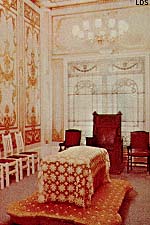
I know of only one other temple with dark woodwork in the sealing rooms.  This is the Oakland California Temple.  At least one (although not all) of the Oakland Temple sealing rooms is done in dark wood as seen in the picture below.  I like the dark wood and think it would contrast nicely with the white clothing worn in the temple.  I also like how here the altar glows in a bright contrast to the darker walls.
Oakland California Temple Sealing Room
I have not been in any of the dark wood sealing rooms.  If any of you have, please comment and tell us what they are like and what you think of them.  Also, if you know of any dark wood sealing rooms that I haven't mentioned, please write and let us know about them.

San Antonio Texas Temple Tree of Life Sealing Room

I was going to write about barrel vaulted ceiling rooms, which would also include the Las Vegas Nevada Temple sealing rooms, but I decided to just focus on the best of the group.  The San Antonio Texas Temple sealing room with a stained glass window of the tree of life is inspiring.  The brightness and whiteness of the room seems to be enhanced by the colors of the tree of life window.  Utah artist Tom Holdman did the stained glass windows for the entire temple and did a wonderful job in my opinion.


Washington D.C. Temple Oval Sealing Room
Washington D.C. Temple Sealing Room
Since I am talking about unique sealing rooms I have to mention this sealing room in the Washington D.C. Temple.  I love the oval shape of the room, the metallic wall covering (wall paper or metallic paint or something) that makes the walls shine.  I also find the oval altar interesting.
Washington D.C. Temple Sealing Room (another view)
So that is my list of the most unique sealing rooms.  There are so many more nice sealing rooms that you can tell us about in the comments.  I'll leave you with a picture of one of the Hong Kong China Temple sealing rooms.  I like it mainly because it has elliptical windows, which is just cool.

Sunday, February 6, 2011

Latter-day Saint Temple Courtyards and Atriums

Temples built by The Church of Jesus Christ of Latter-day Saints are usually surrounded with beautiful gardens giving a place for anyone to sit and enjoy the temple and the beauty of nature.  A few temples have an atrium or courtyard giving a special experience.  I want to discuss a few of these and hope that you will comment and tell me about any temples that I've missed.


The Portland Oregon Temple
I loved it when I went to the Portland Oregon Temple and found a small atrium just inside the front doors.  In the photo to the left (from Google Maps) the atrium is on the north (top) of the temple.  It is those two sections with a glass roof in between a spire and a small dome.  The atrium was really nice and was open to the public.  This came in handy for me as I was able to show it to a friend who isn't a Latter-day Saint.  Non-members frequently feel left out of the temple, and having this nice garden that we let them go into is a way to help them feel welcome.  The temple atrium is filled with beautiful plants.  Pictures of the atrium can be seen here, here, here, and here.

The Las Vegas Nevada Temple
The Las Vegas Nevada Temple uses the same floor plan as the Portland Oregon Temple and consequently it also has an interior garden.  This time I'm calling it a courtyard because it is open air.  In the areal photo the courtyard is around the spire with the Angel Moroni (this is on the right center of the photo.  That green patch is a bunch of plants in a beautiful garden including fountains.  While the grounds are also beautiful and filled with gardens, the courtyard, by its enclosed nature, is a quieter garden to sit in and contemplate.  Again it is open to the public.  I couldn't find pictures of the interior (and unfortunately I didn't take any photos on my several visits to this temple).


The San Diego California Temple
Unfortunately, I have never been to the San Diego California Temple.  I have read about it and know that it has an atrium.  In the photo on the left the atrium is between the two towers and is an eight sided star shape (technically the symbol is The Seal of Melchizedek).  From what I've read, the atrium is just outside the Celestial Room (possibly by the sealing rooms?).  For this reason, it is not open to the public but provides a wonderful scenic garden to inspire patrons to the temple.


Bountiful Utah Temple
The first temple I ever went inside was the Bountiful Utah Temple.  I went there for the temple open house before I was 12.  I have since been there many times.  One unique feature of this temple is the courtyard/atrium near the baptistery.  It is underground, yet open air.  On the level above cars can drive around the atrium making it the center of a sort of round about.  In the picture it is the center of the circle on the top.  If you park in the underground parking  lot you enter the temple just before the atrium and then walk around the atrium and finally get to the recommend desk, meaning this atrium is open to the general public.  Here is a picture of it.  Here is another showing how it is beautiful even in the winter.  The atrium is circular with glass all around.  I always loved going to the Bountiful Temple to do baptisms because I got to walk around this atrium.

The Salt Lake Temple (a long while ago)
Most people don't realize that the Salt Lake Temple used to have a greenhouse built in.  The room was attached to the garden room.  In fact, early plans of the temple had the entire garden room as a greenhouse attached to the temple on one side.  Real plants were planned to fill the room making it a literal garden.  The completed temple had the garden room inside the temple with a painted mural of the Garden of Eden.  The garden room originally also had a greenhouse attached to it seen here allowing real plants to be in the garden room.  The greenhouse is on the right side of the photo.  You will need to look closely as it isn't very big and resembles a small shack attached to the temple.  Ultimately this is probably the best use of a temple atrium because it is used to reinforce and facilitate the teachings of the endowment.  Architecturally it never quite matched the temple exterior, which is probably why it was removed.  I think it would have been nice to be in the garden room and look forward to where there are 3 arches up a few stairs with curtains in front of them (if you've been in the room you should know what I'm talking about), and have these areas open and leading to a naturally lit garden with real plants.  I think it would add a lot to the temple ceremony and provide a wonderful representation of the Garden of Eden.  I think it would be nice to add the greenhouse again.  It could be made to resemble the sealing room annex on the north of the temple, only with more glass.  I think this would work and is how the Salt Lake Temple was intended.  (I added the photo next to this paragraph which makes the greenhouse much easier to see).
 
The Oakland California Temple
From what I've read and seen in pictures, I understand that the Oakland California Temple has a courtyard garden enclosed on 3 sides.  In the picture this is on the north (top).  I mentioned in an earlier post that the courtyard has sculptures including this one (I like dogs by the way).  The sculptures are looking towards one of the two relief sculptures of Jesus Christ teaching.  I like the idea of this partially enclosed sculpture garden as an area to contemplate Christ and the temple.

Those are the temples that I know have (or had) an atrium or courtyard.  I think several others used to have them before additions took over the courtyards.  With our current focus on small temples, I don't expect to see many more of these, although the Rome Italy Temple complex forms a square garden between the temple, visitor's center, stake center, and family history center.  I think several other temples have this type of setup that creates a more private garden.  I do hope that we occasionally see an atrium or courtyard in a new temple.  The high school I attended had numerous small gardens with a single tree surrounded by glass that went into 2-3 classrooms and a hallway.  This brought a lot of natural light into the rooms and was really nice.  This idea could be used even in our smaller temples as it would only require a small space.

Please comment and let us all know what you think about temple atriums, courtyards, and enclosed gardens.  If you know of any I've missed please comment as well.

Monday, November 1, 2010

Temple Statues (other than those of the Angel Moroni)

Most Latter-day Saint temples have statues of the Angel Moroni on their tallest spire, and I wrote about that a few posts ago.  I have also written about relief sculptures on temples.  I mentioned that there is only 1 temple I know of that had a non-Moroni sculpture on the temple.  In this post I’m going to talk about that temple’s sculptures and other statuary on LDS temple grounds.

The Salt Lake Temple is the only temple I know of that used to have statues other than of the Angel Moroni on the temple.  I wrote “statues” because there were 2 of them and I wrote “used to” because they have since been moved to elsewhere on temple square.  Have you ever noticed those little covered spaces just to the sides of the doors of the Salt Lake Temple (seen in the picture on the right of the door)?  Brides love to get pictures standing underneath them.  Well these aren’t just wedding picture locations, they are statuary niches.  The top covering would keep rain off statues, slowing corrosion while framing the statue at the same time.  While there are 4 places for statues, there were only ever 2 statues placed in them.  Originally bronze statues of the martyrs Joseph Smith Jr. and his brother Hyrum Smith were placed in the statuary niches on the east side of the Salt Lake Temple.

Some years after the completion of the Salt Lake Temple the church moved the statues to another spot on temple square south of the temple so you can still see them there.  I am confused why they did this.  Articles I’ve read discussing this say that the niches are loved by brides getting pictures, but the west niches never had statues so brides could still use those.  Also, these were in the temple design and are symbols of sacrifice, testimony, and priesthood (a prophet and patriarch) among other things.  I think they should be put back in the niches.  Maybe the reasoning was that having 2 of 4 niches empty was silly, but having 4 of 4 niches empty is even sillier in my opinion.  Maybe they wanted them to get noticed more on temple square; however, with the general public now allowed to walk right up to the doors this isn’t an issue.  Placing statues in the niches should also attract more attention.  Moving the statues would also be really easy and would provide more protection to them.

Well, this post isn't just about these statues of Joseph and Hyrum Smith on the Salt Lake Temple, but before I leave that topic I'd like to propose a discussion for the comments.  If the church put the statues back in the niches on the east side of the temple and they wanted to fill the two empty west statuary niches, who's statue would you place there?  I know a few of my nominations, but I'll save them for the comments.  There are a lot of factors to consider - the symbolism, importance of the people, how the statues will match the other two, etc.  PLEASE COMMENT

Other temples also have statues on their grounds.  Here is a list I've compiled (very incomplete):

Many temples have visitors centers with replicas of Thorvaldsen's Christus statue.  Although I really like this statue, I would like to see the church commission Christ statues or make replicas of other artist’s Christ statues for some variety.  I can always see the Christus replica when I visit Temple Square in Salt Lake.

Manti Utah Temple – this temple actually has a statue of the ancient American prophet Moroni, only not as an angel and not on the tower or temple itself.

Salt Lake Temple – Temple Square has many statues on the grounds.

Laie Hawaii Temple – Multiple statues by the Fairbanks brothers ore around the temple including:
  A fountain statue dedicated to motherhood with a mother holding a giant clam shell and pouring water over children as a symbol of mothers pouring love, hope and care on their children. 
  A statue of Joseph being blessed by his father.
  A statue of the The Book of Mormon prophet Lehi

Oakland California Temple – The courtyard has a sculpture of children (and a cute dog) and quotes 3 Nephi  17

Nauvoo Illinois Temple – Grounds to the west have a statue of Joseph and Hyrum Smith on horseback.

Rome Italy Temple – This planned temple has a plaza between the visitors center, stake center, patron housing, family history center and temple that includes statues.  You can clearly see in the rendering bronze statues showing the restoration of the Melchizedek Priesthood and the restoration of the Aaronic Priesthood.  In addition there are 2 other statues.  One looks like it has women, the other I’m not sure.

Winter Quarters Nebraska Temple – shares grounds with a pioneer cemetery with statues and bas-relief sculptures.

I also notice that the Manti Utah Temple has a bunch of empty statuary niches.  I don't think these were ever planned to contain statues.  In the Logan Utah Temple the same places have windows.

If you want to discuss other temple statues, talk about adding statues to future temples, or anything else, PLEASE COMMENT.
I personally think that one of the new 2 towered temples would look good with a statue of the Aaronic Priesthood restoration in front of the Aaronic Priesthood side (baptistery entrance) and a statue of the Melchizedek Priesthood Restoration in front of the Melchizedek Priesthood side (main entrance).  These could either be in niches above the doors or just have a path around them.  Bas-relief sculptures would also be an option.  Either way the art would strengthen temple themes and teach.
I also like the idea of putting other statues on temples.  For instance, John the Baptist would look great on a temple west spire.  He already shows up in a lot of temple baptistery paintings and stained glass.

-The following is an addition to the original post

My brother-in-law reminded me of a few statues inside the Salt Lake Temple.  In the celestial room, in front of a Tiffany glass window there is a statue of a woman with two babies on either side.  She is holding something, I think laurels or flowers, or another plant.  I have been unable to find the reference on this, but I thought the statue is supposed to represent something and not a specific person.  It represents love or innocence or some ideal like that.  I find several blog entries claiming it is Aphrodite which in 1890s neoclassicism means love, beauty and fetility.  I also have found some people who say it is the Virgin Mary (one even claimed the Catholic church had donated it to the LDS church) but I'm not sure about that because the statue is flanked by 2 children, not holding one infant Jesus.

There is also a statue of a Cupid or Eros or a cherub on a railing on a staircase that leads up to a sealing room where couples are married for time and all eternity.  The statue is only a foot or so tall and includes a quiver of arrows.  This is clearly a symbol of love.  Neoclassical statues like these were common in 1893 and even earlier.  Many cathedrals in Europe are filled with similar statues representing ideals or showing Greek and Roman gods in a symbolic Christian way (like having Cupid for love).  The other statues in the Celestial Room( if you want to call them statues) are a few birds and a lot of fruits and flowers carved into the walls and ceiling.

Saturday, October 30, 2010

Latter-day Saint Temple Relief Sculptures


This entry is about temple sculptures other than Angel Moroni statues or other statues.  There are or rather were 2 other statues I know of on one temple.   If you know what I’m talking about, feel free to post a comment.  Either way  I’ll get to that in another blog post about statues on temples and on temple grounds.  For this post I’, focusing on Friezes or bas-relief or any type of relief sculpture for that matter.  Although Nauvoo, Salt Lake and many other temples have sculptures of suns, moons, stars, trumpets, clouds, constellations, earths, tree of lifes, flowers, etc., this post isn’t about them.  I’m writing today about the Laie Hawaii Temple, Mesa Arizona Temple, Oakland California Temple, Newport Beach California Temple and the Cardston Alberta Temple although it is a little different.

 The first temple relief sculpture was on the Laie Hawaii Temple in 1919.  On the four sides of the temple there are friezes that are relief sculpture planned by J. Leo Fairbanks and  built by him and Avard Fairbanks, his brother.  These depict Christ in 4 dispensations, or perhaps more accurately in 4 scriptural periods.  These are:

West - Old Testament
South - New Testament
North - Book of Mormon
East - Latter-day Dispensation (Doctrine and Covenants)

If you live in (or visit) Utah you can see smaller bronze copies of these sculptures (by another artist, I can’t find his name but it was one of the big latter-day saint names, like Knaphus) in the lobby of the new Church History Museum.  During the recent renovation of the Laie Temple they added a waiting room with copies of the sculptures so patrons inside the temple could appreciate the scenes and not just those outside.

The next relief sculpture was at the Cardston Alberta Canada Temple in 1923.  I say “at” because I don’t think this relief is actually on the temple but just the grounds, although I am unsure.  It was originally in front of a pool which has since been removed.  The sculpture by Torlief Knaphus depicts Jesus Christ talking to the woman at the well and even quotes scripture.  If you live in Utah you can see a plaster casting of this sculpture in the lobby of the Provo Utah Temple (with added color!). 

With the previous 2 temples including relief sculptures, a relief frieze was included on the Mesa Arizona Temple in 1927.  This sculpture, also by Torlief Knaphus includes 8 panels, 2 on each corner of the temple, depicting the gathering of Israel from the 4 corners of the earth.  The panels depict gathering scenes of:

Early Latter-day Saints crossing the plains to the Salt Lake Valley
A ship landing with English, Welsh, Irish and Scottish immigrants
Handcart pioneers
Mexicans travelling to Zion
Native Americans gathering
Pacific Islanders (who actually aren’t travelling unlike every other panel)
French, Swiss,  Italians travelling
Continued with Germans and Dutch leaving their homes and heading to Zion

The Mesa Temple also has a lion head on the east side by the baptistery entrance.  It is a fountain.

After the Mesa Temple it took 37 years before the Oakland California Temple included relief sculptures in 1964.  It has a sculpture of Jesus teaching the people in and around Jerusalem during his mortal ministry on the north side of the temple.  On the south side of the temple there is a sculpture of Jesus Christ appearing to the Nephites in the Americas after his resurrection.  I can’t seem to find out who sculpted these scenes, but if you know please tell us in the comments on this post.  This temple also has tree of life sculptures, but they are more of an architectural detail so I might discuss them in a later post.

Most websites and articles say that the Oakland Temple is the last with relief sculptures, but they are simply wrong.  The Newport Beach California Temple built in 2005 has a relief sculpture of Christ appearing to 10 of the 12 apostles after his resurrection.  The sculpture looks like bronze and is above the front doors.  Although smaller than the other sculptures in this article, it is a welcome return to relief sculptures and I hope we see more scenes on new temples.  I don’t know who sculpted the Newport Beach Temple frieze and would really like to know.  LeRoy Transfield sculpted this beautiful sculpture.  If you know any information on this PLEASE COMMENT.

So there you have my discussion of relief sculpture on Latter-day Saint temples.  We have scriptural scenes (Laie Hawaii, Cardston Alberta, Oakland California and Newport Beach) and latter-day gathering (Mesa Arizona) represented in these fascinating works of art.

If you know of any other temple sculptures (not statues, I’ll deal with them later) please tell us in comments.

-The following is an addition to the original post
I noticed that although the Winter Quarters Nebraska Temple doesn't have relief sculptures on it (unless you count the doors), the grounds are shared with a pioneer cemetery with some nice relief sculptures of Christ, etc. in a style I really like.