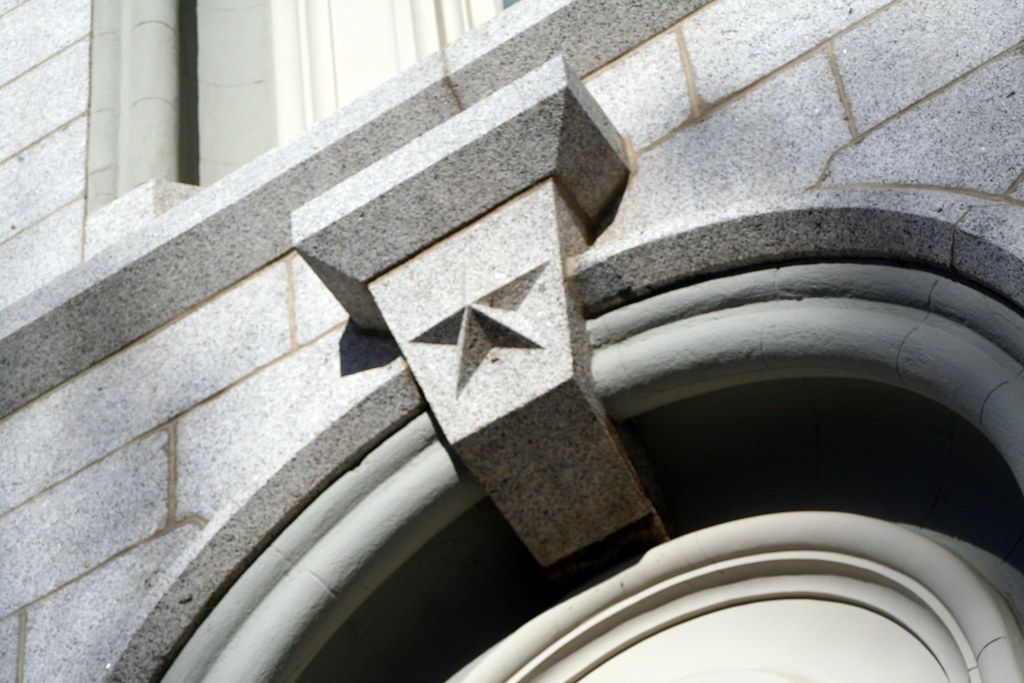
Thursday, September 1, 2011

The St. George Utah Temple

Today I'd like to write a little about the St. George Utah Temple.

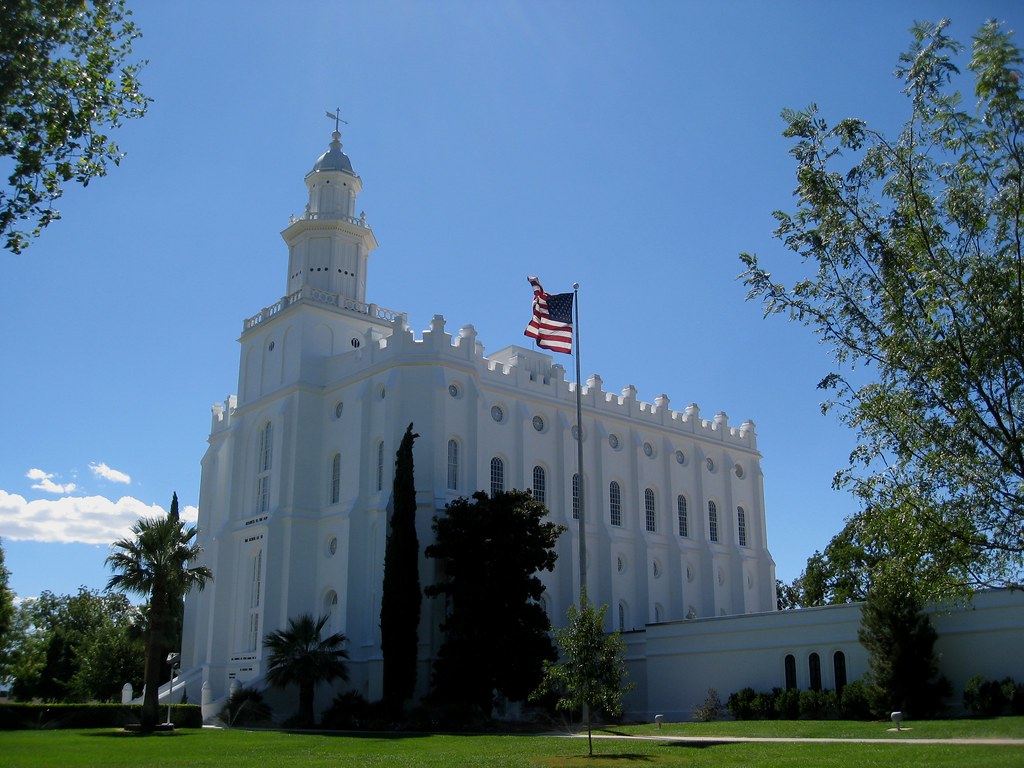
St. George Utah Temple (see original)
This temple was the first completed after the Nauvoo Temple (the Salt Lake Temple was started before, but took 40 years to complete) making this the oldest temple owned by The Church of Jesus Christ of Latter-day Saints (Kirtland is older but not owned by The Church and the Nauvoo Temple was rebuilt in 2002).

The Exterior
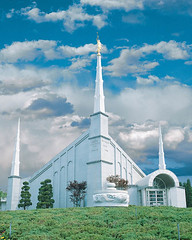
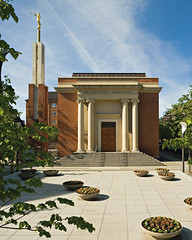
The temple sits on an entire city block, giving it its own temple square including a visitor's center and nice grounds which have Christmas lights in the winter.  The temple is very similar to the Nauvoo Illinois Temple, but shows some new temple characteristics.  The most prominent new features are the crenelations, buttresses, and other castle architecture.  During this pioneer time period the temples used this architecture to represent the literal Kingdom of God on Earth and the protection that our temple covenants and ordinances give us.  The temple is bright white.  This is actually a stucco over red sandstone.  The Logan Temple originally had a similar white finish, but the church let the Logan Temple's finish wear off so now you just see the dark stone.

The exterior has few symbols, but it does have the following:
Beehives on the St. George Utah Temple staircases (original photo)
  • Beehives appear on each side of the two front door staircases.  These are a symbol of industry, cooperation, community, Zion, Utah, etc.
  • The aforementioned castle architectural features are symbolically used.
  • The tower has 16 five-pointed stars along the top, just below the dome.
  • The tower also has a weather vane on top.  This was used for practical reasons (like Nauvoo's clock tower with bell) but it can also symbolize how the temple helps us understand life and how to move through life (overcoming storms, knowing which way to go, foreseeing dangers). 
St. George Utah Temple Tower (original photo)
The exterior of the St. George Temple has changed through the years.  Originally it had a short, squatty, poorly proportioned spire that Brigham Young complained about.  Because the temple was already completed he begrudgingly let the spire remain that way.  Several months later Brigham Young died, then the tower was struck by lightning and burned to the base of the spire.  The saints decided that Brigham Young had got his way in the end and rebuilt the spire much taller.  The original temple also had an odd looking round turret towards the back that has obviously been removed at some point.
The St. George Utah Temple shortly after completion
Original plans for the temple called for a different "Holiness to the LORD, The House of the LORD" inscription than the one currently used.  The inscription was supposed to be around the small circular window at the top of the square portion of the tower.  The word "Holiness" would have been written along the top half of the circle and the rest of the inscription, dates, etc. would have filled up the space beneath the window.  So in shape the inscription stone would have resembled the one on the Salt Lake Temple but with a small window where the words "to the" appear.  Instead the inscription looks like this.  I like the original design much better.  If the church is ever redoing the stucco and thinks about moving the inscription, I hope they move it to where it was originally planned.  You can see the original inscription plan in the visitor's center.

The Interior
The interior of the St. George Temple is very nice, but it has changed throughout the years.  Originally it was laid out like the Nauvoo Temple, so it was just two assembly halls, one on top of the other, sealing rooms, and a baptistry.  Later, (1881) one hall was divided into endowment rooms with murals using solid partitions and not the curtains originally used.  In 1937-38 these changes were made permanent.  Other changes due to painting, remodeling, and adding a staircase and annex building have changed the temple.  For the most part it retains its historical feel.


The baptistry used to look like this.

St. George Utah Temple Baptistry
The current baptistry is very similar.  The font is very similar, although the decorative grillwork on the steps appears to have been lost.  A mural of Christ has also been added as well as some chandeliers.  A picture of the current baptistry can be seen here or in the visitor's center.  One nice thing to look at in this baptistry, is the doorknobs to the font room.  They are original to the temple and very ornate brass (or something similar).  They remind me of the original Logan, Manti, and Salt Lake Temple doorknobs.  I don't know if there are other original doorknobs in the temple.  The confirmation rooms weren't anything special and could be improved upon in my opinion, but in general I really like this baptistry.  There is also a model of the temple in the waiting room for some reason.

The endowment rooms have nice murals.  The current murals date to 1937-38 when the lower hall was formally partitioned off into the current endowment room layout (although some division of rooms had been completed in 1881).  The rooms were further altered in the 1975 remodel that changed from the live actor format with progression (moving from room to room) to staying in a single room and watching the acted portions of the endowment on a movie screen.  In my opinion, this lessons the effect of the temple as you only see one mural of the three intended.  It also doesn't make the temple any more efficient.  You could still use film and move from room to room with the same temple capacity as the current setup.  I hope they restore the movement.  I don't have a picture of the Creation room (and have not been in it).  Here are pictures of the Garden and World endowment rooms:
St. George Utah Temple Garden Room
St. George Utah Temple World Room
Currently you stay in one room until the end and then move into the Terrestrial Room for the last part of the ceremony.  The room can be seen below.  It is stunning in person.  The columns are cluster columns and their shape in plan looks like the cross shaped pattern on the exterior of the temple (which is also along the top of this room and the Celestial Room).  There are also five-pointed stars running along the top of this room and the Celestial Room.  The front of the room is semicircular.  Desert pinks and pretty blues color the room in an elegant southwest color scheme.  This is one of my favorite Terrestrial rooms (and the picture doesn't do it any justice).
St. George Utah Temple Terrestrial Room
The Celestial Room is also well done with the aforementioned stars.  It also has cluster columns matching those in the Terrestrial Room.  These are painted to look like stone.  There is a small staircase leading to a sealing room in the tower pictured below.  The ceiling also arches elliptically.  It is a fine example of pioneer architecture, although quite a bit plainer than the Manti or Salt Lake Temples (which isn't a bad thing).
St. George Utah Temple Celestial Room
St. George Utah Temple Sealing Room
 Just outside the Celestial Room there is a staircase that takes you back to the dressing rooms.
St. George Utah Temple Staircase
There are also spiral staircases in the two corners on either side of the tower.  I asked to see these and was shown them.  They have central supports and were fairly simple spiral staircases.  They were also extremely hot.  Apparently they don't bother to air condition them because they aren't used often.

If you go upstairs you can see the original sealing rooms.  Most of these are along the north end of the temple where the middle row of circular windows is.  Many of the rooms are small with a single circular window opposite the door and a beautifully carved altar in the center.  As you walk to the sealing office you might notice that the walls are incredibly thick as you walk through an archway.  There is also a waiting room in the tower.  According to the temple workers, the other half of the sealing room floor is largely empty unfinished rooms.  I guess they have some space to expand.

The top floor of the temple houses the Priesthood Assembly Hall.  This assembly hall is used for special meetings and is similar to those in the Kirtland, Nauvoo, Logan, Manti, Salt Lake, Los Angeles, and Washington D.C. Temples.  There are pulpits on each end of the room representing the Aaronic and Melchizedek Priesthoods.  You can read more in the link.  This room has cluster columns like those in the Terrestrial and Celestial Rooms and gives you an idea of how the endowment and celestial rooms used to look before they were formally divided.  The same stars and other patterns are also in this room.  There are also stars on the pulpits.
St. George Utah Temple Assembly Hall
St. George Utah Temple Assembly Hall Pulpits
I like the St. George Utah Temple.  It has great pioneer style and fine craftsmanship.  I would restore the endowment room progression, replace doorknobs with replicas of the original doorknobs, redo the confirmation rooms, and redo the inscription on the temple's exterior.  Otherwise I love this temple and am glad we have it.

Please comment and let us know what you think about this temple, how it has changed, and how it is today.

Sunday, August 28, 2011

The Church of Jesus Christ of Latter-day Saints - Temple Glass - Sun Moon and Star Circles

Stained glass or art glass windows are diversely used in temples built by The Church of Jesus Christ of Latter-day Saints.   I've already written about how glass has been used to depict people, usually in scriptural scenes.  Now I'd like to focus on suns, moons, and stars in stained and other art glass.

Historical accounts of the original Nauvoo Illinois Temple mention skylights in the attic area where the endowment and sealings were performed.  In the rebuilt temple similar skylights have been added.  One of these lets light into the Celestial Room and can be seen in the picture below.  This skylight has a large sun surrounded by 24 moons in various phases (forming an eternal ring of the moon going through its phases).  These are then surrounded by eight six-pointed stars.  The rugs in the room have a similar pattern on them but with some added symbols such as five pointed stars, if I remember correctly.
Nauvoo Illinois Temple Art Glass Skylight
Of course I should also mention the famous Nauvoo Illinois Temple five pointed star windows.  These can be seen hereOriginal drawings also show what might have been twelve pointed star windows, but it is unknown if they were included in the original temple.

The Manhattan New York Temple includes similar art glass windows (they are by Tom Holdman, the same artist who did the Nauvoo Illinois Temple skylight windows).  In this version, Holdman has added four fig leaves at the four compass points.  The sun has 16 rays and there are 16 moons going through their phases in an infinite loop with the top of the glass containing the full moons.
Manhattan New York Temple Art Glass
The stars are no longer around the sun, but there are stars in windows nearby.  You can see the whole celestial room window layout here.

Other temples have arranged the sun, moons, and stars differently.  Take, for instance, the Winter Quarters Nebraska Temple (also by Holdman).  The glass in this temple looks like this:
Winter Quarters Nebraska Temple Art Glass
So here we have the stars in the dark portion of the moons.  Some of the stars are supposed to be laid out in the big dipper constellation.  The three moons are in different phases and form the center of compass roses which also double as suns.

The Columbia River Washington Temple has a large art glass window in the Celestial Room that has many moons (12 in the bottom section, 24 in the middle section, 1 in the top section) and a star/sun at the top of the window.   The moons start in the upper left corner with a new moon waxing as you go down.  On the right side there is another new moon and the moon waxes as you go up.  In the center the moons are all full moons.
Columbia River Washington Temple Art Glass

The St. Louis Missouri Temple has another round window with six moons in different phases inside a giant Star of David.  This can be seen here.

The Redlands California Temple features a sun design in its windows.  Circles in squares and circles in the Seal of Melchizedek (a special type of eight pointed star similar to the Star of David) form a border around the window.
Redlands California Temple Art Glass
The Lubbock Texas Temple has similar windows but with added rays of light extending from the sun.  A photo can be seen here.

The San Antonio Texas Temple has stunning stained glass windows (also by Holdman).  The spire is particularly noteworthy.  It has a long, thin window on each side filled with stained glass stars.  The very top of the windows has a large bright star with 16 points.  It is probably meant to be the sun.  It could also represent a compass.  I don't know for sure what the artist intended.  You can see this window here.

The Las Vegas Nevada Temple has 12 six-pointed cut glass stars and one giant cut glass sun mandala in its Celestial Room.  Photos of these can be seen here. I explained possible symbolism of this in this post.

Of course, the Oquirrh Mountain Utah Temple also uses stars in its windows.  As you get higher in the temple there are more stars in the glass.  In the Celestial Room, the windows are divided into three levels with increasing densities of stars as you go up.  This is meant to represent the three degrees of glory in the Celestial Kingdom (and also the three heavens).
Oquirrh Mountain Utah Temple Art Glass
The Bountiful Utah Temple uses Native American designs throughout the temple.  Sun designs are prominently featured, especially in the Celestial Room window.  The window can be seen here.

I should also mention the San Diego California Temple.  Its windows are filled with eight-pointed stars that are the Seal of Melchizedek.  You can see pictures here and here.

That is my list of temple art glass windows with suns, moons, and stars.  Please comment and mention any that I've missed, or just talk about what you think about these windows.

Sunday, August 21, 2011

Possible New Temple Locations

Recently, The Church of Jesus Christ of Latter-day Saints announced that they are trying to build a temple near Paris, France.  This was an exciting development, although not too surprising as church leaders have stated that they were trying to find land for a temple for about 15 years.  The only real question was when they would find the land and make the temple announcement.

In the last April General Conference three new temples were announced - Winnipeg Canada, Fort Collins Colorado, and Meridian Idaho.  This broke a pattern of announcing 5 new temples each October General Conference and none in the April General Conference.

I'd like to discuss some places where I see new temples are likely to be built.  I have based my guesses on some articles/websites about church growth and the likelihood of a temple being built in a particular location.  My guesses are also largely based on my personal feelings.

Utah

Cedar City, Utah - This city is about an hour from St. George which has been rapidly growing.  The trip from Cedar City to St. George is usually fine, but sometimes in the winter it can be dangerous.  Placing a temple in this city would have other benefits.  One of the six universities in Utah is in this city so a temple would serve the college students, helping them get into a habit of temple attendance in their early adult years.  A temple would also reduce travel times for people living in Beaver and other cities that currently have 2+ hour travel times to the temple.  I would expect this temple to be either small or medium sized.

Layton, Utah - Even with the Ogden Temple remodel and the new Brigham City Temple, the demands on the Ogden Temple and Bountiful Temple remain high and something needs to be done to alleviate overcrowding.  Layton is a prime candidate for a temple as it is between Ogden and Bountiful.  I would expect this temple to be medium or large sized.

Tooele Valley, Utah - A temple could be built in Tooele (two-wheel-a), Stansbury Park, Grantsville, or a few other locations in this valley.  Tooele valley is one valley west of the Salt Lake Valley.  This valley has a reasonable population.  People in the Tooele Valley must travel all the way to the Salt Lake Temple, an hour to hour and a half drive.  I would expect this temple to be small or maybe medium sized.

Price, Utah - I suspect Price will eventually have a temple as it has faithful members, a junior college, and a long travel time to the Manti Temple.  I don't expect a temple to be built here for a while because it would drain the Manti Temple district, which has low population.

Richfield, Utah - I eventually expect a temple here, but because it would drain the Manti Temple district quite a bit, I don't expect one in the short term.  In 10-20 years I could see a temple in Richfield being very likely.

Salt Lake Valley, Utah - There are already four temples in the Salt Lake Valley, but we should expect more as a huge percentage of the church lives there.  Also, President Hinckley already announced plans to build a fifth temple in the Salt Lake Valley when needed.  Rumors identify the temple as being in Herriman or Bluffdale, both in the extreme southwest corner of the valley.  Temples could also be built elsewhere in the valley.  I wouldn't be surprised to see more temples in the Salt Lake area soon.

United States

Pocatello, Idaho - With a good number of members and the nearest temples (Idaho Falls, Logan, Brigham City, and Twin Falls) an hour or more away, I think a temple will likely be built here.  It might be 5 or 10 years before an announcement is made, depending on crowding at Idaho Falls.  I expect a small temple, but a medium sized is also possible.


Wyoming - Wyoming is an oddity.  It has many members with over 60,000 members, yet it has no temples.  This is probably due to low population density and the fact that most population centers are near borders with other states and not that far from a temple in another state.  Even so, it would be nice to see this state receive a temple.  I prefer Casper as it is central and would be near Martin's Cove and could be a historical temple like Winter Quarters, Palmyra, Nauvoo, and Kansas City.

Rapid City, South Dakaota - South Dakota is another state without a temple.  Rapid City is where I would expect one to be built as it has a reasonable population and receives a lot of tourists.  The Latter-day Saint tourists would then be able to visit a temple when they go to visit Mt. Rushmore National Monument and The Badlands National Park.  Rapid City is also close to Wyoming, bringing a temple closer to the saints in that state.

El Paso, Texas - This city almost has a temple, but it is in Ciudad Juarez, Mexico across the Rio Grande river.  The temple was built there to be easier for saints in Mexico to attend as crossing into the U.S. legally can be difficult.  Unfortunately, a string of violent kidnappings, murders, and other violence (mostly drug related) has made Juarez very unsafe.  I know U.S. citizens who are originally from Mexico that are afraid to travel to Juarez for fear of being kidnapped or killed.  If I lived in El Paso, I would travel to San Antonio or Lubbock to attend the temple, rather than risk my life in Juarez.  So, I expect to see a temple in El Paso eventually.

Tucson, Arizona - Arizona has been getting a lot of temples recently.  This isn't surprising if you've attended the Mesa Temple and realized how overcrowded it was.  The state has a ton of members.  Tucson is about 2 hours from the Mesa/Gilbert Temples and is a significant city.  I'd expect a temple to be announced in Tucson soon.

North and South America
Managua, Nicaragua - Recently, many Central American countries have received temples.  Nicaragua still does not have one, but it does have decent membership numbers and a population centralized in a single metro area.  I expect that the church will build a temple in Managua, Nicaragua soon.

The Caribbean - Currently there is a temple in the Domican Republic.  I think another temple is likely in the next decade.  It could be in Puerto Rico, or another island.  I don't know enough about the region to speculate more.

South America - Several South American countries are getting their second temple now, and Brazil continues to get temples. I expect to see more, but don't know enough about South America to speculate where.  I would love to see Guyana, Suriname, and French Guiana receive temples as they are the last countries in South America without temples.  They also don't have many members so although I'd like them to receive temples, I'm not expecting them to receive temples anytime soon.

Europe
Scotland - The U.K. has two temples (Preston England and London England).  It also has more members that any country in Europe by a long shot.  I think another temple in England is very likely.  Scotland would be a good location as it is many hours from Preston and would reduce travel times for other members living even further north.  Scotland also has a mission and a good number of members.

Birmingham, England - An alternative to a temple is Scotland would be another temple in England.  Birmingham seems like a reasonable guess.  Cambridge would also be interesting.

Norway - With Denmark, Sweden and Finland all having temples, Norway seems like a likely candidate and would cover Scandinavia with temples.

Africa
East Africa - I think East Africa needs a temple.  Perhaps in Uganda or Kenya

Kinshasha Congo - Apparently The Congo has a lot of members and is a likely candidate for a temple.

Asia
Thailand/Southeast Asia - This area has a lot of members and seems right for a temple.

India - Apparently the members in India are faithful.  This would also bless members throughout the Indian Ocean region from East Africa to Southeast Asia.

Australia
Unfortunately I don't know Australia or the Pacific islands well enough to speculate on a new temple location, but feel free to speculate in the comments section.

There are some of the areas I envision seeing a new temple.  Feel free to discuss other options in the comments section.

Sunday, July 24, 2011

The Church of Jesus Christ of Latter-day Saints - Temple Symbols - Stars - Oquirrh Mountain Temple Stars

Sorry I haven't posted in a while.  I've been distracted by new nieces and nephews.  Holding newborns has taken precedence over the blog.  I don't think you can blame me.  They are really cute.

I've spent several posts discussing depictions of the sun, moon, star, earth, etc. on temples built by The Church of Jesus Christ of Latter-day Saints. I've already discussed 5 and 6 pointed starstones.  Now I'd like to discuss the stars on the Oquirrh Mountain Utah Temple.  This temple has four pointed stars in many of the art glass windows of the temple.


Oquirrh Mountain Temple sealing room window

I've only seen this type of star on the Oquirrh Mountain Utah Temple.  They are on the second and third floors which hold the endowment rooms, celestial room, and sealing rooms.  I don't think the four points on the stars are symbolic, but the stars definitely are.  They probably symbolize the heavens and heavenly things.  Also, they are used to represent progression and increasing glory.  This is done by increasing the number of stars in windows as one progresses in the temple.  The basement and first floor windows have no stars.  The second floor has a few stars in each of the endowment room windows.  Then the celestial room has three main levels of windows with each gaining more and more stars.  This probably also refers to the three degrees of glory in the celestial kingdom.
Oquirrh Mountain Temple Celestial Room Windows
The Oquirrh Mountain Temple's star theme is also apparent in the chandeliers which resemble stars.  In profile, many chandeliers resemble the four pointed stars used in the temple glass.  In plan most of these chandeliers actually make eight pointed stars or The Seal of Melchizedek (which I will eventually write on when I get to the San Diego Temple).
Celestial Room Chandelier
Sealing Room Chandelier
Staircase Chandelier
 I really like the Oquirrh Mountain Utah Temple.  I love its use of stars (and items that resemble stars).  I love the beauty these details add, and the subtle symbolism they convey.

Please comment and let us know what you think about this temple's stars.

Sunday, July 3, 2011

Detached Temple Spires


The vast majority of temples built by The Church of Jesus Christ of Latter-day Saints have their spires and/or towers attached to the main structure of the temple.  There are a few that instead have a spire or spires away from the main structure.  I'd like to highlight these.

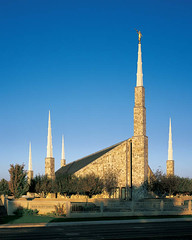
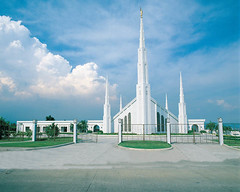
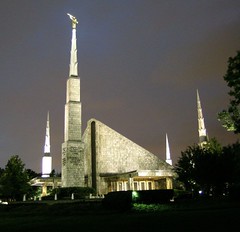
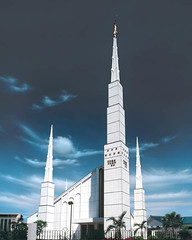
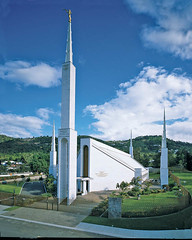
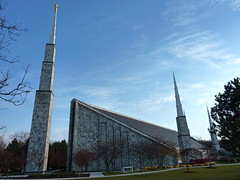
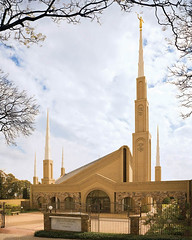
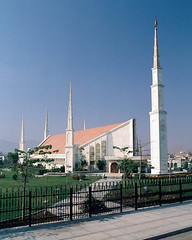
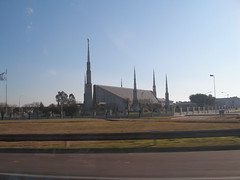
Most of the detached spire temples were the 6 spire sloped roof style of temple used throughout the 80s.  All of these except the final two (Portland and Las Vegas) have spire(s) away from the main building and in every case except Frankfurt Germany they have six spires.  These temples were built around the time that detached spires were common in Latter-day Saints' meetinghouses.  The meetinghouse spires were very often structurally unsound, particularly in earthquakes, and aesthetically unappealing.  They were given names such as the 3 Nephites (as many were essentially 3 flag poles clustered together) and generally not liked.  Most of these spires clashed with the architecture of the church building they were attached to and looked like afterthoughts.  The dislike of this type of spire has gone so far that the church has removed many of them and is actively removing others.  The detached spires on temples are an entirely different story.  They tend to look good, are high quality, and are obviously part of the temple designs.  With the six spire temples, the spires represent the Aaronic and Melchizedek Priesthoods and tie these temples to the Salt Lake Temple's architecture.  Here are the temples (Click on the links for the original photos):


Notice that the central spire has a large arch to let light through.  I'm assuming that this lets light get to a window on the front of the temple (although I'm not sure if this is a window).  You can see a picture of this here.  Other temples of this style have an opening at the front, but their spires don't have a corresponding hole.

Stockholm Sweden
(see photo here)
Notice that the spires are more different than other temples in this style.


This temple is soon to look like this:
Buenos Aires Argentina Mormon Temple

 Notice that this temple only has one spire despite clearly being the same style as these other six spire sloped roof temples.  I'm guessing there were local ordinances that only allowed a single spire, but I'm not sure.  The bottom of this spire is composed of four columns so it also lets light through the spire as was also done in the Guatemala City Guatemala Temple.  You can see pictures of this here and here.  I also think this spire has been made more unique than most of the spires on this style of temple.

Overall I like the detached spires in this type of temple.  A lot of them are similar, but they have minor variations and I think they are all stylish and nice and work.  Architecturally these detached spires remind me of minarets (in a good way) or watch towers.  They definitely make these temples feel unique.  Their presence seems to mark the land around the temple as a sacred space.

One other temple has had a detached spire.  This is the Copenhagen Denmark Temple.
This temple was built from an existing historic chapel that was remodeled to be a temple.  The architecture of the original chapel didn't have a spire and, looking at the building, it would have been difficult to add a spire on the main structure aesthetically.  The solution, which I think works, was to add this detached spire.  It identifies the building clearly as a temple and gives a place for the Angel Moroni statue, while preserving the main building's architecture.  

Those are the detached spires currently on Latter-day Saint Temples.  I personally like them, and wouldn't mind seeing them used on other temples (despite hating them on churches for the most part).  I don't expect to see more detached spires in the short term as I don't feel they are popular among architects at the moment (although the Copenhagen Denmark Temple was completed in 2004).  In time I think detached spires will become popular again and hopefully we'll see some interesting variations.

Detached spires and towers are not unique to temples.  Other religious buildings have them.  For instance, the leaning tower of Pisa is just the detached bell tower for the Pisa Cathedral.  Other freestanding bell towers can be seen here.  The Taj Mahal, a mausoleum in India, is sorrounded by 4 detached minarets.  Many other churches and mosques and other structures can be found with detached spires and towers.

Please comment and let us know what you think about detached spires on temples built by The Church of Jesus Christ of Latter-day Saints, how they are used, and the possibility of using them on future temples.

Sunday, June 12, 2011

The Church of Jesus Christ of Latter-day Saints Temple Symbols - Starstones - 6 Pointed Stars

I am again writing about temple symbols and this time about 6 pointed starstones.  Five pointed starstones get a lot of attention because critics misinterpret the symbolism and use that misinterpretation to falsely characterize the temple and the church.  Since six pointed stars are harder to interpret sinisterly, they are conveniently overlooked by critics.  I am not a critic and will tell you about six pointed starstones.

Nauvoo Temple detail showing starstones (original)
The Nauvoo Illinois Temple was the first to have six pointed starstones.  These were found in several places.  The first are just above the inverted five pointed stars under the roof overhang.  This makes these stars literally overhead, which fits as six-pointed stars often depict the actual stars in heaven.  In this context, these stars can simply be a symbol for heaven or the heavens.  They can also remind us that as the stars are above this earth, God and his ways are greater and higher than this earth.  The temple then is an elevated place, a place where things greater than just this earth happen.

More six-pointed stars are also found further up on a railing surrounding the roof line (they are five sided point up stars near the tower).

What else do these stars represent?  Well, in my earlier posts on sunstones, moonstones, and five pointed starstones, I pointed out that one meaning was to represent the vision of John in Revelation 12:1 where he saw a woman with the moon at her feet, clothed with the sun, and with a crown of 12 stars.  This is part of the six pointed star meaning.  They can also have other meanings as discussed later on.

Salt Lake Temple big dipper (original)
Several temples were built after the Nauvoo Temple without six pointed starstones.  Then, the Salt Lake Temple was built with a few six pointed stars.  There are 7 of them (which is a symbolic number) and they are laid out to represent the big dipper constellation, which is the constellation used to find the north star, the one star that is fixed in the sky.  This makes these stars symbols of eternity, guidance, and finding our way (they help us find the north star which helps us find our way).  They represent the true direction possible through the temple and the priesthood.  An early trial version of these starstones is found inside one of the towers where there is a six pointed star cut into the stone rather than projecting out of it.  Apparently the builders didn't like the look and changed to the current design, but kept the trial stone for an interior block.

Washington D.C. Temple big dipper (original)
The next temple with six pointed stars was the Washington D.C. Temple.  Here the stars were again used to represent the big dipper.  In this case the stars were on the doors and are made out of metal.  A good image is found here.  A close up image of the big dipper panel is found here.  You will notice that not all of the stars are six pointed, but clearly they all represent the actual stars that make up the big dipper.

Portland Oregon Temple stars on spires (original)
The Portland Oregon Temple was the next to use six pointed stars.  Here they have several uses.  Most of the stars are on the eastern three spires (the west spires lack stars which confused me until I realized they were referencing the Salt Lake Temple symbolism).  These stars represent John's vision in Revelation 12:1 (being above the sunstones).  Additionally, they may represent the Melchizedek Priesthood guiding us and the noble and great ones foreordained to be the leaders in the church (read my 5-pointed starstone post for that explanation) The Salt Lake Temple has the same symbolic use of many stars (40) on the east towers that aren't on the west towers; whereas, the Portland Oregon Temple has 120 stars on the eastern spires.  Both numbers, 40 and 120, are symbolic.  Additionally, these six pointed stars can represent the heavens or heavenly things.  They may also represent the star of Bethlehem due to the elongated bottom point (as I also discussed in my 5-pointed star post). In the same way that the Star of Bethlehem pointed to where Christ was, these stars point down to the temple, where Christ can be found today.  The doors of the Portland Temple also have the same stars on them in beautiful wood.  Neither the wood door stars, nor the fiberglass spire stars are stone, so I guess these aren't really starstones, but they are close enough, and a beautiful variation on this symbol.

Las Vegas Nevada Temple Starglass
The Las Vegas Nevada Temple (a fraternal twin of the Portland Oregon Temple) has six pointed stars in art glass windows.  These are above the sunstones and represent John's vision and the heavens.  Additionally, the stars represent the 12 apostles.  This is because in the celestial room there are 12 star windows and one giant cut glass sunburst mandala (see manufacturer's website).  These combine to reference Lehi's vision in 1 Nephi 1 where he sees one like the sun followed by 12 like the stars.  So through clever placement of this star window, the star was able to have multiple meanings simultaneously.


The St. Louis Missouri Temple also features a six sided star glass window.  You can see it here.  You'll notice that there are also moons in the window, but I'm not going to get into the symbolism now.  The star portion of the window is a Star of David.  While this symbol is most commonly used to represent Judaism these days, on the temple it instead refers to God's covenant people, the restoration and gathering of the 12 tribes of Israel, God's covenants with us, etc.  Thus, it is not odd to see this symbol on this Christian Temple.  Similar Star of David windows are found on the Assembly Hall on Temple Square in Salt Lake City.

I believe those are all of the six pointed stars on temples.  If I missed some, please tell us about them in the comments.  Also, please comment and let us know what you think about these stars and their use (symbolically and artistically) on temples built by The Church of Jesus Christ of Latter-day Saints.

Wednesday, June 8, 2011

The Church of Jesus Christ of Latter-day Saints - Temple Symbols - Starstones - 5 Pointed Stars

I've already written about sunstones and moonstones on temples built by The Church of Jesus Christ of Latter-day Saints.  Now I'd like to write about starstones.  I'll begin with five pointed stars and gradually progress through the various types of stars on Latter-day Saints temples.
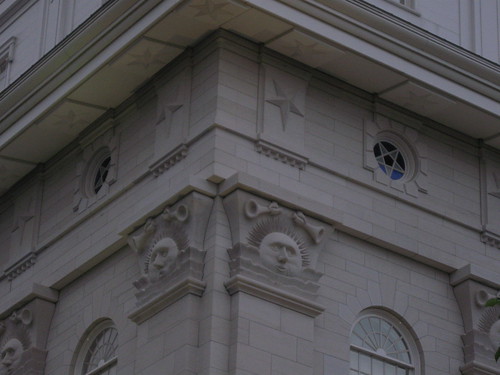
Nauvoo Temple corner with various symbolic stones
The Nauvoo Illinois Temple was the first to use symbolic sun, moon, and star stones.  As I pointed out earlier, these were meant to represent the vision of John in Revelation 12:1

 And there appeared a great wonder in heaven; a woman clothed with the sun, and the moon under her feet, and upon her head a crown of twelve stars:
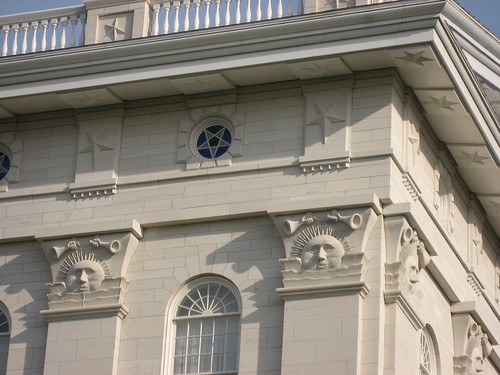
In this context, the stars would not represent the Telestial Kingdom of God, or lowest heaven.  This makes sense, as the stars are above the sunstones on the Nauvoo Temple.  There are several types of stars on the Nauvoo Temple.  In the photo (original here) you can see the five pointed stars are directly above the sunstones.  These stars are also upside down and have an elongated bottom point.  First off, they have no satanic meaning.  Upside down stars were first used to represent evil things decades after the temple was built (see FAIR article).  Inverted stars have been (and still are) used by many churches and organizations worldwide.  When I visited Illinois I noticed that buildings built in the 1800s often had inverted five pointed stars, even ones built far away from the saints.  I like how the inverted stars look on the Nauvoo Temple.  Notice that there are also red, white, and blue inverted star windows on the temple as well.  There are also right side up stars on the Nauvoo Temple on the tower and just below the tower.  You can see them in this picture.  I count 2 sets of 40 stars on the tower (possibly 40 more on the overhang for a symbolic 120 or 3X40) and a bunch more lower down along the railing.  In the Salt Lake Temple discussion I'll talk more about what right side up stars can mean, especially on towers and related to the number 40.

St George Temple celestial room
The St. George Utah Temple doesn't have exterior stars, but it does have some stars in the terrestrial and celestial rooms as well as the assembly hall.  These are not inverted.  I think they are used simply to represent heaven or the heavens, which is a common way to interpret a star.  This would explain how they can be used in a room representing the celestial kingdom.


Logan Temple Starstone
There is some added symbolism in the inverted star, particularly with an elongated point.  When the Logan Utah Temple was being built, the saints again added inverted five pointed stars.  They said that it represented the Star of the Morning, a symbol of Christ (see aforementioned FAIR article).  This makes sense as the morning star, actually the planet Venus, looks elongated because it is lit by the sun.  It is the bright morning and evening star, the first and last star in the sky, another way of saying the alpha and omega, the beginning and the end.  The symbol can also have another meaning and represent us getting our light from Jesus Christ as the morning and evening star gets its light from the sun.  The Logan Temple has two of these star stones (one on the west center tower and one on the east center tower) and they are almost the only symbol on the temple (the towers, keystones, and scroll stones are the other symbols).  You can see the original photo I've used here.

Salt Lake Temple Starstone (original)


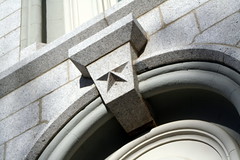
The Salt Lake Temple includes many star stones.  Among the five pointed stars represented are both point up and inverted stars.  Most are found on keystones above windows and doors.    The inverted stars represent Jesus Christ and the Morning Star and the other symbolism discussed above on the Logan Temple.  These stones are between the moon and sun stones so they do not relate to John's vision.  Original plans were going to have the inverted stars with an elongated bottom point, but the completed temple has equal length points on all stars.

Salt Lake Temple Starstone (original)
The use of point side up and inverted stars may also imply that some stars have an additional meaning.  It is likely that the point side up stars represent the heavens in general.  The point up stars are found on the east and west ends of the temple, and the point down stars are found on the main body of the temple.  Many point up stars are above the level of the sunstones and are used to represent John's vision as was done on the Nauvoo Temple.  You might notice in the north visitor's center on Temple Square that there are planter boxes near the Christus statue that have upside down five pointed stars with elongated points.  For a short while the north visitor's center was a temporary annex to the Salt Lake Temple while the current annex was being built.

On the east towers there are an additional forty point side up stars.  Some can be seen in this photo between the cloud stones (also known as trumpet stones).  The absence of these stars on the west towers (a similar absence on west towers has been copied in other temples) implies that they have special meaning to the Melchizedek Priesthood that the east towers represent.  In the book Sacred Walls: Learning From Temple Symbols by Gerald E. Hansen Jr., it states:
According to scholar Richard Oman, the forty five-pointed stars, found only on the three eastern towers, may refer also to God's gift of priesthood to guide us, in that they may represent the great and noble spirits of premortality whom God assigned to be rulers in His kingdom.
I'm not sure how this symbolism is derived, but it sounds interesting.  The number forty is also symbolic.  It is worth noting that the east towers have these forty point side up five-pointed stars forming a sort of constellation, while the west side has the big dipper constellation made out of six-pointed stars.  So the towers representing each priesthood have their own unique stars.

The Laie Hawaii Temple also has a five pointed star.  It is not really a starstone, but rather a part of the relief sculptures that surround the top of the temple.  I believe this one was meant to represent the Star of Bethlehem, which is a common meaning of starstones.  I didn't mention before, but the inverted stars on temples may also refer to the Star of Bethlehem that looked down on Jesus Christ's location.  On a temple then, it can mean that as the Star of Bethlehem pointed to where Christ was, these starstones are signifying that He can be found in this temple.

Washington D.C. Temple Star
The Washington D.C. Temple used stars again.  In this case they were metal star medallions on the doors.  You can see the full image on the left here.  Another great view of these doors is here.   In this usage, the stars clearly can refer to the Telestial Kingdom, or the lowest heaven, as they are at the bottom of the doors.  They can also have the meanings for inverted and point side up stars, as both are in the star.  You might also notice that the stars are inscribed in pentagons with smaller stars within larger stars, possibly symbolizing growth and progression and infinity (as the pattern could be repeated without end).  I like the new and interesting use of the star in this temple.
Mount Timpanogos Temple Starstones (see original)
The Bountiful Utah Temple and Mount Timpanogos Utah Temple (almost identical) each have starstones on their single towers.  The general arrangement of sun, moon, and starstones is the same as the Salt Lake Temple and they carry essentially the same meaning.  Here the stones have the stars cut into the spire (rather than projecting out of it).  Apparently this was tried in the Salt Lake Temple, but not used in the completed temple.  A single cut in star stone is found on the interior of a tower in the Salt Lake Temple.  There are 24 star stones on the Bountiful and Mount Timpanogos Temples.  In case you don't know, 24 is a symbolic number related to the priesthood.  For instance, one plan for the future temple at Independence, Missouri actually calls for 24 temples in a large complex.

The Preston England Temple uses starstones to represent the Telestial Kingdom and a starting point on our eternal progression.  The stone actually has a new moon as its center.  I go into a lot more detail in my post on moonstones.  I like that this starstone is unique.  There are only 2 starstones on this temple.
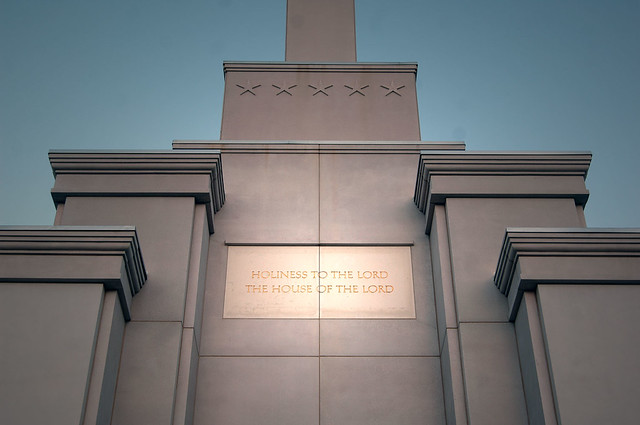
Albuquerque New Mexico Temple starstones (see original)
The Albquerque New Mexico Temple has star stones around its single spire (above the sunstones) suggesting the same symbolism of John's vision from the Nauvoo Temple and of the priesthood from the Salt Lake Temple east towers.

Palmyra New York Temple starstones.
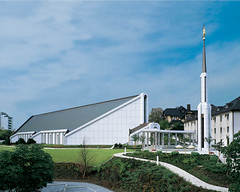
The Palmyra New York Temple also has starstones on its spire.  In this case there are 12 of them with the number twelve used symbolically.  This may refer to the twelve apostles symbolized by stars in Lehi's vision in 1 Nephi 1:9-10 in The Book of Mormon (the symbolism especially works because the sunstones in this temple represent Jesus Christ).  The stars are also arranged with 3 on each of the 4 sides which adds symbolism from the number 3 (related to the Godhead) and 4 (related to man and this earth and its four corners).  It is nice that they added extra symbolism to this small temple.

I think those are all of the five-pointed stars used on Latter-day Saints' Temples with the exception of some in stained glass windows.  I hope this has been informative.  Remember, these symbols have deep and varied symbolism and usually represent heavenly things and only occasionally the Telestial Kingdom.  They represent Christ, his apostles and other laborers and the church of Christ and other holy things.  They can also represent creation as God's creation of the stars is recorded in the scriptures and the temple.
Please comment with your insights, information on other places these have been used, and anything else you'd like to discuss.

In future posts I will discuss 4, 6, 8, and 12 pointed stars and how they are used on temples.