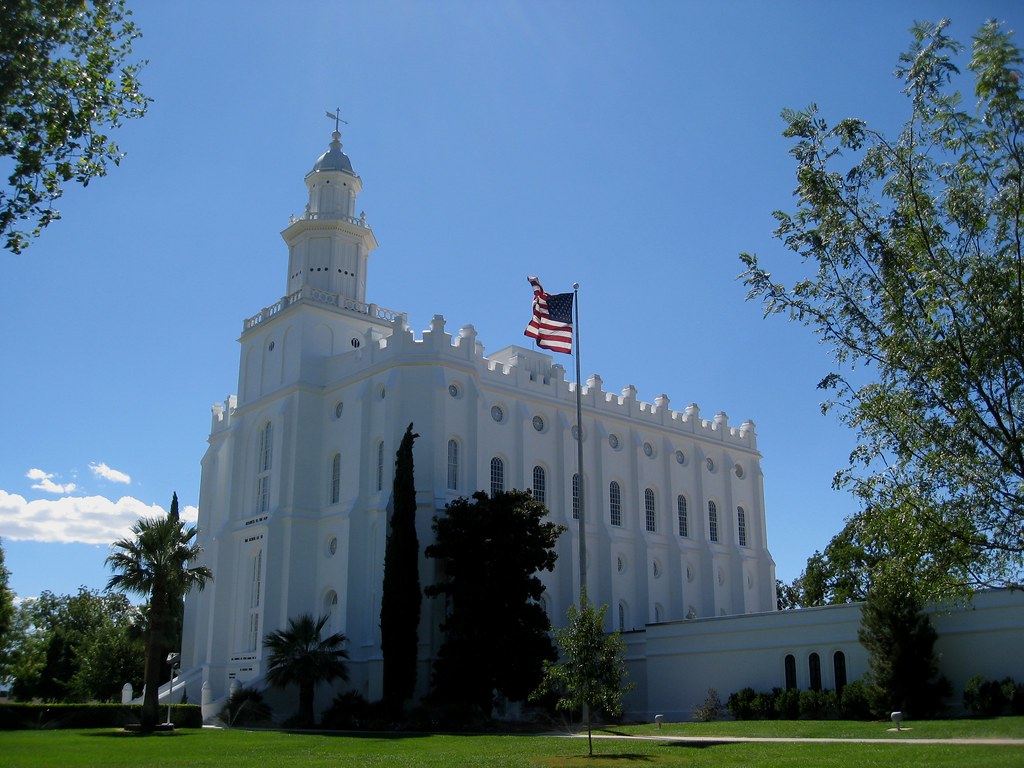
Today I'd like to write a little about the St. George Utah Temple.
This temple was the first completed after the Nauvoo Temple (the Salt Lake Temple was started before, but took 40 years to complete) making this the oldest temple owned by The Church of Jesus Christ of Latter-day Saints (Kirtland is older but not owned by The Church and the Nauvoo Temple was rebuilt in 2002).
The Exterior
The temple sits on an entire city block, giving it its own temple square including a visitor's center and nice grounds which have Christmas lights in the winter. The temple is very similar to the Nauvoo Illinois Temple, but shows some new temple characteristics. The most prominent new features are the crenelations, buttresses, and other castle architecture. During this pioneer time period the temples used this architecture to represent the literal Kingdom of God on Earth and the protection that our temple covenants and ordinances give us. The temple is bright white. This is actually a stucco over red sandstone. The Logan Temple originally had a similar white finish, but the church let the Logan Temple's finish wear off so now you just see the dark stone.
The exterior has few symbols, but it does have the following:
- Beehives appear on each side of the two front door staircases. These are a symbol of industry, cooperation, community, Zion, Utah, etc.
- The aforementioned castle architectural features are symbolically used.
- The tower has 16 five-pointed stars along the top, just below the dome.
- The tower also has a weather vane on top. This was used for practical reasons (like Nauvoo's clock tower with bell) but it can also symbolize how the temple helps us understand life and how to move through life (overcoming storms, knowing which way to go, foreseeing dangers).
The exterior of the St. George Temple has changed through the years. Originally it had a short, squatty, poorly proportioned spire that Brigham Young complained about. Because the temple was already completed he begrudgingly let the spire remain that way. Several months later Brigham Young died, then the tower was struck by lightning and burned to the base of the spire. The saints decided that Brigham Young had got his way in the end and rebuilt the spire much taller. The original temple also had an odd looking round turret towards the back that has obviously been removed at some point.
 |
| The St. George Utah Temple shortly after completion |
Original plans for the temple called for a different "Holiness to the LORD, The House of the LORD" inscription than the one currently used. The inscription was supposed to be around the small circular window at the top of the square portion of the tower. The word "Holiness" would have been written along the top half of the circle and the rest of the inscription, dates, etc. would have filled up the space beneath the window. So in shape the inscription stone would have resembled
the one on the Salt Lake Temple but with a small window where the words "to the" appear. Instead the inscription looks like
this. I like the original design much better. If the church is ever redoing the stucco and thinks about moving the inscription, I hope they move it to where it was originally planned. You can see the original inscription plan in the visitor's center.
The Interior
The interior of the St. George Temple is very nice, but it has changed throughout the years. Originally it was laid out like the Nauvoo Temple, so it was just two assembly halls, one on top of the other, sealing rooms, and a baptistry. Later, (1881) one hall was divided into endowment rooms with murals using solid partitions and not the curtains originally used. In 1937-38 these changes were made permanent. Other changes due to painting, remodeling, and adding a staircase and annex building have changed the temple. For the most part it retains its historical feel.
The baptistry used to look like this.
 |
| St. George Utah Temple Baptistry |
The current baptistry is very similar. The font is very similar, although the decorative grillwork on the steps appears to have been lost. A mural of Christ has also been added as well as some chandeliers. A picture of the current baptistry can be seen
here or in the visitor's center. One nice thing to look at in this baptistry, is the doorknobs to the font room. They are original to the temple and very ornate brass (or something similar). They remind me of the original Logan, Manti, and Salt Lake Temple doorknobs. I don't know if there are other original doorknobs in the temple. The confirmation rooms weren't anything special and could be improved upon in my opinion, but in general I really like this baptistry. There is also a model of the temple in the waiting room for some reason.
The endowment rooms have nice murals. The current murals date to 1937-38 when the lower hall was formally partitioned off into the current endowment room layout (although some division of rooms had been completed in 1881). The rooms were further altered in the 1975 remodel that changed from the live actor format with progression (moving from room to room) to staying in a single room and watching the acted portions of the endowment on a movie screen. In my opinion, this lessons the effect of the temple as you only see one mural of the three intended. It also doesn't make the temple any more efficient. You could still use film and move from room to room with the same temple capacity as the current setup. I hope they restore the movement. I don't have a picture of the Creation room (and have not been in it). Here are pictures of the Garden and World endowment rooms:
 |
| St. George Utah Temple Garden Room |
 |
| St. George Utah Temple World Room |
Currently you stay in one room until the end and then move into the Terrestrial Room for the last part of the ceremony. The room can be seen below. It is stunning in person. The columns are cluster columns and their shape in plan looks like the cross shaped pattern on the exterior of the temple (which is also along the top of this room and the Celestial Room). There are also five-pointed stars running along the top of this room and the Celestial Room. The front of the room is semicircular. Desert pinks and pretty blues color the room in an elegant southwest color scheme. This is one of my favorite Terrestrial rooms (and the picture doesn't do it any justice).
 |
| St. George Utah Temple Terrestrial Room |
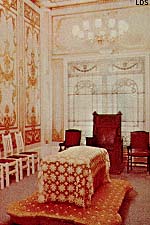
The Celestial Room is also well done with the aforementioned stars. It also has cluster columns matching those in the Terrestrial Room. These are painted to look like stone. There is a small staircase leading to a sealing room in the tower pictured below. The ceiling also arches elliptically. It is a fine example of pioneer architecture, although quite a bit plainer than the Manti or Salt Lake Temples (which isn't a bad thing).
 |
| St. George Utah Temple Celestial Room |
 |
| St. George Utah Temple Sealing Room |
Just outside the Celestial Room there is a staircase that takes you back to the dressing rooms.
 |
| St. George Utah Temple Staircase |
There are also spiral staircases in the two corners on either side of the tower. I asked to see these and was shown them. They have central supports and were fairly simple spiral staircases. They were also extremely hot. Apparently they don't bother to air condition them because they aren't used often.
If you go upstairs you can see the original sealing rooms. Most of these are along the north end of the temple where the middle row of circular windows is. Many of the rooms are small with a single circular window opposite the door and a beautifully carved altar in the center. As you walk to the sealing office you might notice that the walls are incredibly thick as you walk through an archway. There is also a waiting room in the tower. According to the temple workers, the other half of the sealing room floor is largely empty unfinished rooms. I guess they have some space to expand.
The top floor of the temple houses the
Priesthood Assembly Hall. This assembly hall is used for special meetings and is similar to those in the Kirtland, Nauvoo, Logan, Manti, Salt Lake, Los Angeles, and Washington D.C. Temples. There are pulpits on each end of the room representing the Aaronic and Melchizedek Priesthoods. You can read more in the link. This room has cluster columns like those in the Terrestrial and Celestial Rooms and gives you an idea of how the endowment and celestial rooms used to look before they were formally divided. The same stars and other patterns are also in this room. There are also stars on the pulpits.
 |
| St. George Utah Temple Assembly Hall |
 |
| St. George Utah Temple Assembly Hall Pulpits |
I like the St. George Utah Temple. It has great pioneer style and fine craftsmanship. I would restore the endowment room progression, replace doorknobs with replicas of the original doorknobs, redo the confirmation rooms, and redo the inscription on the temple's exterior. Otherwise I love this temple and am glad we have it.
Please comment and let us know what you think about this temple, how it has changed, and how it is today.