Wednesday, March 27, 2013

Salt Lake Temple Towers Priesthood Symbolism

The Salt Lake Temple's towers symbolize the Aaronic and Melchizedek Priesthoods.  They do this many ways.  I have written on some of these before, but not organized quite this way.  Also I have some new insights.  Here are some of the ways that the priesthood is represented in The Salt Lake Temple's towers:
Salt Lake Temple (original photo)

Two sides of the temple
The Salt Lake Temple has two main sides - the east side and the west side.  Each end has 3 towers.  The west side represents the Aaronic Priesthood and the east side represents the Melchizedek Priesthood.  This two side pattern started with the Kirtland Temple which had 2 large rooms (one on the first floor and one on the second floor).  These rooms had pulpits at opposite ends that were designated for the Aaronic Priesthood on one end and the Melchizedek Priesthood on the opposite end.  The Salt Lake Temple started the practice of showing this two-ended priesthood symbolism on the exterior.  This pattern was copied for the Logan Utah and Manti Utah Temples, was brought back for the Washington D.C. Temple, and revived again for the 1980s six spire temples starting with the Boise Idaho Temple and ending with the Las Vegas Nevada Temple.  The San Diego California Temple is a unique version of a two ended temple with its two great towers.  Recently, two ended temples have returned starting with the Kansas City Missouri Temple, Brigham City Utah Temple, Rome Italy Temple, Philadelphia Pennsylvania Temple, Fortaleza Brazil Temple and potentially with other temples in planning.

Three towers on each end of the temple
The west and east ends of the Salt Lake Temple each have 3 main towers.  These are used to represent the priesthood leadership.  The 3 Melchizedek Priesthood towers on the east end represent the First Presidency or a stake presidency - the leadership of the Melchizedek Priesthood.  On the east side the three Aaronic Priesthood towers represent the Presiding Bishopric or a local bishopric - the leadership of the Aaronic Priesthood.  Some other temples have kept the 6 tower symbolism.  The Logan and Manti Utah Temples each have smaller side towers that are often overlooked.  The Washington D.C. Temple and 1980's six spire temples also include 6 total towers.  The Brigham City Utah Temple has also included smaller side towers to keep the 6 tower symbolism intact.  A lot of the other two ended temples lack the 6 towers symbolism.

Twelve Pinnacles
You might notice little spires on the towers of the Salt Lake Temple.  On each tower of the temple there are 3 levels of 4 pinnacles.  This makes 12 pinnacles on each tower (in addition to the main point of the tower).  The pinnacles on the east end represent the 12 apostles.  The Bountiful Utah and Mount Timpanogos Utah Temples both have 12 circular windows at the top to represent the same thing (6 go into the celestial room and 6 into the chapel).  I have read that the 12 pinnacles on the west end of the Salt Lake Temple represent the high council, although I am unable to track down this explanation and am unsure how this relates the the Aaronic Priesthood.

Different Tower Heights
On the Salt Lake Temple, the east towers are 6 feet taller than the west towers.  This is to represent the Melchizedek Priesthood being above the Aaronic Priesthood.  This symbolism has also been done in the Logan Temple, Manti Temple, and many others.  The center towers on each side of the Salt Lake Temple are also taller than their side towers representing the President of the Church, stake president, Presiding Bishop, or bishop leading among their counselors.  The Washington D.C. Temple takes this symbolism even further by having all 6 towers at different heights which would show the relative position of a first counselor and a second counselor.

Windows
The windows on the Salt Lake Temple towers also contain symbolism.  The western towers have 4 levels of windows and the eastern towers have 5 levels of windows.  These represent the offices in the priesthoods.  The four Aaronic Priesthood offices are deacon, teacher, priest, and bishop.  The 5 Melchizedek Priesthood offices are elder, high priest, patriarch, seventy, and apostle.  Windows are a fitting symbol as they bring in light, as does priesthood and the revelations associated with it.  This window symbolism developed gradually - earlier temples lacked it and early plans for the Salt Lake Temple didn't include it.

So that is some of the priesthood symbolism in the Salt Lake Temple Towers.  Priesthood symbolism is important because the temple is very much about the priesthood and the 2 priesthoods are important to the ordinances of the temple.

Please comment with any insights you may have on this topic.

Here are some of my references:
http://www.deseretnews.com/article/705382705/Symbolism-can-be-seen-in-architecture-of-SL-Temple.html?pg=all
http://www.ldschurchtemples.com/saltlake/
https://www.lds.org/new-era/1978/06/the-salt-lake-temple?lang=eng
https://www.lds.org/manual/doctrine-and-covenants-and-church-history-gospel-doctrine-teachers-manual/lesson-8-the-restoration-of-the-priesthood?lang=eng See additional teaching idea 1.


Saturday, March 23, 2013

The Church of Jesus Christ of Latter-day Saints' Temple World Rooms - The Salt Lake Temple

I have written a lot about murals in the past, but as I was attending the Salt Lake Temple last weekend it occurred to me that I could write more in detail about some.  So I am starting a set of posts on World Rooms in The Church of Jesus Christ of Latter-day Saints' Temples.
Salt Lake Temple World Room

World Rooms are very interesting because they have to both show the fallen state of this world while at the same time indicating the progression of man through the temple and through mortality.  The tension between these two ideas, falling and progression, makes for interesting art and architecture.  In the Salt Lake Temple, this is accomplished in several ways.

As you enter the World Room you are now one floor higher than the Garden Room, having ascended most of the Grand Staircase.  There is also now natural light from windows on the left side of the room.  The ceiling is also higher than it was in the Garden Room and the chandeliers are larger and more ornate.  Moldings are more intricate and doors are taller.  All of these elements signify progression.  But this room also is used to represent a fallen world.  This is mainly done through the fine mural adorning its walls.

Salt Lake Temple World Room
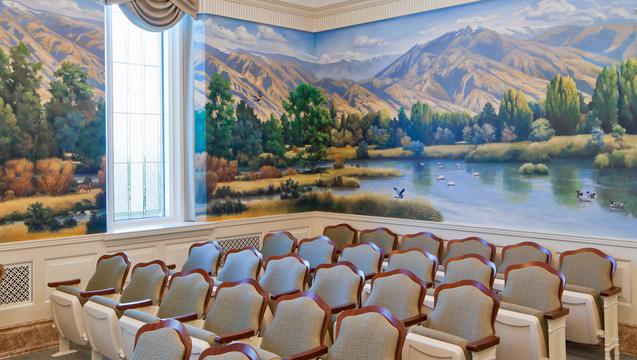
The main theme of this mural is competition and decay.  It must have been interesting for the artist to brainstorm ways to repeat these themes over and over again.  We can start with the geological components.  At the front of the room there is a large cliff that was been eroded by a river.  A desert occurs on the right wall towards the back.  A storm rages in the back right corner.  A rocky mountain covers the rear wall.  On the left wall there is a swamp with its filthy water.  Also on this wall, there is a tropical scene complete with waterfalls cutting through the landscape.  Distant mountains are also seen throughout the painting showing rugged terrain in contrast to the Garden Rooms gentle scene.

Salt Lake Temple World Room
The plants further reinforce the mural's themes.  At the cliff in the front of the room plants have been completely removed by the erosive forces of a river.  Some that remain on the bottom are bent awkwardly either by wind or want of light.  On the right wall there are two trees competing for the same space, choking each other out.    On the left wall parasitic vines are climbing on tress in the swamp.  In the front left corner there is a tree that has some healthy branches, some diseased and dying branches, and some dead branches.  In the right back corner there is a completely dead tree and another tree with some major branches missing.  There is also desert with scraggly plants.  Barren cliffs are on one wall.  There is also a tropical forest on the left wall, which would be nice if it weren't for the creatures living in it.

Speaking of creatures, the mural gets more interesting when you consider the animals depicted in it.  At the front we see lions fighting with each other in contrast to the lamb and lion lying down together in the Garden Room.  In fact, whereas in the Garden Room the animals all seemed to be peacefully grazing, in this room they are running, hiding, fighting, eating others, being eaten, starving, competing, etc.  There are two different birds in the partially dying tree that don't seem to like each other at the front.  On the right wall, some sort of cat (bobcat? lynx?) is waiting in the trees, not sure whether to pounch on two bears, or flee from them.  At the rear we see an elk, with large antlers both for defense and for quarreling with other elk.  In the left rear corner there is a hawk flying back to its nest, which would be nice if it wasn't holding a small animal (rabbit?) in its talons.  On the left wall there is some large jungle cat rather enthusiastically eating its prey.  These are just the animals I noticed in the mural last week.  They remind us that competition, violence, etc. are part of this fallen world.  Through the teachings of the temple, we learn how to follow God's laws and overcome all these fallen aspects of life.

The mural shows the decay of this fallen world, but the mural also shows progression in several ways.  The vistas are grander than in the Garden Room.  The colors used are also lighter than in the Garden room.  The entire room is larger, so the mural is also larger.  It is also interesting that the World Room doesn't feel dark, despite all the decay and death it is showing, but it does make you feel like you need to do what you need to do and then more on to greater things.

The mural also works with the room to highlight parts of the endowment ceremony.  You might notice how the stream eroded cliff at the front works with a large staircase.  This staircase allows certain characters to enter and exit the room high up, while another enters through the door at floor level.  The two doors are kept vertically apart, highlighting the difference in the characters.  I won't explain more outside the temple, but it should be obvious to the initiated what I am talking about.  The door to the Terrestrial Room is also slightly elevated showing our progression from this fallen world to a better world where we keep God's commandments and the covenants we have made.

Those are my thoughts on the Salt Lake Temple World Room and especially its mural.  Please comment with other things you noticed in it.

As a piece of fun trivia, if you look at the wall between the doors to the Terrestrial Room and the large staircase you can see an inscription by artists that touched up the murals during the depression (thanks to the commenter who pointed this out).


Saturday, March 2, 2013

Temple Ordinance Space and Other Space

My last post drew a lot of attention and has apparently led to some arguments and it sounds like hurt feelings.  I have re-read my post and made some changes that hopefully convey what I wanted to better without sounding negative.  I hope you will forgive me if my opinions, or the comments on either side of the issue offended you.  That post is somewhat related to this post.  I think this post is interesting, although it is essentially an essay.


Original Font, Logan Utah Temple
The Church of Jesus Christ of Latter-day Saints' temples have certain areas that are required for ordinances.  These are the baptismal font, confirmation rooms, initiatory rooms, endowment rooms, celestial room, sealing rooms, Holy of Holies and Priesthood Assembly Halls (the sacrament is performed there).  Some of these are somewhat optional.  Confirmations don't require a separate room and are occasionally done in the font room.  A sealing room can also be used as a temporary Holy of Holies.  Temples generally need to have this ordinance space to be considered a temple, although the Kirtland temple only had initiatory space and Assembly halls and most temples don't have assembly halls.  In theory a temple could consist of purely a baptistry, although I would be really surprised to see the church build one like that.  The point I want to make is that ordinances and the rooms associated with them are what is most important architecturally in a temple.

Waiting Room, Palmyra New York Temple
There are other rooms in temples that aren't vital.  These include lobbies, waiting areas, worker training rooms, bride's rooms, kitchens and cafeterias, laundry areas, locker rooms, the grounds, atriums, temple offices, bathrooms, staircases, closets, etc.  None of these spaces are really required for a temple, although a lot of them are practical so we almost always see them in temples.  For example, locker rooms are always there so we don't have to change into our whites before even entering the temple.  Other spaces such as cafeterias are no longer added to temples to save space and money as they aren't necessary.  President Hinckley's small temples were possible because he identified what was really necessary for a temple and left almost everything else out.  This saved expense and space and allowed for easier permitting for temples and much faster construction.  Even so, these temples still have Bride's rooms, waiting areas, and locker rooms.

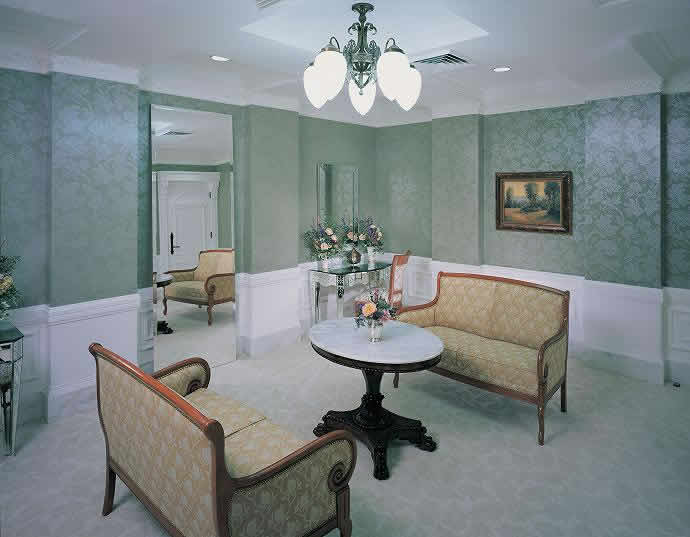
Bride's Room, Manhattan New York Temple
Temples often have non-ordinance areas either for convenience or to architecturally strengthen the temple experience.  Bride's rooms are a good example of this.  They allow a bride to relax and feel special on their wedding day.  This highlights the sealing ordinance.  In my earlier controversial post I argued that Groom's rooms could also be included in temples to enhance the sealing experience for men in the same way as they do for women.  I hope we all agree that Bride's rooms (and Groom's rooms if ever added) are other space.  They aren't vital to the temple, but they help the temple experience.  I think they would be a nice addition to the temple.  If you don't that is fine, but please let me have an opinion on the matter.

Spiral Staircase, Manti Utah Temple
Other rooms also help our experience.  Lobbies frequently contain art that inspires and adds to the temple experience.  The Washington D.C. Temple lobby displays a large mural of the Second Coming of Jesus Christ.  The Provo Utah Temple has a low relief sculpture of Christ with the woman at the well.  Other temples have paintings or stained glass of Christ visiting the Americas.  The Ogden Utah Temple used to have a mural or Christ and some Apostles at the Mount of Transfiguration.  These all help to reinforce temple themes and strengthen church members.   The atriums in the San Diego, Bountiful, Portland, and Las Vegas Temples highlight the beauty of God's creations, reinforcing themes from The Temple Endowment.  Spiral staircases give a feeling of upward movement and demonstrate great skill and dedication in the construction of the temples.  All of these non-ordinance spaces in temples augment the temple.

A major purpose of this blog, for me, was to influence future architects to build exceptional temples.  I have been writing about architectural insights I have about temples partly so future architects can learn from them.  Sometimes I write suggestions on what would be interesting to see.  Yes, groom's rooms are an example of this.  Other suggestions are ornate door handles, particularly if symbolic, stained glass, spiral staircases, etc.  I hope that readers will continue to appreciate my insights and suggestions, even when their tastes are different than mine.

Well that is the post.  I'm not sure that it had much or a point other than letting me think about how space is divided in temples and what is really important, what is helpful, and what is merely convenient.  Please comment with any thoughts you have.  Hopefully I'll get back to posting somewhat regularly soon.

Sunday, November 11, 2012

Why aren't there groom's rooms in temples?

One thing that I find odd is that there are Bride's rooms in The Church of Jesus Christ of Latter-day Saints' temples but no groom's rooms.  I think the lack of groom's rooms is a missed opportunity and sends architecturally mixed signals.  Here are a few of the functions of Bride's rooms and why I think groom's rooms are also needed. 

The main function of Bride's rooms are to be a place where the bride can get dressed for the sealing and then afterwards change into her often more elaborate wedding dress for photos on the temple grounds.  The room gives more space than a normal locker so brides can more easily change into larger dresses and so they can do their hair, etc., sometimes with help.  Grooms wouldn't need quite as much space, but tuxedos are a bit difficult to put on in a cramped locker and so grooms could certainly use more room.

Bride's rooms are also elaborate rooms with chandeliers, art, sculpted carpets, etc.  There are several reasons for this.  One is that it provides an appropriate setting to change into the temple clothes that she will be sealed in.  Grooms have to change into similar temple clothes for their sealing and so they should similarly have a special room for changing on this most special day.

Bride's rooms also display art chosen to ennoble the bride and inspire her to live righteously and realize her incredible worth as a daughter of God and as a wife.  Often a picture of Queen Esther from the Bible hangs in the room, reminding women that they have great influence for good in marriage and that there are great examples of women in the scriptures.  I think grooms could use similar art so that as they prepare on the day of their sealing they too can think about how to properly treat their wife and future family and to honor their priesthood.  I think this would help set the tone for the sealing the groom is also about to participate in.

Bride's rooms provide a quieter, separate space to prepare for a sealing.  Surely grooms could use this as well.

I have heard that Bride's rooms are there because a wedding day is "her day".  While it is true that in American culture women seem to obsess a lot more about their wedding day with colors, cake flavors and reception details planned years in advance, it really isn't just her day.  It is the couple's day.  Both could use special rooms to change in as is commonly the case in reception centers.

I have also heard that we have Bride's rooms out of respect to women.  I've never really bought this argument.  Having respect for women doesn't mean we have to have disregard for men.  I am personally fine with groom's rooms being less elaborate than Bride's rooms, but I think they should still exist.  A similar situation exists in our church architecture.  There the Relief Society room used by the women is usually the nicest room in the building (with the possible exception of the chapel) while the priesthood rooms are usually in an overflow or spare classroom somewhere.  This sends the architectural signal that women and the Relief Society are really important but that the priesthood can go anywhere and isn't really that important (which is odd given the doctrinal importance of the priesthood).  This wasn't always the case.  If you look at old churches (built 50 years or more ago) they almost always have an Aaronic Priesthood Room and an Elder's Quorum or Melchizedek Priesthood Room (often wings) in addition to Relief Society rooms.  So in the past in churches our architecture was more consistent with our doctrine.

This is a bit off topic, but we make the same mistake in our chapels where we tell everyone that the sacrament is the most important part and the focus of sacrament meeting and then place the sacrament table on one side of the room where it isn't the focus and instead have the pulpit and the talks as the focal point.  If you go back 50+ years sacrament tables used to be in front of the pulpits in the center or the sacrament tables were in the center of the stand with the pulpit off to one side.  This made the architecture consistent with the doctrine, not in conflict with it.

Let's get back to my real topic, my confusion about why we don't have groom's rooms in temples.

We hear so many talks telling men to take marriage seriously or lamenting that men are neglecting family duties, and yet on the very day that they are married, sealed for eternity, and form a family we miss the opportunity to architecturally tell them that it is more important than other days and to emphasize the importance of marriage and family.  Instead, the typical lockers will do.  Architecturally we are saying that women need to value marriage and family and should be overjoyed at the marriage, but the architecture is silent when it comes to men.  I know that this isn't what is taught, but the presence of an elaborate bride's room with instructive art and the lack of a groom's room doesn't architecturally show heightened importance for men in marriage.  We have an opportunity to set the tone for the sealing.  We have a chance to instruct the groom  on the importance of marriage, family, and his duties as a husband and father.  We can help him take his marriage seriously.  By not including groom's rooms we are being less effective in these areas.  If we are seriously concerned about men not living up to their marriage and family responsibilities, adding grooms rooms is one way we could help them (even if it is fairly minor).

I propose that we should start including groom's rooms in temples.  These don't need to be as elaborate as bride's rooms, but stained glass and nice carpets would be appropriate.  Room to comfortably change into temple clothes and later formal attire such as tuxedos would be nice.  Finally, good paintings and other art that is particularly suited to grooms and their responsibilities to their wife, future family, etc. should be in the groom's rooms to help set the tone and prepare the groom for the sealing ceremony.  When a groom goes into the groom's room he should feel like his wedding day is extra special.  He should realize that to the very core the day is special because of the importance of the sealing ordinance in God's plan.  He should feel a need to make this day special for his bride and his future family.  Grooms rooms would aid in this goal.

Let me know what you think about this. To be clear, I find it confusing that we don't have groom's rooms and I find it to be a missed opportunity, yet they aren't a necessary part of the temple.  The temple is still God's house without them, I just think it would be better with them.

Sunday, September 30, 2012

The Church of Jesus Christ of Latter-day Saints - Temple Art - Restoration Themes

I wanted to highlight some art in temples built by The Church of Jesus Christ of Latter-day Saints that is related to the restoration of the gospel of Jesus Christ and of the last dispensation of the gospel (1820 to now).

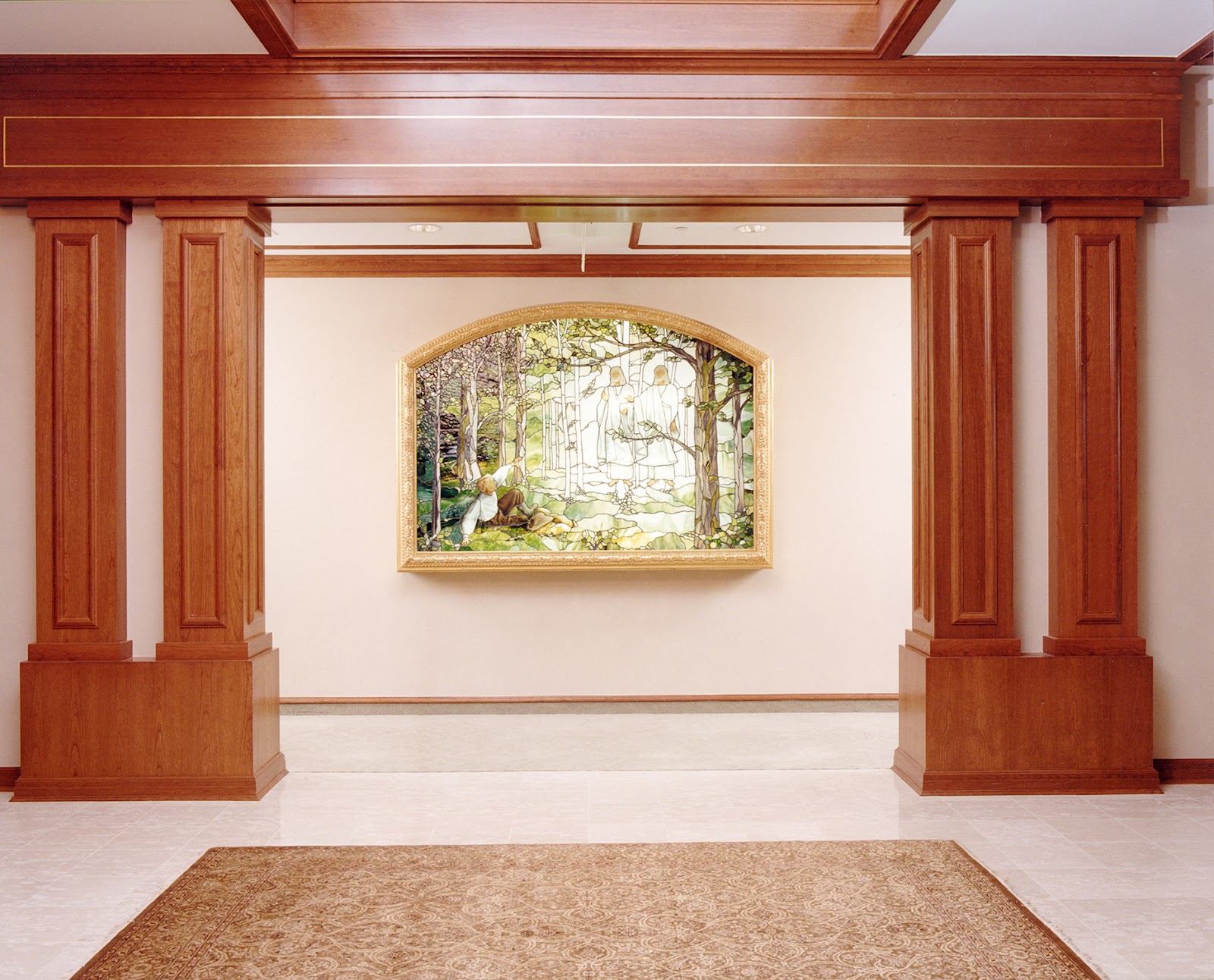
Many temples depict the First Vision of God the Father and Jesus Christ to Joseph Smith.  Some notable examples are in the Salt Lake Temple Holy of Holies which has a stained glass window of the vision (top below), in the lobby of the Palmyra New York Temple (which is overlooking the actual grove of trees where the vision occurred (middle below), and in the entry of the Redlands California Temple which also has a stained glass window of the vision (bottom below).


Another popular restoration theme is of the restoration of the Aaronic Priesthood and of baptisms in modern times.  The Cardston Alberta Canada Temple has murals in its baptistry including ones of John the Baptist ordaining Joseph Smith and Oliver Cowdery to the Aaronic Priesthood in May of 1829.  This event is recorded in Doctrine and Covenants 13.  Copies of this mural are found in the Logan Utah Temple and the Helsinki Finland Temple (top below). The Mesa Arizona Temple has a mural of Joseph Smith and Oliver Cowdery baptizing each other after having received the priesthood from the angel (middle below).  The Manti Utah Temple also has murals of baptisms (I believe of Joseph Smith and Oliver) that can be seen in the bottom photo below (although they are somewhat cut off).  There is also a depiction of these baptisms in the newly completed Quetzaltenango Guatemala Temple.  I was pleased to see that the baptistry mural in the Brigham City Temple depicts baptisms in a stream near Brigham City, presumably during pioneer times.  There is also a painting at the back of the baptistry chapel of a Native American being ordained near Brigham City in pioneer times.

The Salt Lake Temple used to have a mural of Joseph Smith preaching to Native Americans.  Currently the  Mesa Arizona Temple includes a large mural of Joseph Smith and others preaching to the Native Americans in the 1830s.

The Idaho Falls Idaho Temple World Room mural has a depiction of pioneers arriving by wagons, a couple farming the land, and of seagulls coming to rescue the pioneers from the plague of crickets.
The Winter Quarters Nebraska Temple has many pioneer related items and art.  Most notable is a large window made like a quilt, but out of glass.  It contains images related to Winter Quarters and the Latter-day Saint migration (often called the Mormon migration) such as the prophet Brigham Young, the Kanesville Tabernacle, pioneers burying a child, Brigham Young signing a treaty with the Native Americans, Native Americans who mercifully helped the saints, the odometer which was invented there, etc.
The Salt Lake Temple has several other restoration themed pieces of art.  One sealing room has a stained glass depiction of Joseph Smith receiving the plates that he translated into The Book of Mormon from the Angel Moroni.
In the downstairs portion of the main hallway in the Salt Lake Temple there are two prominent paintings on opposite sides of the hallway by Alfred Lambourne.  These are of The Hill Cumorah and Adam-Ondi-Ahman.  The painting of the Hill Cumorah (below) shows the hill where Joseph Smith received the plates that were translated into The Book of Mormon.  This hill in New York state may not be the same as the hill mentioned in The Book of Mormon and was not referred to as the Hill Cumorah until many years after Joseph Smith obtained the plates there, but it is often associated with the Hill Cumorah in The Book of Mormon where the Nephite nation was destroyed.  Lambourne played off of this.  The painting is both showing the Hill with its positive associations of the Nephite record, and it has an ominous tone reminding us that just as the Nephites were eventually destroyed for their wickedness, we need to remain righteous and keep our temple covenants if we are to keep receiving The LORD's blessings.  The painting of the valley of Adam-Ondi-Ahman shows the valley in Missouri where several notable events occurred and will occur.  The Doctrine and Covenants states that Adam and Eve went to this valley after leaving the Garden of Eden and that Adam gathered and blessed his posterity there.  A temple site was dedicated there in the 1830s, but the temple was never built.  Finally, the Doctrine and Covenants contains a prophecy that as part of the Second Coming of Jesus Christ, HE will appear there and minister to the righteous.  This painting works with the Hill Cumorah painting.  Our obedience or disobedience to God and his covenants we make in the temple will determine if we end up like the Nephites, destroyed as at Cumorah, or if we end up with the faithful, gloriously greeted by the returning Messiah.  By the way, Lambourne made 2 copies of each painting.  One set is in the Salt Lake Temple.  The other set is on display on the first floor of the Church History Library in Salt Lake City so the general public can view these.
Finally, there are several temples with sculptures related to the restoration.  Most notably, the Laie Hawaii Temple has a sculpted frieze of the Dispensation of the Fulness of Times (below) which depicts events from 1820 onward.  There is a bronze replica of this sculpture in the Church History Library on the first floor.  The Mesa Arizona Temple also has sculpted friezes showing the gathering of Israel from the four corners of the earth and depicts various groups joining The Church of Jesus Christ of Latter-day Saints with most immigrating to be with the church.  These can be seen in my post on sculpures here or in this article from The Ensign magazine.

There are many other examples of restoration themed art in Latter-day Saint temples.  I noticed a painting of the heavenly visitations that occurred in the Kirtland Temple in the Manhattan New York and Brigham City Utah Temples.  Please comment and share what restoration themed art you have noticed in temples.

Sunday, September 9, 2012

The Brigham City Utah Temple

A few weeks ago I had the wonderful opportunity to attend the Brigham City Utah Temple open house.  It was a wonderful experience and I'd like to share some of my impressions about this temple which was built by The Church of Jesus Christ of Latter-day Saints.

First, if you haven't already, you can go to the following link and download photos of the interior:
http://www.mormonnewsroom.org/article/mormon-brigham-city-utah-temple-opens-for-public-tours
That link will not stay up forever, so get the photos now if you want them.

I loved the detail in the Brigham City Temple.  The style is meant to tie back to the pioneer temples (Salt Lake, Logan, Manti and St George temples in Utah).  It does this through a number of features.  On the exterior, the two main towers with spires and four corner towers echo the pioneer temples.  On the interior, the neoclassical style feels similar to the ornate grandeur of the pioneer temples, particularly Salt Lake and Manti.

One detail I particularly liked was the use of a cast bronze font instead of the white fiberglass fonts that have been used in recent years.  I like that it makes it look more like the fonts used from pioneer times through about the 1950s.  I also like it because as much as I like white oxen, you need to occasionally do something different.  It feels fresh and I like that.

Brigham City Temple Baptistry
While you are admiring the photo of the font, make sure that you notice the original paintings in this room.  There are a lot  of new paintings in this temple.  I particularly want to point out the painting of baptisms being performed in a river in the Brigham City area seen in the photo, and a painting of a Native American being confirmed in pioneer times which is also in the baptistry.  I also noticed several paintings of people harvesting fruit.  One was a lady placing apples in a basket.  These tied into the history of Brigham City which is known for its orchards, and they tie into the temple and gospel themes of gathering, fruit, harvest, etc.  In the Matron's office, which leads into the Bride's Room, there are some paintings of birds that were painted by President Boyd K. Packer, current president of the Quorum of the 12 Apostles who was raised in Brigham City and who used to go to school on the site the temple was built on.  I'm not sure if President Packer's love of birds influenced the endowment room murals, but they are full of numerous birds.  Brigham City is also home to a bird sanctuary and many varieties of birds are in the area due to the very close proximity of the Great Salt Lake and its tributaries.  I enjoyed the endowment room murals.

Brigham City Utah Temple Endowment Room A
This temple has a lot of ornate decorations.  This is very apparent in the second endowment room, essentially the Terrestrial Room, which is ornate enough to pass for a Celestial Room in most temples.  I really enjoyed the room.  If you look at the photos, notice the unique wood carving above the curtain.  It is also in the Celestial Room and Sealing Rooms.  The wood carving is extremely impressive in this temple.  The wood was rough carved by machine and then all finished my hand.  The detail is spectacular, and you really do have to see it in person to realize just how incredible it is.

The Celestial Room has stunning detail.  You can look at the photos.  If I remember correctly there are gold peach branches on the ceiling of the room.  I also noticed that the cream on white "wallpaper" appeared to be hand painted stenciling and not wallpaper.  The sculpted peach blossoms in the carpet were also beautifully done.

Brigham City Temple Sealing Room
The sealing rooms were probably my favorite part of this temple.  The photos the church has provided unfortunately skip the best part.  The ceilings of the room have a circular section painted blue with peach branches in bloom running over the top.  So looking up from the altar it looks like you are laying under a peach tree looking through the white and pink blossoms towards a clear blue sky.  I used to have a peach tree and loved it in spring, so I really liked this detail.  Also, if I remember correctly, the peach branches on the ceiling were also in the Celestial Room, but only in the sealing room were they fully in bloom with colorful blossoms.  So I liked that symbolism.  The sealing rooms may be my favorite of any temple, although I'm not certain about that.  The detail is stunning.

There are many other aspects of this temple that I loved.  I liked the unifying peach blossom motif.  The intricate stone inlays were beautifully crafted.  Many colors were incorporated into the temple making it more interesting than the white and off white color schemes found in most temples, while still being light and inspiring.  The stained glass is really beautiful.  Also, the railings and woodwork are very nicely done and detailed.

I could go on, and perhaps I will later add some to this post.  For now, I'd like to hear what your thoughts are on this spectacularly done temple.  So please comment.

One final note, the detail in this temple makes me optimistic that someday they will restore the Logan Temple with this level of detail.  Clearly we can still build temples as ornate as the pioneers.


Sunday, July 22, 2012

Celestial Rooms With Ceilings Vaulted Into Towers

So often in temples built by The Church of Jesus Christ of Latter-day Saints, the Celestial Room, even when directly below a tower, does not actually look up into the tower (for example, the Oquirrh Mountain Utah Temple).  There are probably several reasons for this.  Some building codes may limit the height of useable space, so the room cannot open into the spire and meet building codes (which I find silly by the way).  Also, as a structural engineer I know that the building is much easier to design if you don't stick a hole in the roof diaphragm, although we can still get buildings to work, it just takes more effort on our part.  I love it when a temple actually uses the space of the spire to make the celestial room even taller.  Here are a few examples:


Cardston Alberta Temple Celestial Room
Laie Hawaii Temple Celestial Room
The Cardston Alberta Canada Temple and the Laie Hawaii Temple were the first to really use the space at the top of the temple.  While neither of these temples technically have a tower, they do jut up a bit at the center and this central space is the vaulted top of each temple's celestial room.  The vaulting in these temples allows for windows on every side of their celestial rooms.

Idaho Falls Temple Celestial Room
The Idaho Falls Temple is probably the first with a tower that the Celestial Room opens into.  I don't have a photo of this, but if you sit in the Celestial Room you can stare up into the tower and actually get use of the tower windows.


San Diego Temple Celestial Room
Probably the best example of actually using the spire space has got to be the San Diego California Temple.  Its Celestial Room occupies one of its two main towers and provides the spectacular view pictured here.


Draper Utah Temple Celestial Room
More recently, the Draper Utah Temple has somewhat used its tower.  the view from the celestial room takes advantage of the lower portions of the spire.  The upper windows are still not visible from the celestial room and the dome at the top in the picture is painted to look like a dome and actually doesn't poke up into the spire.  Even so, this is a better use of the spire space than most temples accomplish.


I'd like to hear about other temples that actually use the spire space in the Celestial Room (or elsewhere) so please comment about other temples that use this space.  I hope that we will start seeing the tower space of temples being used much more often.