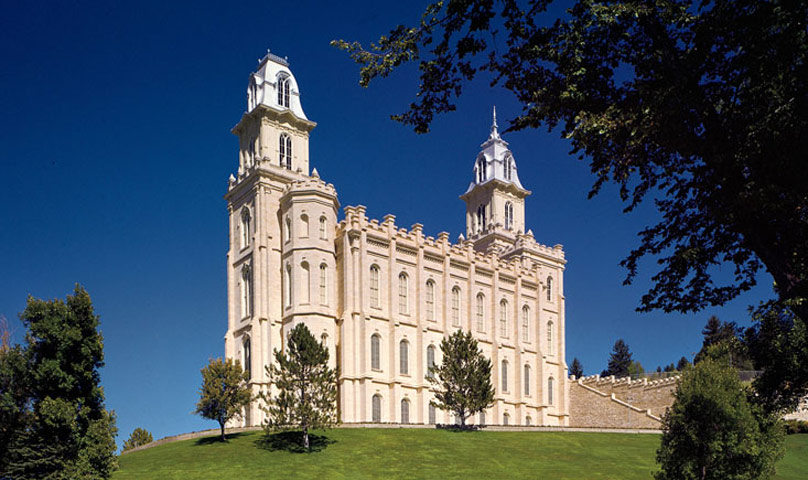
Showing posts with label Salt Lake Temple. Show all posts

Sunday, April 18, 2021

The Salt Lake Temple Sealing Room Angel Moroni Stained Glass


Salt Lake Temple Sealing Room

One of the original sealing rooms in the Salt Lake Temple has a stained window of the Joseph Smith getting the golden plates that he would translate into The Book of Mormon as the Angel Moroni talks with him. This is a beautiful stained glass, but it has always seemed odd for this particular stained glass window to be in a sealing room as it would appear to have nothing to do with marriage or family. As I read the first volume of The Church of Jesus Christ of Latter-day Saints new official history, Saints, I realized that this stained glass window actually has some significant meaning related to sealings.

When Joseph Smith went to get the plates from the hill he tried to pull the plates out but was unable to. The angel appeared and told Joseph that this was because he had not kept the commandments. He then instructed Joseph and then Joseph asked when he could have the plates. Moroni replied "The twenty-second day of September next, if you bring the right person with you." Then Joseph asked "Who is the right person?" and Moroni replies "Your oldest brother". This is significant for sealing rooms because Alvin was Joseph's oldest brother and he dies before the next September and Joseph cannot get the plates at that time. Joseph's family doesn't understand what happened to Alvin's soul since he died before the church was restored, but years later Joseph Smith has a vision where he sees Alvin in the Celestial Kingdom and is told that anyone who died without being able to join the church who would have accepted the gospel if given the chance were saved in the Celestial Kingdom of God. Later revelations would show that proxy ordinances such as baptisms for the dead and sealings for the dead (of husband and wife and of children to parents) is a part of the process that allows those who died to be able to enter God's kingdom. So this stained glass can remind us of Alvin and those who we are doing proxy sealings for. It can also remind us of the good influence that a family member such as a son or a brother can have in that apparently Alvin would have had a good enough influence on Joseph that he would have gotten the plates earlier had Alvin survived.

After Alvin's death, Joseph continued to be instructed by Moroni. Eventually the angel told Joseph Smith to bring someone with him the next year when he went to get the plates. Joseph asked, "Who is the right person?" and Moroni said "You will know". Joseph used a seer stone and asked the Lord who the right person was and he was shown that it was Emma Hale who he had been dating and wanted to marry. In the following year Joseph Smith married Emma and she came with him when he successfully obtained the plates and would help him stay on track for the rest of his life. I think this example is a wonderfully fitting reason for the sealing room to show Joseph obtaining the plates. He needed a wife who would help him be better so he could achieve his potential and only with her good influence was he able to become worthy to obtain the plates. It also reminds us that women have been and are immensely important in the work of God and can be a great influence for good. It reminds us that husbands and wives should work together in righteousness.

I hope sealers in this sealing room in the Salt Lake Temple tell some of these stories to patrons who are using this sealing room so they understand some of the deeper meanings of the room. Like Joseph Smith, we need to have strong families to strengthen us - siblings, spouse, etc. We should take our sealings seriously and strive to help our families grow in righteousness.

If you have any comments or insights about this stained glass window, please comment.

Sunday, November 1, 2020

Salt Lake Temple Celestial Room Stained Glass Windows

I haven't written on this blog for years, mainly because I exhausted my ideas for new posts and also because I got married and had children and that has kept me quite busy and satisfied. But I still retain my love for temples and great temple architecture. I truly miss attending the temple due to the coronavirus limiting who can attend and hope I can go again soon. 

During the last few years I've been thrilled to see remodels of temples with historical preservation highlighted. President Nelson's announcement that the 4 pioneer temples will be renovated/restored to preserve their unique pioneer craftsmanship and character made me very happy. The Church of Jesus Christ of Latter-day Saints has shown some renderings of the Salt Lake Temple renovation and I am pleased to see the original colors, woodwork, etc returning to this temple. So far we haven't seen renderings of the baptistery, terrestrial room, celestial room, sealing rooms, holy of holies, assembly room, administration rooms, etc and that has got me wondering how the celestial room might be renovated. So I looked through old black and white photos of the celestial room and compared those to more recent color photos of the celestial room. Here are two of those photos:


I was looking at these photos noticing a bunch of differences. The base of columns was originally a painted faux marble (the Saints podcast pointed this out), the lower portion of the columns had an interesting four pointed star sort of pattern, sconces were attached to the columns, there was a patterned wallpaper on the vaulted portion of the ceiling, the walls weren't white or cream, only the doors and their moldings appear white. Then I noticed the stained glass windows. As far as I can tell, none of the stained glass windows in the celestial room are original.

The most obvious one is the stained glass window above the veil. It appears to have been added after the black and white photo was taken (1911 or 1912). Then I looked closer and noticed that the 8 semi-elliptical stained glass windows above the doors in the vaulted portions of the ceiling also appear to be missing in the black and white photo. The semi-elliptical space where the windows were added appears to just be wall originally. I suppose there may have been some on the other side of the room, but I haven't found photos to support that. I tried to find some information on when these were added, but I didn't find anything. I'm guessing these windows were added in the 1960s when the celestial room was repainted and the temple was renovated. These windows are a little peculiar because they tilt out. If you look carefully in other photos or when you are in the celestial room you can see that at least the interior windows have a gap at the top. I'm guessing these might actually have been added to conceal air conditioning vents, which i appreciate. These windows must have been carefully chosen because they seamlessly blend in with the original temple architecture so well that most people would have to carefully study old photos to realize they aren't from the 1890s.

I love having the pioneer temples preserved and restored. I hope respectful additions such as these stained glass windows in the celestial room are also kept in the renovated temple. I'd be surprised if they removed these for historical purposes as they appear to match other original art glass windows and enhance the incredible architecture of the Salt Lake Temple celestial room. If you look at the rendering of the grand staircase and hallway that the church has released and compare it to historical photos, it appears that they are adding a stained glass window on the landing of the grand staircase. That window is a similar style to these and makes me think they are keeping tasteful additions to the building. I like that.

Wednesday, March 27, 2013

Salt Lake Temple Towers Priesthood Symbolism

The Salt Lake Temple's towers symbolize the Aaronic and Melchizedek Priesthoods.  They do this many ways.  I have written on some of these before, but not organized quite this way.  Also I have some new insights.  Here are some of the ways that the priesthood is represented in The Salt Lake Temple's towers:
Salt Lake Temple (original photo)

Two sides of the temple
The Salt Lake Temple has two main sides - the east side and the west side.  Each end has 3 towers.  The west side represents the Aaronic Priesthood and the east side represents the Melchizedek Priesthood.  This two side pattern started with the Kirtland Temple which had 2 large rooms (one on the first floor and one on the second floor).  These rooms had pulpits at opposite ends that were designated for the Aaronic Priesthood on one end and the Melchizedek Priesthood on the opposite end.  The Salt Lake Temple started the practice of showing this two-ended priesthood symbolism on the exterior.  This pattern was copied for the Logan Utah and Manti Utah Temples, was brought back for the Washington D.C. Temple, and revived again for the 1980s six spire temples starting with the Boise Idaho Temple and ending with the Las Vegas Nevada Temple.  The San Diego California Temple is a unique version of a two ended temple with its two great towers.  Recently, two ended temples have returned starting with the Kansas City Missouri Temple, Brigham City Utah Temple, Rome Italy Temple, Philadelphia Pennsylvania Temple, Fortaleza Brazil Temple and potentially with other temples in planning.

Three towers on each end of the temple
The west and east ends of the Salt Lake Temple each have 3 main towers.  These are used to represent the priesthood leadership.  The 3 Melchizedek Priesthood towers on the east end represent the First Presidency or a stake presidency - the leadership of the Melchizedek Priesthood.  On the east side the three Aaronic Priesthood towers represent the Presiding Bishopric or a local bishopric - the leadership of the Aaronic Priesthood.  Some other temples have kept the 6 tower symbolism.  The Logan and Manti Utah Temples each have smaller side towers that are often overlooked.  The Washington D.C. Temple and 1980's six spire temples also include 6 total towers.  The Brigham City Utah Temple has also included smaller side towers to keep the 6 tower symbolism intact.  A lot of the other two ended temples lack the 6 towers symbolism.

Twelve Pinnacles
You might notice little spires on the towers of the Salt Lake Temple.  On each tower of the temple there are 3 levels of 4 pinnacles.  This makes 12 pinnacles on each tower (in addition to the main point of the tower).  The pinnacles on the east end represent the 12 apostles.  The Bountiful Utah and Mount Timpanogos Utah Temples both have 12 circular windows at the top to represent the same thing (6 go into the celestial room and 6 into the chapel).  I have read that the 12 pinnacles on the west end of the Salt Lake Temple represent the high council, although I am unable to track down this explanation and am unsure how this relates the the Aaronic Priesthood.

Different Tower Heights
On the Salt Lake Temple, the east towers are 6 feet taller than the west towers.  This is to represent the Melchizedek Priesthood being above the Aaronic Priesthood.  This symbolism has also been done in the Logan Temple, Manti Temple, and many others.  The center towers on each side of the Salt Lake Temple are also taller than their side towers representing the President of the Church, stake president, Presiding Bishop, or bishop leading among their counselors.  The Washington D.C. Temple takes this symbolism even further by having all 6 towers at different heights which would show the relative position of a first counselor and a second counselor.

Windows
The windows on the Salt Lake Temple towers also contain symbolism.  The western towers have 4 levels of windows and the eastern towers have 5 levels of windows.  These represent the offices in the priesthoods.  The four Aaronic Priesthood offices are deacon, teacher, priest, and bishop.  The 5 Melchizedek Priesthood offices are elder, high priest, patriarch, seventy, and apostle.  Windows are a fitting symbol as they bring in light, as does priesthood and the revelations associated with it.  This window symbolism developed gradually - earlier temples lacked it and early plans for the Salt Lake Temple didn't include it.

So that is some of the priesthood symbolism in the Salt Lake Temple Towers.  Priesthood symbolism is important because the temple is very much about the priesthood and the 2 priesthoods are important to the ordinances of the temple.

Please comment with any insights you may have on this topic.

Here are some of my references:
http://www.deseretnews.com/article/705382705/Symbolism-can-be-seen-in-architecture-of-SL-Temple.html?pg=all
http://www.ldschurchtemples.com/saltlake/
https://www.lds.org/new-era/1978/06/the-salt-lake-temple?lang=eng
https://www.lds.org/manual/doctrine-and-covenants-and-church-history-gospel-doctrine-teachers-manual/lesson-8-the-restoration-of-the-priesthood?lang=eng See additional teaching idea 1.


Saturday, March 23, 2013

The Church of Jesus Christ of Latter-day Saints' Temple World Rooms - The Salt Lake Temple

I have written a lot about murals in the past, but as I was attending the Salt Lake Temple last weekend it occurred to me that I could write more in detail about some.  So I am starting a set of posts on World Rooms in The Church of Jesus Christ of Latter-day Saints' Temples.
Salt Lake Temple World Room

World Rooms are very interesting because they have to both show the fallen state of this world while at the same time indicating the progression of man through the temple and through mortality.  The tension between these two ideas, falling and progression, makes for interesting art and architecture.  In the Salt Lake Temple, this is accomplished in several ways.

As you enter the World Room you are now one floor higher than the Garden Room, having ascended most of the Grand Staircase.  There is also now natural light from windows on the left side of the room.  The ceiling is also higher than it was in the Garden Room and the chandeliers are larger and more ornate.  Moldings are more intricate and doors are taller.  All of these elements signify progression.  But this room also is used to represent a fallen world.  This is mainly done through the fine mural adorning its walls.

Salt Lake Temple World Room
The main theme of this mural is competition and decay.  It must have been interesting for the artist to brainstorm ways to repeat these themes over and over again.  We can start with the geological components.  At the front of the room there is a large cliff that was been eroded by a river.  A desert occurs on the right wall towards the back.  A storm rages in the back right corner.  A rocky mountain covers the rear wall.  On the left wall there is a swamp with its filthy water.  Also on this wall, there is a tropical scene complete with waterfalls cutting through the landscape.  Distant mountains are also seen throughout the painting showing rugged terrain in contrast to the Garden Rooms gentle scene.

Salt Lake Temple World Room
The plants further reinforce the mural's themes.  At the cliff in the front of the room plants have been completely removed by the erosive forces of a river.  Some that remain on the bottom are bent awkwardly either by wind or want of light.  On the right wall there are two trees competing for the same space, choking each other out.    On the left wall parasitic vines are climbing on tress in the swamp.  In the front left corner there is a tree that has some healthy branches, some diseased and dying branches, and some dead branches.  In the right back corner there is a completely dead tree and another tree with some major branches missing.  There is also desert with scraggly plants.  Barren cliffs are on one wall.  There is also a tropical forest on the left wall, which would be nice if it weren't for the creatures living in it.

Speaking of creatures, the mural gets more interesting when you consider the animals depicted in it.  At the front we see lions fighting with each other in contrast to the lamb and lion lying down together in the Garden Room.  In fact, whereas in the Garden Room the animals all seemed to be peacefully grazing, in this room they are running, hiding, fighting, eating others, being eaten, starving, competing, etc.  There are two different birds in the partially dying tree that don't seem to like each other at the front.  On the right wall, some sort of cat (bobcat? lynx?) is waiting in the trees, not sure whether to pounch on two bears, or flee from them.  At the rear we see an elk, with large antlers both for defense and for quarreling with other elk.  In the left rear corner there is a hawk flying back to its nest, which would be nice if it wasn't holding a small animal (rabbit?) in its talons.  On the left wall there is some large jungle cat rather enthusiastically eating its prey.  These are just the animals I noticed in the mural last week.  They remind us that competition, violence, etc. are part of this fallen world.  Through the teachings of the temple, we learn how to follow God's laws and overcome all these fallen aspects of life.

The mural shows the decay of this fallen world, but the mural also shows progression in several ways.  The vistas are grander than in the Garden Room.  The colors used are also lighter than in the Garden room.  The entire room is larger, so the mural is also larger.  It is also interesting that the World Room doesn't feel dark, despite all the decay and death it is showing, but it does make you feel like you need to do what you need to do and then more on to greater things.

The mural also works with the room to highlight parts of the endowment ceremony.  You might notice how the stream eroded cliff at the front works with a large staircase.  This staircase allows certain characters to enter and exit the room high up, while another enters through the door at floor level.  The two doors are kept vertically apart, highlighting the difference in the characters.  I won't explain more outside the temple, but it should be obvious to the initiated what I am talking about.  The door to the Terrestrial Room is also slightly elevated showing our progression from this fallen world to a better world where we keep God's commandments and the covenants we have made.

Those are my thoughts on the Salt Lake Temple World Room and especially its mural.  Please comment with other things you noticed in it.

As a piece of fun trivia, if you look at the wall between the doors to the Terrestrial Room and the large staircase you can see an inscription by artists that touched up the murals during the depression (thanks to the commenter who pointed this out).


Sunday, April 8, 2012

Temple Symbols - Olives

A few days ago I was looking over the interior photos of the Kansas City Missouri Temple that are currently posted on The Church of Jesus Christ of Latter-fay Saint's newsroom website.  The photos are very nice and I encourage you to view them.  One repeated element of this temple is olive branches.  There are olive branches in the exterior precast panels, carved into art glass, added to custom railings and light fixtures, sculpted into carpets, gold leafed onto walls, and painted in the temple.  A large stained glass window of an olive tree stands behind the recommend desk, flanked by olive branches sculpted into the adjacent panes. The furniture in the temple also features olive branches (the sealing room sealer's desk is covered in olive branches).  There are also bowls in the celestial room with olive branches on them.  Olive branches are the unifying symbol in this temple.  I want to take a little time to discuss how olive branches are used in temple architecture and how they are an appropriate symbol.

I thought that olive branches had been used a lot in temple architecture, but discovered very few examples of their use.  I suspect (and hope) that I have missed a few places where they are used.

The Winter Quarters Nebraska Temple contains various temple symbols.  In the baptistry there are three panes with sculpted glass.  They are a fig branch, an almond branch, and an olive branch (left).  All 3 are symbolic.  The Winter Quarters Nebraska Temple also has olive branches on the front doors.  You can see these in the photo on the right.

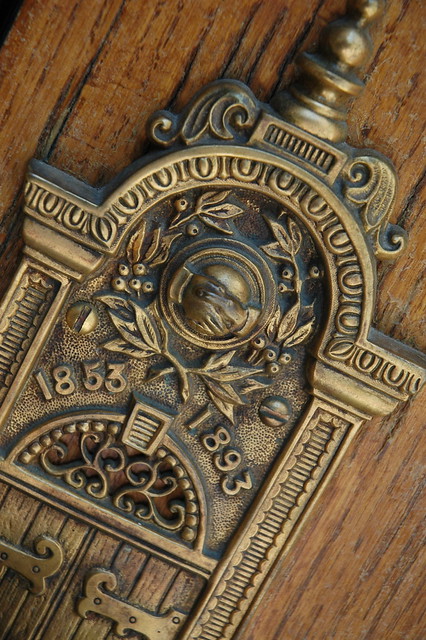
The Salt Lake Temple also has olive branches.  The front doors have olive branches on the metal plate behind the doorknob seen in the picture below.  You can see the original of this photo here.
Olive branches and trees make an excellent temple symbol.  Olives represent peace.  They are a symbol of God's covenants with man (a dove brought an olive branch to Noah showing that the flood was over).  Olive oil is used in priesthood ordinances and so olives are a symbol of the priesthood and Christ.  Olive oil can provide light and olives symbolize light.  Olive trees represent Israel, God's chosen people, and all mankind (see Jacob 5 in The Book of Mormon where the tame olive tree represents Israel and the wild olive tree represents everyone else and God is concerned about saving both).  Olive oil is also a symbol of royalty and was used to anoint kings and priests.

In the temple, olives signify that temple work is done by the priesthood, concerns all of humanity, brings us peace and heals us.  It establishes the government of God.  Olives are indeed a great temple symbol.

I like how extensively the olive symbol was used in the Kansas City Missouri Temple and hope that olives, olive branches, and olive trees will continue to be used in temple architecture.  I also find olives fitting for Kansas City.  The temple is a 5 minute drive from Liberty Jail in Missouri where the prophet Joseph Smith and others were imprisoned for a time.  It is in a state where a lot of violence, murders, etc. were done against The Church of Jesus Christ of Latter-day Saints and where Latter-day Saints were driven from the state.  The olive branch helps show that this tragic past has been overcome and points to the fact that we believe that Jesus Christ will come to Missouri as a part of his second coming and that Zion, the New Jerusalem will be built not far from here in Independence, Missouri.  The peace of the gospel and the Millenial reign of Jesus Christ will more than overcome the past.

Those are my thoughts.  Please write and let us know what you think and particularly where else olives are used in temples.

Sunday, March 4, 2012

The Salt Lake Temple Finials

Angel Moroni statues are common on temples built by The Church of Jesus Christ of Latter-day Saints and usually function as their finials (decorative spire tips).  But there are many other finials used.  I thought I'd highlight those on the Salt Lake Temple.
Salt Lake Temple finials.  (original photo here)
Salt Lake Temple Moroni (original)


The Salt Lake Temple has 6 main towers.  One is topped with the Angel Moroni statue which functions as its finial.


Salt Lake Temple finial
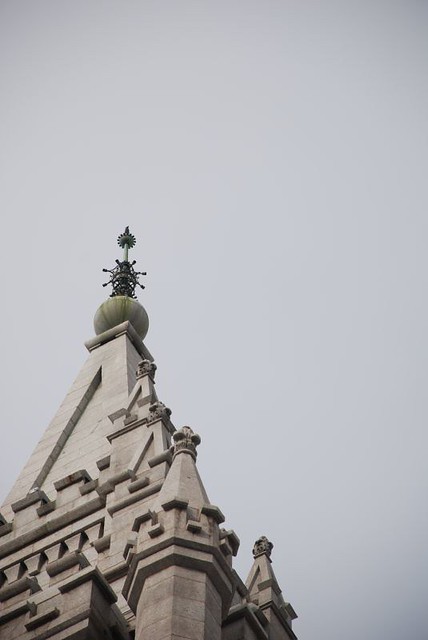
The other 5 towers have a detailed copper finial on a granite sphere.  These copper finials used to have light bulbs along their tops and were the original source of tower lighting to the temple.

Salt Lake Temple finials (original)
Each main tower is also surrounded by 12 smaller points with their own finials.  These have a sculpted bud.  One book I read claimed that these might be flames, although I don't buy that interpretation as I think it is pretty clear that they are buds.  As buds they may just be decorative because buds are a very common type of finial in non-religious buildings.  But they may have added symbolism.  In the Bible, Aaron's rod, a symbol of his priesthood authority, was made of wood.  In Numbers chapter 17 we are told that The LORD miraculously made Aaron's rod bud.  It "budded, and brought forth buds, and bloomed blossoms, and yielded almonds."  This was symbolic of The LORD choosing the tribe of Levi to hold the priesthood.  After that, the rod was placed in the Ark of the Covenant which was kept in the Holy of Holies in the Tabernacle and later in the Temple of Solomon.  So having flower buds on the top of the temple is a fitting priesthood and temple symbol.  This also fits because there are 12 bud finials on each tower and 12 is a priesthood symbol and a symbol of Israel.  So the bud finials may have special priesthood and temple symbolism, or they could just be decoration.  Either way, they look good and add to the Salt Lake Temple.

I like all the wonderful details on the Salt Lake Temple.  A few other temples have extra finials such as the San Diego California Temple which is clearly inspired by the Salt Lake Temple.  But I think the Salt Lake Temple is the most detailed with its finials and the most successful in its architecture.,

Feel free to comment and let us know what you think about these neat architectural details.

Saturday, May 14, 2011

Temple Symbols - Ursa Major (The Big Dipper) and Polaris

Temples built by The Church of Jesus Christ of Latter-day Saints contain many symbols. The constellation Ursa Major (The Big Dipper) is carved onto the Salt Lake Temple's west central tower.  This symbol has a lot of meaning and is used in a few other temples.  I'd like to highlight the symbol's meaning and how and where it is used.

The first temple to have this symbol was the Salt Lake Temple.  The west central tower lacks windows on the top story allowing for the big dipper sculpture.  While there are other stars depicted on the temple, this sculpture uses them differently.  The stars are six sided instead of the other stars which are five sided.  They are also arranged in a group.  On the Salt Lake Temple the big dipper stars point towards the actual north star.

The big dipper's symbolism can be understood in several ways.
1. The big dipper points to the north star, Polaris, the only star that doesn't move during the night.  As the big dipper is used to find the north star, the temple is used to help us find God who doesn't change.
2. As the big dipper helps us find our way, the temple guides us through life and to eternity.
3. The symbol can represent progression if used in conjunction with other temple symbols.  The temple lowest stones are the earth stones (originally to show the earth rotating through hours of a day).  The next stones are moon stones going through phases which can represent days and months.  Next up are the sun stones.  The sun goes through seasons so it could represent seasons and years.  The big dipper sculpture is higher on the temple and hints at Polaris, the star that doesn't change.  It represents infinity, eternity.  So as we go up we get hours, days, months, years, and finally eternity.  As we progress in the temple we approach the infinite and eternal.
4. The eternity symbolism can also represent going from a temporal, mortal state to an eternal, immortal, resurrected state.
5. The big dipper as a guiding constellation can be seen as a symbol for the Holy Ghost which guides us through life.
The next temple (I know of) to display the big dipper is the Washington D.C. Temple.  This temple is a stylized version of the Salt Lake Temple.  The symbolic sculptures from the Salt Lake Temple were depicted in the detailed doors of the Washington D.C. Temple.  Among the panels is one on the bottom right corner showing the big dipper and the north star (over the Seal of Melchizedek).  Because this temple also depicts the north star, it hints that the symbol is supposed to be understood with the north star.  I'm glad they added this symbolism to the Washington D.C. Temple.

The Anchorage Alaska Temple also contains the big dipper symbol.  The Alaska state flag is just the big dipper and north star.  So including the big dipper symbol from the Salt Lake Temple was one way to make this temple fit in locally.  The stars are eight sided on this temple and are carved into the stone rather than projecting out of it.  You can see the big dipper and north star carvings in this photo.  You will need to look closely.  The north star is on the left top and is larger than the other stars.  The next star is a little more than half way down the wall on the other side of the first window.  It may take you a minute, but you can find all the stars.  The last two are at the top of the wall with one between the last two windows and the other to the right of the last window.  I think the carvings are on the celestial room wall, but I may be wrong.

The Winter Quarters Nebraska Temple also includes the big dipper and north star (see this Church News article).  They are in the stained glass in one of the dressing rooms and are positioned as they would have been on April 6, 1830, the day The Church of Jesus Christ of Latter-day Saints was organized.  Here is a photo showing stars, although I don't think this is the big dipper one (it has too few stars).

I don't know of any other temples that have used the big dipper symbol.  If you know of any others please comment.  Comment also and let us know what you think of this symbol and how it is used on temples.  I am glad that the church has used this symbol on more than just the Salt Lake Temple.  I hope it continues to be used from time to time.

Thursday, May 5, 2011

Crenelated Temples of The Church of Jesus Christ of Latter-day Saints

Perhaps you are wondering what a crenelation is.  It is a parapet with short segments cut out.  They are used in castles and fortress walls.  So I could have also labeled this post "Battlements on Latter-day Saint Temples" or "The Castellated Temple Style".  But crenelation is a fun word, so I'm going to use it.

A major feature of the temples Brigham Young built are the crenelations and other castle style architecture used.  The pioneers were trying to literally build the Kingdom of God and it showed in their architecture.  Even churches were made to resemble castles.  The defensive architecture was also used as a symbol of the protection faithfully living the gospel and attending the temple provided (temporally and spiritually).  It also reinforced the royal imagery of a church with the royal priesthood and as sons and daughters of God destined to be kings and queens.  It reminds us that the temple is the House of the Lord with Christ as the King of Kings, the Prince of Glory.  The castle look also visually unites the four pioneer temples despite their differences.

The St. George Temple was the first to look like a castle.  It is brilliant white and has buttresses and crenelations giving it a look of strength and nobility.


The Logan Temple was built next and it again features buttresses and crenelations or battlements.  The current dark stone seems to add to the fortress look of the temple (originally it was painted white).  The corner towers are also octagonal giving a turret look which makes the building look even stronger.


The Manti Temple continued to use castle features despite having towers with French revival influences.  Again buttresses and crenelations are found on the walls.  The middle towers also have pyramidal stones at the tops of the walls that make them look even more defensive.  Another feature is the large stone retaining wall which includes crenelations and adds to the fortified look.  The west end towers are octagonal giving a turret look, while the east towers are all square to make them visually appealing butting into a hill.  This also makes the east towers appear weightier and stronger and larger, which is fitting as they represent the Melchizedek Priesthood.

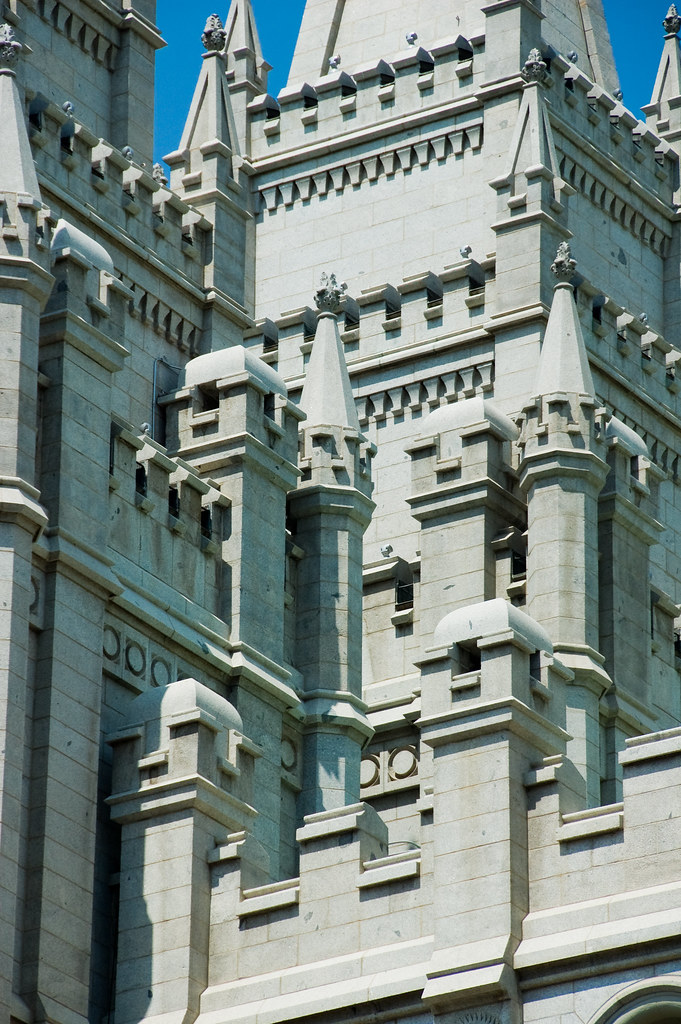
The Salt Lake Temple is of course covered with castle elements.  Its architecture is often called castellated gothic (I think the name isn't very fitting as the architecture isn't very gothic with no pointed arches or flying buttresses and relatively little glass).  The architecture is very well done and beautiful.  The temple really is a conglomeration of styles, but the crenelations, buttresses, and deeply set windows all give a feeling of strength and a castle look.  The use of normal arches and not pointed arches probably helps it look like a castle as well.  You might also notice that the buttresses extend above the crenelated parapet.  This is because at that level every other buttress is also a chimney.  You can see that half of them are open in this photo. The open ones are chimneys.

These four temples, the pioneer temples, are the only ones to use the castle style with crenelations.  Other temples have mimicked features of these temples including the Brigham City Utah Temple which is currently under construction.  That temple isn't using crenelations.  The San Diego Temple is often compared to a castle and it is beautiful and has a look of strength, but it is not crenelated.  The crenelated castle style is part of what makes the pioneer temples unique.  I would like to see it incorporated into a new temple, but if not, we still have four superb examples of the style.  I should also mention that using a crenelated castle style of church architecture is not unique to Mormonism - I saw many examples of it on my mission in England.

Sunday, May 1, 2011

Holy of Holies in Temples of The Church of Jesus Christ of Latter-day Saints

The Holy of Holies is the most sacred part of a temple and is only really in one temple today - the Salt Lake Temple.  Little known is the fact that several temples have had Holy of Holies.

To start out I should point out that the term "Holy of Holies" comes from the Bible and referred to the most sacred part of the Tabernacle, Solomon's Temple, Zerrubbabel's Temple, and the Temple of Herod.  The term "Most Holy Place" is usually another name for the Holy of Holies.  The room contained the ark of the covenant and could only be entered by the High Priest once a year.  It was separated from "the holy place" by the veil of the temple.  In this way, our current temple celestial rooms are somewhat comparable to the Jewish Holy of Holies.  Still, the rooms are quite a bit different.  This should be expected as the Jewish temples were Aaronic Priesthood preparatory temples while ours are Melchizedek Priesthood higher law Christian temples.

The Holy of Holies in our temples have some similarities to their ancient counterparts.  They have limited access - the prophet and occasionally others can enter the room.  They are also used for heavenly visitations.  Anciently, the Holy of Holies was where Gabriel appeared and announced to Zacharias that his wife would give birth to John the Baptist.  In today's Holy of Holies, the prophet may receive similar heavenly visitations and directions on how to run Christ's church.

You might wonder what else "Holy of Holies" is used for.  Apparently it is used for the higher ordinances of the priesthood.  Apostle James E. Talmage said that it is "reserved for the higher ordinances in the priesthood relating to the exaltation of both living and dead".  See his book The House of the Lord for this information. There are several temple ordinances mentioned in the scriptures which aren't performed often or even talked about regularly.  I suspect that some of them might performed in the holy of holies.  Here is one such verse:
Therefore, verily I say unto you, that your annointings, and your washings, and your baptisms for the dead, and your solemn assemblies, and your memorials for your sacrifices by the sons of Levi, and for your oracles in your most holy places wherein you receive conversations, and your statutes and judgments, for the beginning of the revelations and foundation of Zion, and for the glory, honor, and endowment of all her municipals, are ordained by the ordinance of my holy house, which my people are always commanded to build unto my holy name.
D&C 124:39
Notice that this verse says "most holy places" which might mean "Holy of Holies".  I suspect that the "memorials for your sacrifices by the sons of Levi" may simply refer to the sacrament served during solemn assemblies.  In another place we read:

And he shall be received by the ordinance of the washing of feet, for unto this end was the ordinance of the washing of feet instituted.
And again, the ordinance of washing feet is to be administered by the president, or presiding elder of the church.
It is to be commenced with prayer; and after partaking of bread and wine, he is to gird himself according to the pattern given in the thirteenth chapter of John's testimony concerning me. Amen.                                 
D&C 88:139-141
This verse refers to the ordinance of washing of feet - particularly in relation to the School of the Prophets.  This ordinance was instituted by Jesus Christ just prior to his crucifixion and is a priesthood ordinance.  Christ gave this ordinance to his apostles and I highly suspect that the same ordinance is given to any apostle, although it is also apparently given to others as well.  It would not surprise me if the Holy of Holies was used for this ordinance, although it may be performed elsewhere in the temple.

Lets leave this chain of thought and instead get to the architecture of the Holy of Holies and when they have been used.

You can consider the Kirtland Temple to have included a Holy of Holies.  The assembly halls could be divided using curtains (essentially veils) and on April 3, 1836 the Melchizedek Priesthood pulpits were curtained off with Joseph Smith and Oliver Cowdery inside when Jesus Christ, Moses, Elias, and Elijah appeared to them, accepted the temple, and conferred priesthood keys and the sealing power.  For this reason, I think you could consider the pulpits in the Kirtland Temple as an early Holy of Holies.

The original Nauvoo Temple included a sealing room identified as the Holy of Holies.  This was room 1 or the clerk's office.  It was a sealing room, clerk's office, and Holy of Holies.  Apparently it was used so much for the higher ordinances that other rooms had to be used for sealings so the room could be used for the higher ordinances.  See this article for more details.  Here is a drawing of a sealing room in the original Nauvoo Temple from lds.org.  Details of how the room looked are probably guessed, but it gives you some idea of what the Holy of Holies may have looked like.

I don't know if the St. George Temple had a Holy of Holies, but I suspect it at least had a sealing room occasionally used for that purpose.

The Logan Temple used to contain a sealing room sometimes used as the Holy of Holies.  This was the Gold Room.  The room had gold directly applied to the plaster walls using a hot iron.  As you can see, intricate patterns were made on the walls.  The curtain is covering a doorway leading into the southeast tower spiral staircase.  Also, notice the stained glass window.  The windows were removed when the temple was gutted and remodeled in the 1980s.  You can see the windows in the Church History museum (and I think the Manti Temple cafeteria has some of them as well - they looked familiar last time I ate there). 
Logan Temple Gold Room - Sometimes a Holy of Holies

The Manti Temple also included a Holy of Holies.  This one is directly off the celestial room and is still in the temple.  It has its door left open so you can see the room and is now officially a sealing room, although one you can't use.  Apparently President Hinckley wanted the room kept special because of its history (according to temple workers at the Manti Temple who said the room is rumored to have been a Holy of Holies.  As you can see, the room is extremely ornate.  I particularly like the arched area above the altar and the intricate detailing used there.  Even small details such as the door handle and the hinges on the door are covered in symbolic details.  This really is a fitting Holy of Holies.
Manti Temple Sealing Room - Sometimes a Holy of Holies
The Salt Lake Temple is currently the only temple with a permanent Holy of Holies.  This room is accessed from the celestial room and is in between two sealing rooms that are also directly off the celestial room.  The room is round with a dome.  In fact, the room directly above the Holy of Holies is called the dome room because the dome ceiling of the Holy of Holies takes up the middle of the room.  As you can see, the room has numerous art glass windows in the dome (lights in the dome room light them up).  There is also an authentic Tiffany Glass window depicting the First Vision (which can be seen on the other side of the window from the sealing office).  The glass window says
IF ANY OF YOU LACK WISDOM LET HIM ASK OF GOD
THAT GIVETH TO MEN LIBERALLY AND UPBRAIDETH NOT
AND IT SHALL BE GIVEN HIM
                                     James 1-5v
THIS IS MY BELOVED SON       HEAR HIM
The room contains other nice architectural details.  Carved faces are found on the arches.  Vines are found on the columns.  Sconces, a chandelier(s?), and art glass windows bring a lot of light into the room.  You can also see that the room has intricate carvings.  Despite all of this, the room is remarkably restrained for a room with so many intricate details. In Talmage's book The House of the Lord he states that the Holy of Holies is
reached by an additional flight of six steps inside the sliding doors.  The short staircase is bordered by hand-carved balustrades, which terminate in a pair of newel-posts bearing bronze figures symbolizing innocent childhood; these support flower clusters, each jeweled blossom enclosing an electric bulb.  On the landing at the head of the steps is another archway, beneath which are sliding doors; these doors mark the threshold of the inner room or Holy of Holies. . . 
Talmage then describes the Holy of Holies:
The floor is of native hard wood blocks, each an inch in cross section.  The room is of circular outline, eighteen feet in diameter, with paneled walls, the panels separated by carved pillars supporting arches; it is decorated in blue and gold.  The entrance doorway and the panels are framed in red velvet with an outer border finished in gold.  Four wall niches, bordered in crimson and gold, have a deep blue background, and within these are tall vases holding flowers.  The room is practically without natural light, but it is brilliantly illuminated by a large electrolier and eight side clusters of lamps.  The ceiling is a dome in which are set circular and semicircular windows of jeweled glass, and on the outside of these, therefore above the ceiling, are electric globes whose light penetrates into the room in countless hues of subdued intensity. . .
Salt Lake Temple Holy of Holies
In many ways we only need the one Holy of Holies because a major function of the room is for the prophet to go and pray and receive revelation and heavenly visitations relating to how the church should be run.  Yet, it also has its function for higher ordinances and the prophet (or apostles) may wish to use a Holy of Holies when they are away from Salt Lake.  For these reasons, sealing rooms in temples are occasionally used as Holy of Holies.  I was told in the Preston England Temple that one of the sealing rooms in that temple is designated to be used for the prophet or apostles when needed.  When they need the room it is temporarily set apart for that purpose, so essentially it is occasional a Holy of Holies.  This may also explain why many temples have one small sealing room that is really nice, but impractical for large weddings.  It is probably used only for sealings for the dead and also rarely as a Holy of Holies.

I hope you found this interesting.  You may comment but remember that this is on the internet and these are sacred rooms, so let's be restrained in our comments on this one.

Here is a picture of the Dome Room, the room above the Holy of Holies in the Salt Lake Temple.  It is just used to access the ceiling lights above the Holy of Holies and has been used as a dressing room.
Dome Room Above Holy of Holies in the Salt Lake Temple
Talmage describes the Dome Room as follows:
. . . the large Dome Room, thirty nine by forty four feet.  On the south side are three oval windows, and opposite these on the north are semi-discs of pebbled glass looking down into the Celestial Room and set in the arches thereof.  In the center appears a large dome, fifty one feet in circumference at its base and seven feet high.  This is set with seventeen jeweled windows and may be readily recognized as the ceiling of the Holy of Holies . . . In each of these windows electric bulbs are placed, and it is from these the room below derives its beauty of ceiling illumination and coloring.  The walls are hung with portraits of Church authorities.  No specific ordinance work belongs to this apartment. . .
For more information, please read James E. Talmage's The House of the Lord first printed in 1912.

Monday, April 18, 2011

Temple Spiral Staircases

When The Tolmans suggested that I write a post on The Church of Jesus Christ of Latter-day Saints' temple staircases, I don't think they considered how broad of a topic that really is.  There are internal and external staircases.  There are multiple configurations of staircases.  I've been organizing what to write on staircases for the last week or two and have decided that the topic will require multiple posts.  I'm going to start with spiral staircases.

Spiral staircases are perhaps the most impressive type of staircase.  They require great skill to build.  Their form has a special grace that makes them among the most attractive staircases around.  The Kirtland Ohio Temple staircases are curved, although I don't think you would consider them full spiral staircases.  Here are some examples of temples with proper spiral staircases:

The Nauvoo Illinois Temple (original and rebuilt) has spiral staircases without central supports, similar to those in the Manti Temple.  I was told that in the rebuilt Nauvoo Temple the staircases are not free standing because they couldn't figure out how to make them work.  It is much more likely that the engineers decided not to make them free standing for other reasons and decided this was fine because they still look the same.


When I visited the Nauvoo Temple, the workers told us that President Hinckley asked the nearby Shaker community (it may have been the Mennonites) to do the woodwork for the temple including these very nice hardwood railings.  If you don't know, the Shakers (and Mennonites) are famous for their craftsmanship.  The Shaker congregation was invited to tour the completed temple before its dedication.  This is a great example of including other faiths and getting along with others as Christ would have us do. The rebuilt Nauvoo Temple does not include spiral staircases in all four towers.  Apparently the current building codes would only allow a few to be spiral.  They have wisely chosen to have a spiral staircase  lead to the dressing rooms and the baptistery so that all patrons will get to see the staircases.

Another spiral staircase is found in the Nauvoo Temple bell tower seen here.


The St George Utah Temple was the next built and it has spiral staircases in the corners.  I haven't found a photo of them yet; however, I asked to see them the last time I visited the St. George Temple and they showed them to me.  I recall that they had central supports.  I also noticed that they don't air condition the staircases - they were really warm.

The Logan Utah Temple was built next and it has spiral staircases in the four corner towers.  I think they are still there in the remodeled temple, although I have never seen them and do not know if they will show them to you.  The pictures to the left show these staircases.  The first shows them looking up from the assembly hall level.  They are free standing from this level up.  The next photo shows a view looking down and the last shows a view walking down the stairs.  

 
When the Logan Temple was being remodeled they wanted to run conduits through the center supports of the spiral staircases.  When they tried this they discovered that the central supports are solid stone.

The Logan Temple has had several fires over the years.  A fire in 1917 destroyed a spiral staircase that used to be in the middle of the temple (led from the celestial room back to the first floor) and it was replaced with an orthogonal staircase, which has since been demolished completely when the temple was gutted.

The Manti Utah Temple was built next and has some of the most unique spiral staircases in the world.  In the two west corner towers there are freestanding spiral staircases without central supports.  If you attend this temple, ask a worker to see the staircases and they will take you to see them.  They have incredible craftsmanship.  When they restored the temple for the centennial they found something like 2 creaks in the one staircase and none in the other, despite being heavily used by temple workers and used by patrons to access several sealing rooms in the towers.  The seams between pieces of wood on the railings are also extremely difficult to find.
 
I said that these were some of the most unique staircases in the world.  That is because there are only a few free standing spiral staircases that lack central supports in the world.  I believe there are only eight in the U.S. with two being in the Supreme Court Building (those are elliptical).  So the Manti Temple spiral staircases are really special.

One of the staircases goes up clockwise and the other counterclockwise.  They really are an impressive sight and a great asset of the Manti Temple.


The Salt Lake Temple was built next and it includes eight spiral staircases.  All have central supports.  The four corner towers have solid granite staircases.  These have a nice dark wood wainscot.  I have only seen these towers from the baptistery level.  There they have actually installed restrooms on the staircase (weirdly shaped and tight, but interesting).

The other four spiral staircases are found in the priesthood assembly hall.  Here, four spiral staircases provide access to the balcony seating.  These show fine woodwork. and wonderful carpenters' skills.  I hope to see them some day.


The next temple to include spiral staircases, that I am aware of, is the San Diego California Temple built in 1993.  It includes a very modern spiral staircase.  As you can see, the staircase has exquisite woodwork.  It is also very open, which is important as it allows all the light coming through the art glass windows to permeate the temple.

Looking up from this staircase you get this wonderful view.
The last spiral staircase that I know of in a Latter-day Saint temple is found in the newly built Copenhagen Denmark Temple.  This temple was remodeled from an existing church that was gutted, so there is a chance that the staircase was part of the original church.  If not, I am glad to see the church go out of its was to include a spiral staircase.  This staircase is also not centrally supported, making it even nicer.  I love how the light floods into the temple from a well placed skylight.

Those are the spiral staircases I know of in Latter-day Saint Temples.  If you know of others please comment.  Also, If you have a photo of the St. George Temple spiral staircases please let me know.  I would love to have one.  Please comment and let us know what you think about these staircases.  In the future I will post about other temple staircases.  There is a lot more variety in them than you may realize.

Tuesday, April 12, 2011

Metal Clad Temple Towers, Domes, and Spires

The Church of Jesus Christ of Latter-day Saints' temple towers, spires, and domes have occasionally been clad in metal.  I want to talk a little about these.

Many historic Christian churches have metal clad spires.  Lead, Aluminum, Copper, Gold, and other metals have been used throughout history.  The metals serve a practical function of protecting the spire as they weather well.  Placing metals on churches was also a a way to make the church extra special, as many of the metals were hard to come by.


Orig. 1884 Salt Lake Temple Spire Sections
Truman Angel Sr.'s 1884 plans for the Salt Lake Temple had metal sheathed spires.  So the slanted portions of all six towers would have been covered in metal.  In 1887, Truman Angel Jr. changed the design to have the granite spires that the temple has today. (See Salt Lake Temple: A Monument to a People)  Today, the only metal on the spires are five copper finials and the gold leaf covered Angel Moroni statue.


The London England Temple has a metal spire.  You can see a photo here.  The spire is the most detailed portion of the temple's exterior and I like it.  I also served my mission in London so I'm biased.  According to ldschurchtemples.com
The original design of the London England Temple called for a spire of perforated aluminum, similar in appearance to the spires of the Oakland California Temple. The perforations were later removed from the design, however, in favor of a solid sheath of lead-coated copper.
The Oakland California Temple has five perforated gold colored spires.  They are apparently not metal, but rather reinforced concrete that is painted to look like metal.  I've read that the oriental look of the spires is not a coincidence, but rather was used because of the large number of Asian Americans in California and particularly the Bay Area.  You can see pictures of the spires here and here and here.  I love their complexity.  I also love how the lattice structure lets the spires glow.

The Ogden and Provo Temples were the next to have metal spires.  Theirs were originally an orange gold color seen here and here. They were meant to represent the pillar of fire by night that led the Israelites from Egypt.  The upper floors of the temple just below the spire was supposed to represent the cloud that led the Israelites by day.  This is neat symbolism with, in my opinion, horrible execution.  The temples ended up resembling rocket ships, birthday cakes, and other unintended things.  In the 2000s each temple had a statue of the Angel Moroni added (which was actually in the original plans, so we shouldn't think that destroyed the architectural vision of these temples).  At the same time, the spires were painted white, covering the original metal.

Next, the Washington D.C. Temple was built with 6 pointy metal spires.  Their length makes this temple the tallest temple.  The spires are made of steel overlaid with gold leaf.  Each spire has a lot more detail than you usually notice.

The Sao Paulo Brazil Temple was the next temple with a metal spire.  Originally the temple lacked an Angel Moroni statue, but made up for this with a detailed spire.

I think the Tokyo Japan Temple spire is metal.  The Stockholm Sweden Temple and Frankfurt Germany Temple also used metal on their spires.  Many have since used some metal in the spires.

The Houston Texas Temple uses a lot of copper to cover its prominent spire. I really like the style of this temple and feel that the weathered copper gives the modern classical architecture a dignified, mature look.

The Boston Massachusetts Temple was originally completed without a tower due to a lawsuit.  A few months after its dedication, a tower clad in metal was added to the temple.  I like the design.  It is modern, yet fits in with the New England architecture, partially due to the metal spire.

The Helsinki Finland Temple features a metal spire for the tower and a metal dome over the celestial room.

Orig. Oquirrh Mountain Temple Plan With a Copper Spire
The original plans for the Oquirrh Mountain Temple included a copper clad spire.  This would have been nice as Kennecott Copper donated the land for the temple and the Oquirrh Mountains have the largest copper mine (and largest open pit mine) in the world.  The final design has a stone clad tower.


A few temples have metal domes.  The Nauvoo Illinois Temple has a metal tower dome.  I think the Manti Temple towers are clad in metal, but they may use shingles. The Vernal Utah Temple has two copper domes.  The Newport Beach California also has two copper domes, one on the tower, the other above the celestial room.

Other temples have some metal cladding.  The Cochabamba Bolivia Temple was metal on top of its central and 4 side towers.  The Las Vegas Nevada Temple has a copper roof.  Other temples have metal used here and there.

I like metal spires, towers, and domes on temples.  They haven't been used as often as stone or fiberglass or painted spires.  That makes them unique and interesting.  Metal brings a certain dignity to these temples.  There are a wide variety of uses with numerous metals to choose from.  Different styles can and have been used such as perforating the metal, adding etchings, adding a textured pattern, using a smooth metal surface, using several metals, etc.  Metals can retain an untarnished glory or be allowed to develop a dignified patina.  The possibilities are great and so I expect to continue seeing metal temple spires, domes, and towers.  That is a good thing.

Please comment and let us know what you think.

Saturday, April 9, 2011

Latter-day Saint Temple Murals - Pt 5 - Miscellaneous Murals

This is a continuation of my posts on Latter-day Saint Temple murals.  You can read the earlier posts by clicking on the links below:
Part 1, Part 2, Part 3, Part 4, Celestial Room Murals

After the LA Temple was completed, the endowment began to be presented on film, eliminating the need for murals in endowment rooms.  Because of this, murals stopped being used in endowment rooms until the 2000s.  Even so, between the 1950s and the early 2000s, a few temple murals were included.  These tended to be in hallways or lobbies.  Here is the list I was able to come up with:

The Washington D.C. Temple
Washington D.C. Temple Mural of the Second Coming of Jesus
The main lobby of this temple has a 30 foot long mural of the second coming of Jesus Christ.  The painting is probably familiar to you if you are a member of The Church of Jesus Christ of Latter-day Saints.  It shows Christ coming and welcoming the righteous (living and newly resurrected dead people are portrayed) on his right hand, while the wicked despair and hide on his left hand side.  The Washington D.C. Temple is also painted into the mural.

The Jordan River Utah Temple
In the main lobby of the Jordan River Temple there is a mural of the Garden of Eden based on the LA Temple garden room mural.  You can see the LA Temple garden room mural in part 4 of my temple murals posts.


The Mexico City Mexico Temple
Mexico City Temple Lobby with Mural of Jesus Christ in 3 Nephi 11
This temple has a print of a famous painting of Jesus Christ coming to teach the Nephites in the Americas after his resurrection as recorded in 3 Nephi 11 in The Book of Mormon.  The print is in the main lobby.

The Ogden Utah Temple
This temple had a mural of Jesus Christ and some apostles on the Mount of Transfiguration.  I'm not sure if it was a print or an original, but it was large and striking in the main lobby.  I hope it is kept in the temple after the current remodel is completed.  This mural was also effective because the Mount of Transfiguration has been linked to the temple and multiple people (prophets and apostles) have said that this is likely where Peter, James, and John received their endowments.

Salt Lake Temple Annex
The new (added in 1960s) Salt Lake Temple Annex includes a chapel with murals on both the front and rear of the room.

The Bountiful Utah Temple
Bountiful Utah Temple Chapel
The chapel in this temple includes a print of part of a painting of Jesus Christ's second coming.  This is technically a mural as the room is planned around the piece and the piece is permanently applied to the wall.


The Vernal Utah Temple
Vernal Utah Temple Celestial Room
The same painting of Jesus Christ's Second Coming is used as a mural in the Vernal Utah Temple Celestial Room.


Baptistery Murals
There are many temple that have baptistery murals, but I am going to cover those not already covered in a separate post.

There is my list of miscellaneous Latter-day Saint Temple Murals from 1960 to 2000.  Surely I have missed some.  Please comment and let us know what you think, tell us of other murals I didn't know about, and discuss murals you would like to see.  While I am thrilled that temples have begun using endowment room murals again, I also like seeing these murals in various places in the temple.  I love how each temple is different, with random murals adding interesting variety.  Please Comment