Sunday, February 26, 2012

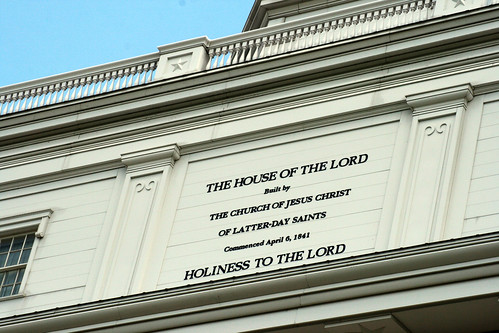
Holiness to the LORD The House of the Lord

Holiness to The LORD
The House of The LORD

The Church of Jesus Christ of Latter-day Saints' temples have that phrase inscribed on them as a reminder of what the temple is and how it should be treated.  This phrase is from the scriptures (Exodus 28:36, Exodus 39:30, Zechariah 14:20, etc.) and was connected to the Temple.  It is placed on the Temple as a reminder that it is God's house and that we need to be holy to enter it and we need to respect the temple as it is sacred ground that The LORD and his angels visit.  The word holy means set apart for a sacred purpose.  So the inscription on the temple means that the building is set apart for something special - in this case the higher ordinances of the gospel such as marriage for eternity, the saving work for the dead, and other special worship such as prayer.  It also means that we need to be purposeful when we go to the Temple, focusing on God and bettering ourselves.

Here are some interesting uses of the phrase "Holiness to The LORD, The House of The LORD" on Latter-day Saints Temples.

The Nauvoo Illinois Temple:
Nauvoo Illinois Temple Inscription (original)

The Logan Utah Temple:
Logan Temple Keystone (original)

The Salt Lake Temple:
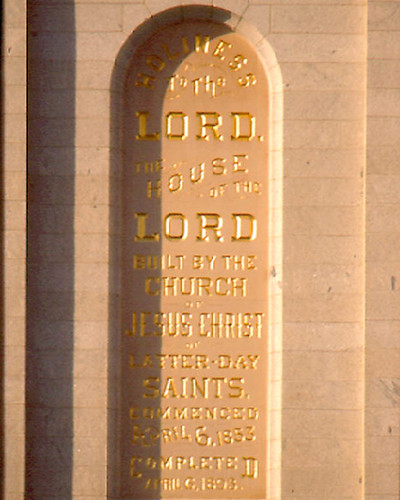
Salt Lake Temple Inscription Stone (original)
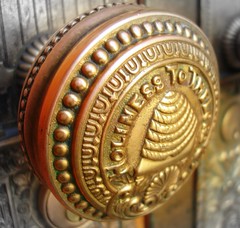
Salt Lake Temple Doorknob (original)
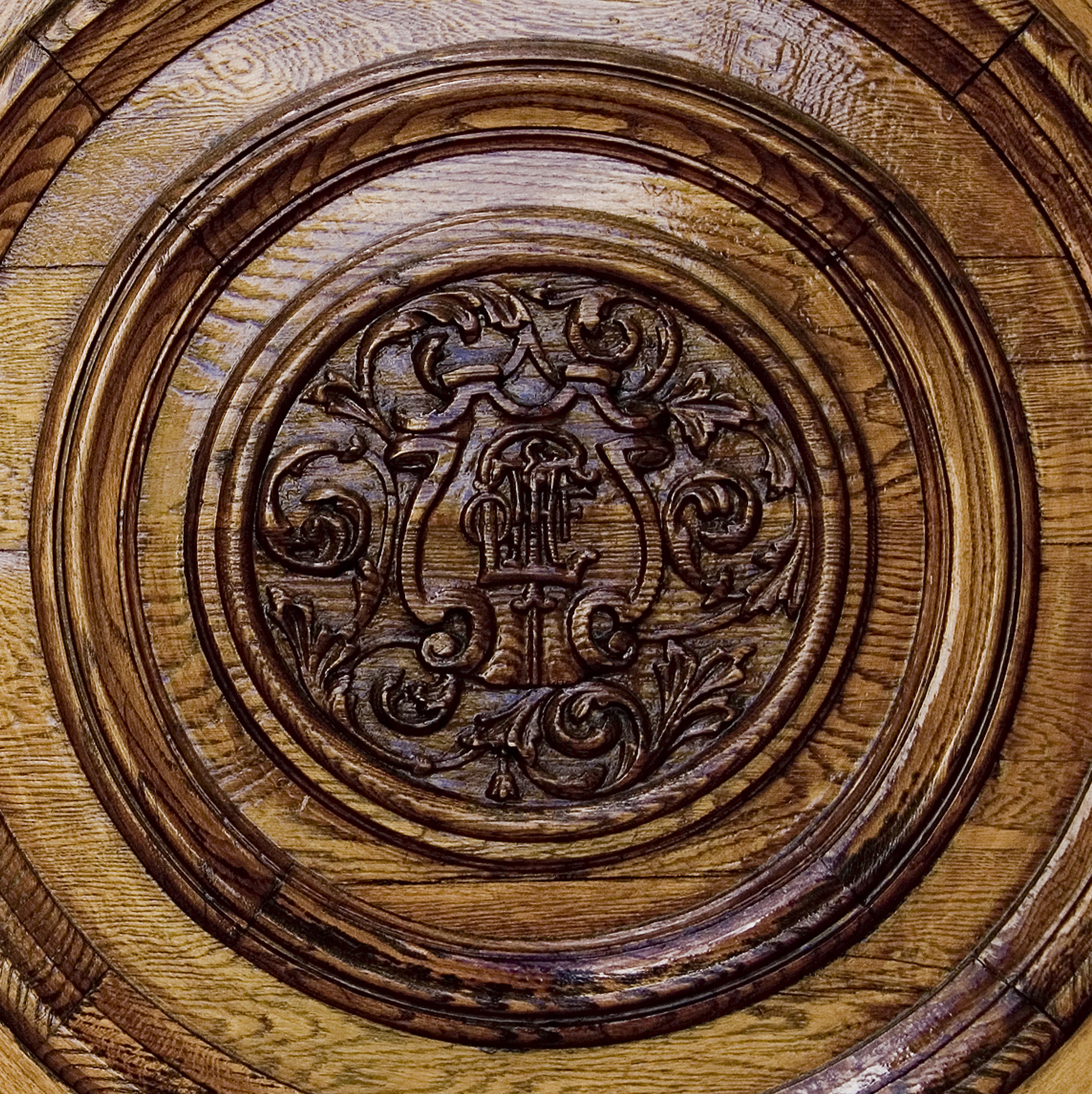
HTTL Monogram on the Salt Lake Temple Door (original)
The Cardston Alberta Temple's inscription can be seen here.
The Mesa Arizona Temple's inscription can be seen here.
The London England Temple's inscription can be seen here.
The Oakland California Temple has its inscription below one of its large sculpture panels of Jesus Christ.
The Denver Colorado Temple's inscription can be seen here.
One of the inscriptions on the Winter Quarters Nebraska Temple is above the ornate front doors.

Those are just a few examples of Holiness to The LORD, The House of The LORD inscriptions on Latter-day Saint Temples.  From ornate to simple, these provide a reminder of the mindset we need as we enter the temple and remind us whose temple it is.  I particularly like the more unique versions of this phrase.  For example, the Salt Lake Temple monogram and doorknobs and the Logan Utah Temple keystone are particularly interesting, in my opinion.  I am glad to see that the new Provo Temple being made out of the burned Provo Tabernacle will have a nice inscription above the east central window.

Well those are some of my thoughts.  Comment and let us know what you thing about these inscriptions, or any interesting uses of them that I am unaware of.

*Addendum
I read a few comments.  One pointed out that many temples have very plain inscriptions.  This is fine and I tried to focus on the interesting ones instead of the plain.  I would like to comment on the St. George Utah Temple's inscription.  It has very plain lettering that looks like it was added many years after the temple's completion - perhaps 50 years or more later.  You can see a photo here.  One reason why I find this inscription particularly disappointing is that the original plans showed a more interesting inscription.  I'm guessing that was removed entirely before the temple was built and the current inscription was added later so that this temple would have the inscription, although that is speculation on my part.  The original plans showed the inscription higher up, on the tower around the small circular window seen here.  If I was doing a restoration of this temple I would redo the inscription as shown in the original plans.  You can see the original elevation with the different inscription in the temple visitors center or I believe it is in one of the St. George Temple books.
 

Sunday, January 8, 2012

The Jordan River Utah Temple

Jordan River Utah Temple
Today I'd like to give some of my feelings about The Church of Jesus Christ of Latter-day Saints' Jordan River Utah Temple.  This temple was the first I ever attended.  I went there most often to do baptisms for the dead as a teenager.  I was also endowed in this temple, and witnessed the sealing ordinance for the first time there.  I currently live in the Jordan River Utah Temple district.  I also worked there as a temple worker shortly after my mission.  So I am familiar with the temple.

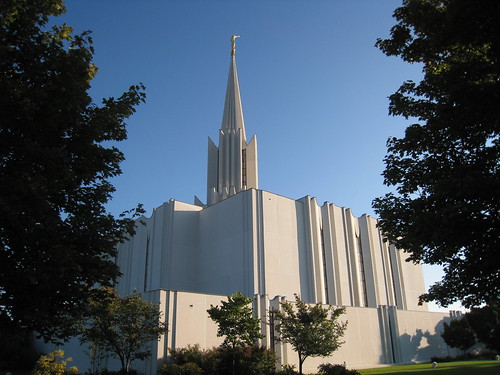
The Jordan River Utah Temple
The Jordan River Utah Temple was completed in 1981 and is in South Jordan Utah and West Jordan Utah (the temple is on the boundary between these two cities).   The temple land was donated to the church and the cost of the temple (and maintenance for many years) was entirely from member donations (outside of tithing).  This was unusual at the time.

The Exterior

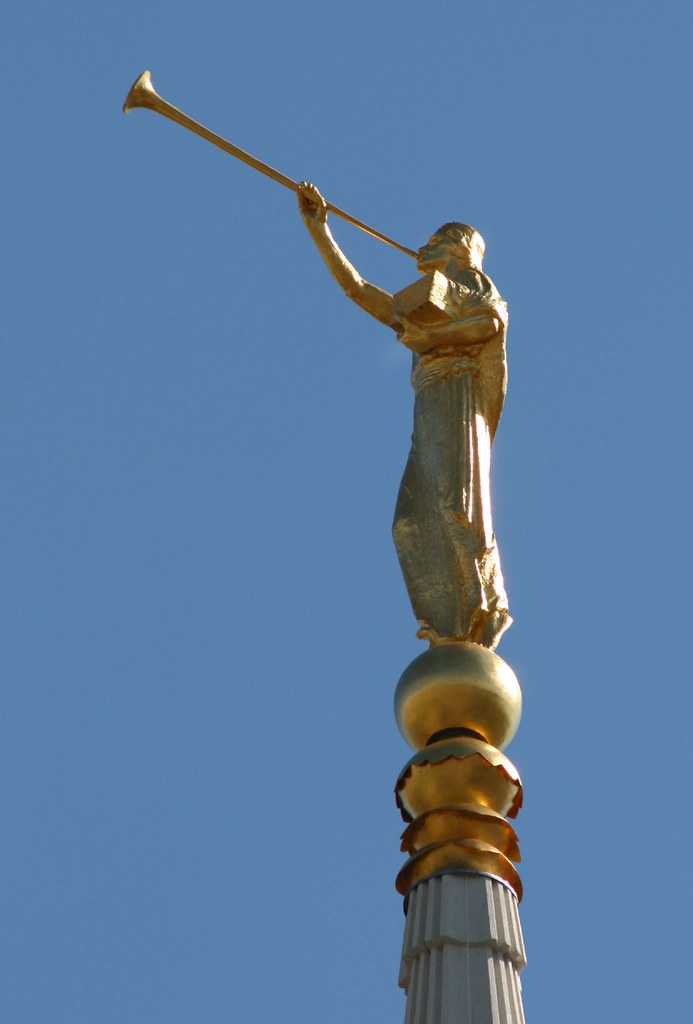
Angel Moroni Statue
The Jordan River Temple is topped with a smaller replica of the Washington D.C. Temple Angel Moroni statue. This statue is one of the few that is depicted holding the golden plates that The Book of Mormon was translated from.

The architecture of this temple is a modern 1980s style. The exterior is made of white cast stone (precast concrete panels) with white marble chips.  These panels have a repeated inverted swoop theme which is also used as the main decorative motif in this temple.  These swoops (inverted parabolic arches?) are generally displayed in threes.

The temple tower is actually made of fiberglass which significantly reduces the weight on the structure below and reduces the mass of the building to reduce the seismic loads on the structure.  Despite being a different material, it blends perfectly with the cast stone.

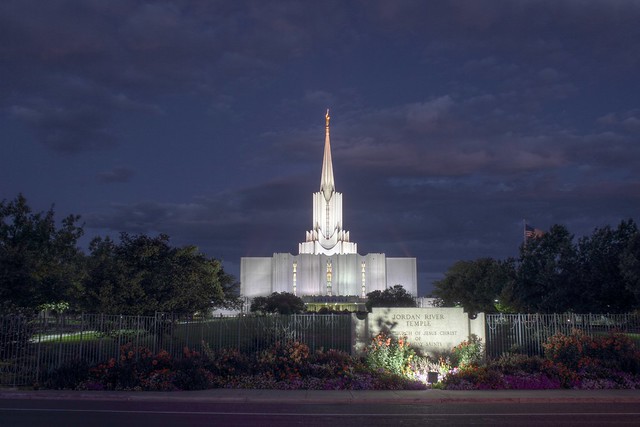
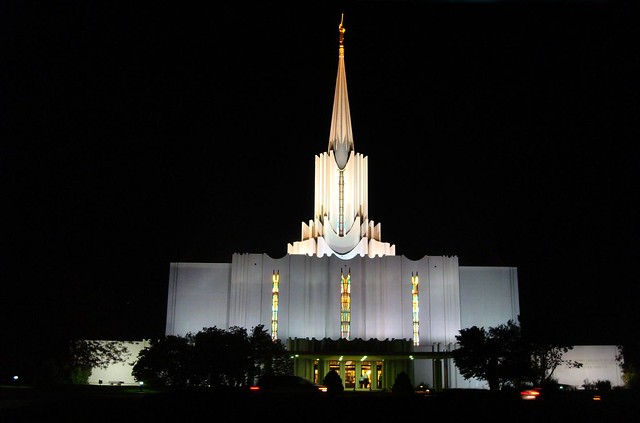
The Jordan River Utah Temple at night
The temple also has stained glass windows (abstract) that glow at night.  The windows are very colorful and are geometric patterns.  They are beautiful on the inside when the sun is shining through them in the right way.

The temple has a lot of symmetry, with each of the four sides being nearly identical.  This makes the temple approachable from all directions.

The exterior and interior of this temple is very light on symbolism with the Angel Moroni statue on the spire and oxen statues supporting the font being the only prominent symbols. 

The Interior

Jordan River Temple Font
The Jordan River Temple is the fourth largest in the church with 148,236 square feet of floor space.  The temple entrance is on the east side.  In between the first and second set of doors is a staircase leading down to the baptistry.  As you enter the baptistry there is a small chapel used so groups can have a short prayer and devotional before starting baptisms.  This was added in the late 1990s (at least I seem to remember them adding it around then).  There is also a larger chapel that faces the font (with glass in between).  The room has dark wood that I don't particularly care for, but was fashionable in the 1980s when the temple was built.  The baptistry gets very busy and it is not uncommon for a several hour wait to do work.  This is why Utah continues to get new temples even though it already has 13.  The baptismal font is very similar in style to the Provo and Ogden (original) temples.  There are mirrors on two sides of the room giving an eternity effect.  There is also a 1980s style simple chandelier above the font.  The confirmation rooms are very small and feel more like closets than ordinance rooms.  This is unfortunate, because they feel like afterthoughts and not rooms for ordinances.  I don't know if their size and lack of ornamentation is due to the space required for two chapels, but they are the most disappointing part of the baptistry.  Even so, this was the first temple I did baptisms for the dead at and I do like it.

The bottom floor of the temple also has worker training rooms and a cafeteria.  The cafeteria is good, although the smell of food does drift into the baptistry where it is distracting.

The first floor of the temple houses the temple offices, a lobby, and dressing rooms.  The lobby was redone sometime around 2005 with new lights, stone flooring, etc. and is really nice.  There is a huge painting of the Garden of Eden (essentially copied from the L.A. Temple garden room mural) on one wall.

The Jordan River Utah Temple is one of the few temples with escalators.  They aren't as bad as you might think.  While I would welcome actual stairs, the escalators work well, are fairly quiet, and provide good views of the stained glass windows.

The second floor contains the chapel and the sealing rooms.  The chapel has some dark wood, but not annoyingly so.  It has an electronic organ.  In front of the speakers are dark wood posts that give the feel of pipes (while clearly being just decorative).  These have the same swooping pattern found elsewhere on the temple.  They look really cool, but are hard to describe, so you'll just have to see them for yourself.

Sealing Room
The sealing rooms are fairly simple.  Most, if not all, have facing mirrors to give an eternity effect.  The chandeliers are a dignified classical style.  The altars are made of stone and different colors of stone are used in each room.  Several rooms (there are 17 sealing rooms total, only the St. George Utah Temple has more with 18) have exterior stained glass windows.  These are the sealing rooms used most often for living sealings.  If I recall correctly, one or two rooms have 2 stained glass windows and the others have one stained glass window.  These sealing rooms are on the north and south ends of the temple.


The endowment rooms and celestial rooms are on the third floor of the temple.  There are six endowment rooms and the Jordan River Temple is one of only 4 temples with this many endowment rooms.  I am fairly sure that the endowment rooms in the Jordan River Temple are larger than the other temples making this the temple with the highest capacity.  Even with sessions starting every 20 minutes, this temple is kept busy.  The endowment rooms are fairly simple.  Their walls have alternating vertical strips or wallpaper and wood paneling with brass swoops matching the swoops elsewhere in the temple.  The altars are made of stone and match those in the sealing rooms.  The rooms can seat around 125-150 (If I remember correctly) and feel very spacious.  They also have high ceilings.

Jordan River Temple Celestial Room
The Celestial Room is a modern 1980s style.  It is oval shaped with an oval dome.  There are numerous mirrors on the walls with brass lines matching the unique brass chandelier.  Both the chandelier and mirrors match the exterior architecture.  The chandelier is a little hard to describe, so hopefully the photo helps.  The room has glass vases, tables, and other modern elements that work nicely.  I like this celestial room.  If I was to add anything it would be some of the colorful stained glass that is on the exterior of the temple, but the room is fine without it.

The third floor hallways also contain nice artwork - mainly landscapes.  The halls also provide views of the stained glass windows.

Throughout the temple there are also specially sculpted doorknobs.  These are brass or bronze and have swoops and other shapes that echo the architecture and patterns common in this temple.  It is nice seeing custom handles to make the temple a special place.

The Jordan River Utah Temple is a great example of 1980s modern architecture in my opinion.  It has beautiful repeated patterns, clean lines, and great functionality.  It does lack much symbolism, but I suppose it is okay for a few temples to be this way.  I love this temple and am glad we have it.

One of the best parts of the Jordan River Temple has nothing to do with the architecture, but rather how it is run.  The temple (at least when I worked there) went to great efforts to make patrons feel comfortable.  It is always a friendly place and among the best in that regard.

Those are some of my thought on this temple.  Please comment and let us know what you think about this temple.

Sunday, December 11, 2011

Christmas at The Church of Jesus Christ of Latter-day Saints' Temples

With Christmas approaching, I thought I'd write a little bit about The Church of Jesus Christ of Latter-day Saints' temples that have Christmas displays.  This list is not exhaustive, but should highlight some of the great Christmas displays at Latter-day Saint temples.


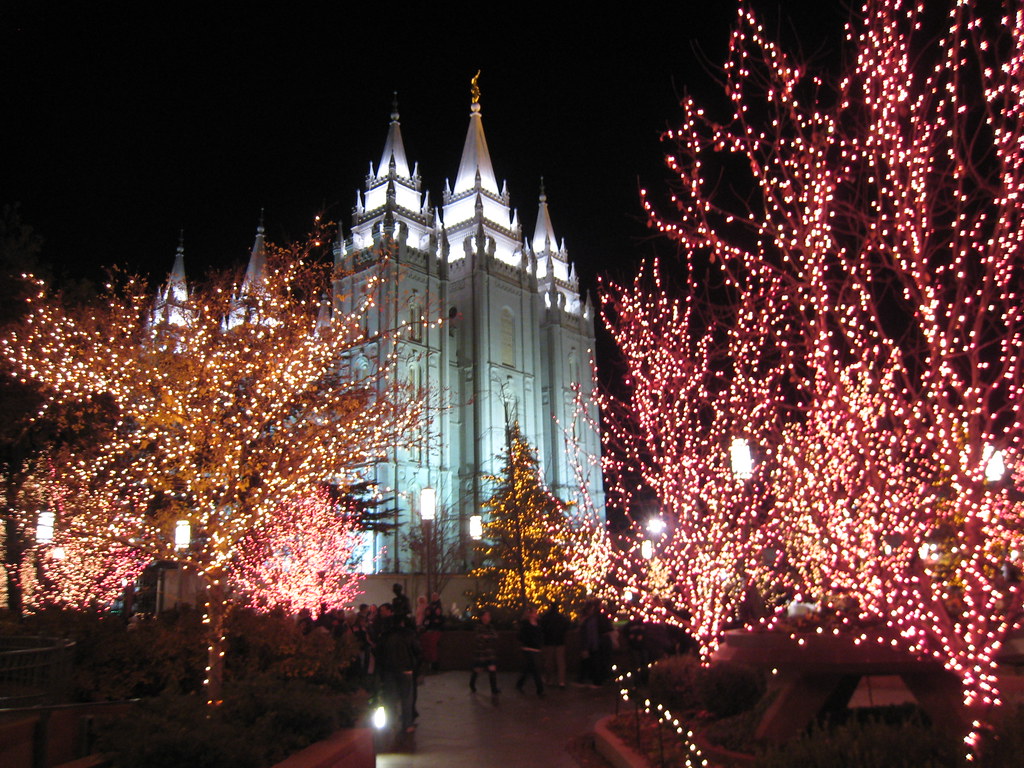
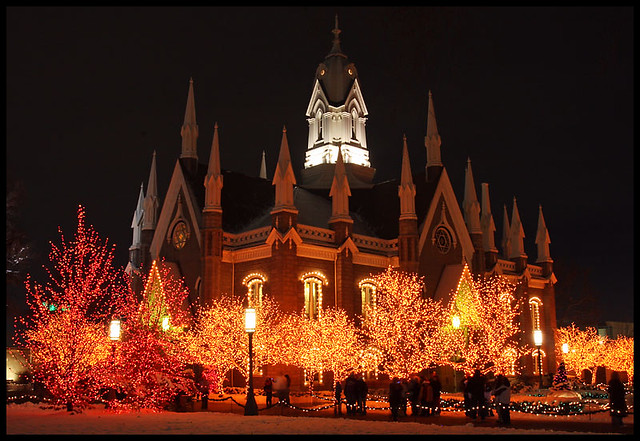
The Salt Lake Temple has the most prominent Christmas displays.  Massive amounts of intricately placed tasteful Christmas lights fill Temple Square, the Conference Center Plaza, Main Street Plaza, and the block east of the temple.  Dozens of large nativity sets are placed on the block east of the temple.  A prominent nativity scene, complete with audio narration, is done on the grass between the Tabernacle and the North Visitors Center.
Christmas Lights at Temple Square

The buildings on Temple Square also receive decoration with wreaths and Christmas trees being placed in the Conference Center, Tabernacle, Assembly Hall, Visitors Centers, and Joseph Smith Memorial Building.  Christmas events also take place such as the Mormon Tabernacle Choir Christmas Concert, the First Presidency Christmas Devotional, Christmas themed films in the visitors centers, and numerous other Christmas concerts and events.  You can see some photos and read a great article on how Christmas lights started at Temple square here.

Christmas Lights around the Assembly Hall on Temple Square

The St. George Temple also has Christmas lights.  There is a formal lighting ceremony each year, usually on the day after Thanksgiving.  A photo can be seen here.

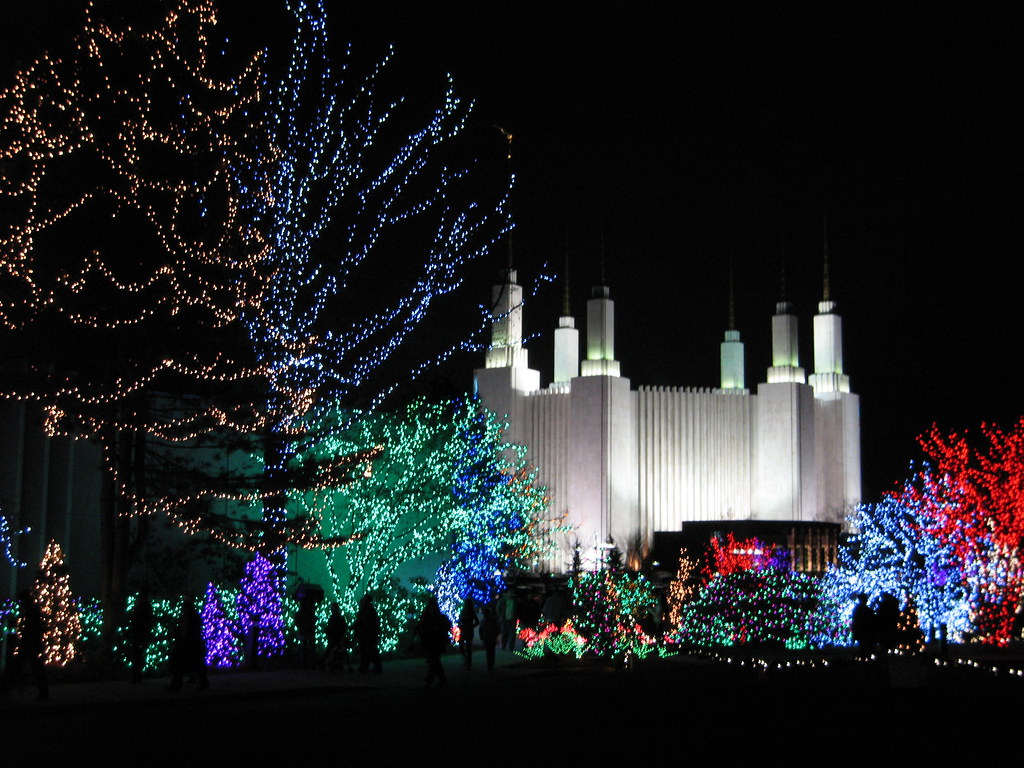
The Washington D.C. Temple features its Festival of Lights each Christmas season.  The festival includes international nativity scenes and Christmas trees, nightly concerts, and a vast number of Christmas lights.
Washington D.C. Temple Festival of Lights

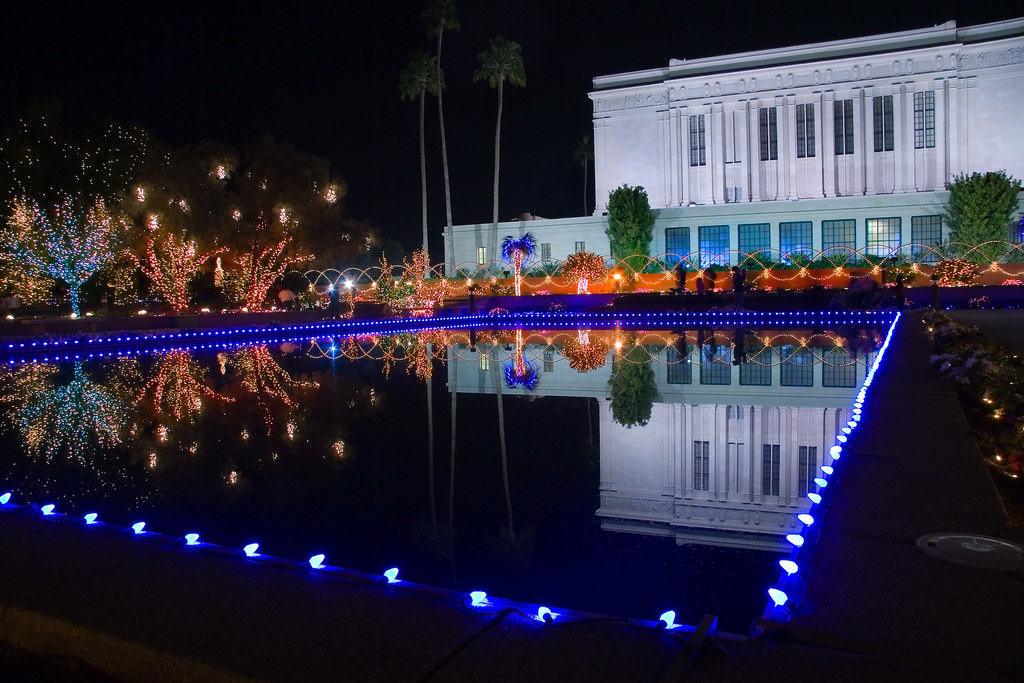
The Mesa Arizona Temple also has a Christmas light display and nativity scenes.  Some photos can be seen here.  International nativity scenes are on display.
Mesa Arizona Temple Christmas Lights

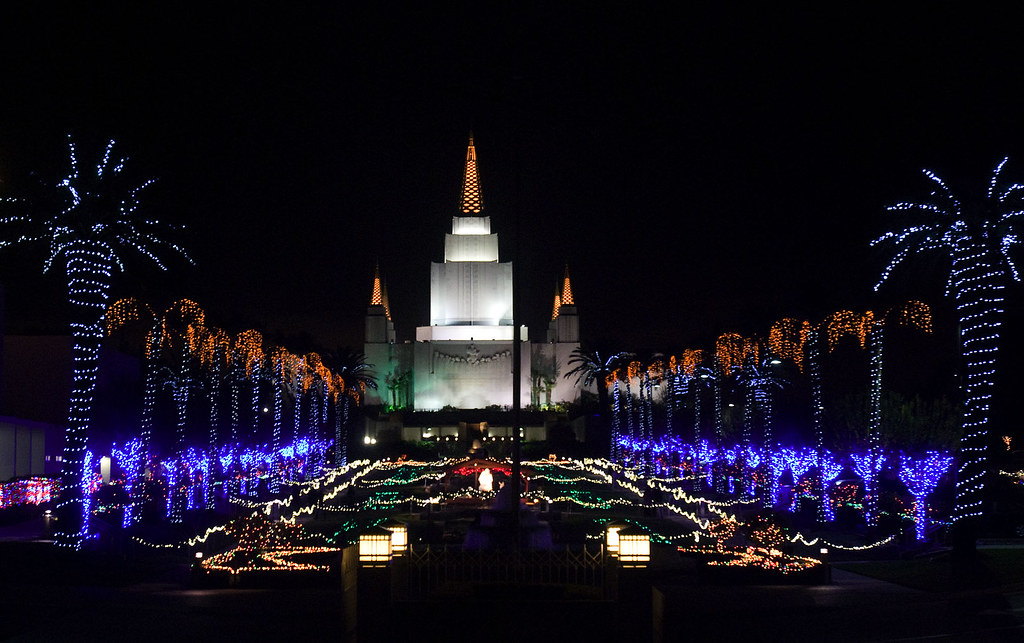
The Oakland California Temple has a Christmas lights display.
Oakland California Temple Christmas Lights

The San Diego California Temple has some Christmas lights and a nativity scene that can be seen here.  In fact, many temples have a small nativity scene even though most temples don't have Christmas lights or other events that would attract non temple patrons during the holidays.

The Los Angeles California Temple has a Christmas lights display that can be seen here.

The Hamilton New Zealand Temple also features a Christmas lights display that can be seen here.

One of the nice things about Christmas lights at temples is how tastefully they are done.  The lights are very neatly arranged.  Great care is taken so that the lights don't take away from the temple.  Nativity sets are a common feature so that these Christmas displays can remain religious and focused on Jesus Christ who is the reason for Christmas and central to our temples.  I've seen Christmas light displays at other churches with varying degrees of success .  Some are tasteful, but unfortunately some are commercial, lack the religious elements, or are focused on Santa instead of The LORD Jesus Christ.  I'm glad that The Church of Jesus Christ of Latter-day Saints keeps the proper focus on Jesus Christ.

There are probably a few more temples with Christmas lights and other Christmas decorations.  Please comment and tell us about them, or more about some of the ones that I mentioned but know little about.

Monday, November 21, 2011

The Fortaleza Brazil Temple Rendering

In case you missed it, The Church of Jesus Christ of Latter-day Saints recently broke ground on, and released the rendering of, the Fortaleza Brazil Temple.  It is another of the two towered temple style.  Here is the rendering, followed by the renderings of the other new two towered temples for reference.
Fortaleza Brazil Temple Rendering
Brigham City Temple Rendering
Kansas City Temple Rendering
Rome Italy Temple Rendering
Philadelphia Pennsylvania Temple Rendering
 I like the new rendering of the Fortaleza Brazil Temple.  I am a big fan of the new two towered temple style.  I like the classical design of this new temple, although I like the neoclassical architecture used in the Philadelphia Temple even more.  The Fortaleza Temple is built into a hill which should allow light to fill the baptistery.  I particularly like the towers of the Fortaleza Temple and the slight concave curves on each side.  I also like the columns on the towers and the fact that they cluster on the corners.

Well, that was a really short post, but hopefully you liked the rendering.  Please comment and let us know what you think about this new temple rendering.

Saturday, November 5, 2011

The Washington D.C. Temple of The Church of Jesus Christ of Latter-day Saints

I love the Washington D.C. Temple.  I have been inside once and outside two other times.

The Washington D.C. Temple (actually in Maryland, right next to the Capitol Beltway) is a huge temple.  It is 288 ft tall, taller than the Salt Lake Temple.  It is the third largest temple by square footage, but I believe it is the largest in overall dimensions (100 ft wide by 247 feet long by 288 ft tall).  The temple sits on a heavily wooded site, but due to its size, it is noticeable from all around and very prominently seen from the freeway.  It looks even bigger in person.
The Washington D.C. Temple
The exterior architecture of the Washington D.C. Temple is based on the Salt Lake Temple.  It has 6 spires (and was the first temple since Salt Lake to have six).  The three spires on the east side represent the Melchizedek Priesthood and presidencies in it (in particular a stake presidency or the first presidency).  The western three spires represent the Aaronic Priesthood and a bishopric or the presiding bishopric.  On this temple, all six spires are at different elevations, which gives the temple a slightly different look as you walk around it.  The top of the towers have gold leafed spires with pointed arches in them.  Pointed arches are used throughout the temple.


The Washington D.C. Temple also has a unique Angel Moroni Statue (added when only the Salt Lake and LA Temples had one).  This Angel Moroni statue is holding a representation of the gold plates that The Book of Mormon was translated from (and is one of the few that do).  If you want to see this statue, but can't get to D.C., the Jordan River Utah Temple, Seattle Washington Temple, and Mexico City Mexico Temple each are topped with replicas of the Washington D.C. Angel Moroni statue.  The original was sculpted by Avard Fairbanks and is an 18 ft tall bronze sculpture covered in gold leaf.  The replicas are 15 ft.

The doors of the Washington D.C. Temple are also very ornate.  I've discussed them before on this blog.  You can read about them here.  They incorporate many of the symbols on the Salt Lake Temple.  I also intend to update that post with more pictures of the doors, so you may want to look at it again.  There are ornate doors on the southeast and northeast sides of the temple and slightly different doors on the main entry on the north.
Washington D.C. Temple northeast doors
Washington D.C. Temple main entry doors

The Washington D.C. Temple is not just a copy of the Salt Lake Temple.  It was completed in 1974 and has a lot of 60s and 70s architecture (in a good way).  It is very modern and sleek.  The temple is made of reinforced concrete covered in white marble.  You might think that it doesn't have windows.  It actually has two types of windows.  On the east and west sides there is a stained glass window going continuous from the first to seventh floors.  This is striking at night when the temple is viewed from the outside.  On the inside, the center towers are open center staircases with these windows along one corner.  The other windows in this temple are stone windows.  Some of the white marble was cut thin enough to be translucent and provides light to the interior.  Numerous vertical ribs draw the eye upward and exaggerate the height of the already tall building.  They also add to the sleek look of the temple and cast small shadows that constantly change the way that the temple looks as the sun moves.

The Interior
You enter the Washington D.C. Temple on the north.  The entrance is actually in an annex.  Behind the recommend desk there is stained glass similar to that found on the east and west center towers.  Then there is a nice lobby on a bridge leading to the temple proper.  The glass is clear here so you can see the trees and the temple.  Even more importantly, you can a very large (30 ft long) original painting of the second coming of Jesus Christ painted for this temple.  I've seen prints of this painting many times before.  It shows the righteous on the right hand of Jesus, welcoming him in joy and the wicked on the left hand side hiding from him.  In the upper corner on the left side of the painting (right hand of Christ) is the Washington D.C. Temple.  Prints of this painting are nice, but experiencing it in person is even better.  As you approach it you are walking straight towards Christ, and because you are on a bridge, at first you cannot see the whole painting.  All that you can see is Christ and the righteous.  It feels like you are coming to join Christ in joy as you approach the temple (which you can see through the clear windows of the bridge).  When you get fully into the temple proper, you can see the entire painting including the wicked, which makes you want to help them.  I don't know if the artist intended the painting to be displayed this way, but it is effective and powerful.  Intended or not, how the painting is displayed magnifies its effect.  The painting is in a room with a lot of dark walnut woodwork which, although not in style right now, looks really good.  This is the second floor of the temple.  Most of the floor is a lobby with this painting.  The floor also holds a chapel and temple offices.
Washington D.C. Temple annex bridge
Washington D.C. Temple mural of the second coming of Jesus Christ
You can go up or down floors either by using one of the staircases on either end of the temple, or by taking one of four elevators (two on each end).  There are also four other staircases in the smaller towers, but I didn't see them.  The east and west end staircases are square in shape with an open center.  There is a fountain on the first floor level of each that can be seen and heard from all 7 floors of the temple.  The views from any floor of these two staircases are impressive looking up or down, especially since you can view 7 floors of colorful stained glass window.  The stained glass window is W shaped and has chipped glass so that more light is refracted into the temple.  The August 1974 Ensign states:

The colors near the ground are rich and vibrant - reds and oranges- but as they rise, they give way to clearer tones: blue, violet, and finally white.  According to Brother Henry Fetzer, the change in colors is symbolic of the purity and clarity that enters a person's life as he leaves earthly concerns and aspires toward heavenly matters.  The unbroken line of window rising continuously to the top of the temple is a reminder of the unbroken progress that is possible in the gospel.
Progression is also shown in the temple color scheme elsewhere.  The Ensign also states:
The interior colors also change.  Walnut paneling and deep blue give way to more and more white, with accents of gold.  The celestial room, with white walls and a white ceiling, is carpeted in a very pale apricot gold.  Plants provide the only other colors.

Many doors in this temple have door handles with a stylized version of the three towers on each side of the temple on them.  I like seeing custom door handles.  It is a nice touch.

The first floor used to have a cafeteria, but now it only has some vending machines.  You can get to the baptistry from here (down one floor in the basement and sub-basement) although I suspect that there is a separate baptistry entrance somewhere.  I liked the baptistry.  Originally it had nice blue carpet, but now it has been redone with golds and greens and stone (I assume faux) that looks really good.  I liked the original (first photo) and would have kept it, but the new finishes (second photo) are really nice so it is hard to complain much.
Washington D.C. Temple Baptismal Font
The third floor of the temple contains the clothing rental, dressing rooms, and brides' rooms.  A hallway runs from east to west connecting the main staircases.  The dressing rooms haven't been updated since the 70s (as the particular shade of blue lockers showed) and show some wear, but I suspect the lockers will be replaced soon enough.  This floor is mainly powder pink, as is most of the temple.

The fourth floor contains the endowment rooms and celestial room.  There are six endowment rooms around a centrally located celestial room.  There are only 3 other temples in the world with that many endowment rooms - Ogden Utah, Provo Utah, and Jordan River Utah.  The Washington D.C. Temple used to need that many rooms when it was the only temple for the eastern U.S. and Canada.  Now sessions run once an hour, but my middle of the day session had enough people to do the ordinances.  The endowment rooms are simple.  The back of the rooms have a lot of vertical lines which somewhat tie the room into the exterior architecture.  There also appeared to be a few translucent stone windows along the top of the back of the room.  The seating doesn't have a central aisle which is highly unusual for a Latter-day Saint temple.  Men and women still sit on opposite sides of the room, but it is possible to sit next to someone of the opposite gender.  The white marble altar in the front has pointed arches cut into it.  Pointed arches are repeated throughout the temple. 
Washington D.C. Temple Endowment Room
The centrally located Celestial Room is quite large.  It takes up the center of the fourth floor and the middle of the fifth floor.  The room is oval shaped.  It doesn't have a central chandelier.  Instead it has 12 classic chandeliers around the perimeter of the room between 12 columns.  The square columns are uniquely shaped with their tops flaring into a modern version of a capital and forming pointed arches in the process.  They are done in marble (faux?) with gold ornamentation.  Mirrors surround the room.  As you walk in, you see several reflections of yourself due to the curved walls.  The carpet is intricately sculpted and the furniture feels elegant and fitting for Washington while not out of place with the modern elements.  The top has a dome with clouds in a blue sky painted on it.  You can see a better photo of this photo here.

Washington D.C. Temple Celestial Room
The fifth floor of the temple is not open because it just houses mechanical units (heating, etc.) and the upper portion of the celestial room takes up some of the space.

The sixth floor of the Washington D.C. Temple has the sealing rooms and sealing office.  I particularly like the oval sealing rooms (first photo) which have been redone, but still look really good.  The rectangular sealing rooms are also nice.  The altars are all white marble with pointed arches carved in.
Washington D.C. Temple Sealing Room
The seventh floor of the temple is a large priesthood assembly room.  Few temples have such rooms, and you can read about them in my post here.  The Washington D.C. Temple's pulpits (there are 24 in the room) mimic the style of the Salt Lake Temple pulpits.  Pointed arches appear on the backs of the stands in the solemn assembly room.
Washington D.C. Temple Priesthood Assembly Hall
The August 1974 Ensign magazine has numerous construction photos of the Washington D.C. Temple, as well as a section of the temple on pg. 12 and a plan of the sixth floor on page 18.  There are also numerous architectural sketches and a lot of explanation about the temple.  If you don't have that issue of the Ensign laying around, you can find it at the Church History Library when you are in Salt Lake.

I loved visiting this temple.  It is so grand, unique, symbolic, modern, and beautiful.  It truly is very good architecture and a wonderfully done temple.

I'd like to hear what you think about this temple, or anything that you might have to add, so please add you comments on this article below.

Sunday, October 9, 2011

The Church of Jesus Christ of Latter-day Saints - Temple Celestial Room Domes

The Temples of The Church of Jesus Christ of Latter-day Saints are spectacular. I really like the use of domes in temple celestial rooms.  Many recent temples have included them, in addition to some older temples.

Both the St. Louis Missouri and Preston England Temples have domes in their celestial rooms.  The temples share the same floor plan, so this isn't too surprising.  Other temples with this style likely have domes.  I know that Boston has a small dome at the end of the room.  If I recall correctly it has clouds painted in a fake oculus.
St. Louis Missouri Temple Celestial Room
Preston England Temple Celestial Room

The first style of small temple had a few mentionable domes.  The Brisbane Australia Temple has a dome with cloud and sky scene and the Snowflake Arizona Temple has an elliptical dome with a sunburst pattern.  These temples are often criticized for being cookie-cutter.  The domes help add some garnish to the very nice cookies.

Brisbane Australia Temple Celestial Room Dome
Snowflake Arizona Temple Celestial Room Dome
The next style of small temple shared a common floor plan that almost always included a celestial room dome.  These temples were given many architectural distinctions to make them much less cookie-cutter.  The temple domes are differentiated with unique, detailed patterns.  All of these temples have a lot of detail.  I wasn't able to find pictures of them all, but here are the ones I could get:
Apia Samoa Temple Celestial Room Dome
Newport Beach California Temple Celestial Room Dome
Redlands California Temple Celestial Room Dome
Sacramento California Temple Celestial Room Dome
San Antonio Texas Temple Celestial Room Dome
The Draper Utah Temple was also given a dome.  I'm pretty sure this is a faux dome, painted to look like a dome.  It is really high up in the room so it is hard to tell, but I think the ceiling is actually flat or only very slightly curved.  The shading makes it look curved and makes it appear to be a dome.  I'm fine with that.  I also love the ring of Sego Lilies (Utah's state flower, which also fed starving pioneers) around the perimeter.
Draper Utah Temple Celestial Room Dome
Several older temples also have domes.  The Sao Paulo Brazil Temple has a dome with nice gold.  I don't know if this dome is original, or if it was added during a recent remodel.  I think it may be glass, but am unsure.
Sao Paulo Brazil Temple Celestial Room Dome
Other temples have had domes added.  For instance, the Boise Idaho Temple had a stained glass dome installed in its celestial room.  Pictures can be seen here.  From what I've seen. a lot of the six spire sloped roof 1980s temples had a central celestial room with an octagonal dome.  I've only seen Dallas' in person.  I liked it.

The Jordan River Utah Temple has an oval dome.  It is really simple with just some texture added like you sometimes see on vaulted ceilings in homes.  The Provo Utah and Ogden Utah Temple both have domes in their celestial rooms.  At least one of them is a dome with numerous ribs and a nice pattern.

The Orlando Florida Temple has a glass dome in its celestial room that can be seen here.

The Rexburg Idaho Temple has an elliptical dome with a wheat pattern painted on it.

I'm sure other temples have domes.  Please comment and let us know about other interesting Latter-day Saint Temple celestial room domes, or what you think about these.

Sunday, October 2, 2011

New Temple Announcements

So new temples were announced in General Conference for Kinshasa, Congo; Barranquilla, Columbia; Durban, South Africa; Star Valley, Wyoming; and Provo, Utah (which already has a temple, and will get a new one with the recently burned Tabernacle being rebuilt as a temple).  We were also reminded that the church is building a temple in Paris, France (which was announced about 2 months ago).

I'm excited for these temples.  I love that the continent of Africa is going from having 3 temples to 5 temples.  I also love that Star Valley, Wyoming (near Jackson Hole) is getting a temple.  I was up there about a month ago and found out that Afton, Wyoming has a Tabernacle.  Maybe the new temple will be built near that Tabernacle.  I am glad that Wyoming will finally have a temple.  I'd have guessed that a temple would be built near Casper so that it would be by Martin's Cove, but Star Valley probably has a larger population of members of The Church of Jesus Christ of Latter-day Saints.

Then there is the Provo Temple.  Okay, that name is already taken by the Provo Temple.  Let's call it the Provo Tabernacle Temple (Provo Temple 2?).  I was reading various reactions to this new temple online and one commenter, who apparently reads this blog, mentioned The Trumpet Stone and wondered what I would think about the Second Provo Temple.  So I guess I'm obligated to give my opinion :).

I love the idea of turning the shell of the Tabernacle into a temple.  When the Tabernacle burned it was unclear what the church would do.  Tabernacles were the first stake centers (which is why when the modern stake centers were introduced in the 1950s or so the church stopped building Tabernacles).  Since that time, many Tabernacles have been torn down, but a lot have been preserved.  The preserved ones are used for stake conferences from time to time and for community meetings and special events such as concerts.  To fully restore the burned Provo Tabernacle would have been extremely expensive for a building that the church doesn't build anymore and whose function can be fulfilled by numerous other buildings in the city.  This meant that the church would be spending a lot for something they didn't need.  Making the Tabernacle into a temple gets around this problem because the money for restoration will also make the Tabernacle into something useful and needed, not superfluous (although historic and beautiful and great for the city).

Some have commented that they think it is too costly to make a temple out of a Tabernacle.  I've seen comments claiming that the church would never make a temple out of an existing structure after the Vernal Utah Temple because that temple cost too much.  These people seem unaware that the Copenhagen Denmark Temple and Manhattan New York Temple were both built out of existing structures after the Vernal Temple was completed.  Even if the church doesn't like remodeling existing structures into temples, the Provo Tabernacle Temple is a unique situation.  The interior has already been gutted for us.  To not build will involve the cost of demolition at the least.  This means that this temple remodel should be simpler than the other re-purposed temples and the cost shouldn't be prohibitive.

You can see a rendering of the new Provo Temple here.  You can also see it at newsroom.lds.org.  I like the rendering.  I read online that one person didn't like that they were adding the central tower.  I think the building has looked odd ever since they removed the original central tower in 1917.  The original tower was causing structural problems so they removed it, but this made the building look odd.  Later they removed the square base of the spire and went with a simple roof ridge.  This helped aesthetics a little, but the corner towers still looked like they were meant to have a companion.  The new temple central tower is a faithful reproduction of the original central tower (either lighter this time, or with stronger supports) with the addition of a statue of the Angel Moroni.  I'm guessing that the finials on the four corner towers weren't originally gold leafed, and I like that they will match the new statue of Moroni.  I also like the light color of the tower which helps the building feel like a light, bright, holy temple (similar to the two white tower tops on the Logan Temple that help overcome the dark stone of the main building).

I also like the use of brick on this temple.  Several other temples are made of brick including the Vernal Utah Temple (converted from a tabernacle), the Copenhagen Denmark Temple (converted from a chapel) and the Johannesburg South Africa Temple.  I like the red brick.  It reminds me of the blood of Christ.  It also reminds me of Nauvoo and the Red Brick Store in Nauvoo where the Temple Endowment was first given to a select few by Joseph Smith while the temple was being completed.  I also love the buttressing of the walls, the pointed arches, and the keystones and other prominent stones done in a lighter grey or white.  I like the stained glass windows (added when they removed the original spire) and it appears that they will be restoring the windows.  Since the central tower never would have had stained glass windows it will be interesting to see how they do those windows and if they use them to work in symbolism.

Another thing I like about this temple is that it will be the second (or third if you count the Cochabamba Bolivia Temple) temple with five towers (the Oakland California Temple also has five towers).  I am not the biggest fan of central tower temples, but I like the look with four complimentary corner towers.

I look forward to seeing how the interior of this temple will look.  The original tabernacle had an ornate interior.  I hope the copy a lot of the beautifully carved elements for the temple.  By the way, the church is adding ornately carved moldings to the Brigham City Temple.  You can see pictures in this article.  I hope similarly ornate work goes into the temple rooms.  Here is what the tabernacle interior used to look like.

It will also be interesting to see how they divide the interior into rooms.  I've never been in the original tabernacle, so I'm unsure just how much floorspace is available.  I'd assume that that the church will add an underground annex with dressing rooms and offices and perhaps a chapel so as much of the historic building as possible can be used for temple ordinances.

There are some of my thoughts on these new temples, and mainly on the Provo Tabernacle Temple.  Please comment and let us know what you think about these temples.