Showing posts with label Jordan River Temple. Show all posts

Sunday, January 8, 2012

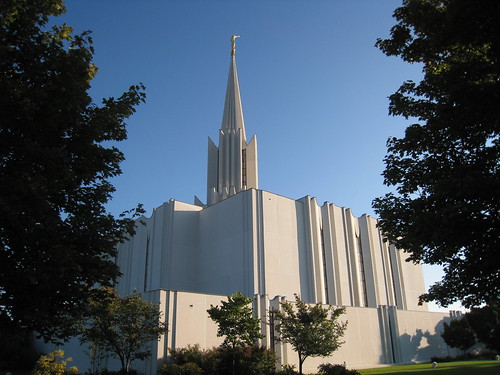
The Jordan River Utah Temple

Jordan River Utah Temple
Today I'd like to give some of my feelings about The Church of Jesus Christ of Latter-day Saints' Jordan River Utah Temple.  This temple was the first I ever attended.  I went there most often to do baptisms for the dead as a teenager.  I was also endowed in this temple, and witnessed the sealing ordinance for the first time there.  I currently live in the Jordan River Utah Temple district.  I also worked there as a temple worker shortly after my mission.  So I am familiar with the temple.

The Jordan River Utah Temple
The Jordan River Utah Temple was completed in 1981 and is in South Jordan Utah and West Jordan Utah (the temple is on the boundary between these two cities).   The temple land was donated to the church and the cost of the temple (and maintenance for many years) was entirely from member donations (outside of tithing).  This was unusual at the time.

The Exterior

Angel Moroni Statue
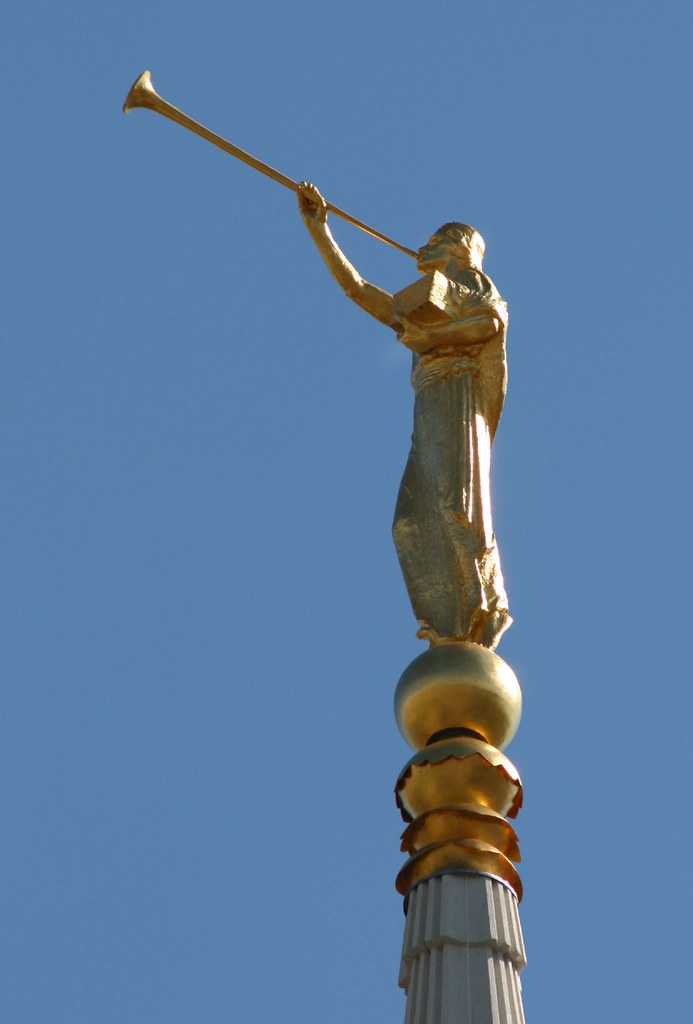
The Jordan River Temple is topped with a smaller replica of the Washington D.C. Temple Angel Moroni statue. This statue is one of the few that is depicted holding the golden plates that The Book of Mormon was translated from.

The architecture of this temple is a modern 1980s style. The exterior is made of white cast stone (precast concrete panels) with white marble chips.  These panels have a repeated inverted swoop theme which is also used as the main decorative motif in this temple.  These swoops (inverted parabolic arches?) are generally displayed in threes.

The temple tower is actually made of fiberglass which significantly reduces the weight on the structure below and reduces the mass of the building to reduce the seismic loads on the structure.  Despite being a different material, it blends perfectly with the cast stone.
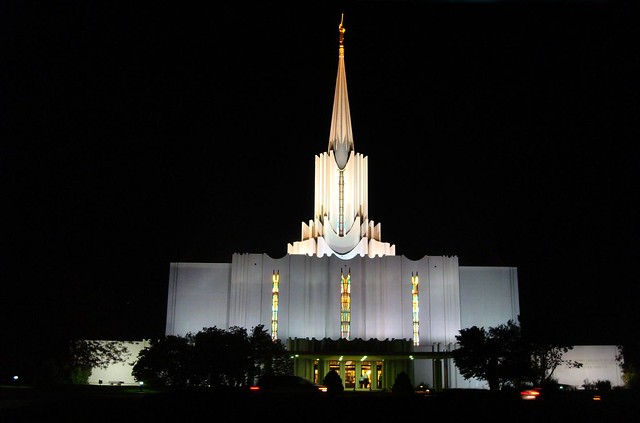
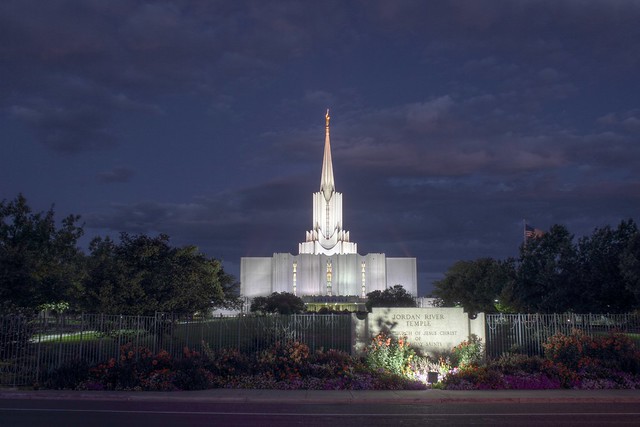
The Jordan River Utah Temple at night
The temple also has stained glass windows (abstract) that glow at night.  The windows are very colorful and are geometric patterns.  They are beautiful on the inside when the sun is shining through them in the right way.

The temple has a lot of symmetry, with each of the four sides being nearly identical.  This makes the temple approachable from all directions.

The exterior and interior of this temple is very light on symbolism with the Angel Moroni statue on the spire and oxen statues supporting the font being the only prominent symbols. 

The Interior

Jordan River Temple Font
The Jordan River Temple is the fourth largest in the church with 148,236 square feet of floor space.  The temple entrance is on the east side.  In between the first and second set of doors is a staircase leading down to the baptistry.  As you enter the baptistry there is a small chapel used so groups can have a short prayer and devotional before starting baptisms.  This was added in the late 1990s (at least I seem to remember them adding it around then).  There is also a larger chapel that faces the font (with glass in between).  The room has dark wood that I don't particularly care for, but was fashionable in the 1980s when the temple was built.  The baptistry gets very busy and it is not uncommon for a several hour wait to do work.  This is why Utah continues to get new temples even though it already has 13.  The baptismal font is very similar in style to the Provo and Ogden (original) temples.  There are mirrors on two sides of the room giving an eternity effect.  There is also a 1980s style simple chandelier above the font.  The confirmation rooms are very small and feel more like closets than ordinance rooms.  This is unfortunate, because they feel like afterthoughts and not rooms for ordinances.  I don't know if their size and lack of ornamentation is due to the space required for two chapels, but they are the most disappointing part of the baptistry.  Even so, this was the first temple I did baptisms for the dead at and I do like it.

The bottom floor of the temple also has worker training rooms and a cafeteria.  The cafeteria is good, although the smell of food does drift into the baptistry where it is distracting.

The first floor of the temple houses the temple offices, a lobby, and dressing rooms.  The lobby was redone sometime around 2005 with new lights, stone flooring, etc. and is really nice.  There is a huge painting of the Garden of Eden (essentially copied from the L.A. Temple garden room mural) on one wall.

The Jordan River Utah Temple is one of the few temples with escalators.  They aren't as bad as you might think.  While I would welcome actual stairs, the escalators work well, are fairly quiet, and provide good views of the stained glass windows.

The second floor contains the chapel and the sealing rooms.  The chapel has some dark wood, but not annoyingly so.  It has an electronic organ.  In front of the speakers are dark wood posts that give the feel of pipes (while clearly being just decorative).  These have the same swooping pattern found elsewhere on the temple.  They look really cool, but are hard to describe, so you'll just have to see them for yourself.

Sealing Room
The sealing rooms are fairly simple.  Most, if not all, have facing mirrors to give an eternity effect.  The chandeliers are a dignified classical style.  The altars are made of stone and different colors of stone are used in each room.  Several rooms (there are 17 sealing rooms total, only the St. George Utah Temple has more with 18) have exterior stained glass windows.  These are the sealing rooms used most often for living sealings.  If I recall correctly, one or two rooms have 2 stained glass windows and the others have one stained glass window.  These sealing rooms are on the north and south ends of the temple.


The endowment rooms and celestial rooms are on the third floor of the temple.  There are six endowment rooms and the Jordan River Temple is one of only 4 temples with this many endowment rooms.  I am fairly sure that the endowment rooms in the Jordan River Temple are larger than the other temples making this the temple with the highest capacity.  Even with sessions starting every 20 minutes, this temple is kept busy.  The endowment rooms are fairly simple.  Their walls have alternating vertical strips or wallpaper and wood paneling with brass swoops matching the swoops elsewhere in the temple.  The altars are made of stone and match those in the sealing rooms.  The rooms can seat around 125-150 (If I remember correctly) and feel very spacious.  They also have high ceilings.

Jordan River Temple Celestial Room
The Celestial Room is a modern 1980s style.  It is oval shaped with an oval dome.  There are numerous mirrors on the walls with brass lines matching the unique brass chandelier.  Both the chandelier and mirrors match the exterior architecture.  The chandelier is a little hard to describe, so hopefully the photo helps.  The room has glass vases, tables, and other modern elements that work nicely.  I like this celestial room.  If I was to add anything it would be some of the colorful stained glass that is on the exterior of the temple, but the room is fine without it.

The third floor hallways also contain nice artwork - mainly landscapes.  The halls also provide views of the stained glass windows.

Throughout the temple there are also specially sculpted doorknobs.  These are brass or bronze and have swoops and other shapes that echo the architecture and patterns common in this temple.  It is nice seeing custom handles to make the temple a special place.

The Jordan River Utah Temple is a great example of 1980s modern architecture in my opinion.  It has beautiful repeated patterns, clean lines, and great functionality.  It does lack much symbolism, but I suppose it is okay for a few temples to be this way.  I love this temple and am glad we have it.

One of the best parts of the Jordan River Temple has nothing to do with the architecture, but rather how it is run.  The temple (at least when I worked there) went to great efforts to make patrons feel comfortable.  It is always a friendly place and among the best in that regard.

Those are some of my thought on this temple.  Please comment and let us know what you think about this temple.

Sunday, May 8, 2011

Temple Materials - Precast Concrete

This post will start a series of posts that I intend to write from time to time about materials used in temples built by The Church of Jesus Christ of Latter-day Saints.  Oddly enough, instead of starting with stone or plaster (the earliest materials) I am starting with precast concrete (the most modern material in my opinion).

As an engineer, I respect concrete as a building material.  It is essentially a combination of coarse aggregate (stone chips, gravel, small rocks, etc.), fine aggregate (sand), water, various admixtures, and cement.  The Romans used concrete to make their wonderful structures such as the Pantheon, so it isn't really that modern.  The Romans had a recipe for cement which was lost until the 1800s.  When water is added to cement it causes a chemical reaction that binds the various other components of concrete together and gives strength.  This can make the completed product stronger than stone.
Concrete has the great compressive strength of stone with several major advantages.  Concrete can be poured and cast into the desired shape (even with patterns).  It also allows structures to be built without large pieces of stone.  Concrete is weak in tension, so weak that we neglect its tensile strength in design.  This is why it can crack.  Stone has the same problem and requires arches and other structural components to be used to keep the structure in compression.  You can reinforce concrete with steel (or other materials) and let the steel take the tension.  This creates a much better, stronger, and more versatile building material.
Precast concrete is used to save time (normally you must wait for lower levels of a structure to cure before adding higher levels).  Panels can be cast on or off site ahead of time and then added when needed.  Precasting concrete also allows for controlled conditions because things such as temperature and humidity have a huge impact on concrete curing and resulting strength.  Precast panels can also be prestressed, giving them even greater strength.  Intricate designs can be cast into precast panels and even stone finishes or other finishes can be added to precast panels.

Okay, so I've probably bored all the non-engineers out there, so I'll move on to the temples using precast concrete.  You might think it odd that a temple would use concrete.  Concrete can be an ugly material, or even just have an unfinished look not appropriate for a temple.  It can also be finely finished and make some of the most beautiful buildings in the world such as the Sydney Opera House or this Bahaii Temple.

So on to The Church of Jesus Christ of Latter-day Saints' temples with exposed precast concrete exteriors.  I was a little surprised that a few temples didn't make the list as they were actually stucco or plaster exteriors and not precast concrete.  Here is the chronological list I came up with after reviewing all the temples on ldschurchtemples.com :

Built
Ogden Utah Temple (original only - remodeled will have stone)
Provo Utah Temple
Tokyo Japan Temple
Seattle Washington Temple
Jordan River Utah Temple
Atlanta Georgia Temple
Mexico City Mexico Temple
Denver Colorado Temple
Las Vegas Nevada Temple
Toronto Ontario Canada Temple
Orlando Florida Temple
St. Louis Missouri Temple
Billings Montana Temple
Albuquerque New Mexico
Rexburg Idaho Temple
Twin Falls Idaho Temple
Gila Valley Arizona Temple
Under Construction:
Kansas City Kansas Temple
Brigham City Utah Temple


I don't think all of these work well, but the most recent are very nicely done.  I think that the "cast stone" version of concrete panels tends to just look like fake stone; whereas, the temples that fully embrace concrete as their material tend to look better.  Temples with detailed cast panels also tend to look better than those with flat panels.  The temples with my favorite uses of precast concrete are Jordan River, Mexico City, Rexburg, and Twin Falls.  Let me elaborate:

The Jordan River Utah Temple is very modern.  It uses inverted parabolic (hyperbolic?) arches as an architectural motif.  Using cast stone allows the temple to hold these details without prohibitive engraving costs.  White marble chips have been added to the concrete to give it the bright white color.  The spire is actually a type of fiberglass (you don't want to throw the weight of concrete that high up a building in Utah for seismic reasons).

The Mexico City Mexico Temple has intricate Mayan designs incorporated into the precast stone panels.  Unfortunately, due to the horrible pollution in Mexico City, the panels turned a nasty brown color.  Fortunately, the church recently replaced all the exterior panels with exact replicas.  I assume the replicas now how a special finish that makes dirt and pollution fall off (they can finish the concrete and make it do that now).  I also love how the Mexico City Temple incorporates local ancient architecture and uses modern precast concrete to make a temple in a successful fusion of old and new.  The temple won an award for its artistic use of precast concrete (see ldschurchtemples.com)

The Rexburg Idaho Temple refreshingly uses precast concrete.  According to ldschurchtemples.com,
The exterior walls of the Rexburg Idaho Temple are made of 637 precast panels from 45 different molds, including the retaining wall. The material is called China White—a white quartz finish (mined in Washington state) on concrete panels. A water-proofing compound allows dust to wash off in the rain, keeping the temple a radiant white.
I also love the art deco influences (I'm a huge art deco fan).  I love how columns and pilasters resemble wheat (wheat is used throughout the temple stained glass, carpets, stair railings, wall designs, etc.).  I think the concrete works because it is finely finished, detailed, and kept immaculate.

The Twin Falls Idaho Temple was built at the same time as the Rexburg Temple and shares many similar features.  I must state that I don't think it is as well proportioned as Rexburg or in general design; however, I like the temple and loved attending it (the inside is very well executed with the exception of ductwork making the terrestrial room windows fake).  The precast panels are the biggest strength of the exterior and are well done.  They incorporate a waterfall theme.  The panels have a nice white quartz finish.  I think the panels are the same concrete used in the Rexburg Temple.

Other notable precast concrete temples are:
The Las Vegas Nevada Temple with desert lilies, sun, moon, and earth "stones" cast into the concrete.
The Denver Colorado Temple's modern designs cast in concrete.
The Albuquerque New Mexico Temple with its use of sun and moon "stones" made of precast concrete.
The Seattle Washington Temple has shafts of wheat cast into the panels.

I also like that several new temples will use precast concrete.  The Kansas City Temple is already sheathed in its precast panels and will have a sleek look.  Some nice details have been cast between windows.  The Brigham City Temple will also use precast concrete panels, despite being heavily influenced by stone pioneer temples.  I like the design and think it will be more interesting in person than in the rendering.

I used to think that using concrete was somehow being cheap.  When nicely done, it is not cheap.  In fact, a major reason that precast concrete isn't used for temple exteriors in many parts of the world is that the countries don't have the skill, technology, or quality control to produce the panels.  They are advanced and a very good building material.  In many temples they have been a beautiful building material as well.

Please comment and let us know what you think about precast concrete as a temple building material.

Saturday, April 9, 2011

Latter-day Saint Temple Murals - Pt 5 - Miscellaneous Murals

This is a continuation of my posts on Latter-day Saint Temple murals.  You can read the earlier posts by clicking on the links below:
Part 1, Part 2, Part 3, Part 4, Celestial Room Murals

After the LA Temple was completed, the endowment began to be presented on film, eliminating the need for murals in endowment rooms.  Because of this, murals stopped being used in endowment rooms until the 2000s.  Even so, between the 1950s and the early 2000s, a few temple murals were included.  These tended to be in hallways or lobbies.  Here is the list I was able to come up with:

The Washington D.C. Temple
Washington D.C. Temple Mural of the Second Coming of Jesus
The main lobby of this temple has a 30 foot long mural of the second coming of Jesus Christ.  The painting is probably familiar to you if you are a member of The Church of Jesus Christ of Latter-day Saints.  It shows Christ coming and welcoming the righteous (living and newly resurrected dead people are portrayed) on his right hand, while the wicked despair and hide on his left hand side.  The Washington D.C. Temple is also painted into the mural.

The Jordan River Utah Temple
In the main lobby of the Jordan River Temple there is a mural of the Garden of Eden based on the LA Temple garden room mural.  You can see the LA Temple garden room mural in part 4 of my temple murals posts.


The Mexico City Mexico Temple
Mexico City Temple Lobby with Mural of Jesus Christ in 3 Nephi 11
This temple has a print of a famous painting of Jesus Christ coming to teach the Nephites in the Americas after his resurrection as recorded in 3 Nephi 11 in The Book of Mormon.  The print is in the main lobby.

The Ogden Utah Temple
This temple had a mural of Jesus Christ and some apostles on the Mount of Transfiguration.  I'm not sure if it was a print or an original, but it was large and striking in the main lobby.  I hope it is kept in the temple after the current remodel is completed.  This mural was also effective because the Mount of Transfiguration has been linked to the temple and multiple people (prophets and apostles) have said that this is likely where Peter, James, and John received their endowments.

Salt Lake Temple Annex
The new (added in 1960s) Salt Lake Temple Annex includes a chapel with murals on both the front and rear of the room.

The Bountiful Utah Temple
Bountiful Utah Temple Chapel
The chapel in this temple includes a print of part of a painting of Jesus Christ's second coming.  This is technically a mural as the room is planned around the piece and the piece is permanently applied to the wall.


The Vernal Utah Temple
Vernal Utah Temple Celestial Room
The same painting of Jesus Christ's Second Coming is used as a mural in the Vernal Utah Temple Celestial Room.


Baptistery Murals
There are many temple that have baptistery murals, but I am going to cover those not already covered in a separate post.

There is my list of miscellaneous Latter-day Saint Temple Murals from 1960 to 2000.  Surely I have missed some.  Please comment and let us know what you think, tell us of other murals I didn't know about, and discuss murals you would like to see.  While I am thrilled that temples have begun using endowment room murals again, I also like seeing these murals in various places in the temple.  I love how each temple is different, with random murals adding interesting variety.  Please Comment

Monday, January 11, 2010

Temple Baptisteries

My brother and I have been going to a lot of different temples to do baptisms for the dead recently. I want to discuss some of my feelings about their architecture.

Ogden, Provo, Jordan River and Logan have essentially the same design with a chapel overlooking the font and confirmation rooms on the left hand side. I think Ogden and Provo work best, probably due to the obvious addition of stone tile flooring, light wallpaper, geometric ceiling designs and in the case of Provo small crystal chandeliers and sconces in the confirmation rooms. Jordan River has a lot of potential, although it is a bit dark due to off-white wallpaper and dark woodwork which I think could be redone while preserving the original architecture. Also, the confirmation rooms are cramped and feel like closets which isn't very fitting for a room set apart for an important ordinance. As for Logan, the baptistery has natural light but is essentially a clone of the other temples, including the font. I think this is a shame as we have the original temple font in the Church Museum of History and Art so I don't know why it isn't placed in the temple.

The Bountiful and Mount Timpanogos temples both have nice baptisteries. I prefer Bountiful but that is due to my tastes. I like that in these baptisteries there are two semicircular rows of pews on top of the oxen immediately next to the font.

The Salt Lake Temple baptistery has a wonderful font. The confirmation rooms are small and out of the way which is a downside. Also the entrance is hidden and the tunnels leading into the baptistery have a 60s or 70s feel. Still, I like this baptistery.

Utah's two newest temples, Draper and Oquirrh Mountain have wonderful baptisteries. Draper has stained glass behind the font letting light flood in. The confirmation rooms have glass doors making the rooms for this ordinance seem important and not an afterthought. Oquirrh Mountian has the best baptistery as a whole in my opinion. There the chapel has glass on all 4 sides. The front overlooks the font (with glass on 3 sides) and behind are the confirmation rooms with glass doors and wall. This allows the confirmations to be seen from the font and chapel and definitely makes the rooms for this ordinance important.

In general I liked tiled baptisteries better than carpeted ones because carpet (especially in locker rooms) tends to mildew causing a bad smell.

I love the variety in temple baptismal fonts listed here and others I have seen and hope to see many more.