Showing posts with label Washington D.C. Temple. Show all posts

Saturday, November 5, 2011

The Washington D.C. Temple of The Church of Jesus Christ of Latter-day Saints

I love the Washington D.C. Temple.  I have been inside once and outside two other times.

The Washington D.C. Temple (actually in Maryland, right next to the Capitol Beltway) is a huge temple.  It is 288 ft tall, taller than the Salt Lake Temple.  It is the third largest temple by square footage, but I believe it is the largest in overall dimensions (100 ft wide by 247 feet long by 288 ft tall).  The temple sits on a heavily wooded site, but due to its size, it is noticeable from all around and very prominently seen from the freeway.  It looks even bigger in person.
The Washington D.C. Temple
The exterior architecture of the Washington D.C. Temple is based on the Salt Lake Temple.  It has 6 spires (and was the first temple since Salt Lake to have six).  The three spires on the east side represent the Melchizedek Priesthood and presidencies in it (in particular a stake presidency or the first presidency).  The western three spires represent the Aaronic Priesthood and a bishopric or the presiding bishopric.  On this temple, all six spires are at different elevations, which gives the temple a slightly different look as you walk around it.  The top of the towers have gold leafed spires with pointed arches in them.  Pointed arches are used throughout the temple.


The Washington D.C. Temple also has a unique Angel Moroni Statue (added when only the Salt Lake and LA Temples had one).  This Angel Moroni statue is holding a representation of the gold plates that The Book of Mormon was translated from (and is one of the few that do).  If you want to see this statue, but can't get to D.C., the Jordan River Utah Temple, Seattle Washington Temple, and Mexico City Mexico Temple each are topped with replicas of the Washington D.C. Angel Moroni statue.  The original was sculpted by Avard Fairbanks and is an 18 ft tall bronze sculpture covered in gold leaf.  The replicas are 15 ft.

The doors of the Washington D.C. Temple are also very ornate.  I've discussed them before on this blog.  You can read about them here.  They incorporate many of the symbols on the Salt Lake Temple.  I also intend to update that post with more pictures of the doors, so you may want to look at it again.  There are ornate doors on the southeast and northeast sides of the temple and slightly different doors on the main entry on the north.
Washington D.C. Temple northeast doors
Washington D.C. Temple main entry doors

The Washington D.C. Temple is not just a copy of the Salt Lake Temple.  It was completed in 1974 and has a lot of 60s and 70s architecture (in a good way).  It is very modern and sleek.  The temple is made of reinforced concrete covered in white marble.  You might think that it doesn't have windows.  It actually has two types of windows.  On the east and west sides there is a stained glass window going continuous from the first to seventh floors.  This is striking at night when the temple is viewed from the outside.  On the inside, the center towers are open center staircases with these windows along one corner.  The other windows in this temple are stone windows.  Some of the white marble was cut thin enough to be translucent and provides light to the interior.  Numerous vertical ribs draw the eye upward and exaggerate the height of the already tall building.  They also add to the sleek look of the temple and cast small shadows that constantly change the way that the temple looks as the sun moves.

The Interior
You enter the Washington D.C. Temple on the north.  The entrance is actually in an annex.  Behind the recommend desk there is stained glass similar to that found on the east and west center towers.  Then there is a nice lobby on a bridge leading to the temple proper.  The glass is clear here so you can see the trees and the temple.  Even more importantly, you can a very large (30 ft long) original painting of the second coming of Jesus Christ painted for this temple.  I've seen prints of this painting many times before.  It shows the righteous on the right hand of Jesus, welcoming him in joy and the wicked on the left hand side hiding from him.  In the upper corner on the left side of the painting (right hand of Christ) is the Washington D.C. Temple.  Prints of this painting are nice, but experiencing it in person is even better.  As you approach it you are walking straight towards Christ, and because you are on a bridge, at first you cannot see the whole painting.  All that you can see is Christ and the righteous.  It feels like you are coming to join Christ in joy as you approach the temple (which you can see through the clear windows of the bridge).  When you get fully into the temple proper, you can see the entire painting including the wicked, which makes you want to help them.  I don't know if the artist intended the painting to be displayed this way, but it is effective and powerful.  Intended or not, how the painting is displayed magnifies its effect.  The painting is in a room with a lot of dark walnut woodwork which, although not in style right now, looks really good.  This is the second floor of the temple.  Most of the floor is a lobby with this painting.  The floor also holds a chapel and temple offices.
Washington D.C. Temple annex bridge
Washington D.C. Temple mural of the second coming of Jesus Christ
You can go up or down floors either by using one of the staircases on either end of the temple, or by taking one of four elevators (two on each end).  There are also four other staircases in the smaller towers, but I didn't see them.  The east and west end staircases are square in shape with an open center.  There is a fountain on the first floor level of each that can be seen and heard from all 7 floors of the temple.  The views from any floor of these two staircases are impressive looking up or down, especially since you can view 7 floors of colorful stained glass window.  The stained glass window is W shaped and has chipped glass so that more light is refracted into the temple.  The August 1974 Ensign states:

The colors near the ground are rich and vibrant - reds and oranges- but as they rise, they give way to clearer tones: blue, violet, and finally white.  According to Brother Henry Fetzer, the change in colors is symbolic of the purity and clarity that enters a person's life as he leaves earthly concerns and aspires toward heavenly matters.  The unbroken line of window rising continuously to the top of the temple is a reminder of the unbroken progress that is possible in the gospel.
Progression is also shown in the temple color scheme elsewhere.  The Ensign also states:
The interior colors also change.  Walnut paneling and deep blue give way to more and more white, with accents of gold.  The celestial room, with white walls and a white ceiling, is carpeted in a very pale apricot gold.  Plants provide the only other colors.

Many doors in this temple have door handles with a stylized version of the three towers on each side of the temple on them.  I like seeing custom door handles.  It is a nice touch.

The first floor used to have a cafeteria, but now it only has some vending machines.  You can get to the baptistry from here (down one floor in the basement and sub-basement) although I suspect that there is a separate baptistry entrance somewhere.  I liked the baptistry.  Originally it had nice blue carpet, but now it has been redone with golds and greens and stone (I assume faux) that looks really good.  I liked the original (first photo) and would have kept it, but the new finishes (second photo) are really nice so it is hard to complain much.
Washington D.C. Temple Baptismal Font
The third floor of the temple contains the clothing rental, dressing rooms, and brides' rooms.  A hallway runs from east to west connecting the main staircases.  The dressing rooms haven't been updated since the 70s (as the particular shade of blue lockers showed) and show some wear, but I suspect the lockers will be replaced soon enough.  This floor is mainly powder pink, as is most of the temple.

The fourth floor contains the endowment rooms and celestial room.  There are six endowment rooms around a centrally located celestial room.  There are only 3 other temples in the world with that many endowment rooms - Ogden Utah, Provo Utah, and Jordan River Utah.  The Washington D.C. Temple used to need that many rooms when it was the only temple for the eastern U.S. and Canada.  Now sessions run once an hour, but my middle of the day session had enough people to do the ordinances.  The endowment rooms are simple.  The back of the rooms have a lot of vertical lines which somewhat tie the room into the exterior architecture.  There also appeared to be a few translucent stone windows along the top of the back of the room.  The seating doesn't have a central aisle which is highly unusual for a Latter-day Saint temple.  Men and women still sit on opposite sides of the room, but it is possible to sit next to someone of the opposite gender.  The white marble altar in the front has pointed arches cut into it.  Pointed arches are repeated throughout the temple. 
Washington D.C. Temple Endowment Room
The centrally located Celestial Room is quite large.  It takes up the center of the fourth floor and the middle of the fifth floor.  The room is oval shaped.  It doesn't have a central chandelier.  Instead it has 12 classic chandeliers around the perimeter of the room between 12 columns.  The square columns are uniquely shaped with their tops flaring into a modern version of a capital and forming pointed arches in the process.  They are done in marble (faux?) with gold ornamentation.  Mirrors surround the room.  As you walk in, you see several reflections of yourself due to the curved walls.  The carpet is intricately sculpted and the furniture feels elegant and fitting for Washington while not out of place with the modern elements.  The top has a dome with clouds in a blue sky painted on it.  You can see a better photo of this photo here.

Washington D.C. Temple Celestial Room
The fifth floor of the temple is not open because it just houses mechanical units (heating, etc.) and the upper portion of the celestial room takes up some of the space.

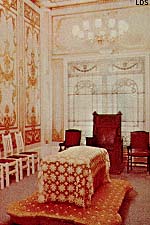
The sixth floor of the Washington D.C. Temple has the sealing rooms and sealing office.  I particularly like the oval sealing rooms (first photo) which have been redone, but still look really good.  The rectangular sealing rooms are also nice.  The altars are all white marble with pointed arches carved in.
Washington D.C. Temple Sealing Room
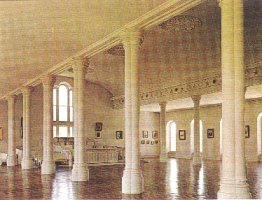
The seventh floor of the temple is a large priesthood assembly room.  Few temples have such rooms, and you can read about them in my post here.  The Washington D.C. Temple's pulpits (there are 24 in the room) mimic the style of the Salt Lake Temple pulpits.  Pointed arches appear on the backs of the stands in the solemn assembly room.
Washington D.C. Temple Priesthood Assembly Hall
The August 1974 Ensign magazine has numerous construction photos of the Washington D.C. Temple, as well as a section of the temple on pg. 12 and a plan of the sixth floor on page 18.  There are also numerous architectural sketches and a lot of explanation about the temple.  If you don't have that issue of the Ensign laying around, you can find it at the Church History Library when you are in Salt Lake.

I loved visiting this temple.  It is so grand, unique, symbolic, modern, and beautiful.  It truly is very good architecture and a wonderfully done temple.

I'd like to hear what you think about this temple, or anything that you might have to add, so please add you comments on this article below.

Saturday, May 14, 2011

Temple Symbols - Ursa Major (The Big Dipper) and Polaris

Temples built by The Church of Jesus Christ of Latter-day Saints contain many symbols. The constellation Ursa Major (The Big Dipper) is carved onto the Salt Lake Temple's west central tower.  This symbol has a lot of meaning and is used in a few other temples.  I'd like to highlight the symbol's meaning and how and where it is used.

The first temple to have this symbol was the Salt Lake Temple.  The west central tower lacks windows on the top story allowing for the big dipper sculpture.  While there are other stars depicted on the temple, this sculpture uses them differently.  The stars are six sided instead of the other stars which are five sided.  They are also arranged in a group.  On the Salt Lake Temple the big dipper stars point towards the actual north star.

The big dipper's symbolism can be understood in several ways.
1. The big dipper points to the north star, Polaris, the only star that doesn't move during the night.  As the big dipper is used to find the north star, the temple is used to help us find God who doesn't change.
2. As the big dipper helps us find our way, the temple guides us through life and to eternity.
3. The symbol can represent progression if used in conjunction with other temple symbols.  The temple lowest stones are the earth stones (originally to show the earth rotating through hours of a day).  The next stones are moon stones going through phases which can represent days and months.  Next up are the sun stones.  The sun goes through seasons so it could represent seasons and years.  The big dipper sculpture is higher on the temple and hints at Polaris, the star that doesn't change.  It represents infinity, eternity.  So as we go up we get hours, days, months, years, and finally eternity.  As we progress in the temple we approach the infinite and eternal.
4. The eternity symbolism can also represent going from a temporal, mortal state to an eternal, immortal, resurrected state.
5. The big dipper as a guiding constellation can be seen as a symbol for the Holy Ghost which guides us through life.
The next temple (I know of) to display the big dipper is the Washington D.C. Temple.  This temple is a stylized version of the Salt Lake Temple.  The symbolic sculptures from the Salt Lake Temple were depicted in the detailed doors of the Washington D.C. Temple.  Among the panels is one on the bottom right corner showing the big dipper and the north star (over the Seal of Melchizedek).  Because this temple also depicts the north star, it hints that the symbol is supposed to be understood with the north star.  I'm glad they added this symbolism to the Washington D.C. Temple.

The Anchorage Alaska Temple also contains the big dipper symbol.  The Alaska state flag is just the big dipper and north star.  So including the big dipper symbol from the Salt Lake Temple was one way to make this temple fit in locally.  The stars are eight sided on this temple and are carved into the stone rather than projecting out of it.  You can see the big dipper and north star carvings in this photo.  You will need to look closely.  The north star is on the left top and is larger than the other stars.  The next star is a little more than half way down the wall on the other side of the first window.  It may take you a minute, but you can find all the stars.  The last two are at the top of the wall with one between the last two windows and the other to the right of the last window.  I think the carvings are on the celestial room wall, but I may be wrong.

The Winter Quarters Nebraska Temple also includes the big dipper and north star (see this Church News article).  They are in the stained glass in one of the dressing rooms and are positioned as they would have been on April 6, 1830, the day The Church of Jesus Christ of Latter-day Saints was organized.  Here is a photo showing stars, although I don't think this is the big dipper one (it has too few stars).

I don't know of any other temples that have used the big dipper symbol.  If you know of any others please comment.  Comment also and let us know what you think of this symbol and how it is used on temples.  I am glad that the church has used this symbol on more than just the Salt Lake Temple.  I hope it continues to be used from time to time.

Tuesday, April 12, 2011

Metal Clad Temple Towers, Domes, and Spires

The Church of Jesus Christ of Latter-day Saints' temple towers, spires, and domes have occasionally been clad in metal.  I want to talk a little about these.

Many historic Christian churches have metal clad spires.  Lead, Aluminum, Copper, Gold, and other metals have been used throughout history.  The metals serve a practical function of protecting the spire as they weather well.  Placing metals on churches was also a a way to make the church extra special, as many of the metals were hard to come by.


Orig. 1884 Salt Lake Temple Spire Sections
Truman Angel Sr.'s 1884 plans for the Salt Lake Temple had metal sheathed spires.  So the slanted portions of all six towers would have been covered in metal.  In 1887, Truman Angel Jr. changed the design to have the granite spires that the temple has today. (See Salt Lake Temple: A Monument to a People)  Today, the only metal on the spires are five copper finials and the gold leaf covered Angel Moroni statue.


The London England Temple has a metal spire.  You can see a photo here.  The spire is the most detailed portion of the temple's exterior and I like it.  I also served my mission in London so I'm biased.  According to ldschurchtemples.com
The original design of the London England Temple called for a spire of perforated aluminum, similar in appearance to the spires of the Oakland California Temple. The perforations were later removed from the design, however, in favor of a solid sheath of lead-coated copper.
The Oakland California Temple has five perforated gold colored spires.  They are apparently not metal, but rather reinforced concrete that is painted to look like metal.  I've read that the oriental look of the spires is not a coincidence, but rather was used because of the large number of Asian Americans in California and particularly the Bay Area.  You can see pictures of the spires here and here and here.  I love their complexity.  I also love how the lattice structure lets the spires glow.

The Ogden and Provo Temples were the next to have metal spires.  Theirs were originally an orange gold color seen here and here. They were meant to represent the pillar of fire by night that led the Israelites from Egypt.  The upper floors of the temple just below the spire was supposed to represent the cloud that led the Israelites by day.  This is neat symbolism with, in my opinion, horrible execution.  The temples ended up resembling rocket ships, birthday cakes, and other unintended things.  In the 2000s each temple had a statue of the Angel Moroni added (which was actually in the original plans, so we shouldn't think that destroyed the architectural vision of these temples).  At the same time, the spires were painted white, covering the original metal.

Next, the Washington D.C. Temple was built with 6 pointy metal spires.  Their length makes this temple the tallest temple.  The spires are made of steel overlaid with gold leaf.  Each spire has a lot more detail than you usually notice.

The Sao Paulo Brazil Temple was the next temple with a metal spire.  Originally the temple lacked an Angel Moroni statue, but made up for this with a detailed spire.

I think the Tokyo Japan Temple spire is metal.  The Stockholm Sweden Temple and Frankfurt Germany Temple also used metal on their spires.  Many have since used some metal in the spires.

The Houston Texas Temple uses a lot of copper to cover its prominent spire. I really like the style of this temple and feel that the weathered copper gives the modern classical architecture a dignified, mature look.

The Boston Massachusetts Temple was originally completed without a tower due to a lawsuit.  A few months after its dedication, a tower clad in metal was added to the temple.  I like the design.  It is modern, yet fits in with the New England architecture, partially due to the metal spire.

The Helsinki Finland Temple features a metal spire for the tower and a metal dome over the celestial room.

Orig. Oquirrh Mountain Temple Plan With a Copper Spire
The original plans for the Oquirrh Mountain Temple included a copper clad spire.  This would have been nice as Kennecott Copper donated the land for the temple and the Oquirrh Mountains have the largest copper mine (and largest open pit mine) in the world.  The final design has a stone clad tower.


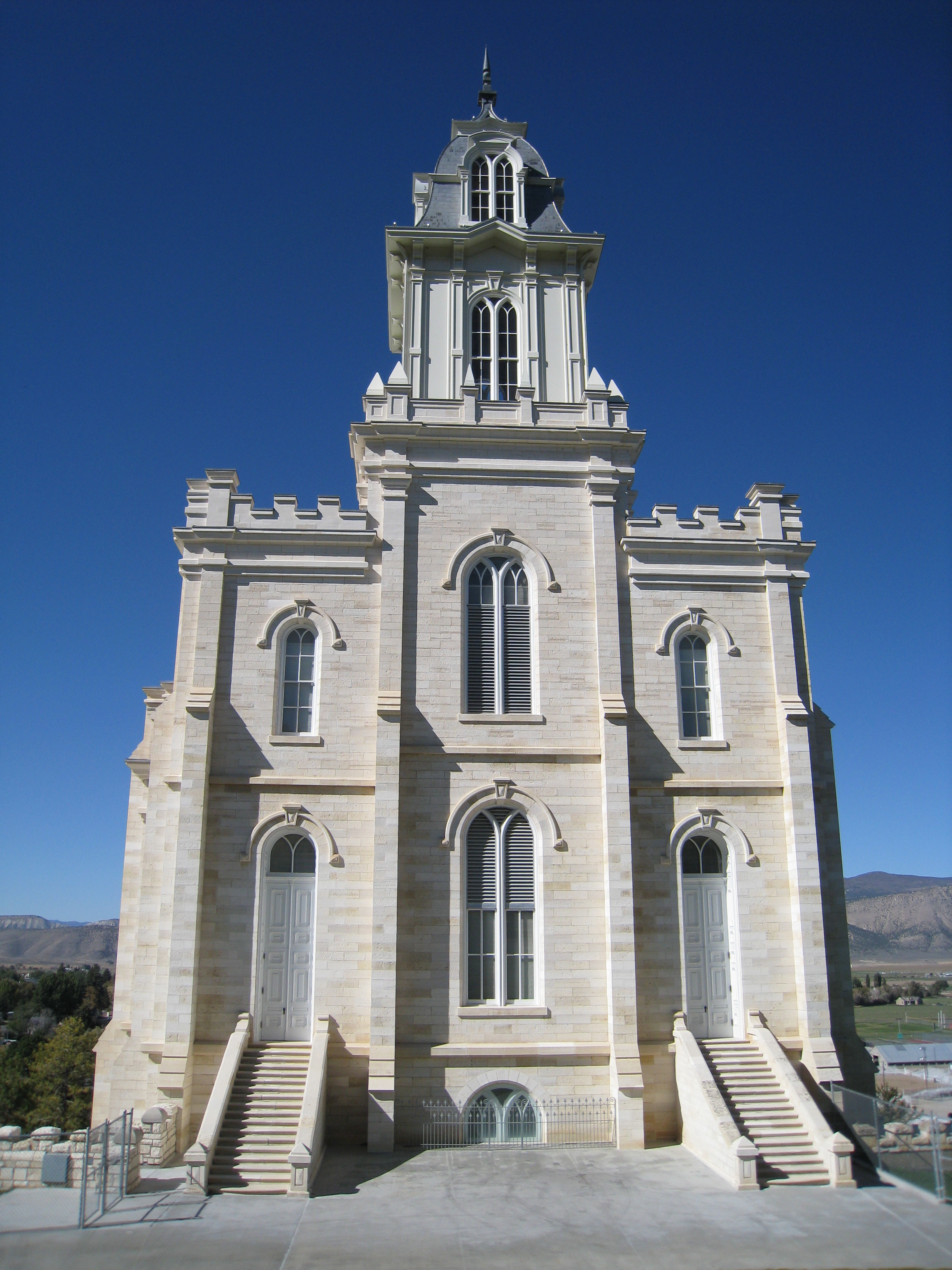
A few temples have metal domes.  The Nauvoo Illinois Temple has a metal tower dome.  I think the Manti Temple towers are clad in metal, but they may use shingles. The Vernal Utah Temple has two copper domes.  The Newport Beach California also has two copper domes, one on the tower, the other above the celestial room.

Other temples have some metal cladding.  The Cochabamba Bolivia Temple was metal on top of its central and 4 side towers.  The Las Vegas Nevada Temple has a copper roof.  Other temples have metal used here and there.

I like metal spires, towers, and domes on temples.  They haven't been used as often as stone or fiberglass or painted spires.  That makes them unique and interesting.  Metal brings a certain dignity to these temples.  There are a wide variety of uses with numerous metals to choose from.  Different styles can and have been used such as perforating the metal, adding etchings, adding a textured pattern, using a smooth metal surface, using several metals, etc.  Metals can retain an untarnished glory or be allowed to develop a dignified patina.  The possibilities are great and so I expect to continue seeing metal temple spires, domes, and towers.  That is a good thing.

Please comment and let us know what you think.

Saturday, April 9, 2011

Latter-day Saint Temple Murals - Pt 5 - Miscellaneous Murals

This is a continuation of my posts on Latter-day Saint Temple murals.  You can read the earlier posts by clicking on the links below:
Part 1, Part 2, Part 3, Part 4, Celestial Room Murals

After the LA Temple was completed, the endowment began to be presented on film, eliminating the need for murals in endowment rooms.  Because of this, murals stopped being used in endowment rooms until the 2000s.  Even so, between the 1950s and the early 2000s, a few temple murals were included.  These tended to be in hallways or lobbies.  Here is the list I was able to come up with:

The Washington D.C. Temple
Washington D.C. Temple Mural of the Second Coming of Jesus
The main lobby of this temple has a 30 foot long mural of the second coming of Jesus Christ.  The painting is probably familiar to you if you are a member of The Church of Jesus Christ of Latter-day Saints.  It shows Christ coming and welcoming the righteous (living and newly resurrected dead people are portrayed) on his right hand, while the wicked despair and hide on his left hand side.  The Washington D.C. Temple is also painted into the mural.

The Jordan River Utah Temple
In the main lobby of the Jordan River Temple there is a mural of the Garden of Eden based on the LA Temple garden room mural.  You can see the LA Temple garden room mural in part 4 of my temple murals posts.


The Mexico City Mexico Temple
Mexico City Temple Lobby with Mural of Jesus Christ in 3 Nephi 11
This temple has a print of a famous painting of Jesus Christ coming to teach the Nephites in the Americas after his resurrection as recorded in 3 Nephi 11 in The Book of Mormon.  The print is in the main lobby.

The Ogden Utah Temple
This temple had a mural of Jesus Christ and some apostles on the Mount of Transfiguration.  I'm not sure if it was a print or an original, but it was large and striking in the main lobby.  I hope it is kept in the temple after the current remodel is completed.  This mural was also effective because the Mount of Transfiguration has been linked to the temple and multiple people (prophets and apostles) have said that this is likely where Peter, James, and John received their endowments.

Salt Lake Temple Annex
The new (added in 1960s) Salt Lake Temple Annex includes a chapel with murals on both the front and rear of the room.

The Bountiful Utah Temple
Bountiful Utah Temple Chapel
The chapel in this temple includes a print of part of a painting of Jesus Christ's second coming.  This is technically a mural as the room is planned around the piece and the piece is permanently applied to the wall.


The Vernal Utah Temple
Vernal Utah Temple Celestial Room
The same painting of Jesus Christ's Second Coming is used as a mural in the Vernal Utah Temple Celestial Room.


Baptistery Murals
There are many temple that have baptistery murals, but I am going to cover those not already covered in a separate post.

There is my list of miscellaneous Latter-day Saint Temple Murals from 1960 to 2000.  Surely I have missed some.  Please comment and let us know what you think, tell us of other murals I didn't know about, and discuss murals you would like to see.  While I am thrilled that temples have begun using endowment room murals again, I also like seeing these murals in various places in the temple.  I love how each temple is different, with random murals adding interesting variety.  Please Comment

Sunday, February 13, 2011

Unique Sealing Rooms

Today I'm just going to show some pictures and short commentary about what I consider are the most unique or interesting sealing rooms in Temples of The Church of Jesus Christ of Latter-day Saints.  These rooms are used for temple marriages where a man and woman are married for time and all eternity and where children can be sealed to them for eternity.

The pioneer temple sealing rooms:

The St. George Utah Temple has a number of unique sealing rooms.  One is up a small staircase in the celestial room (in the tower).  Most of the sealing rooms are on an upper floor and have a single round window going into each room.  To me, the round window just makes the room feel unique.

Orig. Logan Temple Sealing Rm
The original Logan Utah Temple interior had a sealing room (shown to the left) with gold leafed walls and a stained glass window.  It is extremely unfortunate that when the temple was remodeled the room and wall covering was lost.  I think the gold leaf was lost because it was applied to plaster walls and so it couldn't be removed and brought to the new temple (I know that is what happened to at least most of the Logan Temple murals).


Manti Temple Sealing Room
The Manti Utah Temple has many wonderful ornate sealing rooms.  My favorite is a small one off the celestial room (that isn't used any more).  I've been told that this room was the Holy of Holies until the Salt Lake Temple was completed.  Then it was a sealing room for decades.  Apparently President Hinckley wanted to preserve the room and thought it was extra special so he had the room stop being used for sealings.  This could be a rumor, although I think it was a sealer that told me this.  The room is beautiful with an arched ceiling and intricate gold patterns and detailed woodwork.  The door is left open, but roped off so you can see it but not go all the way in now.  It is also very small, with maybe room for 5 or 10 people to witness the sealing.

Salt Lake Temple SE Sealing Room
Salt Lake Temple SW Sealing Room
The Salt Lake Temple has many nice sealing rooms.  Originally it just had 3 sealing rooms.  Two were on either side of the Holy of Holies, just off the celestial room.  The last was up a small staircase on the east side of the celestial room.  The intricate craftsmanship in these rooms is wonderful to see.  The sealing rooms flanking the Holy of Holies have stained glass windows.  Still, my favorite of the three is at the top of the stairs off the celestial room, in the east center tower of the temple.  I love that the staircase leading to this room has a cupid statue on the bottom rail post.  This is a fitting symbol for the room where a man and a woman are married for time and all eternity.  These rooms definitely are unique.

The dark wood sealing rooms:

Cardston Alberta Temple Sealing Room
The Cardston Alberta Canada Temple is the first temple I know of with dark wood sealing rooms.  This temple used extensive woodwork with intricate inlays using woods imported from around the world.  As you progress in the temple the wood becomes more expensive, lush, an more intricately inlaid.  This means that the celestial room is covered in really nice dark woods.  The sealing rooms also end up dark with really involved inlays. I like this.  It is so different from the usual white sealing room, while still being nice.
Cardston Alberta Temple Sealing Room
I know of only one other temple with dark woodwork in the sealing rooms.  This is the Oakland California Temple.  At least one (although not all) of the Oakland Temple sealing rooms is done in dark wood as seen in the picture below.  I like the dark wood and think it would contrast nicely with the white clothing worn in the temple.  I also like how here the altar glows in a bright contrast to the darker walls.
Oakland California Temple Sealing Room
I have not been in any of the dark wood sealing rooms.  If any of you have, please comment and tell us what they are like and what you think of them.  Also, if you know of any dark wood sealing rooms that I haven't mentioned, please write and let us know about them.

San Antonio Texas Temple Tree of Life Sealing Room

I was going to write about barrel vaulted ceiling rooms, which would also include the Las Vegas Nevada Temple sealing rooms, but I decided to just focus on the best of the group.  The San Antonio Texas Temple sealing room with a stained glass window of the tree of life is inspiring.  The brightness and whiteness of the room seems to be enhanced by the colors of the tree of life window.  Utah artist Tom Holdman did the stained glass windows for the entire temple and did a wonderful job in my opinion.


Washington D.C. Temple Oval Sealing Room
Washington D.C. Temple Sealing Room
Since I am talking about unique sealing rooms I have to mention this sealing room in the Washington D.C. Temple.  I love the oval shape of the room, the metallic wall covering (wall paper or metallic paint or something) that makes the walls shine.  I also find the oval altar interesting.
Washington D.C. Temple Sealing Room (another view)
So that is my list of the most unique sealing rooms.  There are so many more nice sealing rooms that you can tell us about in the comments.  I'll leave you with a picture of one of the Hong Kong China Temple sealing rooms.  I like it mainly because it has elliptical windows, which is just cool.

Friday, November 26, 2010

Latter-day Saint Temple Earth Stones and other Earth Representations

In my last post I mentioned "earth stones" and received a comment from Jon saying that he hadn't heard of them.  This really shouldn't have surprised me as they are somewhat obscure.  In any event, the comment prompted me to write about earth stones.

The Salt Lake Temple as currently built has moon stones and sun stones at two different levels of the buttresses around the building.  Originally it was also planned to have earth stones on the bottom level of the buttresses, just above the ground.  These were planned to have continents carved.  Each stone would show the earth rotated slightly so the stones would be going through the hours of a day.  Symbolically these stones would represent:
1. The current telestial earth (with the moon and sun stones representing the terrestrial and celestial kingdoms of God respectively)
2. Time (hours and days).  These show a progression to eternity.  Reading symbols going up the temple you get:
     earth stones = days and hours
     moon stones = days and months
     sun stones = days and seasons and years
     star stones = seasons and years (certain constellations come up at different times of the year)
     star stones representing planets = years - planets move in patterns taking years
     Saturn stones (originally planned) = years
     North Star (Implied by big dipper) = Eternity
3. Earth as the celestial kingdom of God.
There are probably other interpretations such as the gospel going to all the world, or creation.

When it was decided to make the Salt Lake Temple out of granite it became impossible to add the desired details to the earth stones.  They are still on the Salt Lake Temple, but they are blank spheres seen here.

When the Washington D.C. Temple was built the church added earth medallions on the doors.  This is the first time I am aware of that earth stones with actual details of continents appeared on a temple.

The only other temple I am aware of with earth stones is the Edmonton Alberta Canada Temple.  It has earth stones on the outer gate wall complete with continents.


I should recognize that other temples have circles in squares at their bases which could be considered blank earth stones like those on the Salt Lake Temple; however, I don't know that any of those are actually intending to be earth stones.

Thursday, November 25, 2010

The Washington D.C. Temple Doors

Temple doors tend to be nice, but a few excel.  For instance, the Salt Lake Temple doors are more ornate than most and include symbols.  I was going to write about all temple doors with symbols, but have decided to just write about the Washington D.C. Temple doors.  

Washington D.C. Temple southeast doors.
Washington D.C. Temple northeast doors
Washington D.C. Temple main entry doors
I'll start with a little background.  When The Church of Jesus Christ of Latter-day Saints decided to build a temple in Washington D.C. (started 1968, completed 1974) they decided that it needed to be easily recognizable as a Latter-day Saint temple.  They decided that mimicking elements of the Salt Lake Temple would accomplish this.  To the church's credit, it didn't just make a copy of the Salt Lake Temple but rather made a very modern interpretation of it.  So while the temple has 2 sets of 3 symbolic towers with tiers, they don't look like those on the Salt Lake Temple.  Similary, the temple has a priesthood assembly hall which echos the form of the Salt Lake Temple assembly room while being unique.  The Washington D.C. Temple was also given a statue of the Angel Moroni (This wasn't standard then as only L.A. and Salt Lake had these statues at the time) but the statue wasn't a copy of the Salt Lake statue but instead a unique sculpture.

Looking at the Washington D.C. Temple from afar you'd think it lacked most of the symbolism seen on the salt lake temple - namely sun, moon, star and earth stones, the big dipper, etc.  Indeed the stone facade lacks these ornaments; however, they are still present on the Washington D.C. Temple.  They show up on the doors.

These doors have eight symbols.  (Please click on the links to see the full doors)  On the left side from bottom to top we see a star, a planet, concentric circles representing eternity, and the sun complete with a face.  On the right side we have from bottom to top: the big dipper and north star, the earth, seven concentric pentagons representing seven dispensations, and the moon.  I really like these doors because they are beautiful art done in a unique style.  Each of these symbols have special symbolism. 

The sun medallion essentially combines the Nauvoo Temple sun stone (which had a face) and the Salt Lake Temple sun stone style (which incidentally was shown to have a face at one point) while at the same time being a unique symbol.  The moon medallion is round like the Salt Lake Temple’s but it has a crescent shape vaguely reminiscent of the Nauvoo Temple moon stones.  The concentric circles is an adapted form of similar Salt Lake Temple symbols.  The Salt Lake Temple doesn’t have the pentagons or planets, but early plans did call for Saturn stones.  The Salt Lake Temple does have earth stones, however the decision to make the temple out of granite means that they have no detail, so it is nice to see an Earth medallion with details on the D.C. Temple.  The bottom two symbols are also borrowed from the Salt Lake Temple which has many stars (which can represent heaven, a degree of glory, Christ as the morning and evening star, people who rely on the light of Christ, and several other things depending on context) as well as the big dipper which is used to imply the north star or us getting our bearings on life and charting a course for eternity.  It is nice that these doors have the north star included. (The north star can also be a symbol of eternity as it is unchanging).

I really appreciate the detail, symbolism, beauty, artistry, artistic style and uniqueness of the Washington D.C. Temple doors.  I like how they adapt (and add) symbols and brought them from stone to metal.  Another advantage of these doors is that the symbols are brought to a level where you can see and contemplate them easily (In other words they are at eye level).  Other temples have been given symbolic doors and I hope we will from time to time see these unique details in temple designs.

This is an addition to the original post
The artist who created the Washington D.C. Temple doors is Franz Johansen.  He also made the large relief sculpture on the Church History Museum in Salt Lake City.

Here is a new picture of the door handles.  The interior doors have door handles made to look like the east and west sides of the temple with a central tower and two flanking towers, but the exterior door handles look like this.

Washington D.C. Temple exterior door handles
Here are pictures of each of the door medallions.  Each set has the medallion from the main entry doors on the left and the medallion from either the northeast or southeast doors on the right.  I noticed that the symbols are organized.  The top level has the sun and moon, major sources of light in day and night.  The next level has concentric circles and concentric pentagons in circles, so it is where shapes are put.  The next level has the planets and the earth, so it is dealing with planets.  The bottom level has stars on one side, and the big dipper and north star on the other (in an eight pointed star).  So the bottom level is filled with stars.  The organization is nice and suggests that considerable thought went into these doors.
Washington D.C. Temple door sun medallions
Washington D.C. Temple door moon medallions
Washington D.C. Temple door concentric circle medallions
Washington D.C. Temple door concentric pentagon medalions
Washington D.C. Temple planets medallions
Washington D.C. Temple door planet Earth medallions
Washington D.C. Temple door star medallions
Washington D.C. Temple door Big Dipper and Polaris medallions

Wednesday, November 3, 2010

The Church of Jesus Christ of Latter-day Saints' Temple Assembly Halls

Today I want to write about assembly halls in Latter-day Saint temples.  These are also known as solemn assembly halls, assembly rooms, priesthood assembly halls, priesthood assembly rooms, or priesthood rooms and were a part of the first 5 temples built and several built since.

Kirtland Temple Lower Court
The Kirtland Ohio Temple (1836) was essentially two assembly halls, one on top of the other.  The only other rooms were a few small ones in the attic area.  The lower room was designated for sacrament, preaching, fasting and praying.  The upper room was used for the school of the prophets, a school for Latter-day Saint apostles dealing with secular and religious subjects. Both assembly halls had very unique architecture.  The rooms had pulpits in the front and back.  One set was for the Melchizedek Priesthood leadership and the other was for the Aaronic Priesthood leadership.  The pulpits on each side consisted of 12 pulpits arranged in 4 rows of 3 pulpits.  Each pulpit had three letter initials on it designating who sat there.  The three pulpits on each row had the same initials.  These initials on the western Melchizedek Priesthood side are from top to bottom:

M.P.C. (Melchizedek Presiding Council) – First Presidency of church or stake
P.M.H. (Presiding Melchizedek High Priesthood) – Quorum of 12 Apostles or Stake High Council
M.H.P. (Melchizedek High Priesthood) – High Priests Quorum
P.E.M. (Presiding or Presidency Elders Melchizedek) – Elders Quorum Presidency

On the eastern Aaronic Priesthood side the initials are from top to bottom:

B.P.A. (Bishop Presiding over Aaronic Priesthood) – Presiding Bishopric of the church or local Bishopric
P.A.P. (Presiding or Presidency Aaronic Priests) – Priest’s Quorum Reps
P.T.A. (Presiding or Presidency Teachers Aaronic Priesthood) – Teachers Quorum Presidency
P.D.A. (Presiding or Presidency Deacons Aaronic Priesthood) – Deacons Quorum Presidency

The bottom pulpits on both sides included collapsible sacrament tables so the sacrament could be administered.

In the Kirtland Temple the assembly halls were extremely important because they are where Jesus Christ appeared, stood on the breastwork of a pulpit, and accepted the temple.  Then Moses, Elias, and Elijah came as angels and gave the priesthood keys of the gathering of Israel, the dispensation of the gospel of Abraham and “this dispensation”, and the sealing keys that allow ordinances to have power even beyond death allowing baptisms for the dead and eternal marriages to be performed, among other things.  See Doctrine and Covenants Section 110.


The Kirtland Temple assembly halls are also notable because each could be divided into 4 sections by dropping curtains allowing for 8 meetings to take place simultaneously.  The pulpits could also be separated from the rest of the room by curtains, functioning as a sort of Holy of Holies.  The seats were also reversible so the congregation could face either the Aaronic or Melchizedek Priesthood side depending on who was speaking or if the room was divided by curtains.  About 900 to 1000 people could fit in the lower assembly hall.  I’ve been in the Kirtland Temple and the craftsmanship is incredible.  Some people notice that the pews have doors on the row ends.  This isn’t unique to Latter-day Saints, but is actually a common feature of New England architecture.  The doors cut down on drafts in the room in winter time.


Nauvoo Temple Assembly Hall
The Nauvoo Temple (1846) was essentially a larger version of the Kirtland Temple, again with two assembly halls.  The upper assembly room may not have ever been finished (In the rebuilt temple this floor is filled with the endowment rooms and celestial room).  In the original Nauvoo Temple the endowment was presented in the attic level with the space divided into endowment “rooms” using curtains.  Baptisms for the dead were performed in the basement font.  The rebuilt Nauvoo Temple includes the first floor assembly hall, although it is a little smaller width wise.  I’ve seen the assembly room in the Nauvoo Temple on my visits there and it is beautiful.  The pulpits are very similar to those in Kirtland.  The original assembly room could seat about 3,500 people, although in the rebuilt temple the room is smaller and seat less people.  The words "The LORD Has Seen Our Sacrifice - Come After Us" were originally inscribed in gilded letters along the ceiling arch behind the east Melchizedek Priesthood pulpits on the first floor assembly hall.  I've noticed that the new temple has transmitters in the ceiling like those used for headsets used to listen to the endowment in another language.  I assume from this that meetings are broadcast to this temple with translations when needed.
 
St. George Temple Assembly Hall
The St. George Utah Temple (1877) was constructed similar to the Nauvoo Temple with two assembly halls.  Originally the lower hall was divided with curtains to make endowment "rooms".  In 1938 the lower assembly room was converted with walls dividing the space into endowment rooms and a celestial room.  The upper assembly hall is left intact and has Aaronic and Melchizedek Priesthood pulpits but instead of permanent pews it has removable chairs.


Logan Temple Assembly Hall
The Logan Utah Temple (1884) was build with endowment rooms on the lower floors and a single assembly hall on the top floor.  This one also has chairs instead of pews.  Although the Logan Temple was gutted and a new steel frame temple was built inside the stone exterior destroying the original pioneer craftsmanship and layout, it is my understanding that the assembly hall was left intact during the remodel and still occupies the top floor.  I know for a fact that you can see all the way through the temple on the top row of windows, so if they removed the assembly hall, they can't have replaced it with anything.
 
Manti Temple Assembly Hall
The Manti Utah Temple (1888) is similar to Logan with an assembly hall on the top floor.  This time pews are present.  The room has a seating capacity of 1,500 people according to the Millenial Star volume 50 printed in 1888.  Because the temple is on a hill, the east doors of the temple lead into this room whereas the west doors enter the endowment and sealing section of the temple several floors below.


Salt Lake Temple Assembly Ha
The Salt Lake Temple (1893) contains a large assembly hall on the top two floors which seats about 2,200 people.  The top two rows of windows on the temple main body (an arched row and an elliptical row) give light to the room.  The pulpit design breaks away from the Kirtland model (curved breastwork) and instead has podium style pulpits with 12 on each side.  Above the pulpits there is a canopy labeled "Aaronic" and "Melchizedek" on the respective sides (I think it also says Priesthood).  The hall also has a large balcony with spiral staircases.  This room is regularly used for meetings of General Authorities of the church (every Thursday I’ve heard) as well as occasionally for special temple worker meetings and meetings for bishops, etc..  The assembly hall was also temporarily used as a studio to film the endowment when it was first converted to a film format for the Bern Switzerland Temple.  Before the Missionary Training Center was built in Provo, missionaries were trained in Salt Lake City and had special devotionals usually led by an apostle or member of the first presidency in the temple assembly room before leaving on missions.  Here's a cool picture of the room under construction.
 
After the completion of the Salt Lake Temple, temples were built without assembly halls to save money as most temples don’t need them.  This was new as every temple up to this point had an assembly hall.  Another temple wouldn’t be built with an assembly hall for 63 years.


Los Angeles Temple Assembly Hall
The Los Angeles California Temple (1956) was a very large temple with more square feet than the Salt Lake Temple at the time of its construction (additions have made Salt Lake larger) and it included a priesthood assembly hall (because WWII delayed the groundbreaking an assembly hall was added to the plans).  The assembly hall has a very sleek modern design and is a very large room occupying the entire top floor of the temple. It is 300 ft long so the same length as a football field.

For 18 years after the LA Temple was completed temples were built without assembly halls.

Washington D.C. Temple Priesthood Room
The Washington D.C. Temple (1974) again had a priesthood assembly hall.  This one is a modern interpretation of the Salt Lake Temple priesthood assembly room with podium style pulpits.  This temple calls the room "the priesthood room" and it is located on the top floor of the temple.


The Portland Oregon Temple (1989) was the next temple containing an assembly hall.  According to ldschurchtemples.com the top floor contains an assembly hall and sealing rooms.  I’ve been in this temple and the celestial room has a staircase and upper level.  The upper level has a door that apparently leads to the sealing rooms and assembly hall.  I don’t know other details and I don’t have any photos so I don’t know if it follows the Kirtland pattern of 24 pulpits like every other assembly hall.
Portland Temple Assembly Hall
* addition - I have a picture of the assembly hall that I got from a Friend Magazine from 1993. It labels the picture as the temple chapel; however, I've been to the temple and know the chapel is downstairs and has a flat roof and pews.  This is clearly at the celestial room balcony level.  Although it doesn't use the 24 pulpits, I like it.
The Boston Massachusetts Temple (2000) was originally designed as a much larger structure complete with an assembly hall.  I talked with someone involved in the construction and was told that the plans were changed so the basement cafeteria rooms can be used as an assembly hall.  I don’t think there are pulpits there (I’ve been in the cafeteria but haven’t seen all the rooms in it) so I assume this hall would simply have solemn assemblies broadcast from other temples with pulpits.  I did notice that the cafeteria ceiling contained transmitters like those used for headsets used to listen to the endowment in another language, so I assume meetings are transmitted to the temple and translated if needed.

I should explain, temple assembly halls are used for solemn assemblies which are special meetings (usually priesthood meetings) held in the temple.  Meetings are regularly held for general authorities in the Salt Lake Temple.  I’ve heard that the church occasionally holds meetings in temple assembly halls for stake presidents or bishops around general conference and at other times, although I’m not sure how often these meetings are held.  One reason to include assembly halls in temples would be to allow for these special meetings.  Temple assembly rooms are also occasionally used for temple worker devotionals.  These meetings are held about once a year but they don't necessarily have to be held in an assembly hall.

Technically any temple with a chapel could use the chapel as an assembly hall for meetings not requiring the 24 pulpits.  With slight modifications these temples would allow for viewing solemn assemblies broadcast from other temple assembly rooms with the 24 pulpits.  Endowment rooms in other temples could also be modified to allow solemn assembly broadcasts if needed.  Also, although I love the symbolism involved with 24 pulpits showing the two priesthoods and the order in priesthood offices and presidencies, I’m not sure if there is any special ceremonial use of them during solemn assemblies or if a single pulpit would be acceptable.

Well I hope you've enjoyed this post.  Please post a comment or any questions you have.
I love the usage of assembly halls in temples of The Church of Jesus Christ of Latter-day Saints.  Although not necessary, they are great rooms with wonderful symbolism and I hope assembly halls are added in other temples from time to time.  I notice that all the current halls are located in the United States, although they do go coast to coast.  An assembly room in a foreign temple would be interesting.  Based on the history of these rooms I wouldn't expect them to be added very often, so we might be waiting a while.