Stone inlays and mosaics are nice works of art. It takes a lot of time and skill to place the stone properly in order to maintain a level surface. Cutting the shapes just right is also difficult. Skill is also required in selecting the individual pieces of stone so that they look good with each other. The overall product is rich and elaborate and can be expensive, but it shows a certain dedication that is apparent in the various arts used in temples built by The Church of Jesus Christ of Latter-day Saints. Here are some examples that I found.
Temple baptisteries had a lot of examples of stone inlays. The following picture shows stonework in the floors of the following temples (left to right, top to bottom): Draper Utah, Santo Domingo Domican Republic, San Diego California, Toronto Ontario, Panama City Panama, Vernal Utah, Las Vegas Nevada, and Portland Oregon. Particularly interesting is the San Diego California Temple with its eight sided star which is similar to the eight sided Seal of Melchizedek symbol used throughout that temple. Also, the Las Vegas Nevada Temple and Portland Oregon Temple each have a Star of David on the floor. Another interesting pattern is the Panama City Panama Temple's baptistry inlay which is a symbol used by Native Americans in Panama.
The sides of fonts also often have stone inlays. In the image below (left to right, top to bottom) you can see the Accra Ghana, Billings Montana, Quetzaltenango Guatemala, Helsinki Finland, and Apai Samoa Temples' fonts with stone and tile inlays.
Entryways are also a common area for stone inlays and mosaics. In the following image you can see the following temples (left to right, top to bottom): Quetzaltenango Guatemala, Twin Falls Idaho, Draper Utah, Helsinki Finland, Mexico City Mexico, Aba Nigeria, Atlanta Georgia, and Gila Valley Arizona Temples.
Several entries have more elaborate floor inlays or mosaics. From top to bottom in the image below are the Lubbock Texas, Newport Beach California, Apia Samoa, and Redlands California Temples' entry stone inlays. Although I didn't have a picture of it, the entry lobby of the Las Vegas Nevada Temple also has an impressive inlay with numerous types of stone in a large circle.
I like all these stone inlays and hope to see many more in temples. These are only a selection of the ones I found in my photo collection. I noticed several things. First, these all occurred in halls, entrys, lobbies, and baptistries. I would like to see some elsewhere in the temple. Second, I noticed that a lot of there are from newer temples which means that the church is actively promoting this art style in temples. That means we will probably see a lot more.
Please write and let us know what you think about these stone inlays/mosaics in Latter-day Saint Temples and any interesting ones that I skipped that you want to highlight.
Architectural and other insights about temples of The Church of Jesus Christ of Latter-day Saints
Sunday, March 18, 2012
Sunday, March 11, 2012
Symbolic Arrangement of Temple Rooms
Today I'd like to discuss how the arrangement of rooms in a temple built by The Church of Jesus Christ of Latter-day Saints can have symbolic significance.
I was looking over old plans for a church and noticed that one wing was reserved for the Aaronic Priesthood, one for the Stake Presidency, another for the Relief Society, another for Bishoprics and clerks offices. A large section was devoted to the Primary, and another for classrooms. There was definite organization in this building. The rooms used by various groups were each given a place and the organization helped make each auxiliary important. Temples are similar. Many are organized to emphasize certain aspects of the work we do. On the exterior we often see two towers or sets of towers or two main sides representing the two priesthoods, the Aaronic Priesthood and the Melchizedek Priesthood. The Mesa Arizona Temple has four corners representing the gathering of Israel from the four corners of the earth (as the sculptures on the corners make clear). So spatial arrangement of the exterior architecture is clearly used symbolically. The interiors of many temples are no different.
The Kirtland Ohio Temple was the first temple built in this dispensation. It has some unusual interior features. Some, such as booths with doors for the pews are common in older New England architecture. Other features are distinctly Latter-day Saint. It is one of many temples with two main doors in the front and two main side aisles (similar to how our chapels are usually arranged) instead of a center aisle. This is all the more peculiar because the two main rooms were often divided into four sections using curtains, something that would have been easier with a center aisle. So what do the two aisles represent? Well, there are various interpretations, but my two candidates are the two priesthoods, and males and females and their different roles - something that is evident in today's endowment. The Kirtland Temple, and the other temples with Priesthood Assembly Halls, have two sets of pulpits in a room. In Kirtland there were pulpits on the west and east sides of both the main floor and upper floor rooms. These pulpits were reserved for the Aaronic and Melchizedek Priesthoods respectively with the Melchizedek side higher and more ornate. The spatial arrangement here signified two priesthoods and their relative levels. Finally, the Kirtland Ohio and Nauvoo Illinois Temples each originally used rooms in the attic for higher temple ordinances. In Kirtland, this is where initiatory ordinances began to be performed. In Nauvoo, the full endowment and sealings were originally performed in the attic level. This signified that these were higher and important ordinances.
The Nauvoo Illinois Temple introduced another spatially symbolic room - the baptistery. Joseph Smith wrote the following (recorded in Doctrine and Covenants 128:13):
Consequently, the baptismal font was instituted as a similitude of the grave, and was commanded to be in a place underneath where the living are wont to assemble, to show forth the living and the dead, and that all things may have their likeness, and that they may accord one with another—that which is earthly conforming to that which is heavenly, as Paul hath declared, 1 Corinthians 15:46, 47, and 48:
I have emphasized in this scripture that the font was commanded to be underneath as a symbol of the grave. Because of this, most fonts are in a basement and the font often sinks into a sub-basement. This preserves the grave symbolism of burying our sinful selves, and of the resurrection. A few temples have fonts at ground level, so the sculpture is in a basement, while the baptistry is on the main level. This is sometimes required due to high water table, but it is still underneath, and not on a higher level.
The Logan Utah Temple began using progressive, muraled endowment rooms. In that temple and several of the temples that followed, each room got higher up (there were a lot of stairs) and larger. This taught about progression as you moved through the endowment ceremony. Spatially you were being taught that as we move from creation to exaltation, through experience and covenants we are made higher, more important, holier, and closer to heaven and God.
The Salt Lake Temple's baptistry showed that baptism was an Aaronic Priesthood ordinance by having the font in the western half of the basement.
I have read that the Laie Hawaii and Cardston Alberta Temples (pictured) have progressive endowment rooms around a central celestial room. Both buildings are essentially Greek crosses in plan and each wing is used for a different endowment room - Creation, Garden, World, or Terrestrial. You end up in the central celestial room which has windows along the top. This puts the celestial room, symbolic of the highest kingdom of God, in the most prominent place in the temple. The Idaho Falls Temple does a similar thing and has the celestial room also under the single spire of the temple, adding to its prominent spatial placement. Many temples have repeated this pattern. I particularly like when the central celestial room has windows letting natural light flood in as the Draper Utah Temple does.
Many temples have their sealing rooms below the endowment rooms. This tends to be for practical reasons. I love it when a temple instead makes the sealing rooms the highest in the temple. The Oquirrh Mountain Utah Temple and the Rexburg Idaho Temple both have sealing rooms on a floor above the endowment and celestial room floor. This helps to signify that the sealing ordinance is higher than the endowment ordinance. The Portland Oregon Temple has one sealing room off the celestial room in the spire of the temple which also helps to show that the sealing ordinance is required to attain the highest degree of glory in the Celestial Kingdom. Other sealing rooms in this temple are on a higher floor. In the photo the sealing room in the spire is entered on the right, below the mirror. The others can be reached by going up the staircase to a mezzanine level of the Celestial Room and then through doors.
Most of the small temples have progressive endowment rooms with an A room leading into a B room leading into the Celestial Room. These are often arranged in a line with the Celestial Room at the end of the temple where it can be in the most prominent position and have windows for natural light. I'm glad that they are able to use this spatial symbolism.
Not all temples have their rooms placed with spatial symbolism in mind. That is fine. Sometimes having a room near a window for light may be a more important consideration. Often, smaller temple plans have rooms arranged to be cost effective and preserve a small building footprint which doesn't always coincide with arranging rooms symbolically. In these circumstances the architect must find other ways to teach. I am glad that many of our temples are able to use the interior arrangement of rooms to enhance the teaching power of the temple.
Those are my thoughts. Please comment and let us all know what you think about this topic and other great examples that you have seen.
Sunday, March 4, 2012
The Salt Lake Temple Finials
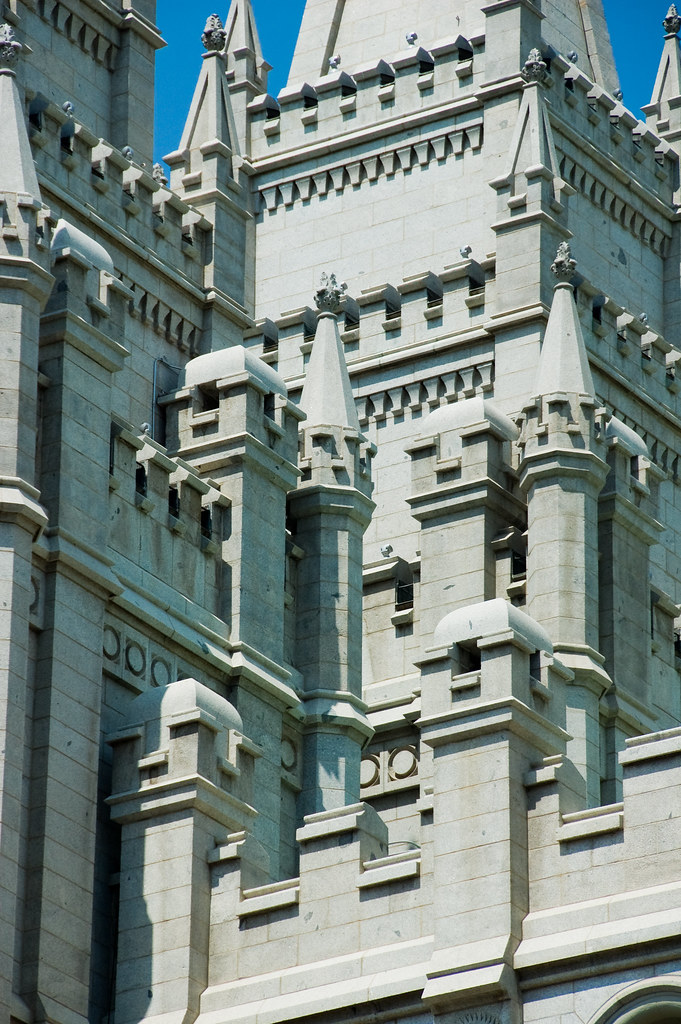
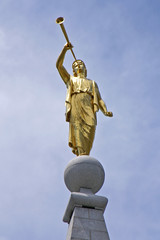
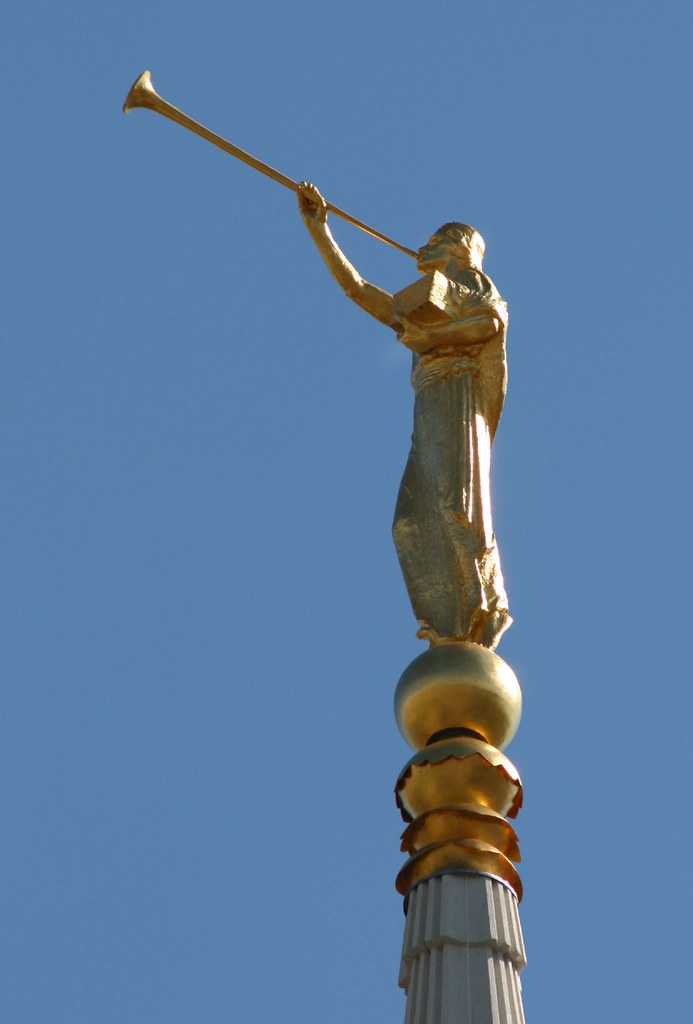
Angel Moroni statues are common on temples built by The Church of Jesus Christ of Latter-day Saints and usually function as their finials (decorative spire tips). But there are many other finials used. I thought I'd highlight those on the Salt Lake Temple.
The Salt Lake Temple has 6 main towers. One is topped with the Angel Moroni statue which functions as its finial.
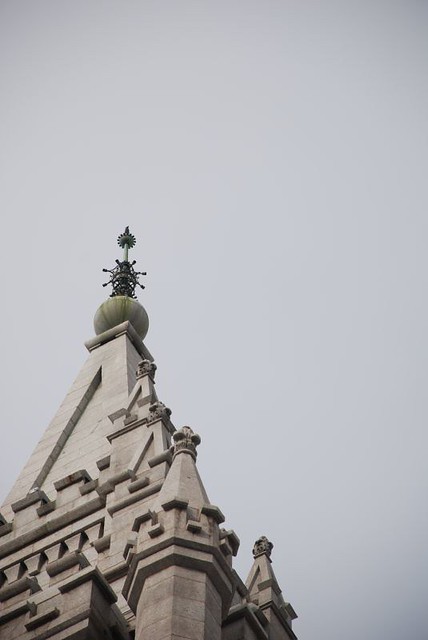
The other 5 towers have a detailed copper finial on a granite sphere. These copper finials used to have light bulbs along their tops and were the original source of tower lighting to the temple.
Each main tower is also surrounded by 12 smaller points with their own finials. These have a sculpted bud. One book I read claimed that these might be flames, although I don't buy that interpretation as I think it is pretty clear that they are buds. As buds they may just be decorative because buds are a very common type of finial in non-religious buildings. But they may have added symbolism. In the Bible, Aaron's rod, a symbol of his priesthood authority, was made of wood. In Numbers chapter 17 we are told that The LORD miraculously made Aaron's rod bud. It "budded, and brought forth buds, and bloomed blossoms, and yielded almonds." This was symbolic of The LORD choosing the tribe of Levi to hold the priesthood. After that, the rod was placed in the Ark of the Covenant which was kept in the Holy of Holies in the Tabernacle and later in the Temple of Solomon. So having flower buds on the top of the temple is a fitting priesthood and temple symbol. This also fits because there are 12 bud finials on each tower and 12 is a priesthood symbol and a symbol of Israel. So the bud finials may have special priesthood and temple symbolism, or they could just be decoration. Either way, they look good and add to the Salt Lake Temple.
I like all the wonderful details on the Salt Lake Temple. A few other temples have extra finials such as the San Diego California Temple which is clearly inspired by the Salt Lake Temple. But I think the Salt Lake Temple is the most detailed with its finials and the most successful in its architecture.,
Feel free to comment and let us know what you think about these neat architectural details.
![]() |
| Salt Lake Temple finials. (original photo here) |
![]() |
| Salt Lake Temple Moroni (original) |
The Salt Lake Temple has 6 main towers. One is topped with the Angel Moroni statue which functions as its finial.
![]() |
| Salt Lake Temple finial |
![]() |
| Salt Lake Temple finials (original) |
I like all the wonderful details on the Salt Lake Temple. A few other temples have extra finials such as the San Diego California Temple which is clearly inspired by the Salt Lake Temple. But I think the Salt Lake Temple is the most detailed with its finials and the most successful in its architecture.,
Feel free to comment and let us know what you think about these neat architectural details.
Sunday, February 26, 2012
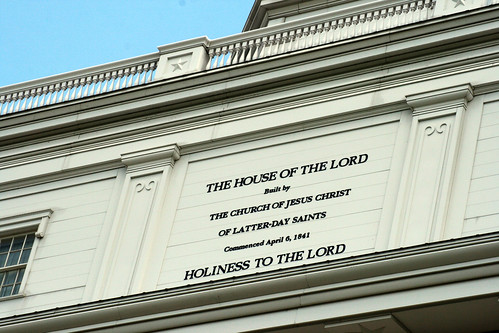
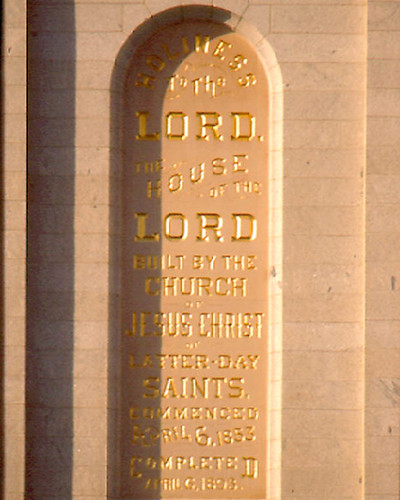
Holiness to the LORD The House of the Lord
Holiness to The LORD
The House of The LORD
The Church of Jesus Christ of Latter-day Saints' temples have that phrase inscribed on them as a reminder of what the temple is and how it should be treated. This phrase is from the scriptures (Exodus 28:36, Exodus 39:30, Zechariah 14:20, etc.) and was connected to the Temple. It is placed on the Temple as a reminder that it is God's house and that we need to be holy to enter it and we need to respect the temple as it is sacred ground that The LORD and his angels visit. The word holy means set apart for a sacred purpose. So the inscription on the temple means that the building is set apart for something special - in this case the higher ordinances of the gospel such as marriage for eternity, the saving work for the dead, and other special worship such as prayer. It also means that we need to be purposeful when we go to the Temple, focusing on God and bettering ourselves.
Here are some interesting uses of the phrase "Holiness to The LORD, The House of The LORD" on Latter-day Saints Temples.
The Nauvoo Illinois Temple:
![]() |
| Nauvoo Illinois Temple Inscription (original) |
The Logan Utah Temple:
![]() |
| Logan Temple Keystone (original) |
The Salt Lake Temple:
![]() |
| Salt Lake Temple Inscription Stone (original) |
![]() |
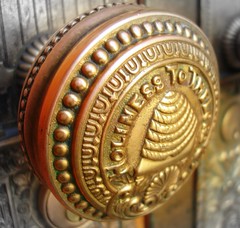
| Salt Lake Temple Doorknob (original) |
![]() |
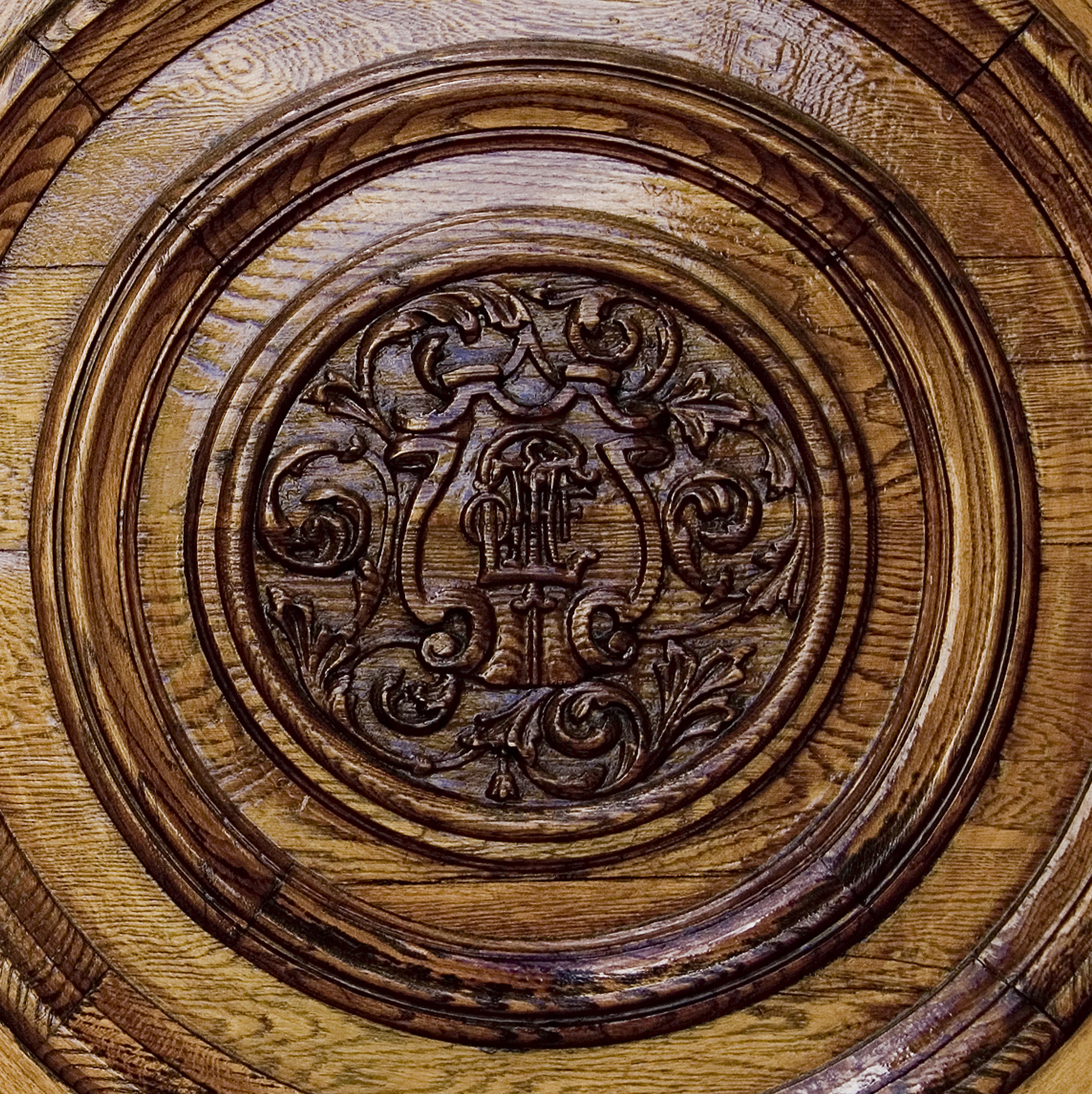
| HTTL Monogram on the Salt Lake Temple Door (original) |
The Cardston Alberta Temple's inscription can be seen here.
The Mesa Arizona Temple's inscription can be seen here.
The London England Temple's inscription can be seen here.
The Oakland California Temple has its inscription below one of its large sculpture panels of Jesus Christ.
The Denver Colorado Temple's inscription can be seen here.
One of the inscriptions on the Winter Quarters Nebraska Temple is above the ornate front doors.
Those are just a few examples of Holiness to The LORD, The House of The LORD inscriptions on Latter-day Saint Temples. From ornate to simple, these provide a reminder of the mindset we need as we enter the temple and remind us whose temple it is. I particularly like the more unique versions of this phrase. For example, the Salt Lake Temple monogram and doorknobs and the Logan Utah Temple keystone are particularly interesting, in my opinion. I am glad to see that the new Provo Temple being made out of the burned Provo Tabernacle will have a nice inscription above the east central window.
Well those are some of my thoughts. Comment and let us know what you thing about these inscriptions, or any interesting uses of them that I am unaware of.
*Addendum
I read a few comments. One pointed out that many temples have very plain inscriptions. This is fine and I tried to focus on the interesting ones instead of the plain. I would like to comment on the St. George Utah Temple's inscription. It has very plain lettering that looks like it was added many years after the temple's completion - perhaps 50 years or more later. You can see a photo here. One reason why I find this inscription particularly disappointing is that the original plans showed a more interesting inscription. I'm guessing that was removed entirely before the temple was built and the current inscription was added later so that this temple would have the inscription, although that is speculation on my part. The original plans showed the inscription higher up, on the tower around the small circular window seen here. If I was doing a restoration of this temple I would redo the inscription as shown in the original plans. You can see the original elevation with the different inscription in the temple visitors center or I believe it is in one of the St. George Temple books.
Sunday, January 8, 2012
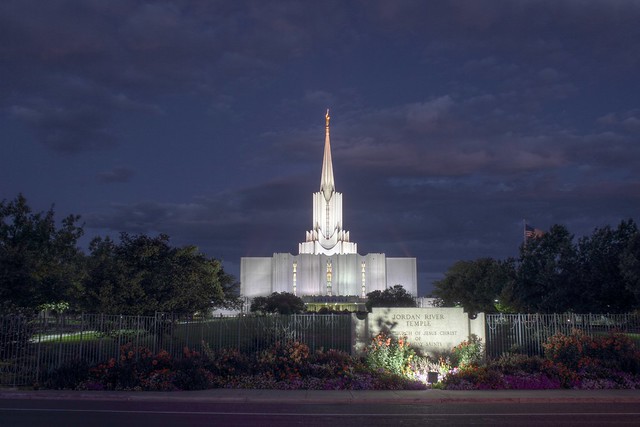
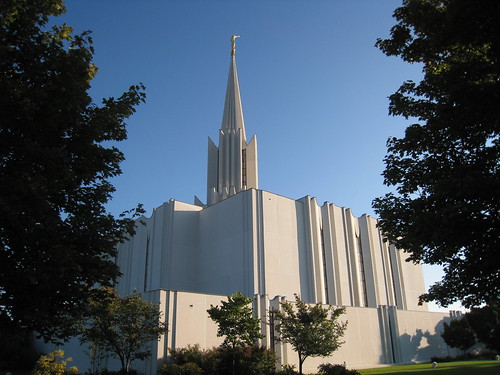
The Jordan River Utah Temple
![]() |
| Jordan River Utah Temple |
![]() |
| The Jordan River Utah Temple |
The Exterior
![]() |
| Angel Moroni Statue |
The architecture of this temple is a modern 1980s style. The exterior is made of white cast stone (precast concrete panels) with white marble chips. These panels have a repeated inverted swoop theme which is also used as the main decorative motif in this temple. These swoops (inverted parabolic arches?) are generally displayed in threes.
The temple tower is actually made of fiberglass which significantly reduces the weight on the structure below and reduces the mass of the building to reduce the seismic loads on the structure. Despite being a different material, it blends perfectly with the cast stone.
![]() |
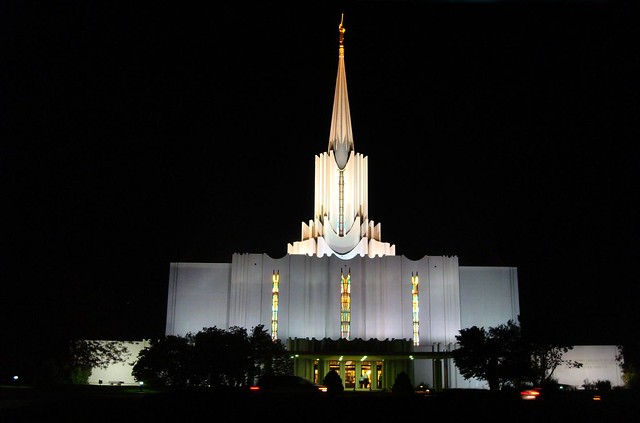
| The Jordan River Utah Temple at night |
The temple has a lot of symmetry, with each of the four sides being nearly identical. This makes the temple approachable from all directions.
The exterior and interior of this temple is very light on symbolism with the Angel Moroni statue on the spire and oxen statues supporting the font being the only prominent symbols.
The Interior
![]() |
| Jordan River Temple Font |
The bottom floor of the temple also has worker training rooms and a cafeteria. The cafeteria is good, although the smell of food does drift into the baptistry where it is distracting.
The first floor of the temple houses the temple offices, a lobby, and dressing rooms. The lobby was redone sometime around 2005 with new lights, stone flooring, etc. and is really nice. There is a huge painting of the Garden of Eden (essentially copied from the L.A. Temple garden room mural) on one wall.
The Jordan River Utah Temple is one of the few temples with escalators. They aren't as bad as you might think. While I would welcome actual stairs, the escalators work well, are fairly quiet, and provide good views of the stained glass windows.
The second floor contains the chapel and the sealing rooms. The chapel has some dark wood, but not annoyingly so. It has an electronic organ. In front of the speakers are dark wood posts that give the feel of pipes (while clearly being just decorative). These have the same swooping pattern found elsewhere on the temple. They look really cool, but are hard to describe, so you'll just have to see them for yourself.
![]() |
| Sealing Room |
The endowment rooms and celestial rooms are on the third floor of the temple. There are six endowment rooms and the Jordan River Temple is one of only 4 temples with this many endowment rooms. I am fairly sure that the endowment rooms in the Jordan River Temple are larger than the other temples making this the temple with the highest capacity. Even with sessions starting every 20 minutes, this temple is kept busy. The endowment rooms are fairly simple. Their walls have alternating vertical strips or wallpaper and wood paneling with brass swoops matching the swoops elsewhere in the temple. The altars are made of stone and match those in the sealing rooms. The rooms can seat around 125-150 (If I remember correctly) and feel very spacious. They also have high ceilings.
![]() |
| Jordan River Temple Celestial Room |
The third floor hallways also contain nice artwork - mainly landscapes. The halls also provide views of the stained glass windows.
Throughout the temple there are also specially sculpted doorknobs. These are brass or bronze and have swoops and other shapes that echo the architecture and patterns common in this temple. It is nice seeing custom handles to make the temple a special place.
The Jordan River Utah Temple is a great example of 1980s modern architecture in my opinion. It has beautiful repeated patterns, clean lines, and great functionality. It does lack much symbolism, but I suppose it is okay for a few temples to be this way. I love this temple and am glad we have it.
One of the best parts of the Jordan River Temple has nothing to do with the architecture, but rather how it is run. The temple (at least when I worked there) went to great efforts to make patrons feel comfortable. It is always a friendly place and among the best in that regard.
Those are some of my thought on this temple. Please comment and let us know what you think about this temple.
Sunday, December 11, 2011
Christmas at The Church of Jesus Christ of Latter-day Saints' Temples
With Christmas approaching, I thought I'd write a little bit about The Church of Jesus Christ of Latter-day Saints' temples that have Christmas displays. This list is not exhaustive, but should highlight some of the great Christmas displays at Latter-day Saint temples.
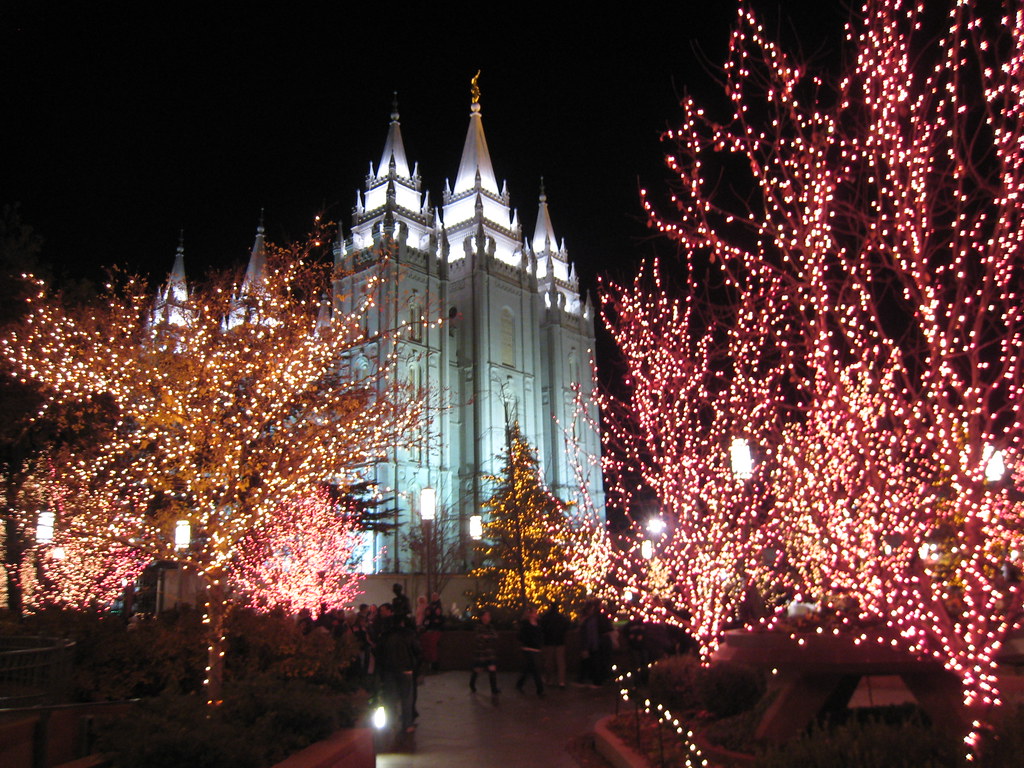
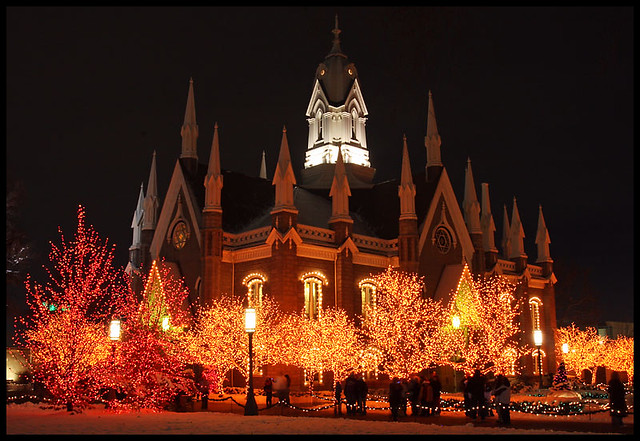
The Salt Lake Temple has the most prominent Christmas displays. Massive amounts of intricately placed tasteful Christmas lights fill Temple Square, the Conference Center Plaza, Main Street Plaza, and the block east of the temple. Dozens of large nativity sets are placed on the block east of the temple. A prominent nativity scene, complete with audio narration, is done on the grass between the Tabernacle and the North Visitors Center.
The buildings on Temple Square also receive decoration with wreaths and Christmas trees being placed in the Conference Center, Tabernacle, Assembly Hall, Visitors Centers, and Joseph Smith Memorial Building. Christmas events also take place such as the Mormon Tabernacle Choir Christmas Concert, the First Presidency Christmas Devotional, Christmas themed films in the visitors centers, and numerous other Christmas concerts and events. You can see some photos and read a great article on how Christmas lights started at Temple square here.
The St. George Temple also has Christmas lights. There is a formal lighting ceremony each year, usually on the day after Thanksgiving. A photo can be seen here.
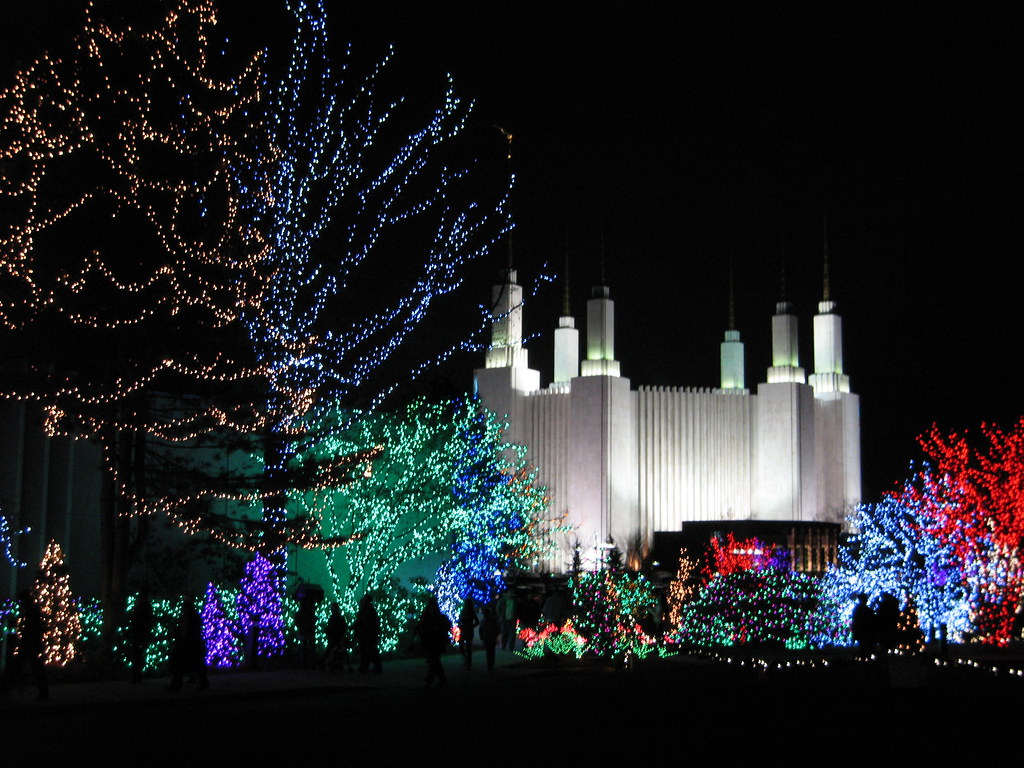
The Washington D.C. Temple features its Festival of Lights each Christmas season. The festival includes international nativity scenes and Christmas trees, nightly concerts, and a vast number of Christmas lights.
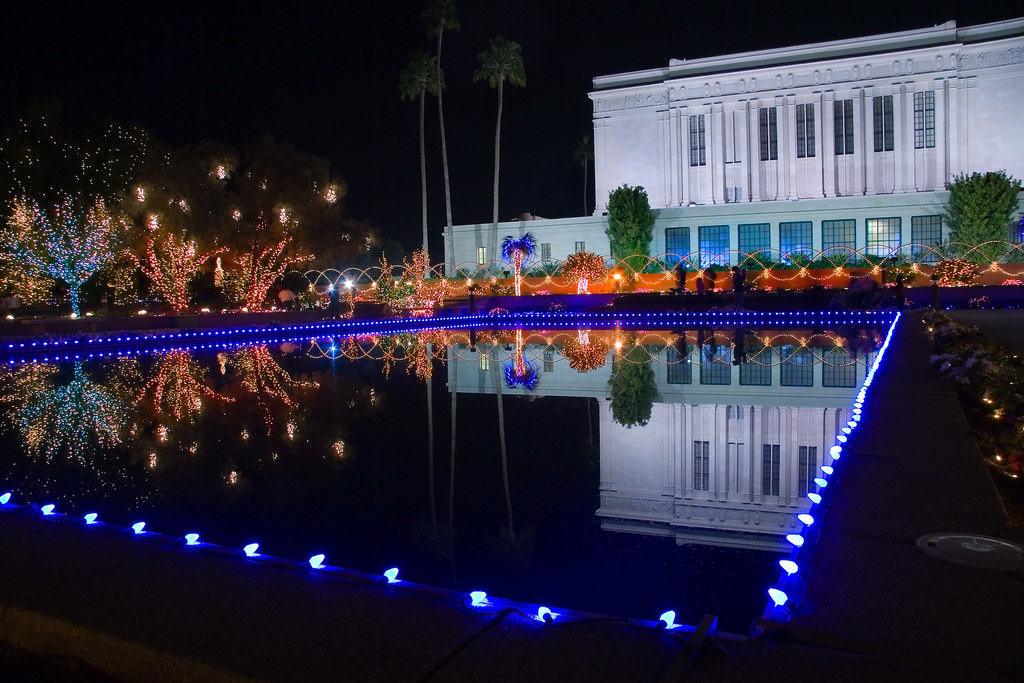
The Mesa Arizona Temple also has a Christmas light display and nativity scenes. Some photos can be seen here. International nativity scenes are on display.
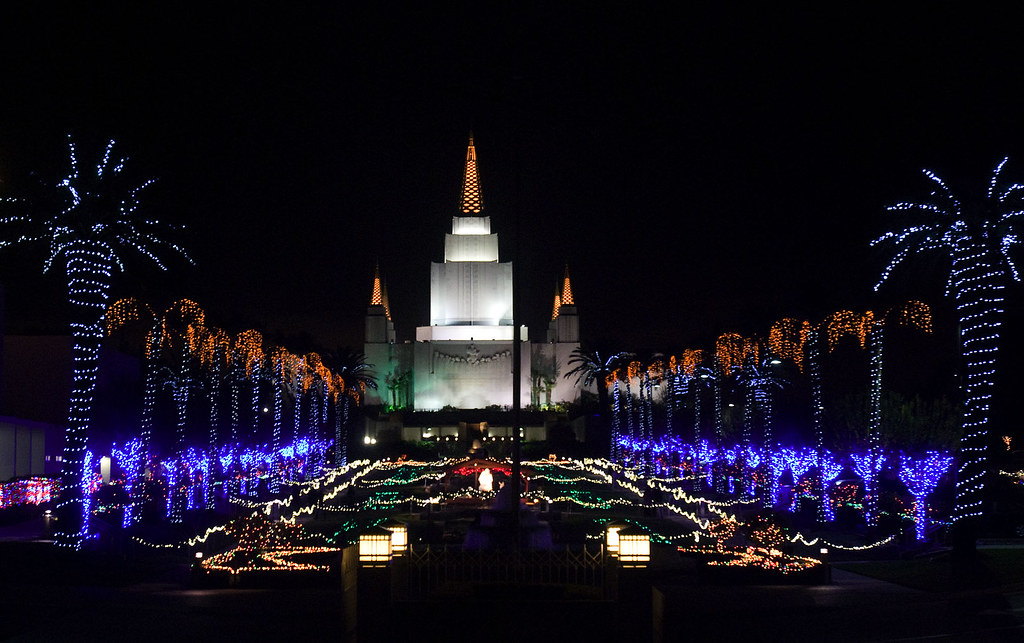
The Oakland California Temple has a Christmas lights display.
The San Diego California Temple has some Christmas lights and a nativity scene that can be seen here. In fact, many temples have a small nativity scene even though most temples don't have Christmas lights or other events that would attract non temple patrons during the holidays.
The Los Angeles California Temple has a Christmas lights display that can be seen here.
The Hamilton New Zealand Temple also features a Christmas lights display that can be seen here.
One of the nice things about Christmas lights at temples is how tastefully they are done. The lights are very neatly arranged. Great care is taken so that the lights don't take away from the temple. Nativity sets are a common feature so that these Christmas displays can remain religious and focused on Jesus Christ who is the reason for Christmas and central to our temples. I've seen Christmas light displays at other churches with varying degrees of success . Some are tasteful, but unfortunately some are commercial, lack the religious elements, or are focused on Santa instead of The LORD Jesus Christ. I'm glad that The Church of Jesus Christ of Latter-day Saints keeps the proper focus on Jesus Christ.
There are probably a few more temples with Christmas lights and other Christmas decorations. Please comment and tell us about them, or more about some of the ones that I mentioned but know little about.
The Salt Lake Temple has the most prominent Christmas displays. Massive amounts of intricately placed tasteful Christmas lights fill Temple Square, the Conference Center Plaza, Main Street Plaza, and the block east of the temple. Dozens of large nativity sets are placed on the block east of the temple. A prominent nativity scene, complete with audio narration, is done on the grass between the Tabernacle and the North Visitors Center.
![]() |
| Christmas Lights at Temple Square |
The buildings on Temple Square also receive decoration with wreaths and Christmas trees being placed in the Conference Center, Tabernacle, Assembly Hall, Visitors Centers, and Joseph Smith Memorial Building. Christmas events also take place such as the Mormon Tabernacle Choir Christmas Concert, the First Presidency Christmas Devotional, Christmas themed films in the visitors centers, and numerous other Christmas concerts and events. You can see some photos and read a great article on how Christmas lights started at Temple square here.
![]() |
| Christmas Lights around the Assembly Hall on Temple Square |
The St. George Temple also has Christmas lights. There is a formal lighting ceremony each year, usually on the day after Thanksgiving. A photo can be seen here.
The Washington D.C. Temple features its Festival of Lights each Christmas season. The festival includes international nativity scenes and Christmas trees, nightly concerts, and a vast number of Christmas lights.
![]() |
| Washington D.C. Temple Festival of Lights |
The Mesa Arizona Temple also has a Christmas light display and nativity scenes. Some photos can be seen here. International nativity scenes are on display.
![]() |
| Mesa Arizona Temple Christmas Lights |
![]() |
| Mesa Arizona Temple Christmas Lights |
The Oakland California Temple has a Christmas lights display.
![]() |
| Oakland California Temple Christmas Lights |
The San Diego California Temple has some Christmas lights and a nativity scene that can be seen here. In fact, many temples have a small nativity scene even though most temples don't have Christmas lights or other events that would attract non temple patrons during the holidays.
The Los Angeles California Temple has a Christmas lights display that can be seen here.
The Hamilton New Zealand Temple also features a Christmas lights display that can be seen here.
One of the nice things about Christmas lights at temples is how tastefully they are done. The lights are very neatly arranged. Great care is taken so that the lights don't take away from the temple. Nativity sets are a common feature so that these Christmas displays can remain religious and focused on Jesus Christ who is the reason for Christmas and central to our temples. I've seen Christmas light displays at other churches with varying degrees of success . Some are tasteful, but unfortunately some are commercial, lack the religious elements, or are focused on Santa instead of The LORD Jesus Christ. I'm glad that The Church of Jesus Christ of Latter-day Saints keeps the proper focus on Jesus Christ.
There are probably a few more temples with Christmas lights and other Christmas decorations. Please comment and tell us about them, or more about some of the ones that I mentioned but know little about.
Monday, November 21, 2011
The Fortaleza Brazil Temple Rendering
In case you missed it, The Church of Jesus Christ of Latter-day Saints recently broke ground on, and released the rendering of, the Fortaleza Brazil Temple. It is another of the two towered temple style. Here is the rendering, followed by the renderings of the other new two towered temples for reference.
I like the new rendering of the Fortaleza Brazil Temple. I am a big fan of the new two towered temple style. I like the classical design of this new temple, although I like the neoclassical architecture used in the Philadelphia Temple even more. The Fortaleza Temple is built into a hill which should allow light to fill the baptistery. I particularly like the towers of the Fortaleza Temple and the slight concave curves on each side. I also like the columns on the towers and the fact that they cluster on the corners.
Well, that was a really short post, but hopefully you liked the rendering. Please comment and let us know what you think about this new temple rendering.
| Fortaleza Brazil Temple Rendering |
![]() |
| Brigham City Temple Rendering |
![]() |
| Kansas City Temple Rendering |
![]() |
| Rome Italy Temple Rendering |
![]() |
| Philadelphia Pennsylvania Temple Rendering |
Well, that was a really short post, but hopefully you liked the rendering. Please comment and let us know what you think about this new temple rendering.
Subscribe to:
Posts (Atom)