Sunday, September 30, 2012

The Church of Jesus Christ of Latter-day Saints - Temple Art - Restoration Themes

I wanted to highlight some art in temples built by The Church of Jesus Christ of Latter-day Saints that is related to the restoration of the gospel of Jesus Christ and of the last dispensation of the gospel (1820 to now).

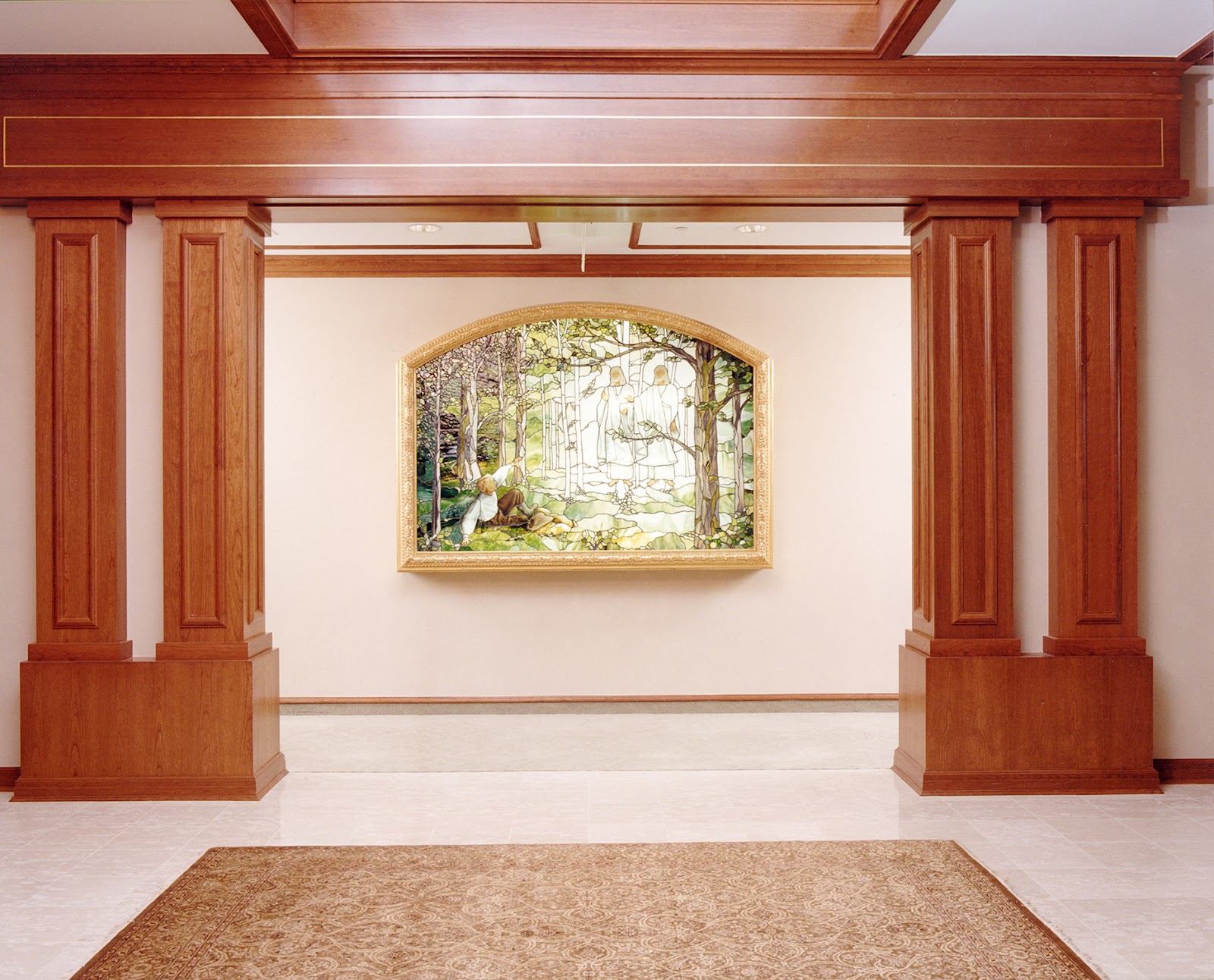
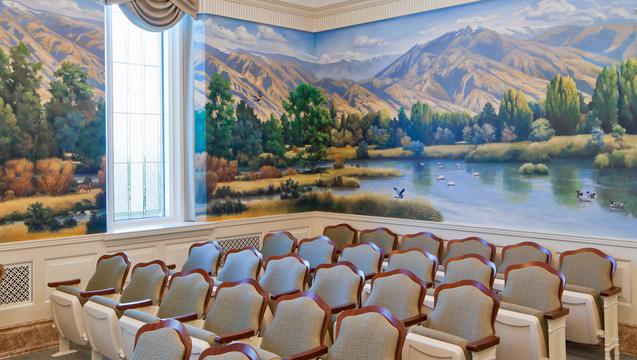
Many temples depict the First Vision of God the Father and Jesus Christ to Joseph Smith.  Some notable examples are in the Salt Lake Temple Holy of Holies which has a stained glass window of the vision (top below), in the lobby of the Palmyra New York Temple (which is overlooking the actual grove of trees where the vision occurred (middle below), and in the entry of the Redlands California Temple which also has a stained glass window of the vision (bottom below).


Another popular restoration theme is of the restoration of the Aaronic Priesthood and of baptisms in modern times.  The Cardston Alberta Canada Temple has murals in its baptistry including ones of John the Baptist ordaining Joseph Smith and Oliver Cowdery to the Aaronic Priesthood in May of 1829.  This event is recorded in Doctrine and Covenants 13.  Copies of this mural are found in the Logan Utah Temple and the Helsinki Finland Temple (top below). The Mesa Arizona Temple has a mural of Joseph Smith and Oliver Cowdery baptizing each other after having received the priesthood from the angel (middle below).  The Manti Utah Temple also has murals of baptisms (I believe of Joseph Smith and Oliver) that can be seen in the bottom photo below (although they are somewhat cut off).  There is also a depiction of these baptisms in the newly completed Quetzaltenango Guatemala Temple.  I was pleased to see that the baptistry mural in the Brigham City Temple depicts baptisms in a stream near Brigham City, presumably during pioneer times.  There is also a painting at the back of the baptistry chapel of a Native American being ordained near Brigham City in pioneer times.

The Salt Lake Temple used to have a mural of Joseph Smith preaching to Native Americans.  Currently the  Mesa Arizona Temple includes a large mural of Joseph Smith and others preaching to the Native Americans in the 1830s.

The Idaho Falls Idaho Temple World Room mural has a depiction of pioneers arriving by wagons, a couple farming the land, and of seagulls coming to rescue the pioneers from the plague of crickets.
The Winter Quarters Nebraska Temple has many pioneer related items and art.  Most notable is a large window made like a quilt, but out of glass.  It contains images related to Winter Quarters and the Latter-day Saint migration (often called the Mormon migration) such as the prophet Brigham Young, the Kanesville Tabernacle, pioneers burying a child, Brigham Young signing a treaty with the Native Americans, Native Americans who mercifully helped the saints, the odometer which was invented there, etc.
The Salt Lake Temple has several other restoration themed pieces of art.  One sealing room has a stained glass depiction of Joseph Smith receiving the plates that he translated into The Book of Mormon from the Angel Moroni.
In the downstairs portion of the main hallway in the Salt Lake Temple there are two prominent paintings on opposite sides of the hallway by Alfred Lambourne.  These are of The Hill Cumorah and Adam-Ondi-Ahman.  The painting of the Hill Cumorah (below) shows the hill where Joseph Smith received the plates that were translated into The Book of Mormon.  This hill in New York state may not be the same as the hill mentioned in The Book of Mormon and was not referred to as the Hill Cumorah until many years after Joseph Smith obtained the plates there, but it is often associated with the Hill Cumorah in The Book of Mormon where the Nephite nation was destroyed.  Lambourne played off of this.  The painting is both showing the Hill with its positive associations of the Nephite record, and it has an ominous tone reminding us that just as the Nephites were eventually destroyed for their wickedness, we need to remain righteous and keep our temple covenants if we are to keep receiving The LORD's blessings.  The painting of the valley of Adam-Ondi-Ahman shows the valley in Missouri where several notable events occurred and will occur.  The Doctrine and Covenants states that Adam and Eve went to this valley after leaving the Garden of Eden and that Adam gathered and blessed his posterity there.  A temple site was dedicated there in the 1830s, but the temple was never built.  Finally, the Doctrine and Covenants contains a prophecy that as part of the Second Coming of Jesus Christ, HE will appear there and minister to the righteous.  This painting works with the Hill Cumorah painting.  Our obedience or disobedience to God and his covenants we make in the temple will determine if we end up like the Nephites, destroyed as at Cumorah, or if we end up with the faithful, gloriously greeted by the returning Messiah.  By the way, Lambourne made 2 copies of each painting.  One set is in the Salt Lake Temple.  The other set is on display on the first floor of the Church History Library in Salt Lake City so the general public can view these.
Finally, there are several temples with sculptures related to the restoration.  Most notably, the Laie Hawaii Temple has a sculpted frieze of the Dispensation of the Fulness of Times (below) which depicts events from 1820 onward.  There is a bronze replica of this sculpture in the Church History Library on the first floor.  The Mesa Arizona Temple also has sculpted friezes showing the gathering of Israel from the four corners of the earth and depicts various groups joining The Church of Jesus Christ of Latter-day Saints with most immigrating to be with the church.  These can be seen in my post on sculpures here or in this article from The Ensign magazine.

There are many other examples of restoration themed art in Latter-day Saint temples.  I noticed a painting of the heavenly visitations that occurred in the Kirtland Temple in the Manhattan New York and Brigham City Utah Temples.  Please comment and share what restoration themed art you have noticed in temples.

Sunday, September 9, 2012

The Brigham City Utah Temple

A few weeks ago I had the wonderful opportunity to attend the Brigham City Utah Temple open house.  It was a wonderful experience and I'd like to share some of my impressions about this temple which was built by The Church of Jesus Christ of Latter-day Saints.

First, if you haven't already, you can go to the following link and download photos of the interior:
http://www.mormonnewsroom.org/article/mormon-brigham-city-utah-temple-opens-for-public-tours
That link will not stay up forever, so get the photos now if you want them.

I loved the detail in the Brigham City Temple.  The style is meant to tie back to the pioneer temples (Salt Lake, Logan, Manti and St George temples in Utah).  It does this through a number of features.  On the exterior, the two main towers with spires and four corner towers echo the pioneer temples.  On the interior, the neoclassical style feels similar to the ornate grandeur of the pioneer temples, particularly Salt Lake and Manti.

One detail I particularly liked was the use of a cast bronze font instead of the white fiberglass fonts that have been used in recent years.  I like that it makes it look more like the fonts used from pioneer times through about the 1950s.  I also like it because as much as I like white oxen, you need to occasionally do something different.  It feels fresh and I like that.

Brigham City Temple Baptistry
While you are admiring the photo of the font, make sure that you notice the original paintings in this room.  There are a lot  of new paintings in this temple.  I particularly want to point out the painting of baptisms being performed in a river in the Brigham City area seen in the photo, and a painting of a Native American being confirmed in pioneer times which is also in the baptistry.  I also noticed several paintings of people harvesting fruit.  One was a lady placing apples in a basket.  These tied into the history of Brigham City which is known for its orchards, and they tie into the temple and gospel themes of gathering, fruit, harvest, etc.  In the Matron's office, which leads into the Bride's Room, there are some paintings of birds that were painted by President Boyd K. Packer, current president of the Quorum of the 12 Apostles who was raised in Brigham City and who used to go to school on the site the temple was built on.  I'm not sure if President Packer's love of birds influenced the endowment room murals, but they are full of numerous birds.  Brigham City is also home to a bird sanctuary and many varieties of birds are in the area due to the very close proximity of the Great Salt Lake and its tributaries.  I enjoyed the endowment room murals.

Brigham City Utah Temple Endowment Room A
This temple has a lot of ornate decorations.  This is very apparent in the second endowment room, essentially the Terrestrial Room, which is ornate enough to pass for a Celestial Room in most temples.  I really enjoyed the room.  If you look at the photos, notice the unique wood carving above the curtain.  It is also in the Celestial Room and Sealing Rooms.  The wood carving is extremely impressive in this temple.  The wood was rough carved by machine and then all finished my hand.  The detail is spectacular, and you really do have to see it in person to realize just how incredible it is.

The Celestial Room has stunning detail.  You can look at the photos.  If I remember correctly there are gold peach branches on the ceiling of the room.  I also noticed that the cream on white "wallpaper" appeared to be hand painted stenciling and not wallpaper.  The sculpted peach blossoms in the carpet were also beautifully done.

Brigham City Temple Sealing Room
The sealing rooms were probably my favorite part of this temple.  The photos the church has provided unfortunately skip the best part.  The ceilings of the room have a circular section painted blue with peach branches in bloom running over the top.  So looking up from the altar it looks like you are laying under a peach tree looking through the white and pink blossoms towards a clear blue sky.  I used to have a peach tree and loved it in spring, so I really liked this detail.  Also, if I remember correctly, the peach branches on the ceiling were also in the Celestial Room, but only in the sealing room were they fully in bloom with colorful blossoms.  So I liked that symbolism.  The sealing rooms may be my favorite of any temple, although I'm not certain about that.  The detail is stunning.

There are many other aspects of this temple that I loved.  I liked the unifying peach blossom motif.  The intricate stone inlays were beautifully crafted.  Many colors were incorporated into the temple making it more interesting than the white and off white color schemes found in most temples, while still being light and inspiring.  The stained glass is really beautiful.  Also, the railings and woodwork are very nicely done and detailed.

I could go on, and perhaps I will later add some to this post.  For now, I'd like to hear what your thoughts are on this spectacularly done temple.  So please comment.

One final note, the detail in this temple makes me optimistic that someday they will restore the Logan Temple with this level of detail.  Clearly we can still build temples as ornate as the pioneers.


Sunday, July 22, 2012

Celestial Rooms With Ceilings Vaulted Into Towers

So often in temples built by The Church of Jesus Christ of Latter-day Saints, the Celestial Room, even when directly below a tower, does not actually look up into the tower (for example, the Oquirrh Mountain Utah Temple).  There are probably several reasons for this.  Some building codes may limit the height of useable space, so the room cannot open into the spire and meet building codes (which I find silly by the way).  Also, as a structural engineer I know that the building is much easier to design if you don't stick a hole in the roof diaphragm, although we can still get buildings to work, it just takes more effort on our part.  I love it when a temple actually uses the space of the spire to make the celestial room even taller.  Here are a few examples:


Cardston Alberta Temple Celestial Room
Laie Hawaii Temple Celestial Room
The Cardston Alberta Canada Temple and the Laie Hawaii Temple were the first to really use the space at the top of the temple.  While neither of these temples technically have a tower, they do jut up a bit at the center and this central space is the vaulted top of each temple's celestial room.  The vaulting in these temples allows for windows on every side of their celestial rooms.

Idaho Falls Temple Celestial Room
The Idaho Falls Temple is probably the first with a tower that the Celestial Room opens into.  I don't have a photo of this, but if you sit in the Celestial Room you can stare up into the tower and actually get use of the tower windows.


San Diego Temple Celestial Room
Probably the best example of actually using the spire space has got to be the San Diego California Temple.  Its Celestial Room occupies one of its two main towers and provides the spectacular view pictured here.


Draper Utah Temple Celestial Room
More recently, the Draper Utah Temple has somewhat used its tower.  the view from the celestial room takes advantage of the lower portions of the spire.  The upper windows are still not visible from the celestial room and the dome at the top in the picture is painted to look like a dome and actually doesn't poke up into the spire.  Even so, this is a better use of the spire space than most temples accomplish.


I'd like to hear about other temples that actually use the spire space in the Celestial Room (or elsewhere) so please comment about other temples that use this space.  I hope that we will start seeing the tower space of temples being used much more often.


Original Latter-day Saint Temple Architectural Drawings

I recently found some great original architectural drawings of the Nauvoo Temple and Salt Lake Temple.  They are on The Church of Jesus Christ of Latter-day Saints' website.

The Nauvoo Temple architectural drawings are found here:
http://churchhistorycatalog.lds.org/primo_library/libweb/pages/dvds/dvd18/MS-11500/seg1.jsp

The Salt Lake Temple Drawings are found here:
http://churchhistorycatalog.lds.org/primo_library/libweb/pages/dvds/dvd18/CR-679-13/contents.jsp

There are only a few drawings of the Nauvoo Temple, but they do let you see how the design changed over time.  The Salt Lake Temple plans are extensive and show numerous changes that are quite fascinating.  You can even see what are essentially shop drawings of every course of stones for the temple.

I hope you enjoy these as much as I do.

Sunday, April 8, 2012

Temple Symbols - Olives

A few days ago I was looking over the interior photos of the Kansas City Missouri Temple that are currently posted on The Church of Jesus Christ of Latter-fay Saint's newsroom website.  The photos are very nice and I encourage you to view them.  One repeated element of this temple is olive branches.  There are olive branches in the exterior precast panels, carved into art glass, added to custom railings and light fixtures, sculpted into carpets, gold leafed onto walls, and painted in the temple.  A large stained glass window of an olive tree stands behind the recommend desk, flanked by olive branches sculpted into the adjacent panes. The furniture in the temple also features olive branches (the sealing room sealer's desk is covered in olive branches).  There are also bowls in the celestial room with olive branches on them.  Olive branches are the unifying symbol in this temple.  I want to take a little time to discuss how olive branches are used in temple architecture and how they are an appropriate symbol.

I thought that olive branches had been used a lot in temple architecture, but discovered very few examples of their use.  I suspect (and hope) that I have missed a few places where they are used.

The Winter Quarters Nebraska Temple contains various temple symbols.  In the baptistry there are three panes with sculpted glass.  They are a fig branch, an almond branch, and an olive branch (left).  All 3 are symbolic.  The Winter Quarters Nebraska Temple also has olive branches on the front doors.  You can see these in the photo on the right.

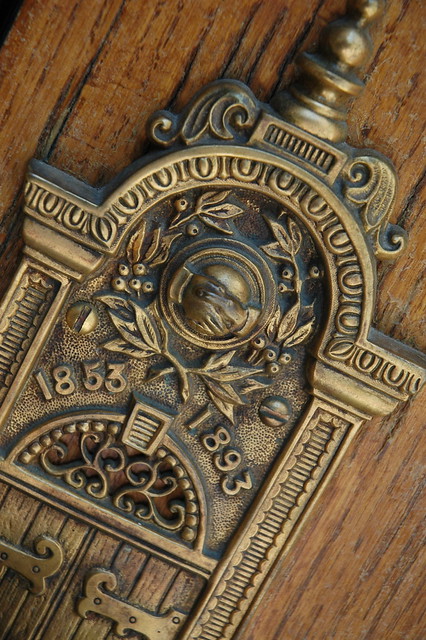
The Salt Lake Temple also has olive branches.  The front doors have olive branches on the metal plate behind the doorknob seen in the picture below.  You can see the original of this photo here.
Olive branches and trees make an excellent temple symbol.  Olives represent peace.  They are a symbol of God's covenants with man (a dove brought an olive branch to Noah showing that the flood was over).  Olive oil is used in priesthood ordinances and so olives are a symbol of the priesthood and Christ.  Olive oil can provide light and olives symbolize light.  Olive trees represent Israel, God's chosen people, and all mankind (see Jacob 5 in The Book of Mormon where the tame olive tree represents Israel and the wild olive tree represents everyone else and God is concerned about saving both).  Olive oil is also a symbol of royalty and was used to anoint kings and priests.

In the temple, olives signify that temple work is done by the priesthood, concerns all of humanity, brings us peace and heals us.  It establishes the government of God.  Olives are indeed a great temple symbol.

I like how extensively the olive symbol was used in the Kansas City Missouri Temple and hope that olives, olive branches, and olive trees will continue to be used in temple architecture.  I also find olives fitting for Kansas City.  The temple is a 5 minute drive from Liberty Jail in Missouri where the prophet Joseph Smith and others were imprisoned for a time.  It is in a state where a lot of violence, murders, etc. were done against The Church of Jesus Christ of Latter-day Saints and where Latter-day Saints were driven from the state.  The olive branch helps show that this tragic past has been overcome and points to the fact that we believe that Jesus Christ will come to Missouri as a part of his second coming and that Zion, the New Jerusalem will be built not far from here in Independence, Missouri.  The peace of the gospel and the Millenial reign of Jesus Christ will more than overcome the past.

Those are my thoughts.  Please write and let us know what you think and particularly where else olives are used in temples.

Sunday, March 18, 2012

The Church of Jesus Christ of Latter-day Saints' Temple Stone Inlays and Mosaics

Stone inlays and mosaics are nice works of art.  It takes a lot of time and skill to place the stone properly in order to maintain a level surface.  Cutting the shapes just right is also difficult.  Skill is also required in selecting the individual pieces of stone so that they look good with each other.  The overall product is rich and elaborate and can be expensive, but it shows a certain dedication that is apparent in the various arts used in temples built by The Church of Jesus Christ of Latter-day Saints.  Here are some examples that I found.

Temple baptisteries had a lot of examples of stone inlays.  The following picture shows stonework in the floors of the following temples (left to right, top to bottom): Draper Utah, Santo Domingo Domican Republic, San Diego California, Toronto Ontario, Panama City Panama, Vernal Utah, Las Vegas Nevada, and Portland Oregon.  Particularly interesting is the San Diego California Temple with its eight sided star which is similar to the eight sided Seal of Melchizedek symbol used throughout that temple.  Also, the Las Vegas Nevada Temple and Portland Oregon Temple each have a Star of David on the floor.  Another interesting pattern is the Panama City Panama Temple's baptistry inlay which is a symbol used by Native Americans in Panama.
The sides of fonts also often have stone inlays.  In the image below (left to right, top to bottom) you can see the Accra Ghana, Billings Montana, Quetzaltenango Guatemala, Helsinki Finland, and Apai Samoa Temples' fonts with stone and tile inlays.
Entryways are also a common area for stone inlays and mosaics.  In the following image you can see the following temples (left to right, top to bottom): Quetzaltenango Guatemala, Twin Falls Idaho, Draper Utah, Helsinki Finland, Mexico City Mexico, Aba Nigeria, Atlanta Georgia, and Gila Valley Arizona Temples.
Several entries have more elaborate floor inlays or mosaics.  From top to bottom in the image below are the Lubbock Texas, Newport Beach California, Apia Samoa, and Redlands California Temples' entry stone inlays.  Although I didn't have a picture of it, the entry lobby of the Las Vegas Nevada Temple also has an impressive inlay with numerous types of stone in a large circle.
I like all these stone inlays and hope to see many more in temples.  These are only a selection of the ones I found in my photo collection.  I noticed several things.  First, these all occurred in halls, entrys, lobbies, and baptistries.  I would like to see some elsewhere in the temple.  Second, I noticed that a lot of there are from newer temples which means that the church is actively promoting this art style in temples.  That means we will probably see a lot more.

Please write and let us know what you think about these stone inlays/mosaics in Latter-day Saint Temples and any interesting ones that I skipped that you want to highlight.

Sunday, March 11, 2012

Symbolic Arrangement of Temple Rooms

Today I'd like to discuss how the arrangement of rooms in a temple built by The Church of Jesus Christ of Latter-day Saints can have symbolic significance.  

I was looking over old plans for a church and noticed that one wing was reserved for the Aaronic Priesthood, one for the Stake Presidency, another for the Relief Society, another for Bishoprics and clerks offices.  A large section was devoted to the Primary, and another for classrooms.  There was definite organization in this building.  The rooms used by various groups were each given a place and the organization helped make each auxiliary important.  Temples are similar.  Many are organized to emphasize certain aspects of the work we do.  On the exterior we often see two towers or sets of towers or two main sides representing the two priesthoods, the Aaronic Priesthood and the Melchizedek Priesthood.  The Mesa Arizona Temple has four corners representing the gathering of Israel from the four corners of the earth (as the sculptures on the corners make clear).  So spatial arrangement of the exterior architecture is clearly used symbolically.  The interiors of many temples are no different.

The Kirtland Ohio Temple was the first temple built in this dispensation.  It has some unusual interior features.  Some, such as booths with doors for the pews are common in older New England architecture.  Other features are distinctly Latter-day Saint.  It is one of many temples with two main doors in the front and two main side aisles (similar to how our chapels are usually arranged) instead of a center aisle.  This is all the more peculiar because the two main rooms were often divided into four sections using curtains, something that would have been easier with a center aisle.  So what do the two aisles represent?  Well, there are various interpretations, but my two candidates are the two priesthoods, and males and females and their different roles - something that is evident in today's endowment.  The Kirtland Temple, and the other temples with Priesthood Assembly Halls, have two sets of pulpits in a room.  In Kirtland there were pulpits on the west and east sides of both the main floor and upper floor rooms.  These pulpits were reserved for the Aaronic and Melchizedek Priesthoods respectively with the Melchizedek side higher and more ornate.  The spatial arrangement here signified two priesthoods and their relative levels.  Finally, the Kirtland Ohio and Nauvoo Illinois Temples each originally used rooms in the attic for higher temple ordinances.  In Kirtland, this is where initiatory ordinances began to be performed.  In Nauvoo, the full endowment and sealings were originally performed in the attic level.  This signified that these were higher and important ordinances.

The Nauvoo Illinois Temple introduced another spatially symbolic room - the baptistery.  Joseph Smith wrote the following (recorded in Doctrine and Covenants 128:13):
Consequently, the baptismal font was instituted as a similitude of the grave, and was commanded to be in a place underneath where the living are wont to assemble, to show forth the living and the dead, and that all things may have their likeness, and that they may accord one with another—that which is earthly conforming to that which is heavenly, as Paul hath declared, 1 Corinthians 15:46, 47, and 48:
I have emphasized in this scripture that the font was commanded to be underneath as a symbol of the grave.  Because of this, most fonts are in a basement and the font often sinks into a sub-basement.  This preserves the grave symbolism of burying our sinful selves, and of the resurrection.  A few temples have fonts at ground level, so the sculpture is in a basement, while the baptistry is on the main level. This is sometimes required due to high water table, but it is still underneath, and not on a higher level.


The Logan Utah Temple began using progressive, muraled endowment rooms.  In that temple and several of the temples that followed, each room got higher up (there were a lot of stairs) and larger.  This taught about progression as you moved through the endowment ceremony.  Spatially you were being taught that as we move from creation to exaltation, through experience and covenants we are made higher, more important, holier, and closer to heaven and God.

The Salt Lake Temple's baptistry showed that baptism was an Aaronic Priesthood ordinance by having the font in the western half of the basement.

I have read that the Laie Hawaii and Cardston Alberta Temples (pictured) have progressive endowment rooms around a central celestial room.  Both buildings are essentially Greek crosses in plan and each wing is used for a different endowment room - Creation, Garden, World, or Terrestrial.  You end up in the central celestial room which has windows along the top.  This puts the celestial room, symbolic of the highest kingdom of God, in the most prominent place in the temple.  The Idaho Falls Temple does a similar thing and has the celestial room also under the single spire of the temple, adding to its prominent spatial placement.  Many temples have repeated this pattern.  I particularly like when the central celestial room has windows letting natural light flood in as the Draper Utah Temple does.

Many temples have their sealing rooms below the endowment rooms.  This tends to be for practical reasons.  I love it when a temple instead makes the sealing rooms the highest in the temple.  The Oquirrh Mountain Utah Temple and the Rexburg Idaho Temple both have sealing rooms on a floor above the endowment and celestial room floor.  This helps to signify that the sealing ordinance is higher than the endowment ordinance.  The Portland Oregon Temple has one sealing room off the celestial room in the spire of the temple which also helps to show that the sealing ordinance is required to attain the highest degree of glory in the Celestial Kingdom.  Other sealing rooms in this temple are on a higher floor.  In the photo the sealing room in the spire is entered on the right, below the mirror.  The others can be reached by going up the staircase to a mezzanine level of the Celestial Room and then through doors.

Most of the small temples have progressive endowment rooms with an A room leading into a B room leading into the Celestial Room.  These are often arranged in a line with the Celestial Room at the end of the temple where it can be in the most prominent position and have windows for natural light.  I'm glad that they are able to use this spatial symbolism.

Not all temples have their rooms placed with spatial symbolism in mind.  That is fine.  Sometimes having a room near a window for light may be a more important consideration.  Often, smaller temple plans have rooms arranged to be cost effective and preserve a small building footprint which doesn't always coincide with arranging rooms symbolically.  In these circumstances the architect must find other ways to teach.  I am glad that many of our temples are able to use the interior arrangement of rooms to enhance the teaching power of the temple.

Those are my thoughts.  Please comment and let us all know what you think about this topic and other great examples that you have seen.