Showing posts with label Kansas City Temple. Show all posts

Sunday, April 8, 2012

Temple Symbols - Olives

A few days ago I was looking over the interior photos of the Kansas City Missouri Temple that are currently posted on The Church of Jesus Christ of Latter-fay Saint's newsroom website.  The photos are very nice and I encourage you to view them.  One repeated element of this temple is olive branches.  There are olive branches in the exterior precast panels, carved into art glass, added to custom railings and light fixtures, sculpted into carpets, gold leafed onto walls, and painted in the temple.  A large stained glass window of an olive tree stands behind the recommend desk, flanked by olive branches sculpted into the adjacent panes. The furniture in the temple also features olive branches (the sealing room sealer's desk is covered in olive branches).  There are also bowls in the celestial room with olive branches on them.  Olive branches are the unifying symbol in this temple.  I want to take a little time to discuss how olive branches are used in temple architecture and how they are an appropriate symbol.

I thought that olive branches had been used a lot in temple architecture, but discovered very few examples of their use.  I suspect (and hope) that I have missed a few places where they are used.

The Winter Quarters Nebraska Temple contains various temple symbols.  In the baptistry there are three panes with sculpted glass.  They are a fig branch, an almond branch, and an olive branch (left).  All 3 are symbolic.  The Winter Quarters Nebraska Temple also has olive branches on the front doors.  You can see these in the photo on the right.

The Salt Lake Temple also has olive branches.  The front doors have olive branches on the metal plate behind the doorknob seen in the picture below.  You can see the original of this photo here.
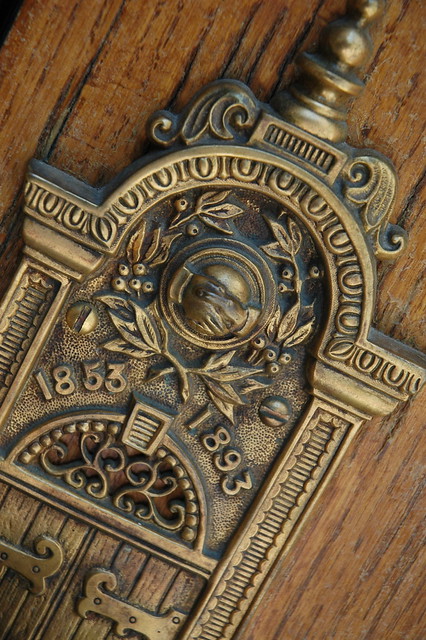
Olive branches and trees make an excellent temple symbol.  Olives represent peace.  They are a symbol of God's covenants with man (a dove brought an olive branch to Noah showing that the flood was over).  Olive oil is used in priesthood ordinances and so olives are a symbol of the priesthood and Christ.  Olive oil can provide light and olives symbolize light.  Olive trees represent Israel, God's chosen people, and all mankind (see Jacob 5 in The Book of Mormon where the tame olive tree represents Israel and the wild olive tree represents everyone else and God is concerned about saving both).  Olive oil is also a symbol of royalty and was used to anoint kings and priests.

In the temple, olives signify that temple work is done by the priesthood, concerns all of humanity, brings us peace and heals us.  It establishes the government of God.  Olives are indeed a great temple symbol.

I like how extensively the olive symbol was used in the Kansas City Missouri Temple and hope that olives, olive branches, and olive trees will continue to be used in temple architecture.  I also find olives fitting for Kansas City.  The temple is a 5 minute drive from Liberty Jail in Missouri where the prophet Joseph Smith and others were imprisoned for a time.  It is in a state where a lot of violence, murders, etc. were done against The Church of Jesus Christ of Latter-day Saints and where Latter-day Saints were driven from the state.  The olive branch helps show that this tragic past has been overcome and points to the fact that we believe that Jesus Christ will come to Missouri as a part of his second coming and that Zion, the New Jerusalem will be built not far from here in Independence, Missouri.  The peace of the gospel and the Millenial reign of Jesus Christ will more than overcome the past.

Those are my thoughts.  Please write and let us know what you think and particularly where else olives are used in temples.

Sunday, September 18, 2011

The New Two-Spire Temple Style

I love seeing the new renderings for temples planned to be built by The Church of Jesus Christ of Latter-day Saints.  This week the press leaked the rendering of the Payson Utah Temple (the church confirmed that this is indeed the temple rendering, but that it wasn't supposed to be released until next month).  The church also broke ground on the Trujillo Peru Temple and Philadelphia Pennsylvania Temple this week.  Pictures can be seen here, or later in this post for Philadelphia.

The Payson Temple looks like it may be a modified version of the Draper Utah and Gilbert Arizona Temples, but it could be unique.  The Trujillo Peru Temple is clearly the same style as the Cordoba Argentina and Phoenix Arizona Temples.  Then there is the Philadelphia Pennsylvania Temple which is one of the new two-spire style temples along with the Kansas City Missouri Temple, Brigham City Utah Temple, Rome Italy Temple and at least one other temple that hasn't had its design publicly revealed.  As a refresher, here are renderings of these 4 temples:

Kansas City Missouri Temple Rendering

Brigham City Utah Temple Rendering

Rome Italy Temple Rendering

Philadelphia Pennsylvania Temple Rendering
The main element that ties all of these temples together is the use of two spires to represent the Aaronic and Melchizedek Priesthoods.  Many Latter-day Saint temples have used either two spires, or two sets of three spires to represent the Priesthoods.  It is nice to see this symbolism returning to temples.

I think this new style of temple is distinctly Latter-day Saint and iconic.  These temples are taller with 3-4 stories in addition to a basement.  Their shape accentuates their height, as do the twin spires.  I like the vertical soaring nature of these temples.  The first two make good use of detailed architectural precast concrete while Rome and Philadelphia appear to use stone.  Either way, the detailing is done well.

I like how the Kansas City Missouri Temple and Rome Italy Temple are both modern.  Rome seems more modern with its numerous curves, sleek design, and cutaway spire.  I think this was a good choice as Rome is so overwhelmed with classical and other architecture that it would have been difficult for the temple to stand out (in a good way) and not look contrived with classical or neoclassical architecture.  The Kansas City Temple, on the other hand, has a modern and somewhat simple exterior, but uses traditional pyramidal spires in addition to arches to visually link it to the Salt Lake and other pioneer temples.  This is fitting as it is being built where a lot of early church history occurred.

The Brigham City Utah Temple is obviously meant to look like a pioneer style temple.  The church has stated that it is a mix between the Salt Lake Temple, St. George Temple, Logan Temple, and Manti Temple.  This helps it fit in with the Box Elder Tabernacle across the street and with the history of the area.  At the same time, if you look at the temple closely you'll notice that it is a modern interpretation of the pioneer style.  Precast concrete is used.  Also, the way the spires taper, concrete details are recessed, and other elements of the building are shaped, are very modern.  Crenelations have been replaced by recessed triangles in the concrete panels.  The buttressing, although present, is somewhat subdued.  So I see the Brigham City Temple as a successful blend of the historic pioneer style temples and present day architecture.

The Philadelphia Pennsylvania Temple is now the most classical (really neo-classical) of these temples (or any for that matter).  It looks like it could easily be 200 years old, and not like a modern take on a 200 year old building.  This appears to be intentional.  It helps the temple fit in a very historical city.  In the rendering you can see that the temple borrows elements from the building across the street (I think a court building).  It will also fit in with a nearby Catholic cathedral and other architecture in the area.  The spires should seem familiar.  They definitely fit in with spires in the city.  I can see that the architects have obviously borrowed elements from the spire of Independence Hall, also in Philadelphia, where the Declaration of Independence and U.S. Constitution were written and signed and where the Liberty Bell once hung.

I love the fine details of the Philadelphia Pennsylvania Temple, and look forward to seeing them in more detail.  I love the fluted columns with Corinthian capitals (I hope they are unique capitals).  I like the mixture or rectangular and cylindrical columns and the clustering of columns at the front.  The window variety is also interesting.  I particularly like the elliptical windows along the fourth level.  There are other details such as the short parapet railing running along the roof line and repeated at two heights on each tower.    I also like the floral bunches (would you call this a wreath or a garland or something else?) on the towers and look forward to seeing what types of flowers are put into them.  I also look forward to seeing the fine details on the cornice.

I also like the large details of the temple.  The corners of the building have a weightier look that makes the building appear strong while at the same time making the center windows seem even more open and beautiful.  The first level is also made of massive blocks which gives it a weighty look.  This is a good architectural trick to give balance to an exterior and makes the temple look enduring.  The soaring spires, combined with the 4 stories and somewhat slender proportions, make the temple appear tall and grand in a great way.

I love the symbolism of this temple with its two spires based on Independence Hall.  This is fitting as Pennsylvania is where the U.S. government was set up with the Declaration of Independence and the U.S. Constitution which we believe to be inspired by God.  The spires represent the priesthoods and remind us that Pennsylvania is also where the government of God, the priesthood, was restored to the earth in 1829.  The Aaronic Priesthood and the Melchizedek Priesthood were restored to the earth by John the Baptist and Peter, James and John respectively near Harmony Pennsylvania.

The whole interior of this temple should be interesting.  The Manhattan New York Temple's interior would fit the exterior architecture perfectly.  It borrowed the neoclassical elements from the Salt Lake Temple.  I would be happy if the Philadelphia Pennsylvania Temple also borrowed interior elements from the Salt Lake Temple.  The murals could also show the area around Harmony, Pennsylvania where the priesthoods were restored and where Joseph Smith and Oliver Cowdery were baptized.  Depictions of the priesthood restorations and baptisms would be great in murals.  Much of the translation of The Book of Mormon also happened in this state and should at least show up in a painting.  Also, the Founding Fathers who met at Independence Hall appeared in the St. George Utah Temple to have their temple work done.  I would add a picture of that event somewhere in the temple.

I really like the new two-spire temple style and hope that the church uses it for a while.  I think it is the best style in a long time.  Please comment and let us know what you think about this style of temple, the individual temples, or anything else in this post.

Thursday, February 11, 2010

Kansas City Temple design

I recently found an architectural rendering of the Kansas City Missouri Temple on ldschurchtemples.com (a wonderful site). The picture was just removed from the site today for some reason, but you can probably find it elsewhere.

The temple design showed a two towered (2 steeple) structure. I was very happy to see this. A lot of temples have the East side represent the Melchizedek Priesthood and the West side represent the Aaronic Priesthood. The Salt Lake Temple started this pattern, having 3 towers on the East and 3 on the West. Logan and Manti look like they have 2 towers (technically they have 2 smaller towers with staircases on either side of each main tower). The San Diego California Temple was the next two ended temple (technically 10 towered, but there are two main towers with 4 smaller towers around each main tower). Then the Vernal Utah Temple was made with 2 towers (I believe the original tabernacle the temple was made from had the two towers).

Recently the church has been building temples with a tower on one side and a small dome on the other end. I have thought that they should just add a second tower. I know building codes don't always allow two spires, but when possible, why not? I think two towers make a temple seem like a special building, not just a fancy church. It adds to the uniqueness of the architecture and adds symbolism.

The KC Temple design isn't perfect, but I like it. It reminds me of the Logan temple in several ways, with the 2 towers being the main one. I look forward to having it built