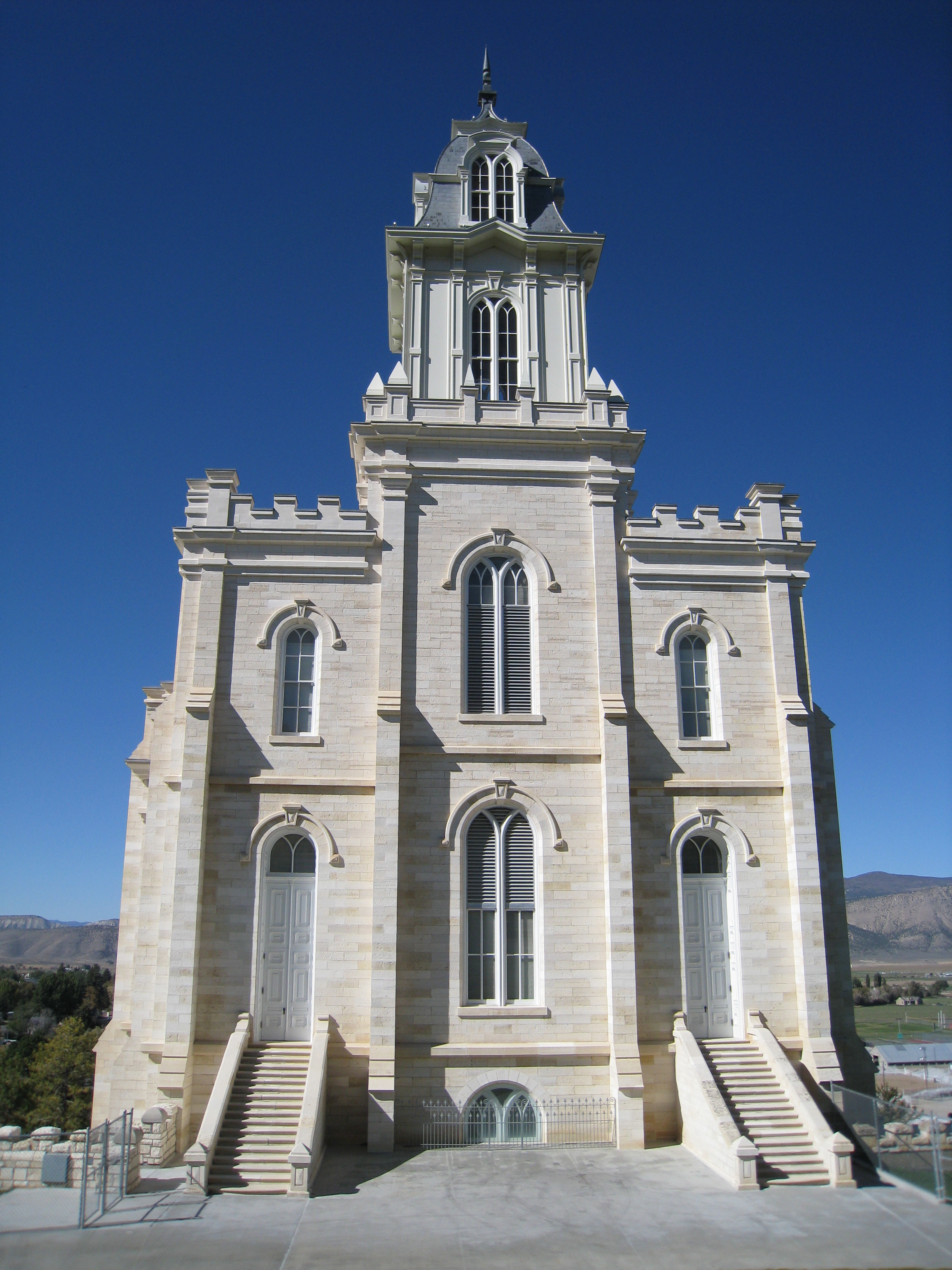
Perhaps you are wondering what a crenelation is. It is a parapet with short segments cut out. They are used in castles and fortress walls. So I could have also labeled this post "Battlements on Latter-day Saint Temples" or "The Castellated Temple Style". But crenelation is a fun word, so I'm going to use it.
A major feature of the temples Brigham Young built are the crenelations and other castle style architecture used. The pioneers were trying to literally build the Kingdom of God and it showed in their architecture. Even churches were made to resemble castles. The defensive architecture was also used as a symbol of the protection faithfully living the gospel and attending the temple provided (temporally and spiritually). It also reinforced the royal imagery of a church with the royal priesthood and as sons and daughters of God destined to be kings and queens. It reminds us that the temple is the House of the Lord with Christ as the King of Kings, the Prince of Glory. The castle look also visually unites the four pioneer temples despite their differences.
The St. George Temple was the first to look like a castle. It is brilliant white and has buttresses and crenelations giving it a look of strength and nobility.
The Logan Temple was built next and it again features buttresses and crenelations or battlements. The current dark stone seems to add to the fortress look of the temple (originally it was painted white). The corner towers are also octagonal giving a turret look which makes the building look even stronger.
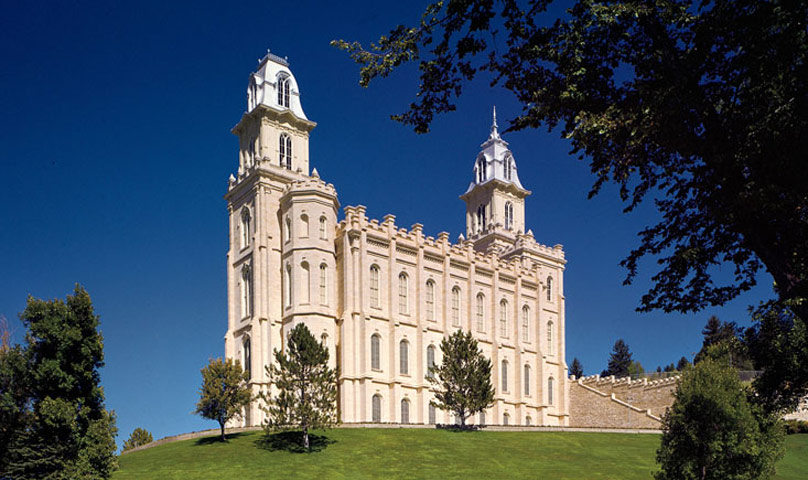
The Manti Temple continued to use castle features despite having towers with French revival influences. Again buttresses and crenelations are found on the walls. The middle towers also have pyramidal stones at the tops of the walls that make them look even more defensive. Another feature is the large stone retaining wall which includes crenelations and adds to the fortified look. The west end towers are octagonal giving a turret look, while the east towers are all square to make them visually appealing butting into a hill. This also makes the east towers appear weightier and stronger and larger, which is fitting as they represent the Melchizedek Priesthood.
The Salt Lake Temple is of course covered with castle elements. Its architecture is often called castellated gothic (I think the name isn't very fitting as the architecture isn't very gothic with no pointed arches or flying buttresses and relatively little glass). The architecture is very well done and beautiful. The temple really is a conglomeration of styles, but the crenelations, buttresses, and deeply set windows all give a feeling of strength and a castle look. The use of normal arches and not pointed arches probably helps it look like a castle as well. You might also notice that the buttresses extend above the crenelated parapet. This is because at that level every other buttress is also a chimney. You can see that half of them are open in this photo. The open ones are chimneys.
These four temples, the pioneer temples, are the only ones to use the castle style with crenelations. Other temples have mimicked features of these temples including the Brigham City Utah Temple which is currently under construction. That temple isn't using crenelations. The San Diego Temple is often compared to a castle and it is beautiful and has a look of strength, but it is not crenelated. The crenelated castle style is part of what makes the pioneer temples unique. I would like to see it incorporated into a new temple, but if not, we still have four superb examples of the style. I should also mention that using a crenelated castle style of church architecture is not unique to Mormonism - I saw many examples of it on my mission in England.
Architectural and other insights about temples of The Church of Jesus Christ of Latter-day Saints
Showing posts with label Manti Temple. Show all posts
Thursday, May 5, 2011
Sunday, May 1, 2011
Holy of Holies in Temples of The Church of Jesus Christ of Latter-day Saints
The Holy of Holies is the most sacred part of a temple and is only really in one temple today - the Salt Lake Temple. Little known is the fact that several temples have had Holy of Holies.
To start out I should point out that the term "Holy of Holies" comes from the Bible and referred to the most sacred part of the Tabernacle, Solomon's Temple, Zerrubbabel's Temple, and the Temple of Herod. The term "Most Holy Place" is usually another name for the Holy of Holies. The room contained the ark of the covenant and could only be entered by the High Priest once a year. It was separated from "the holy place" by the veil of the temple. In this way, our current temple celestial rooms are somewhat comparable to the Jewish Holy of Holies. Still, the rooms are quite a bit different. This should be expected as the Jewish temples were Aaronic Priesthood preparatory temples while ours are Melchizedek Priesthood higher law Christian temples.
The Holy of Holies in our temples have some similarities to their ancient counterparts. They have limited access - the prophet and occasionally others can enter the room. They are also used for heavenly visitations. Anciently, the Holy of Holies was where Gabriel appeared and announced to Zacharias that his wife would give birth to John the Baptist. In today's Holy of Holies, the prophet may receive similar heavenly visitations and directions on how to run Christ's church.
You might wonder what else "Holy of Holies" is used for. Apparently it is used for the higher ordinances of the priesthood. Apostle James E. Talmage said that it is "reserved for the higher ordinances in the priesthood relating to the exaltation of both living and dead". See his book The House of the Lord for this information. There are several temple ordinances mentioned in the scriptures which aren't performed often or even talked about regularly. I suspect that some of them might performed in the holy of holies. Here is one such verse:
Notice that this verse says "most holy places" which might mean "Holy of Holies". I suspect that the "memorials for your sacrifices by the sons of Levi" may simply refer to the sacrament served during solemn assemblies. In another place we read:
This verse refers to the ordinance of washing of feet - particularly in relation to the School of the Prophets. This ordinance was instituted by Jesus Christ just prior to his crucifixion and is a priesthood ordinance. Christ gave this ordinance to his apostles and I highly suspect that the same ordinance is given to any apostle, although it is also apparently given to others as well. It would not surprise me if the Holy of Holies was used for this ordinance, although it may be performed elsewhere in the temple.
Lets leave this chain of thought and instead get to the architecture of the Holy of Holies and when they have been used.
You can consider the Kirtland Temple to have included a Holy of Holies. The assembly halls could be divided using curtains (essentially veils) and on April 3, 1836 the Melchizedek Priesthood pulpits were curtained off with Joseph Smith and Oliver Cowdery inside when Jesus Christ, Moses, Elias, and Elijah appeared to them, accepted the temple, and conferred priesthood keys and the sealing power. For this reason, I think you could consider the pulpits in the Kirtland Temple as an early Holy of Holies.
The original Nauvoo Temple included a sealing room identified as the Holy of Holies. This was room 1 or the clerk's office. It was a sealing room, clerk's office, and Holy of Holies. Apparently it was used so much for the higher ordinances that other rooms had to be used for sealings so the room could be used for the higher ordinances. See this article for more details. Here is a drawing of a sealing room in the original Nauvoo Temple from lds.org. Details of how the room looked are probably guessed, but it gives you some idea of what the Holy of Holies may have looked like.
I don't know if the St. George Temple had a Holy of Holies, but I suspect it at least had a sealing room occasionally used for that purpose.
The Logan Temple used to contain a sealing room sometimes used as the Holy of Holies. This was the Gold Room. The room had gold directly applied to the plaster walls using a hot iron. As you can see, intricate patterns were made on the walls. The curtain is covering a doorway leading into the southeast tower spiral staircase. Also, notice the stained glass window. The windows were removed when the temple was gutted and remodeled in the 1980s. You can see the windows in the Church History museum (and I think the Manti Temple cafeteria has some of them as well - they looked familiar last time I ate there).
The Manti Temple also included a Holy of Holies. This one is directly off the celestial room and is still in the temple. It has its door left open so you can see the room and is now officially a sealing room, although one you can't use. Apparently President Hinckley wanted the room kept special because of its history (according to temple workers at the Manti Temple who said the room is rumored to have been a Holy of Holies. As you can see, the room is extremely ornate. I particularly like the arched area above the altar and the intricate detailing used there. Even small details such as the door handle and the hinges on the door are covered in symbolic details. This really is a fitting Holy of Holies.
The Salt Lake Temple is currently the only temple with a permanent Holy of Holies. This room is accessed from the celestial room and is in between two sealing rooms that are also directly off the celestial room. The room is round with a dome. In fact, the room directly above the Holy of Holies is called the dome room because the dome ceiling of the Holy of Holies takes up the middle of the room. As you can see, the room has numerous art glass windows in the dome (lights in the dome room light them up). There is also an authentic Tiffany Glass window depicting the First Vision (which can be seen on the other side of the window from the sealing office). The glass window says
In many ways we only need the one Holy of Holies because a major function of the room is for the prophet to go and pray and receive revelation and heavenly visitations relating to how the church should be run. Yet, it also has its function for higher ordinances and the prophet (or apostles) may wish to use a Holy of Holies when they are away from Salt Lake. For these reasons, sealing rooms in temples are occasionally used as Holy of Holies. I was told in the Preston England Temple that one of the sealing rooms in that temple is designated to be used for the prophet or apostles when needed. When they need the room it is temporarily set apart for that purpose, so essentially it is occasional a Holy of Holies. This may also explain why many temples have one small sealing room that is really nice, but impractical for large weddings. It is probably used only for sealings for the dead and also rarely as a Holy of Holies.
I hope you found this interesting. You may comment but remember that this is on the internet and these are sacred rooms, so let's be restrained in our comments on this one.
Here is a picture of the Dome Room, the room above the Holy of Holies in the Salt Lake Temple. It is just used to access the ceiling lights above the Holy of Holies and has been used as a dressing room.
Talmage describes the Dome Room as follows:
To start out I should point out that the term "Holy of Holies" comes from the Bible and referred to the most sacred part of the Tabernacle, Solomon's Temple, Zerrubbabel's Temple, and the Temple of Herod. The term "Most Holy Place" is usually another name for the Holy of Holies. The room contained the ark of the covenant and could only be entered by the High Priest once a year. It was separated from "the holy place" by the veil of the temple. In this way, our current temple celestial rooms are somewhat comparable to the Jewish Holy of Holies. Still, the rooms are quite a bit different. This should be expected as the Jewish temples were Aaronic Priesthood preparatory temples while ours are Melchizedek Priesthood higher law Christian temples.
The Holy of Holies in our temples have some similarities to their ancient counterparts. They have limited access - the prophet and occasionally others can enter the room. They are also used for heavenly visitations. Anciently, the Holy of Holies was where Gabriel appeared and announced to Zacharias that his wife would give birth to John the Baptist. In today's Holy of Holies, the prophet may receive similar heavenly visitations and directions on how to run Christ's church.
You might wonder what else "Holy of Holies" is used for. Apparently it is used for the higher ordinances of the priesthood. Apostle James E. Talmage said that it is "reserved for the higher ordinances in the priesthood relating to the exaltation of both living and dead". See his book The House of the Lord for this information. There are several temple ordinances mentioned in the scriptures which aren't performed often or even talked about regularly. I suspect that some of them might performed in the holy of holies. Here is one such verse:
Therefore, verily I say unto you, that your annointings, and your washings, and your baptisms for the dead, and your solemn assemblies, and your memorials for your sacrifices by the sons of Levi, and for your oracles in your most holy places wherein you receive conversations, and your statutes and judgments, for the beginning of the revelations and foundation of Zion, and for the glory, honor, and endowment of all her municipals, are ordained by the ordinance of my holy house, which my people are always commanded to build unto my holy name.
D&C 124:39
And he shall be received by the ordinance of the washing of feet, for unto this end was the ordinance of the washing of feet instituted.
D&C 88:139-141
Lets leave this chain of thought and instead get to the architecture of the Holy of Holies and when they have been used.
You can consider the Kirtland Temple to have included a Holy of Holies. The assembly halls could be divided using curtains (essentially veils) and on April 3, 1836 the Melchizedek Priesthood pulpits were curtained off with Joseph Smith and Oliver Cowdery inside when Jesus Christ, Moses, Elias, and Elijah appeared to them, accepted the temple, and conferred priesthood keys and the sealing power. For this reason, I think you could consider the pulpits in the Kirtland Temple as an early Holy of Holies.
The original Nauvoo Temple included a sealing room identified as the Holy of Holies. This was room 1 or the clerk's office. It was a sealing room, clerk's office, and Holy of Holies. Apparently it was used so much for the higher ordinances that other rooms had to be used for sealings so the room could be used for the higher ordinances. See this article for more details. Here is a drawing of a sealing room in the original Nauvoo Temple from lds.org. Details of how the room looked are probably guessed, but it gives you some idea of what the Holy of Holies may have looked like.
I don't know if the St. George Temple had a Holy of Holies, but I suspect it at least had a sealing room occasionally used for that purpose.
The Logan Temple used to contain a sealing room sometimes used as the Holy of Holies. This was the Gold Room. The room had gold directly applied to the plaster walls using a hot iron. As you can see, intricate patterns were made on the walls. The curtain is covering a doorway leading into the southeast tower spiral staircase. Also, notice the stained glass window. The windows were removed when the temple was gutted and remodeled in the 1980s. You can see the windows in the Church History museum (and I think the Manti Temple cafeteria has some of them as well - they looked familiar last time I ate there).
![]() |
| Logan Temple Gold Room - Sometimes a Holy of Holies |
![]() |
| Logan Temple Gold Room - Sometimes a Holy of Holies |
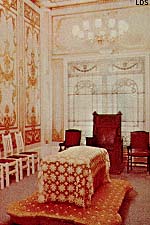
The Manti Temple also included a Holy of Holies. This one is directly off the celestial room and is still in the temple. It has its door left open so you can see the room and is now officially a sealing room, although one you can't use. Apparently President Hinckley wanted the room kept special because of its history (according to temple workers at the Manti Temple who said the room is rumored to have been a Holy of Holies. As you can see, the room is extremely ornate. I particularly like the arched area above the altar and the intricate detailing used there. Even small details such as the door handle and the hinges on the door are covered in symbolic details. This really is a fitting Holy of Holies.
![]() |
| Manti Temple Sealing Room - Sometimes a Holy of Holies |
IF ANY OF YOU LACK WISDOM LET HIM ASK OF GOD
THAT GIVETH TO MEN LIBERALLY AND UPBRAIDETH NOT
AND IT SHALL BE GIVEN HIM
James 1-5v
THIS IS MY BELOVED SON HEAR HIM
The room contains other nice architectural details. Carved faces are found on the arches. Vines are found on the columns. Sconces, a chandelier(s?), and art glass windows bring a lot of light into the room. You can also see that the room has intricate carvings. Despite all of this, the room is remarkably restrained for a room with so many intricate details. In Talmage's book The House of the Lord he states that the Holy of Holies is
reached by an additional flight of six steps inside the sliding doors. The short staircase is bordered by hand-carved balustrades, which terminate in a pair of newel-posts bearing bronze figures symbolizing innocent childhood; these support flower clusters, each jeweled blossom enclosing an electric bulb. On the landing at the head of the steps is another archway, beneath which are sliding doors; these doors mark the threshold of the inner room or Holy of Holies. . .Talmage then describes the Holy of Holies:
The floor is of native hard wood blocks, each an inch in cross section. The room is of circular outline, eighteen feet in diameter, with paneled walls, the panels separated by carved pillars supporting arches; it is decorated in blue and gold. The entrance doorway and the panels are framed in red velvet with an outer border finished in gold. Four wall niches, bordered in crimson and gold, have a deep blue background, and within these are tall vases holding flowers. The room is practically without natural light, but it is brilliantly illuminated by a large electrolier and eight side clusters of lamps. The ceiling is a dome in which are set circular and semicircular windows of jeweled glass, and on the outside of these, therefore above the ceiling, are electric globes whose light penetrates into the room in countless hues of subdued intensity. . .
![]() |
| Salt Lake Temple Holy of Holies |
I hope you found this interesting. You may comment but remember that this is on the internet and these are sacred rooms, so let's be restrained in our comments on this one.
Here is a picture of the Dome Room, the room above the Holy of Holies in the Salt Lake Temple. It is just used to access the ceiling lights above the Holy of Holies and has been used as a dressing room.
![]() |
| Dome Room Above Holy of Holies in the Salt Lake Temple |
. . . the large Dome Room, thirty nine by forty four feet. On the south side are three oval windows, and opposite these on the north are semi-discs of pebbled glass looking down into the Celestial Room and set in the arches thereof. In the center appears a large dome, fifty one feet in circumference at its base and seven feet high. This is set with seventeen jeweled windows and may be readily recognized as the ceiling of the Holy of Holies . . . In each of these windows electric bulbs are placed, and it is from these the room below derives its beauty of ceiling illumination and coloring. The walls are hung with portraits of Church authorities. No specific ordinance work belongs to this apartment. . .For more information, please read James E. Talmage's The House of the Lord first printed in 1912.
Monday, April 18, 2011
Temple Spiral Staircases
When The Tolmans suggested that I write a post on The Church of Jesus Christ of Latter-day Saints' temple staircases, I don't think they considered how broad of a topic that really is. There are internal and external staircases. There are multiple configurations of staircases. I've been organizing what to write on staircases for the last week or two and have decided that the topic will require multiple posts. I'm going to start with spiral staircases.
Spiral staircases are perhaps the most impressive type of staircase. They require great skill to build. Their form has a special grace that makes them among the most attractive staircases around. The Kirtland Ohio Temple staircases are curved, although I don't think you would consider them full spiral staircases. Here are some examples of temples with proper spiral staircases:
The Nauvoo Illinois Temple (original and rebuilt) has spiral staircases without central supports, similar to those in the Manti Temple. I was told that in the rebuilt Nauvoo Temple the staircases are not free standing because they couldn't figure out how to make them work. It is much more likely that the engineers decided not to make them free standing for other reasons and decided this was fine because they still look the same.
When I visited the Nauvoo Temple, the workers told us that President Hinckley asked the nearby Shaker community (it may have been the Mennonites) to do the woodwork for the temple including these very nice hardwood railings. If you don't know, the Shakers (and Mennonites) are famous for their craftsmanship. The Shaker congregation was invited to tour the completed temple before its dedication. This is a great example of including other faiths and getting along with others as Christ would have us do. The rebuilt Nauvoo Temple does not include spiral staircases in all four towers. Apparently the current building codes would only allow a few to be spiral. They have wisely chosen to have a spiral staircase lead to the dressing rooms and the baptistery so that all patrons will get to see the staircases.
The St George Utah Temple was the next built and it has spiral staircases in the corners. I haven't found a photo of them yet; however, I asked to see them the last time I visited the St. George Temple and they showed them to me. I recall that they had central supports. I also noticed that they don't air condition the staircases - they were really warm.
The Logan Utah Temple was built next and it has spiral staircases in the four corner towers. I think they are still there in the remodeled temple, although I have never seen them and do not know if they will show them to you. The pictures to the left show these staircases. The first shows them looking up from the assembly hall level. They are free standing from this level up. The next photo shows a view looking down and the last shows a view walking down the stairs.
When the Logan Temple was being remodeled they wanted to run conduits through the center supports of the spiral staircases. When they tried this they discovered that the central supports are solid stone.
The Logan Temple has had several fires over the years. A fire in 1917 destroyed a spiral staircase that used to be in the middle of the temple (led from the celestial room back to the first floor) and it was replaced with an orthogonal staircase, which has since been demolished completely when the temple was gutted.
The Manti Utah Temple was built next and has some of the most unique spiral staircases in the world. In the two west corner towers there are freestanding spiral staircases without central supports. If you attend this temple, ask a worker to see the staircases and they will take you to see them. They have incredible craftsmanship. When they restored the temple for the centennial they found something like 2 creaks in the one staircase and none in the other, despite being heavily used by temple workers and used by patrons to access several sealing rooms in the towers. The seams between pieces of wood on the railings are also extremely difficult to find.
I said that these were some of the most unique staircases in the world. That is because there are only a few free standing spiral staircases that lack central supports in the world. I believe there are only eight in the U.S. with two being in the Supreme Court Building (those are elliptical). So the Manti Temple spiral staircases are really special.
One of the staircases goes up clockwise and the other counterclockwise. They really are an impressive sight and a great asset of the Manti Temple.
The Salt Lake Temple was built next and it includes eight spiral staircases. All have central supports. The four corner towers have solid granite staircases. These have a nice dark wood wainscot. I have only seen these towers from the baptistery level. There they have actually installed restrooms on the staircase (weirdly shaped and tight, but interesting).
The other four spiral staircases are found in the priesthood assembly hall. Here, four spiral staircases provide access to the balcony seating. These show fine woodwork. and wonderful carpenters' skills. I hope to see them some day.
The next temple to include spiral staircases, that I am aware of, is the San Diego California Temple built in 1993. It includes a very modern spiral staircase. As you can see, the staircase has exquisite woodwork. It is also very open, which is important as it allows all the light coming through the art glass windows to permeate the temple.
The last spiral staircase that I know of in a Latter-day Saint temple is found in the newly built Copenhagen Denmark Temple. This temple was remodeled from an existing church that was gutted, so there is a chance that the staircase was part of the original church. If not, I am glad to see the church go out of its was to include a spiral staircase. This staircase is also not centrally supported, making it even nicer. I love how the light floods into the temple from a well placed skylight.
Those are the spiral staircases I know of in Latter-day Saint Temples. If you know of others please comment. Also, If you have a photo of the St. George Temple spiral staircases please let me know. I would love to have one. Please comment and let us know what you think about these staircases. In the future I will post about other temple staircases. There is a lot more variety in them than you may realize.
Friday, April 8, 2011
The Church of Jesus Christ of Latter-day Saints Historical Temple Artifacts
While most Latter-day Saint temples have historical artifacts placed in their cornerstones, several temples built by The Church of Jesus Christ of Latter-day Saints have historical artifacts on display.
I was walking through the Ogden Temple one day and right by the clothing rental I noticed a copy of The Book of Mormon on display. I believe it was a first edition, although it may have been a few years newer. I assume they will keep it on display once the temple remodel is completed.
In the Manti Temple there are many neat things to see such as the spiral staircases. One item that can be overlooked is a piece of temple clothing framed and hanging on a wall in a hallway. If I remember correctly, the item was from the 1850s. It is in the hallway leading from the recommend desk to the clothing rental.
The Nauvoo Illinois Temple was rebuilt in 2002. Both times that I visited it I asked the workers to show me what they could. They showed me the sealing rooms, baptistery, and assembly hall. They also showed me the historical artifacts that are now in the temple. In the recorder's office you can see a sword owned by Joseph Smith from when he led the Nauvoo Legion. The sword is engraved by him with his name, and also with the names of each person who owned it through the years. Eventually it was donated to the church and is now in the temple. This isn't the only artifact. The hallway north of the assembly hall contains several. There is a framed set of original keys to the temple. Several are replicas, but some keys in the set are the originals. There are also several pieces of framed temple clothing dating to Joseph Smith's time. I believe the first framed set belonged to Lucy Mack Smith, Joseph Smith Jr.'s mother. There is another piece of temple clothing further down the hall.
These temple artifacts are nice to see. I particularly like the old temple clothing as it allows me to compare how pieces were then to how they are now and determine what is merely style, and what is potentially significant and symbolic. It also let me see a way something used to be. I didn't realize we could use more white. I won't say more on that.
Do you know of any historical artifacts on display in temples? Please comment.
I was walking through the Ogden Temple one day and right by the clothing rental I noticed a copy of The Book of Mormon on display. I believe it was a first edition, although it may have been a few years newer. I assume they will keep it on display once the temple remodel is completed.
In the Manti Temple there are many neat things to see such as the spiral staircases. One item that can be overlooked is a piece of temple clothing framed and hanging on a wall in a hallway. If I remember correctly, the item was from the 1850s. It is in the hallway leading from the recommend desk to the clothing rental.
The Nauvoo Illinois Temple was rebuilt in 2002. Both times that I visited it I asked the workers to show me what they could. They showed me the sealing rooms, baptistery, and assembly hall. They also showed me the historical artifacts that are now in the temple. In the recorder's office you can see a sword owned by Joseph Smith from when he led the Nauvoo Legion. The sword is engraved by him with his name, and also with the names of each person who owned it through the years. Eventually it was donated to the church and is now in the temple. This isn't the only artifact. The hallway north of the assembly hall contains several. There is a framed set of original keys to the temple. Several are replicas, but some keys in the set are the originals. There are also several pieces of framed temple clothing dating to Joseph Smith's time. I believe the first framed set belonged to Lucy Mack Smith, Joseph Smith Jr.'s mother. There is another piece of temple clothing further down the hall.
These temple artifacts are nice to see. I particularly like the old temple clothing as it allows me to compare how pieces were then to how they are now and determine what is merely style, and what is potentially significant and symbolic. It also let me see a way something used to be. I didn't realize we could use more white. I won't say more on that.
Do you know of any historical artifacts on display in temples? Please comment.
Wednesday, April 6, 2011
Temple Additions
At the request of The Tolmans who commented on my last post, I'm going to talk a little about temple additions.
The St. George Utah Temple had a stair addition on the rear of the temple. This didn't alter the symmetry (as other temple additions have) and blends in fairly well with the temple. It isn't a perfect addition. Details such as window style give away that it is a 1970s addition. There is also an annex with dressing rooms, etc. that is white, but otherwise doesn't match the original temple.
The Logan Utah Temple has been completely gutted and rebuilt on the inside. At the same time a stair tower was added to the center of the north side. Unfortunately, this ruins the original symmetry of the temple, and the windows don't match the original temple. The stone is a fairly good match. The temple originally jutted out slightly in the same location as the current stair tower (I'm not sure if this was from an earlier stair addition). In that case, the extension had a circular window that looked nice. The original annex also matched the stone of the main temple and was castellated. I'm not sure why they replaced that annex with a cream 1970s style annex that obviously doesn't match the time period of the original temple. But when the Logan Temple was remodeled in the 1970s, little, if any, attention was paid to historical details or matching styles. This is painfully apparent on the inside which looks nothing like the exterior would suggest.
The Manti Temple used to have a drive through tunnel beneath the east towers. This has been blocked off now and parts of it can be seen near the current women's dressing room. Otherwise I am only aware of the current annex addition with dressing rooms. In this case, it matches the temple stone and the annex interior matches the styles present in the rest of the temple.
The Salt Lake Temple has had a sealing room annex added (on the right side in this picture). This addition is 2 stories tall and is found on the north side of the temple. This ruins the symmetry of the original temple, and the windows don't quite match those found on the original temple. Even so, this addition blends fairly well and was needed to increase the number of sealing rooms from 3 to 14.
The Boise Idaho, Chicago Illinois, and Dallas Texas Temples were overcrowded upon opening. Each was remodeled within a few years. The additions present some problems. In at least Dallas and Boise you go to the chapel and then you go back through the dressing rooms to get to the endowment rooms. This is awkward and obviously wasn't the original plan for the building. Boise's addition isn't the most balanced. I remember Dallas' addition doing a better job of preserving symmetry. In addition, one of the formerly detached spires is now in a lobby with glass skylights providing a nice view. I haven't been to the Chicago Temple, so I am not sure how the addition works there.
Currently, the Buenos Aires Argentina Temple is being remodeled. Two wings are being added that match the original temple architecture and preserve the original symmetry.
The Monticello Utah Temple was originally built with just one endowment room, one sealing room, the celestial room, and a baptistery. It was so small because it was a test small temple. Shortly after completion, the temple was expanded and now looks like most other first style small temples, although the window elevations change along the building, giving away that there is an addition. Similarly, the Anchorage Alaska Temple was originally built small and has since been expanded. This gives it a different look.
I've surely missed some temple additions. I've noticed that most additions haven't done the best jobs of preserving the original architecture (they ruin symmetry, windows don't match, rooms and corridors don't flow right afterwords). Still, most aren't overly offensive, and a few work.
Comment and let us know what you think.
The St. George Utah Temple had a stair addition on the rear of the temple. This didn't alter the symmetry (as other temple additions have) and blends in fairly well with the temple. It isn't a perfect addition. Details such as window style give away that it is a 1970s addition. There is also an annex with dressing rooms, etc. that is white, but otherwise doesn't match the original temple.
The Logan Utah Temple has been completely gutted and rebuilt on the inside. At the same time a stair tower was added to the center of the north side. Unfortunately, this ruins the original symmetry of the temple, and the windows don't match the original temple. The stone is a fairly good match. The temple originally jutted out slightly in the same location as the current stair tower (I'm not sure if this was from an earlier stair addition). In that case, the extension had a circular window that looked nice. The original annex also matched the stone of the main temple and was castellated. I'm not sure why they replaced that annex with a cream 1970s style annex that obviously doesn't match the time period of the original temple. But when the Logan Temple was remodeled in the 1970s, little, if any, attention was paid to historical details or matching styles. This is painfully apparent on the inside which looks nothing like the exterior would suggest.
The Manti Temple used to have a drive through tunnel beneath the east towers. This has been blocked off now and parts of it can be seen near the current women's dressing room. Otherwise I am only aware of the current annex addition with dressing rooms. In this case, it matches the temple stone and the annex interior matches the styles present in the rest of the temple.
The Salt Lake Temple has had a sealing room annex added (on the right side in this picture). This addition is 2 stories tall and is found on the north side of the temple. This ruins the symmetry of the original temple, and the windows don't quite match those found on the original temple. Even so, this addition blends fairly well and was needed to increase the number of sealing rooms from 3 to 14.
The Boise Idaho, Chicago Illinois, and Dallas Texas Temples were overcrowded upon opening. Each was remodeled within a few years. The additions present some problems. In at least Dallas and Boise you go to the chapel and then you go back through the dressing rooms to get to the endowment rooms. This is awkward and obviously wasn't the original plan for the building. Boise's addition isn't the most balanced. I remember Dallas' addition doing a better job of preserving symmetry. In addition, one of the formerly detached spires is now in a lobby with glass skylights providing a nice view. I haven't been to the Chicago Temple, so I am not sure how the addition works there.
Currently, the Buenos Aires Argentina Temple is being remodeled. Two wings are being added that match the original temple architecture and preserve the original symmetry.
The Monticello Utah Temple was originally built with just one endowment room, one sealing room, the celestial room, and a baptistery. It was so small because it was a test small temple. Shortly after completion, the temple was expanded and now looks like most other first style small temples, although the window elevations change along the building, giving away that there is an addition. Similarly, the Anchorage Alaska Temple was originally built small and has since been expanded. This gives it a different look.
I've surely missed some temple additions. I've noticed that most additions haven't done the best jobs of preserving the original architecture (they ruin symmetry, windows don't match, rooms and corridors don't flow right afterwords). Still, most aren't overly offensive, and a few work.
Comment and let us know what you think.
Tuesday, April 5, 2011
Words as Temple Decoration
Several temples of The Church of Jesus Christ of Latter-day Saints use words to decorate the temple. For example, at the entrance to the Cardston Alberta Temple there is this verse by Orson Whitney that I found here. Here is the verse:
The Manti Temple doorknobs contain what is claimed to be stylized Arabic (stylized to the point where the inscription cannot be interpreted today), a common art form used by Masons (the doorknob maker was a mason). For more information, read the book The Manti Temple. This book was printed to commemorate the centennial of the Manti Temple.
In Islam since images are often considered idol worship, their mosques and other buildings are often decorated with verses from the Koran, usually extremely stylized. So using text to decorate religious architecture is not even unique to Christianity (which has many examples of using scriptures to decorate churches). I also read a newspaper article a few years ago that featured an old Church of Jesus Christ of Latter-day Saints chapel with scriptures written on each of the roof trusses visible in the chapel.
The Oakland California Temple has relief sculptures of Christ in the New Testament and The Book of Mormon on the temple exterior. On the New Testament Side the inscriptions are:
There is also a large plaque quoting 3 Nephi 17 in the courtyard of the Oakland Temple.
Surely there are many more examples of words being used to decorate temples. Words can remind of of scriptures and easily put us in the right frame of mind. Also, they are easier to understand than the hidden symbols frequently used in temples. Scriptures can bring the spirit and remind us of things we should be focused on.
Although not decorative, when the Logan Temple was gutted they found a wall full of engravings in the plaster hidden beneath the surface. The inscriptions (with spelling errors galore) had names, mentioned that they were being persecuted, and gave other historical information.
I hope some of you know of engravings on temples and can add a comment telling us how words are used to decorate temples. We can also discuss how words could be used in future temple architecture, or what you think of the inscriptions I have highlighted so far. Please comment.
In other temples a verse of scripture is used. In the Mesa Arizona Temple, above the celestial room doors (seen from the grand staircase) is part of D&C 93:36:Where spreads a feast unknown to festive halls.
Freely partake, for freely God hath given
And taste the holy joys that tell of heaven.Here learn of Him who triumphed o’er the grave,
And unto men the keys, the Kingdom gave;
Joined here by powers that past and present bind
The living and the dead perfection find.
THE GLORY OF GOD IS INTELLIGENCEI think it was also in the Mesa Temple (but may have been elsewhere) that the beatitude found in Matthew 5:8 is inscribed on a wall:
BLESSED ARE THE PURE IN HEART FOR THEY SHALL SEE GODThe Idaho Falls Temple has Habukkuk 2:20 on the wall in a foyer area:
BUT THE LORD IS IN HIS HOLY TEMPLE: LET ALL THE EARTH KEEP SILENCE BEFORE HIM.Of course most temple exteriors contain the words:
HOLINESS TO THE LORDThe Salt Lake Temple contains a scroll stone engraved with the words:
THE HOUSE OF THE LORD
I AM ALPHA AND OMEGAThe original Nauvoo Temple had inscriptions in the lower assembly hall. Above the Melchizedek Priesthood pulpits, following the arch of the ceiling in gilded letters were the words:
THE LORD HAS SEEN OUR SACRIFICE - COME AFTER USBoth the Kirtland Ohio and Nauvoo Illinois Temples had assembly halls with three initials on each of the 24 pulpits. The Kirtland Temple had the Melchizedek Priesthood pulpits engraved with the following from top to bottom:
M.P.C. (Melchizedek Presiding Council)P.M.H. (Presiding Melchizedek High Priesthood)M.H.P. (Melchizedek High Priesthood)P.E.M. (Presiding or Presidency Elders Melchizedek)
On the eastern Aaronic Priesthood side the initials are from top to bottom:
This website claims that in the Nauvoo Temple the initials were, on the Melchizedek Priesthood side:B.P.A. (Bishop Presiding over Aaronic Priesthood)P.A.P. (Presiding or Presidency Aaronic Priests)P.T.A. (Presiding or Presidency Teachers Aaronic Priesthood)P.D.A. (Presiding or Presidency Deacons Aaronic Priesthood)
P.H.P. (President of the High Priesthood)And on the Aaronic Priesthood side there were the initials:
P.S.Q. (President of the Seventy Quorums)
P.H.Q. (President of the High priests Quorum)
P.E.Q. (President of the Elders Quorum)
P.A.P. (President of the Aaronic Priesthood)The assembly hall in the Salt Lake Temple contains inscriptions above the pulpits on each end. They are:
P.P.Q. (President of the Priests Quorum)
P.T.Q. (President of the Teachers Quorum)
P.D.Q. (President of the Deacons Quorum)
Aaronic Priesthoodand
Melchizedek Priesthood
The Manti Temple doorknobs contain what is claimed to be stylized Arabic (stylized to the point where the inscription cannot be interpreted today), a common art form used by Masons (the doorknob maker was a mason). For more information, read the book The Manti Temple. This book was printed to commemorate the centennial of the Manti Temple.
In Islam since images are often considered idol worship, their mosques and other buildings are often decorated with verses from the Koran, usually extremely stylized. So using text to decorate religious architecture is not even unique to Christianity (which has many examples of using scriptures to decorate churches). I also read a newspaper article a few years ago that featured an old Church of Jesus Christ of Latter-day Saints chapel with scriptures written on each of the roof trusses visible in the chapel.
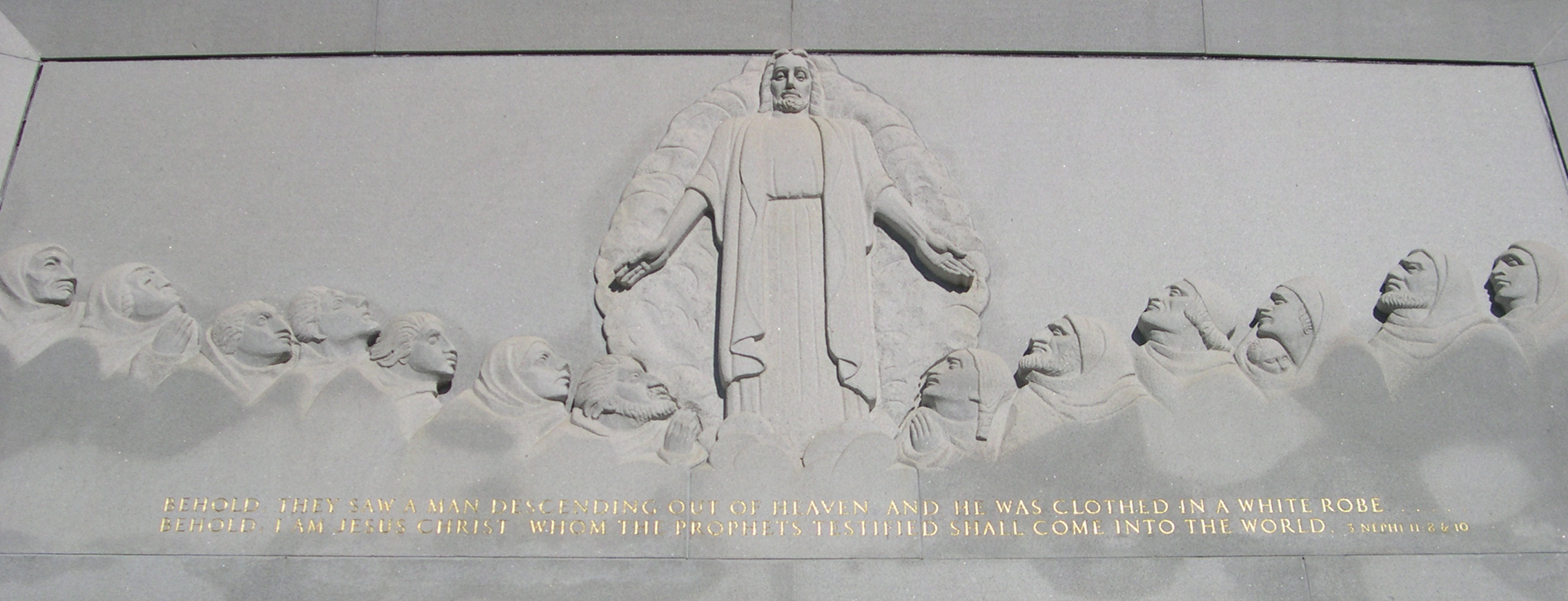
The Oakland California Temple has relief sculptures of Christ in the New Testament and The Book of Mormon on the temple exterior. On the New Testament Side the inscriptions are:
BLESSED ARE THE PURE IN HEART FOR THEY SHALL SEE GOD -Matt 5:8On The Book of Mormon side it reads:
SEEK YE FIRST THE KINGDOM OF GOD AND HIS RIGHTEOUSNESS -Matt 6:33
BEHOLD, THEY SAW A MAN DESCENDING OUT OF HEAVEN AND HE WAS CLOTHED IN A WHITE ROBE
BEHOLD, I AM JESUS CHRIST WHOM THE PROPHETS TESTIFIED SHOULD COME INTO THE WORLD- 3 Ne 11:2&10
There is also a large plaque quoting 3 Nephi 17 in the courtyard of the Oakland Temple.
Surely there are many more examples of words being used to decorate temples. Words can remind of of scriptures and easily put us in the right frame of mind. Also, they are easier to understand than the hidden symbols frequently used in temples. Scriptures can bring the spirit and remind us of things we should be focused on.
Although not decorative, when the Logan Temple was gutted they found a wall full of engravings in the plaster hidden beneath the surface. The inscriptions (with spelling errors galore) had names, mentioned that they were being persecuted, and gave other historical information.
I hope some of you know of engravings on temples and can add a comment telling us how words are used to decorate temples. We can also discuss how words could be used in future temple architecture, or what you think of the inscriptions I have highlighted so far. Please comment.
Sunday, March 27, 2011
Latter-day Saint Temple Murals - Pt 2 - The Manti and Salt Lake Temple Murals
In my last post I talked about how the first temple murals developed. With the Logan Temple built with progressive endowment rooms and murals, plans for the Salt Lake Temple and Manti Temple were updated to include progressive endowment rooms and murals.
The Manti Temple originally had murals painted by the pioneers. These were painted directly on the plastered walls and the murals in the garden and world rooms began to decay. Eventually the murals decayed so much that they could not be repaired and they had to be completely replaced. This is when the church commissioned Robert L. Sheppard and Minerva Teichert to paint the garden and world room murals, respectively. The rooms were completed in 1948. Please follow this link to read a great article on the world room mural which I think is the single best mural or piece of artwork in a temple. Here are pictures of the current Manti Temple Murals:
![]() |
| Manti Temple Baptistery |
The Manti Temple baptistery contains murals showing the baptism of Joseph Smith. I don't recall if other events are depicted in the murals, but this was the first baptistery to contain murals.
![]() |
| Manti Temple Creation Room |
The creation room has volcanoes and dinosaurs included in beautiful murals. During the session, they turn lights on symbolically to match events in creation.
![]() |
| Manti Temple Garden Room |
The garden room murals give a nice depiction of the Garden of Eden. Folding privacy screens with painted trees are also used so that actors presenting the endowment can have a place to hide behind. Potted plants (I think artificial) are also in the room.
![]() |
| Manti Temple World Room |
The world room contains an extremely involved mural. It depicts events from the Tower of Babel to the future founding of Zion in America. Abraham, Joseph, Moses, crusaders, Columbus, poor, rich, and royalty are among those pictured. The article I linked above goes into a lot more detail. There is a lesson about worldliness in the room. After attending the Manti Temple with my mom she said to me, "That's the first world room that made me feel like I didn't want to be in the world anymore and made me want to go into the terrestrial room while in the world room." Indeed, the painting shows the miserable, sick, poor, alone, needy people ignored by the rich and royals who aren't even happy themselves. At the front of the room is a Native American chief welcoming the people to the Americas. The chief is in a Christlike pose and guards the doors exiting the room. Behind him is a depiction of Zion in America as a conglomerate of various Latter-day Saint settlements in Utah. The message is then that we don't have to live in a telestial world in this world. If we come to Christ and live his gospel, then Zion can be established and this world can be a terrestrial world. As we covenant in this room and continue in the endowment, we leave this flawed world and enter the terrestrial room and a more glorious way of living. Anyways, you should read the article. It is very interesting.
While the Salt Lake Temple was originally going to simply have a lower and upper assembly hall, its plans were altered to have progressive endowment rooms and murals. To ensure quality murals for this and other temples, the church sent missionaries to Paris to study art so that they could come back to Utah and paint the Salt Lake Temple murals. This was known as the Paris Arts Mission. I could talk a bunch more about it, but the link has more than enough information, so please read it. As a side note, the church has started calling art missionaries to paint temple murals as this church news article about the Draper and Oquirrh Mountain Utah Temples discusses.
![]() |
| Salt Lake Temple Creation Room w/o Mural |
The Salt Lake Temple creation room was originally not painted with a mural (see photos in The House of the Lord; A Study of Holy Sanctuaries, Ancient and Modern by James E. Talmage). The current mural shows creation through the creation of plants. I'm not sure why the artist didn't include animals in the mural, but he didn't. To see the room with the mural, go to my post here. I'm not sure when the mural was added. Apparently sometime after Talmage wrote his book.
Originally the garden room was to be outside the temple in an attached greenhouse. Revised plans brought the garden room back inside the temple proper; however, a small greenhouse was attached to the wall behind the altar and three doorways entered into this greenhouse giving this room natural light and real plants. The greenhouse has since been removed. I talk about it a little in this post.
The Salt Lake Temple world room murals show nature competing. Plants fight for space and are unhealthy, dried out, broken, etc. Animals fight. A river erodes a hillside. The room is beautiful, but at the same time it shows that this world is fallen. I like the murals in this room. They convey through depictions of nature some of the problems with this fallen world.
So there is a little information on the Manti and Salt Lake Temple murals. Please comment and let us know what you think. I forgot to mention it in my last post, but if you have pictures of the Logan Temple murals, please comment and tell me where I can get them. I have only seen a very small glimpse of them in a book on the Logan Temple that shows them ripping the murals out.
Sunday, February 13, 2011
Unique Sealing Rooms
Today I'm just going to show some pictures and short commentary about what I consider are the most unique or interesting sealing rooms in Temples of The Church of Jesus Christ of Latter-day Saints. These rooms are used for temple marriages where a man and woman are married for time and all eternity and where children can be sealed to them for eternity.
The St. George Utah Temple has a number of unique sealing rooms. One is up a small staircase in the celestial room (in the tower). Most of the sealing rooms are on an upper floor and have a single round window going into each room. To me, the round window just makes the room feel unique.
The original Logan Utah Temple interior had a sealing room (shown to the left) with gold leafed walls and a stained glass window. It is extremely unfortunate that when the temple was remodeled the room and wall covering was lost. I think the gold leaf was lost because it was applied to plaster walls and so it couldn't be removed and brought to the new temple (I know that is what happened to at least most of the Logan Temple murals).
The Manti Utah Temple has many wonderful ornate sealing rooms. My favorite is a small one off the celestial room (that isn't used any more). I've been told that this room was the Holy of Holies until the Salt Lake Temple was completed. Then it was a sealing room for decades. Apparently President Hinckley wanted to preserve the room and thought it was extra special so he had the room stop being used for sealings. This could be a rumor, although I think it was a sealer that told me this. The room is beautiful with an arched ceiling and intricate gold patterns and detailed woodwork. The door is left open, but roped off so you can see it but not go all the way in now. It is also very small, with maybe room for 5 or 10 people to witness the sealing.
The Salt Lake Temple has many nice sealing rooms. Originally it just had 3 sealing rooms. Two were on either side of the Holy of Holies, just off the celestial room. The last was up a small staircase on the east side of the celestial room. The intricate craftsmanship in these rooms is wonderful to see. The sealing rooms flanking the Holy of Holies have stained glass windows. Still, my favorite of the three is at the top of the stairs off the celestial room, in the east center tower of the temple. I love that the staircase leading to this room has a cupid statue on the bottom rail post. This is a fitting symbol for the room where a man and a woman are married for time and all eternity. These rooms definitely are unique.
The Cardston Alberta Canada Temple is the first temple I know of with dark wood sealing rooms. This temple used extensive woodwork with intricate inlays using woods imported from around the world. As you progress in the temple the wood becomes more expensive, lush, an more intricately inlaid. This means that the celestial room is covered in really nice dark woods. The sealing rooms also end up dark with really involved inlays. I like this. It is so different from the usual white sealing room, while still being nice.
I know of only one other temple with dark woodwork in the sealing rooms. This is the Oakland California Temple. At least one (although not all) of the Oakland Temple sealing rooms is done in dark wood as seen in the picture below. I like the dark wood and think it would contrast nicely with the white clothing worn in the temple. I also like how here the altar glows in a bright contrast to the darker walls.
I have not been in any of the dark wood sealing rooms. If any of you have, please comment and tell us what they are like and what you think of them. Also, if you know of any dark wood sealing rooms that I haven't mentioned, please write and let us know about them.
I was going to write about barrel vaulted ceiling rooms, which would also include the Las Vegas Nevada Temple sealing rooms, but I decided to just focus on the best of the group. The San Antonio Texas Temple sealing room with a stained glass window of the tree of life is inspiring. The brightness and whiteness of the room seems to be enhanced by the colors of the tree of life window. Utah artist Tom Holdman did the stained glass windows for the entire temple and did a wonderful job in my opinion.
The pioneer temple sealing rooms:
The St. George Utah Temple has a number of unique sealing rooms. One is up a small staircase in the celestial room (in the tower). Most of the sealing rooms are on an upper floor and have a single round window going into each room. To me, the round window just makes the room feel unique.
![]() |
| Orig. Logan Temple Sealing Rm |
![]() |
| Manti Temple Sealing Room |
![]() |
| Salt Lake Temple SE Sealing Room |
![]() |
| Salt Lake Temple SW Sealing Room |
The dark wood sealing rooms:
![]() |
| Cardston Alberta Temple Sealing Room |
![]() |
| Cardston Alberta Temple Sealing Room |
![]() |
| Oakland California Temple Sealing Room |
San Antonio Texas Temple Tree of Life Sealing Room
I was going to write about barrel vaulted ceiling rooms, which would also include the Las Vegas Nevada Temple sealing rooms, but I decided to just focus on the best of the group. The San Antonio Texas Temple sealing room with a stained glass window of the tree of life is inspiring. The brightness and whiteness of the room seems to be enhanced by the colors of the tree of life window. Utah artist Tom Holdman did the stained glass windows for the entire temple and did a wonderful job in my opinion.
Washington D.C. Temple Oval Sealing Room
![]() |
| Washington D.C. Temple Sealing Room |
Since I am talking about unique sealing rooms I have to mention this sealing room in the Washington D.C. Temple. I love the oval shape of the room, the metallic wall covering (wall paper or metallic paint or something) that makes the walls shine. I also find the oval altar interesting.
![]() |
| Washington D.C. Temple Sealing Room (another view) |
So that is my list of the most unique sealing rooms. There are so many more nice sealing rooms that you can tell us about in the comments. I'll leave you with a picture of one of the Hong Kong China Temple sealing rooms. I like it mainly because it has elliptical windows, which is just cool.
Wednesday, November 3, 2010
The Church of Jesus Christ of Latter-day Saints' Temple Assembly Halls
Today I want to write about assembly halls in Latter-day Saint temples. These are also known as solemn assembly halls, assembly rooms, priesthood assembly halls, priesthood assembly rooms, or priesthood rooms and were a part of the first 5 temples built and several built since.
![]() |
| Kirtland Temple Lower Court |
The Kirtland Ohio Temple (1836) was essentially two assembly halls, one on top of the other. The only other rooms were a few small ones in the attic area. The lower room was designated for sacrament, preaching, fasting and praying. The upper room was used for the school of the prophets, a school for Latter-day Saint apostles dealing with secular and religious subjects. Both assembly halls had very unique architecture. The rooms had pulpits in the front and back. One set was for the Melchizedek Priesthood leadership and the other was for the Aaronic Priesthood leadership. The pulpits on each side consisted of 12 pulpits arranged in 4 rows of 3 pulpits. Each pulpit had three letter initials on it designating who sat there. The three pulpits on each row had the same initials. These initials on the western Melchizedek Priesthood side are from top to bottom:
M.P.C. (Melchizedek Presiding Council) – First Presidency of church or stake
P.M.H. (Presiding Melchizedek High Priesthood) – Quorum of 12 Apostles or Stake High Council
M.H.P. (Melchizedek High Priesthood) – High Priests Quorum
P.E.M. (Presiding or Presidency Elders Melchizedek) – Elders Quorum Presidency
On the eastern Aaronic Priesthood side the initials are from top to bottom:
B.P.A. (Bishop Presiding over Aaronic Priesthood) – Presiding Bishopric of the church or local Bishopric
P.A.P. (Presiding or Presidency Aaronic Priests) – Priest’s Quorum Reps
P.T.A. (Presiding or Presidency Teachers Aaronic Priesthood) – Teachers Quorum Presidency
P.D.A. (Presiding or Presidency Deacons Aaronic Priesthood) – Deacons Quorum Presidency
The bottom pulpits on both sides included collapsible sacrament tables so the sacrament could be administered.
In the Kirtland Temple the assembly halls were extremely important because they are where Jesus Christ appeared, stood on the breastwork of a pulpit, and accepted the temple. Then Moses, Elias, and Elijah came as angels and gave the priesthood keys of the gathering of Israel, the dispensation of the gospel of Abraham and “this dispensation”, and the sealing keys that allow ordinances to have power even beyond death allowing baptisms for the dead and eternal marriages to be performed, among other things. See Doctrine and Covenants Section 110.
The Kirtland Temple assembly halls are also notable because each could be divided into 4 sections by dropping curtains allowing for 8 meetings to take place simultaneously. The pulpits could also be separated from the rest of the room by curtains, functioning as a sort of Holy of Holies. The seats were also reversible so the congregation could face either the Aaronic or Melchizedek Priesthood side depending on who was speaking or if the room was divided by curtains. About 900 to 1000 people could fit in the lower assembly hall. I’ve been in the Kirtland Temple and the craftsmanship is incredible. Some people notice that the pews have doors on the row ends. This isn’t unique to Latter-day Saints, but is actually a common feature of New England architecture. The doors cut down on drafts in the room in winter time.
![]() |
| Nauvoo Temple Assembly Hall |
The Nauvoo Temple (1846) was essentially a larger version of the Kirtland Temple, again with two assembly halls. The upper assembly room may not have ever been finished (In the rebuilt temple this floor is filled with the endowment rooms and celestial room). In the original Nauvoo Temple the endowment was presented in the attic level with the space divided into endowment “rooms” using curtains. Baptisms for the dead were performed in the basement font. The rebuilt Nauvoo Temple includes the first floor assembly hall, although it is a little smaller width wise. I’ve seen the assembly room in the Nauvoo Temple on my visits there and it is beautiful. The pulpits are very similar to those in Kirtland. The original assembly room could seat about 3,500 people, although in the rebuilt temple the room is smaller and seat less people. The words "The LORD Has Seen Our Sacrifice - Come After Us" were originally inscribed in gilded letters along the ceiling arch behind the east Melchizedek Priesthood pulpits on the first floor assembly hall. I've noticed that the new temple has transmitters in the ceiling like those used for headsets used to listen to the endowment in another language. I assume from this that meetings are broadcast to this temple with translations when needed.
![]() |
| St. George Temple Assembly Hall |
The St. George Utah Temple (1877) was constructed similar to the Nauvoo Temple with two assembly halls. Originally the lower hall was divided with curtains to make endowment "rooms". In 1938 the lower assembly room was converted with walls dividing the space into endowment rooms and a celestial room. The upper assembly hall is left intact and has Aaronic and Melchizedek Priesthood pulpits but instead of permanent pews it has removable chairs.
![]() |
| Logan Temple Assembly Hall |
The Logan Utah Temple (1884) was build with endowment rooms on the lower floors and a single assembly hall on the top floor. This one also has chairs instead of pews. Although the Logan Temple was gutted and a new steel frame temple was built inside the stone exterior destroying the original pioneer craftsmanship and layout, it is my understanding that the assembly hall was left intact during the remodel and still occupies the top floor. I know for a fact that you can see all the way through the temple on the top row of windows, so if they removed the assembly hall, they can't have replaced it with anything.
![]() |
| Manti Temple Assembly Hall |
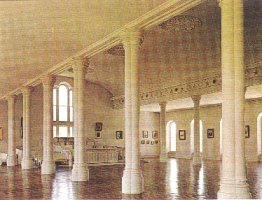
The Manti Utah Temple (1888) is similar to Logan with an assembly hall on the top floor. This time pews are present. The room has a seating capacity of 1,500 people according to the Millenial Star volume 50 printed in 1888. Because the temple is on a hill, the east doors of the temple lead into this room whereas the west doors enter the endowment and sealing section of the temple several floors below.
![]() |
| Salt Lake Temple Assembly Ha |
The Salt Lake Temple (1893) contains a large assembly hall on the top two floors which seats about 2,200 people. The top two rows of windows on the temple main body (an arched row and an elliptical row) give light to the room. The pulpit design breaks away from the Kirtland model (curved breastwork) and instead has podium style pulpits with 12 on each side. Above the pulpits there is a canopy labeled "Aaronic" and "Melchizedek" on the respective sides (I think it also says Priesthood). The hall also has a large balcony with spiral staircases. This room is regularly used for meetings of General Authorities of the church (every Thursday I’ve heard) as well as occasionally for special temple worker meetings and meetings for bishops, etc.. The assembly hall was also temporarily used as a studio to film the endowment when it was first converted to a film format for the Bern Switzerland Temple. Before the Missionary Training Center was built in Provo, missionaries were trained in Salt Lake City and had special devotionals usually led by an apostle or member of the first presidency in the temple assembly room before leaving on missions. Here's a cool picture of the room under construction.
After the completion of the Salt Lake Temple, temples were built without assembly halls to save money as most temples don’t need them. This was new as every temple up to this point had an assembly hall. Another temple wouldn’t be built with an assembly hall for 63 years.
![]() |
| Los Angeles Temple Assembly Hall |
The Los Angeles California Temple (1956) was a very large temple with more square feet than the Salt Lake Temple at the time of its construction (additions have made Salt Lake larger) and it included a priesthood assembly hall (because WWII delayed the groundbreaking an assembly hall was added to the plans). The assembly hall has a very sleek modern design and is a very large room occupying the entire top floor of the temple. It is 300 ft long so the same length as a football field.
For 18 years after the LA Temple was completed temples were built without assembly halls.
![]() |
| Washington D.C. Temple Priesthood Room |
The Washington D.C. Temple (1974) again had a priesthood assembly hall. This one is a modern interpretation of the Salt Lake Temple priesthood assembly room with podium style pulpits. This temple calls the room "the priesthood room" and it is located on the top floor of the temple.
The Portland Oregon Temple (1989) was the next temple containing an assembly hall. According to ldschurchtemples.com the top floor contains an assembly hall and sealing rooms. I’ve been in this temple and the celestial room has a staircase and upper level. The upper level has a door that apparently leads to the sealing rooms and assembly hall. I don’t know other details and I don’t have any photos so I don’t know if it follows the Kirtland pattern of 24 pulpits like every other assembly hall.
* addition - I have a picture of the assembly hall that I got from a Friend Magazine from 1993. It labels the picture as the temple chapel; however, I've been to the temple and know the chapel is downstairs and has a flat roof and pews. This is clearly at the celestial room balcony level. Although it doesn't use the 24 pulpits, I like it.
![]() |
| Portland Temple Assembly Hall |
The Boston Massachusetts Temple (2000) was originally designed as a much larger structure complete with an assembly hall. I talked with someone involved in the construction and was told that the plans were changed so the basement cafeteria rooms can be used as an assembly hall. I don’t think there are pulpits there (I’ve been in the cafeteria but haven’t seen all the rooms in it) so I assume this hall would simply have solemn assemblies broadcast from other temples with pulpits. I did notice that the cafeteria ceiling contained transmitters like those used for headsets used to listen to the endowment in another language, so I assume meetings are transmitted to the temple and translated if needed.
I should explain, temple assembly halls are used for solemn assemblies which are special meetings (usually priesthood meetings) held in the temple. Meetings are regularly held for general authorities in the Salt Lake Temple. I’ve heard that the church occasionally holds meetings in temple assembly halls for stake presidents or bishops around general conference and at other times, although I’m not sure how often these meetings are held. One reason to include assembly halls in temples would be to allow for these special meetings. Temple assembly rooms are also occasionally used for temple worker devotionals. These meetings are held about once a year but they don't necessarily have to be held in an assembly hall.
Technically any temple with a chapel could use the chapel as an assembly hall for meetings not requiring the 24 pulpits. With slight modifications these temples would allow for viewing solemn assemblies broadcast from other temple assembly rooms with the 24 pulpits. Endowment rooms in other temples could also be modified to allow solemn assembly broadcasts if needed. Also, although I love the symbolism involved with 24 pulpits showing the two priesthoods and the order in priesthood offices and presidencies, I’m not sure if there is any special ceremonial use of them during solemn assemblies or if a single pulpit would be acceptable.
Well I hope you've enjoyed this post. Please post a comment or any questions you have.
I love the usage of assembly halls in temples of The Church of Jesus Christ of Latter-day Saints. Although not necessary, they are great rooms with wonderful symbolism and I hope assembly halls are added in other temples from time to time. I notice that all the current halls are located in the United States, although they do go coast to coast. An assembly room in a foreign temple would be interesting. Based on the history of these rooms I wouldn't expect them to be added very often, so we might be waiting a while.
Subscribe to:
Posts (Atom)