Showing posts with label St George Temple. Show all posts

Saturday, May 7, 2011

Alternatives to Angel Moroni Statues

I've already written a lengthy post about Angel Moroni statues on The Church of Jesus Christ of Latter-day Saints' temples.  This post is about other notable temple toppers.

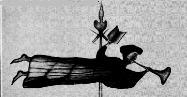
The original and rebuilt Nauvoo Illinois Temple had(have) a bell tower on the top.  Yes, the original temple had a flying Angel Moroni weather vane and the rebuilt one has a statue of Moroni.  In addition to this, both temples contain(ed) a bell as the tower is a bell tower.  The tower in the completed temple can be seen in the picture on the left.  The original temple bell was taken with the saints from Nauvoo when they crossed the plains and settled in Utah.  It currently sits atop a tower at temple square, south and a little west of the Salt Lake Tabernacle.
I like the idea of a temple bell.  On my mission I remember being in Cambridge at Easter and hearing church bells ring out from Great St. Mary's Church.  It was impressive.  I would love to see a bell added to another temple, although I don't expect to see one.  This is mainly  because we like to build in neighborhoods and bells might annoy neighbors.  Also, now days we (all of society, not just the church) don't tend to use bells very often.

This brings up another temple topper, also from the Nauvoo Temple - a clock tower.  The Nauvoo Temple tower has clocks on all four faces.  This was mainly added because it was popular to add clock towers in the 1840s.  Also, at that time, most buildings were considered a community asset and would have many functions.  Adding a clock would provide one more community service.  You have probably also guessed that the Nauvoo Temple bell was installed for use with the clock.  To this day it chimes the hour at temple square.  It probably wasn't intended, but a clock can act as a symbol of time and eternity and of order.


Weather vanes are another temple topper that has been used a few times.  The Kirtland Ohio Temple was built with a weather vane (the current one is a replica).  The original Nauvoo Illinois Temple had a weather vane angel that would have helped people determine the wind direction (you'll notice that the Nauvoo Temple had a lot of practical features for the community).  The St. George Utah Temple was built next and has a weather vane on its tower.  Similar weather vanes top the Logan Temple east and west center towers.  Today one faces north and the other faces south.  I assume that they originally rotated with the wind, but have since been replaced when the towers were replaced with fiberglass replicas.  The weather vanes on these three temples are all arrows.

The Cardston Alberta Canada Temple has no tower or spire, however its gently sloping pyramidal roof has a light or lantern at its peak, a fitting topper to a temple.

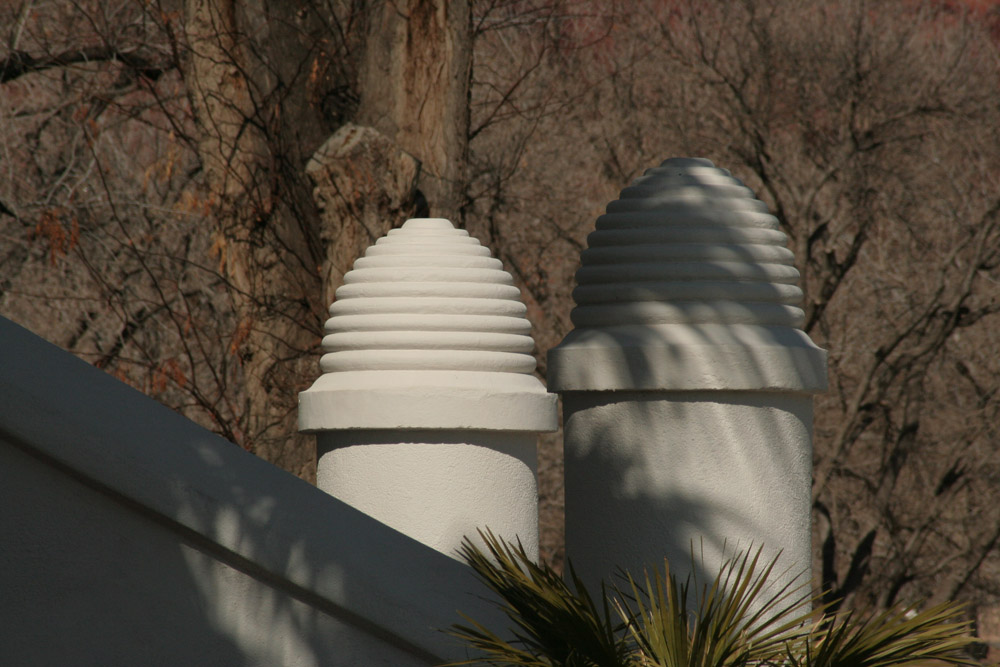
The remaining temples have had some sort of finial or spire when they haven't had Angel Moroni statues but have had towers.

Please comment and let us know what you think about these unique temple features from before Angel Moroni statues became standard.  I like these unique features and hope we keep them intact.

Thursday, May 5, 2011

Crenelated Temples of The Church of Jesus Christ of Latter-day Saints

Perhaps you are wondering what a crenelation is.  It is a parapet with short segments cut out.  They are used in castles and fortress walls.  So I could have also labeled this post "Battlements on Latter-day Saint Temples" or "The Castellated Temple Style".  But crenelation is a fun word, so I'm going to use it.

A major feature of the temples Brigham Young built are the crenelations and other castle style architecture used.  The pioneers were trying to literally build the Kingdom of God and it showed in their architecture.  Even churches were made to resemble castles.  The defensive architecture was also used as a symbol of the protection faithfully living the gospel and attending the temple provided (temporally and spiritually).  It also reinforced the royal imagery of a church with the royal priesthood and as sons and daughters of God destined to be kings and queens.  It reminds us that the temple is the House of the Lord with Christ as the King of Kings, the Prince of Glory.  The castle look also visually unites the four pioneer temples despite their differences.

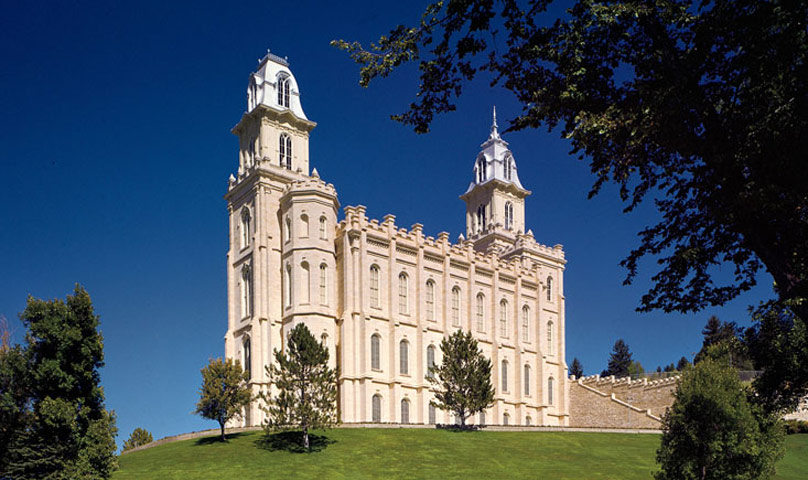
The St. George Temple was the first to look like a castle.  It is brilliant white and has buttresses and crenelations giving it a look of strength and nobility.


The Logan Temple was built next and it again features buttresses and crenelations or battlements.  The current dark stone seems to add to the fortress look of the temple (originally it was painted white).  The corner towers are also octagonal giving a turret look which makes the building look even stronger.


The Manti Temple continued to use castle features despite having towers with French revival influences.  Again buttresses and crenelations are found on the walls.  The middle towers also have pyramidal stones at the tops of the walls that make them look even more defensive.  Another feature is the large stone retaining wall which includes crenelations and adds to the fortified look.  The west end towers are octagonal giving a turret look, while the east towers are all square to make them visually appealing butting into a hill.  This also makes the east towers appear weightier and stronger and larger, which is fitting as they represent the Melchizedek Priesthood.

The Salt Lake Temple is of course covered with castle elements.  Its architecture is often called castellated gothic (I think the name isn't very fitting as the architecture isn't very gothic with no pointed arches or flying buttresses and relatively little glass).  The architecture is very well done and beautiful.  The temple really is a conglomeration of styles, but the crenelations, buttresses, and deeply set windows all give a feeling of strength and a castle look.  The use of normal arches and not pointed arches probably helps it look like a castle as well.  You might also notice that the buttresses extend above the crenelated parapet.  This is because at that level every other buttress is also a chimney.  You can see that half of them are open in this photo. The open ones are chimneys.

These four temples, the pioneer temples, are the only ones to use the castle style with crenelations.  Other temples have mimicked features of these temples including the Brigham City Utah Temple which is currently under construction.  That temple isn't using crenelations.  The San Diego Temple is often compared to a castle and it is beautiful and has a look of strength, but it is not crenelated.  The crenelated castle style is part of what makes the pioneer temples unique.  I would like to see it incorporated into a new temple, but if not, we still have four superb examples of the style.  I should also mention that using a crenelated castle style of church architecture is not unique to Mormonism - I saw many examples of it on my mission in England.

Monday, April 18, 2011

Temple Spiral Staircases

When The Tolmans suggested that I write a post on The Church of Jesus Christ of Latter-day Saints' temple staircases, I don't think they considered how broad of a topic that really is.  There are internal and external staircases.  There are multiple configurations of staircases.  I've been organizing what to write on staircases for the last week or two and have decided that the topic will require multiple posts.  I'm going to start with spiral staircases.

Spiral staircases are perhaps the most impressive type of staircase.  They require great skill to build.  Their form has a special grace that makes them among the most attractive staircases around.  The Kirtland Ohio Temple staircases are curved, although I don't think you would consider them full spiral staircases.  Here are some examples of temples with proper spiral staircases:

The Nauvoo Illinois Temple (original and rebuilt) has spiral staircases without central supports, similar to those in the Manti Temple.  I was told that in the rebuilt Nauvoo Temple the staircases are not free standing because they couldn't figure out how to make them work.  It is much more likely that the engineers decided not to make them free standing for other reasons and decided this was fine because they still look the same.


When I visited the Nauvoo Temple, the workers told us that President Hinckley asked the nearby Shaker community (it may have been the Mennonites) to do the woodwork for the temple including these very nice hardwood railings.  If you don't know, the Shakers (and Mennonites) are famous for their craftsmanship.  The Shaker congregation was invited to tour the completed temple before its dedication.  This is a great example of including other faiths and getting along with others as Christ would have us do. The rebuilt Nauvoo Temple does not include spiral staircases in all four towers.  Apparently the current building codes would only allow a few to be spiral.  They have wisely chosen to have a spiral staircase  lead to the dressing rooms and the baptistery so that all patrons will get to see the staircases.

Another spiral staircase is found in the Nauvoo Temple bell tower seen here.


The St George Utah Temple was the next built and it has spiral staircases in the corners.  I haven't found a photo of them yet; however, I asked to see them the last time I visited the St. George Temple and they showed them to me.  I recall that they had central supports.  I also noticed that they don't air condition the staircases - they were really warm.

The Logan Utah Temple was built next and it has spiral staircases in the four corner towers.  I think they are still there in the remodeled temple, although I have never seen them and do not know if they will show them to you.  The pictures to the left show these staircases.  The first shows them looking up from the assembly hall level.  They are free standing from this level up.  The next photo shows a view looking down and the last shows a view walking down the stairs.  

 
When the Logan Temple was being remodeled they wanted to run conduits through the center supports of the spiral staircases.  When they tried this they discovered that the central supports are solid stone.

The Logan Temple has had several fires over the years.  A fire in 1917 destroyed a spiral staircase that used to be in the middle of the temple (led from the celestial room back to the first floor) and it was replaced with an orthogonal staircase, which has since been demolished completely when the temple was gutted.

The Manti Utah Temple was built next and has some of the most unique spiral staircases in the world.  In the two west corner towers there are freestanding spiral staircases without central supports.  If you attend this temple, ask a worker to see the staircases and they will take you to see them.  They have incredible craftsmanship.  When they restored the temple for the centennial they found something like 2 creaks in the one staircase and none in the other, despite being heavily used by temple workers and used by patrons to access several sealing rooms in the towers.  The seams between pieces of wood on the railings are also extremely difficult to find.
 
I said that these were some of the most unique staircases in the world.  That is because there are only a few free standing spiral staircases that lack central supports in the world.  I believe there are only eight in the U.S. with two being in the Supreme Court Building (those are elliptical).  So the Manti Temple spiral staircases are really special.

One of the staircases goes up clockwise and the other counterclockwise.  They really are an impressive sight and a great asset of the Manti Temple.


The Salt Lake Temple was built next and it includes eight spiral staircases.  All have central supports.  The four corner towers have solid granite staircases.  These have a nice dark wood wainscot.  I have only seen these towers from the baptistery level.  There they have actually installed restrooms on the staircase (weirdly shaped and tight, but interesting).

The other four spiral staircases are found in the priesthood assembly hall.  Here, four spiral staircases provide access to the balcony seating.  These show fine woodwork. and wonderful carpenters' skills.  I hope to see them some day.


The next temple to include spiral staircases, that I am aware of, is the San Diego California Temple built in 1993.  It includes a very modern spiral staircase.  As you can see, the staircase has exquisite woodwork.  It is also very open, which is important as it allows all the light coming through the art glass windows to permeate the temple.

Looking up from this staircase you get this wonderful view.
The last spiral staircase that I know of in a Latter-day Saint temple is found in the newly built Copenhagen Denmark Temple.  This temple was remodeled from an existing church that was gutted, so there is a chance that the staircase was part of the original church.  If not, I am glad to see the church go out of its was to include a spiral staircase.  This staircase is also not centrally supported, making it even nicer.  I love how the light floods into the temple from a well placed skylight.

Those are the spiral staircases I know of in Latter-day Saint Temples.  If you know of others please comment.  Also, If you have a photo of the St. George Temple spiral staircases please let me know.  I would love to have one.  Please comment and let us know what you think about these staircases.  In the future I will post about other temple staircases.  There is a lot more variety in them than you may realize.

Friday, April 8, 2011

Bees and Beehives as Temple Symbols

One interesting symbol occasionally used in Latter-day Saint temples is the beehive (or bee).  Bees and beehives have become a temple symbol for several reasons.  Some early members were masons and apparently the masons like the symbol.  In addition, bees are seen as a symbol of industry and working together.  They are a wonderful symbol of the Law of Consecration.  Bees also are used because The Book of Mormon mentions them.  In Ether 2:3 we read:
And they did also carry with them deseret, which, by interpretation, is a honey bee; and thus they did carry with them swarms of bees, and all manner of that which was upon the face of the land, seeds of every kind.
That verse isn't overly significant, but it did lead to Utah's first name being the Territory of Deseret.  The early church members liked bees and their symbolism, liked the fact that they were mentioned by a special name in The Book of Mormon, and then used the symbol and name "deseret" a lot.  Today they are used in the names of the church's thrift store (Deseret Industries), welfare companies (Deseret Pasta), a name of a Young Women's class (Beehives), the church's temple clothing manufacturer (Beehive Clothing), a Latter-day Saint themed bookstore (Deseret Book), and is on the Utah state flag and is the symbol of Utah, the Beehive State, just to name of few of the symbol's uses today.  When the Conference Center was built, President Hinckley wanted symbols included, so beehives were etched onto the glass and carved beehives were attached to the pulpit.

As a symbol, bees can also remind us of Israel as a promised land of milk and honey in the bible (see verse 17).  It can also remind us that the manna that sustained the Israelites in the wilderness, a type of Christ (John 6:31-35) tasted like honey (see verse 31).  So, whether originally intended or not, bees can be a symbol of Christ.

Of course there is probably more symbolism dealing with bees, beehives, and honey.  But I want to get onto the architectural examples of this symbol in Latter-day Saint temples, so I'll move on.


The St. George Utah Temple
This was the first temple using beehives.  There are four, one on each side of two exterior staircases at the front of the temple.  You can see pictures here and here.

The Logan Utah Temple
Logan Temple Doorknob Bee
The original Logan Temple door knobs included a honeybee design.  The bee was on the plate below the doorknob.  In the picture you can see the bee on the right (and left) in the middle.


The Salt Lake Temple
Beehives are prominently featured in several spots in the Salt Lake Temple.  Doors throughout the temple have beehives on the doorknobs.  The main exterior doors contain more beehives and bees in the decorative grill work.  The new annex also includes the symbol on glass doors.  Interior doors throughout the temple also have beehives etched onto the frosted glass panels.

The Palmyra New York Temple
When I did a session in the Palmyra Temple two years ago I noticed that the celestial room chairs are upholstered with a fabric with honeybees on it.  Look for it when you go there.

The Manhattan New York Temple
Many symbols were worked into the Manhattan Temple.  The door handles were made to resemble the statue of liberty torches.  On the same doors, carved beehives were also included.

Those are the temples using beehive symbols that I know of.  Please comment and let us know where else they are used, or just what you think.

Addition to the original post-
  Recently, endowment room chairs have been replaced in the Logan Temple (and I think Salt Lake as well).  The chairs now have carved wood beehive medallions at the end of rows of seating.

Wednesday, April 6, 2011

Temple Additions

At the request of The Tolmans who commented on my last post, I'm going to talk a little about temple additions.

The St. George Utah Temple had a stair addition on the rear of the temple.  This didn't alter the symmetry (as other temple additions have) and blends in fairly well with the temple.  It isn't a perfect addition.  Details such as window style give away that it is a 1970s addition.  There is also an annex with dressing rooms, etc. that is white, but otherwise doesn't match the original temple.

The Logan Utah Temple has been completely gutted and rebuilt on the inside.  At the same time a stair tower was added to the center of the north side.  Unfortunately, this ruins the original symmetry of the temple, and the windows don't match the original temple.  The stone is a fairly good match.  The temple originally jutted out slightly in the same location as the current stair tower (I'm not sure if this was from an earlier stair addition).  In that case, the extension had a circular window that looked nice.  The original annex also matched the stone of the main temple and was castellated.  I'm not sure why they replaced that annex with a cream 1970s style annex that obviously doesn't match the time period of the original temple.  But when the Logan Temple was remodeled in the 1970s, little, if any, attention was paid to historical details or matching styles.  This is painfully apparent on the inside which looks nothing like the exterior would suggest.

The Manti Temple used to have a drive through tunnel beneath the east towers.  This has been blocked off now and parts of it can be seen near the current women's dressing room.  Otherwise I am only aware of the current annex addition with dressing rooms.  In this case, it matches the temple stone and the annex interior matches the styles present in the rest of the temple.

The Salt Lake Temple has had a sealing room annex added (on the right side in this picture).  This addition is 2 stories tall and is found on the north side of the temple.  This ruins the symmetry of the original temple, and the windows don't quite match those found on the original temple.  Even so, this addition blends fairly well and was needed to increase the number of sealing rooms from 3 to 14.

The Boise Idaho, Chicago Illinois, and Dallas Texas Temples were overcrowded upon opening.  Each was remodeled within a few years.  The additions present some problems.  In at least Dallas and Boise you go to the chapel and then you go back through the dressing rooms to get to the endowment rooms.  This is awkward and obviously wasn't the original plan for the building.  Boise's addition isn't the most balanced.  I remember Dallas' addition doing a better job of preserving symmetry.  In addition, one of the formerly detached spires is now in a lobby with glass skylights providing a nice view.  I haven't been to the Chicago Temple, so I am not sure how the addition works there.

Currently, the Buenos Aires Argentina Temple is being remodeled.  Two wings are being added that match the original temple architecture and preserve the original symmetry.


The Monticello Utah Temple was originally built with just one endowment room, one sealing room, the celestial room, and a baptistery.  It was so small because it was a test small temple.  Shortly after completion, the temple was expanded and now looks like most other first style small temples, although the window elevations change along the building, giving away that there is an addition.  Similarly, the Anchorage Alaska Temple was originally built small and has since been expanded.  This gives it a different look.

I've surely missed some temple additions.  I've noticed that most additions haven't done the best jobs of preserving the original architecture (they ruin symmetry, windows don't match, rooms and corridors don't flow right afterwords). Still, most aren't overly offensive, and a few work.

Comment and let us know what you think.