Showing posts with label Baptistery. Show all posts

Sunday, April 17, 2011

The Portland Oregon Temple

For any of you who didn't notice, I've updated some of my earlier posts with new images.


Portland Oregon Temple
The Portland Oregon Temple is one of my absolute favorite temples.   This temple of The Church of Jesus Christ of Latter-day Saints was completed in 1989. I've been to the grounds twice and inside once (the other time was a Sunday so it was closed).   The Portland Temple is modern, detailed, ornate, sleek, bright, rich, original, symbolic, and spiritual.

For those of you who have not been there, it is just off of a freeway (and visible from the freeway) yet the grounds feel secluded due to the dense forest.  Its use of the six spire sloped roof style of temples.  This brings with it priesthood symbolism with the three towers on the west representing the Aaronic Priesthood and its presidency of a bishop and two counselors.  The eastern three towers represent the Melchizedek Priesthood and its presidency, either a stake presidency composed of three presidents or the First Presidency of the church composed of the prophet and his two counselors, all presidents.  The temple is covered in the same symbols that are found on the Salt Lake Temple - representations of the earth, moon, sun, and stars in stone, on the spires, and on the doors.

The Portland Temple spires were intentionally sculpted so they would compliment the forest that fills the grounds.  The spires are essentially made of a series of pointed arches that taper in as they go up.  On the east spires there are stars all over the spires while on the west side no stars are present.  The spires are made of white fiberglass and work well against the brilliant white marble stone that coats the main body of the temple.

The sloped roof of the temple is a nice green slate which helps the structure match the evergreen forest that covers the grounds.

The doors of the temple are done in a nice dark wood.  Symbolic stars are carved into the doors.  The same white stone and dark wood that are found on the temple exterior also run throughout the temple.  The contrast between the two, and the richness of both, makes this temple strikingly beautiful.

Upon entering the temple, you notice an atrium filled with natural light and lush vegetation.  This atrium is open to the public.  To see other atriums, click here.

Inside or outside the temple you might notice the walls glowing.  This is because there are actually windows made of stone cut so thin that it is translucent.  If you look at this picture closely you'll notice that you can see the sun stones illuminated from within the temple.  When I was there, I noticed the earth stones glowing when I was in the downstairs chapel.

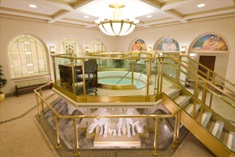
Portland Oregon Temple Baptismal Font
Unfortunately, I have not seen the baptistery.  I do have this picture of it and I have been to the Las Vegas Nevada Temple's baptistery which is really similar.  In the photo you can see the stone windows.  I also love the glass used on the railings.  It has a design etched in it and similar glass is used throughout the temple.  I also notice that the floor has a nice design which appears to either be the Star of David or the Seal of Melchizedek.

One unique feature of this temple are the triangular staircases.  These are either in or next to the spires.  These staircases are different from normal staircases because you go up a flight of stairs, step onto a landing, turn 300 degrees, go up a flight, step onto a landing, turn 300 degrees, and so on.  In this way the staircase is triangular (or perhaps hexagonal if you want to include the landing).  I really liked this as it made the temple feel like a special building and not just any architecture.  It also showed creativity.  In addition, the number 3 is filled with symbolism - particularly about God and the Godhead.


Portland Oregon Temple Endowment Room
The endowment rooms are special.  They have the dark wood mentioned earlier.  The wood has a bright gold pattern on it that really stands out.  The grains in the woodwork are also laid out so they form a diamond pattern, something that must have been carefully planned out and shows skill.  The altar is made of the rich dark wood with gold accents.  The shapes on the altar echo the small domes found on the temple exterior and help to tie the architecture together.  The room also feels different from the world due to its orientation.  The room is approximately square, but the altar, screen, and focus is set on a corner of the room.  The seating is also oriented with the rows of seats on either side of the aisle at 90 degrees to each other.  Finally, the altar and veil are on a raised platform that is sectioned off with a small wood barrier that makes it feel extra special.  By the way, this picture doesn't do the room any justice.

Portland Oregon Temple Celestial Room
Going from the endowment room you enter a cross shaped room between the four endowment rooms.  Following one of the legs of the cross leads you into one of the most spectacular celestial rooms ever envisioned.  As you enter the room you are actually walking beneath a staircase that leads to a mezzanine level of the room.  The room is richly decorated and includes gold colored tapestries covering the stone windows along two walls.  This room is also set at an angle and the two walls covered in tapestries are the east facade on the temple exterior.  The gold tapestries contrast nicely with the brilliant white stone.  The tapestries also get thinner as they go up until at the top all you can see is the brilliant white stone windows and any light glowing through them.  This wonderfully represents the eternal progression found in the celestial kingdom.  A small sealing room can be accessed directly off the celestial room and is actually in the east center tower of the temple.  The celestial room also has three bright brass chandeliers that shine with a gold color.  They are virtually identical to the chandelier in the remodeled Logan Temple celestial room, although they are brighter and golder and they work very well in this room.  Modern sconces are found on the columns along the wall with the tapestries and add a lot of class to the room.

Portland Oregon Temple Celestial Room Staircase
If you decide to venture up the staircase, you will get to see some more features of the celestial room.  The stair railing includes glass panels with an etched pattern in them.  This keeps the room light and airy.  The mezzanine level above provides nice views of the chandeliers.  Seating is also present on this upper level.  The multilevel nature of this celestial room reminds us that in the celestial kingdom there are multiple degrees of glory.  A door leads from the mezzanine level to a number of sealing rooms , perhaps to remind us that to attain the highest degree of glory in the celestial kingdom we must be married eternally through the sealing ordinance.

The temple's special chapel, which is essentially a temple assembly hall, is also found off the celestial room mezzanine.  This keeps with the common pattern of having priesthood assembly halls on the top level of temples.  The ceiling of the room follows the slope of the roof.  It must be nice to attend a special temple meeting in this upper room of the temple, especially in the late afternoon on a clear day when the sun would make the stone windows glow.  In that event you would see the sun stones at the top of each window.

The Portland Oregon Temple is one of the six spire sloped roof temples, but it is different than most with a unique floor plan.  It is also a lot larger than most other six spire sloped roof temples.  The spires are far, far more detailed and the symbolism is more advanced than in most other six spire sloped roof temples.  The floor plan of the Portland Oregon Temple was altered slightly and used for Las Vegas Nevada Temple, another one of my favorites and the only example of the six spire sloped roof temple style that can compare to the Portland Temple.  If you have been in a six spire sloped roof temple, but not Portland or Las Vegas, don't think you know what those two are like.  These temples are different.  Although I like the other six spire sloped roof temples, the Portland Oregon Temple is the gem of the style.  If you get the chance I highly recommend that you visit this temple.  Even if you aren't a member of The Church of Jesus Christ of Latter-day Saints, it would still be worthwhile just to see the atrium, the beautiful grounds, and the exterior architecture.

I'm not sure why they only built two temples with this floor plan as it truly is a spectacular style, but I am so glad that they made this temple, and that they used its floor plan for the Las Vegas Nevada Temple.

If you know more about this temple, please comment.  You can also comment if you have questions or just want to point out something that you liked.

Saturday, April 9, 2011

Latter-day Saint Temple Murals - Pt 6 - Baptistery Murals

To see my other posts on Latter-day Saint temple murals click on the following links:
Part 1, Part 2, Part 3, Part 4, Part 5, Celestial room murals.
Some of those original posts have been updated.  For instance, baptistery murals are now included in the Laie Temple discussion and the Logan and Vernal Utah Temples' celestial room murals are also added to the celestial room murals post.

As a quick recap, I'll show some baptistery murals that were already dicussed:
Manti Temple Baptistery
Laie Hawaii Temple Baptistery
Laie Hawaii Temple Baptistery Murals
Cardston Alberta Temple Baptistery
Cardston Alberta Temple Baptistery Mural Detail

Mesa Arizona Temple Baptistery Mural

Mesa Arizona Temple Baptistery Mural
Idaho Falls Idaho Temple Baptistery
Los Angeles Temple Baptistery

Ok, now I'll move on to new material.

After the LA Temple was completed, murals were discontinued (until the last few years) in endowment rooms.  I've discussed some miscellaneous murals that were included in the meantime.  Baptisteries still occasionally included murals during this time, starting with the Hamilton New Zealand Temple (the first completed after LA).
Hamilton New Zealand Temple Baptistery
The Sao Paulo Brazil Temple has a tile mosaic mural in its baptistery:
Sao Paulo Brazil Temple Baptistery with Mosaic Mural
I think the next baptistery mural was in the Copenhagen Denmark Temple.  Copies of parts of this mural are used as murals in the baptisteries of the Curitiba Brazil Temple, Oquirrh Mountain Utah Temple, remodeled Mexico City Temple, and probably others.  I like the grand scale of this mural and the wonderful scene of the baptism of our Savior Jesus Christ.
Copenhagen Denmark Temple Baptistery

Copenhagen Denmark Temple Baptistery Mural

Many temples include some commonly used picture of the baptism of Jesus Christ.  I'm not going to list all of those, but yes, many temples include baptistery pictures, a few of which could be considered murals.  I like it when they are harmoniously worked into the rooms, and not just any old picture.

The Helsinki Finland Temple uses smaller murals near the top of the baptistery walls.  This reminds me of how murals were done in the Laie Hawaii, Cardston Alberta Canada, and Idaho Falls Idaho Temples.  In fact, if you look closely at these murals you can tell that they are prints of the murals in the Cardston Albeta Temple, so if you want to know what they look like in detail, look at these.
Helsinki Finland Temple Baptistery
Helsinki Finland Temple Baptistery Mural Detail 1
Detail 2
Detail 3


Helsinki Finland Temple Baptistery Mural Detail 4
 Please comment and let us know what you think of these murals and the possibilities for other baptistery murals in future temples.  Also, if I've missed any baptistery murals, let me know.  I have intentionally skipped over stained glass murals in baptisteries, although they are technically murals and are wonderful pieces of art work.

I'd like to see a temple baptistery with murals on the four walls.  I suggest: the baptism of Jesus Christ, the baptism of Joseph Smith and Oliver Cowdery, and the baptisms at the waters of Mormon in Mosiah in The Book of Mormon.  I'm not sure what to put on the forth wall.  It could depict the baptism of Adam so the Old Testament could be represented.  It could also depict other baptisms from The Holy Bible, The Book of Mormon, or the early days of the restoration.  Depictions of the restoration of the Aaronic Priesthood would also be fitting.

Another question is what sorts of murals would you place in a confirmation room?  Usually these just contain typical church paintings that are not necessarily linked to the ordinance of confirmation.

Please comment.

Sunday, March 13, 2011

The Church of Jesus Christ of Latter-day Saints - Temple Architecture Myths

As members of the church we often get a certain picture of what a temple should be like.  The architecture can be limited by preconceived notions of how a temple should be.  I wanted to dispel some temple architecture myths and highlight temples that are different. (By the way, a commenter on this blog was mentioning some of these and his comments led me to write this post.  Please comment, you may have a similar effect on me :)

Myth # 1: All temples must have an Angel Moroni statue.
This is blatantly false.  Many temples have been built without Angel Moroni statues.  Three didn't even have towers (Cardston Alberta, Laie Hawaii, and Mesa Arizona).  Others had towers, but were built before the Atlanta Georgia Temple when Angel Moroni statues became common (because a newspaper said the new temple wasn't to temple standards without one).  Until that point, only the Salt Lake, Los Angeles, Washington D.C., Seattle Washington, and Jordan River Utah Temples had Angel Moroni statues (the original Nauvoo Temple had an angel statue but it was not identified as Moroni).  Several have been built without the statue since, only to have the statue added later.  An Angel Moroni statue is a powerful symbol that we should be free to add to our temples for religious reasons, but is not essential for a temple to be a temple.


Myth # 2: Angel Moroni statues must face east.
This is false.  The Nauvoo Temple (and statue) face west.  The Dallas Texas Temple and statue face south, the Spokane Washington Temple recently had its Angel Moroni statue turned from east to west after President Hinckley didn't like how it looked.  The Seattle Washington Temple and statue face west, the Taipei Taiwan Temple and statue faces west, and the Manhattan New York Temple and statue faces southwest.  The myth developed because most Christian churches face east and so do most temples (this is a symbol of Christ coming from the east at the second coming) but is not essential.  Also, President McKay had the Moroni statue of the LA Temple turned to face east even though the temple faces southeast (I think).  This led to a conversion and spread the myth, even though the east facing statue was clearly for a specific reason.

Myth # 3: Sealing rooms must have facing mirrors, giving an eternal effect.
This type of mirrors is nice, but the St. George, Manti, and Salt Lake Temples have some sealing rooms that don't even have mirrors.  I'm sure other temples break this rule.  The fact is, eternal mirrors are a nice decorative feature to use, but not an essential part of the room.

Myth # 4: Temple baptismal fonts must be on the backs of 12 sculpted oxen and be in a basement.
Several temples were built without oxen supporting fonts (even the Tabernacle in the Old Testament lacked oxen, they were added for the Temple of Solomon) and other temples were built with only 6 oxen and a mirror to give the effect of 12 oxen.  During the design of the Ogden and Provo Temples, the design team looked in the necessity of the oxen and decided they were not essential (although those temples used oxen) and noted that in future temples oxen might not be used.  A lot of 70s and 80s temples (Atlanta, Sydney, and most pacific island temples) were then built without oxen (most, if not all have had oxen later added, and the plan was always to add oxen at a later date).  In these cases, a font similar to a meetinghouse font was used.  As for fonts being in basements, the Doctrine and Covenants reads: "the baptismal font was instituted as a similitude of the grave, and was commanded to be in a place underneath where the living are wont to assemble".  This means it needs to be underneath, but due to high water tables this doesn't necessarily mean in the basement, just on the lowest floor and if possible underground.

Myth # 5: Temples must get lighter as one progresses from room to room
Although light colors are the easiest way to express symbolic progression, light colors are not essential.  The Cardston Alberta Temple has rooms actually getting darker because the woodwork is getting finer and more expensive.  It turns out that the best woodwork is generally dark so the celestial room and sealing rooms in this temple are dark wood.  Windows still bring light in.  I like that this temple has a unique way to show that these rooms represent better and holier things and places.

There are some architectural myths I have identified relating to Latter-day Saints temples.  Please comment about these or point out others I've missed.

Monday, January 11, 2010

Temple Baptisteries

My brother and I have been going to a lot of different temples to do baptisms for the dead recently. I want to discuss some of my feelings about their architecture.

Ogden, Provo, Jordan River and Logan have essentially the same design with a chapel overlooking the font and confirmation rooms on the left hand side. I think Ogden and Provo work best, probably due to the obvious addition of stone tile flooring, light wallpaper, geometric ceiling designs and in the case of Provo small crystal chandeliers and sconces in the confirmation rooms. Jordan River has a lot of potential, although it is a bit dark due to off-white wallpaper and dark woodwork which I think could be redone while preserving the original architecture. Also, the confirmation rooms are cramped and feel like closets which isn't very fitting for a room set apart for an important ordinance. As for Logan, the baptistery has natural light but is essentially a clone of the other temples, including the font. I think this is a shame as we have the original temple font in the Church Museum of History and Art so I don't know why it isn't placed in the temple.

The Bountiful and Mount Timpanogos temples both have nice baptisteries. I prefer Bountiful but that is due to my tastes. I like that in these baptisteries there are two semicircular rows of pews on top of the oxen immediately next to the font.

The Salt Lake Temple baptistery has a wonderful font. The confirmation rooms are small and out of the way which is a downside. Also the entrance is hidden and the tunnels leading into the baptistery have a 60s or 70s feel. Still, I like this baptistery.

Utah's two newest temples, Draper and Oquirrh Mountain have wonderful baptisteries. Draper has stained glass behind the font letting light flood in. The confirmation rooms have glass doors making the rooms for this ordinance seem important and not an afterthought. Oquirrh Mountian has the best baptistery as a whole in my opinion. There the chapel has glass on all 4 sides. The front overlooks the font (with glass on 3 sides) and behind are the confirmation rooms with glass doors and wall. This allows the confirmations to be seen from the font and chapel and definitely makes the rooms for this ordinance important.

In general I liked tiled baptisteries better than carpeted ones because carpet (especially in locker rooms) tends to mildew causing a bad smell.

I love the variety in temple baptismal fonts listed here and others I have seen and hope to see many more.