Saturday, December 26, 2020

Jesus In Latter-day Saint Temples - Sculptures

My wife was looking at Light The World posts and saw that someone was using that hash tag to claim that members of The Church of Jesus Christ of Latter-day Saints aren't christian because our temples don't have pictures of Jesus in them. The post was of course ridiculous (we have pictures of Jesus hanging everywhere in temples) and I think it is an internet troll trying to take the good that came from Light The World and twist it into evil. The claim was ridiculous as the temple ceremonies feature Jesus Christ and his teachings. As a response, I would like to highlight some art in temples that depicts Jesus Christ. I'll start with this post which shows Jesus in sculpture. Of course copies of The Christus, a statue of Jesus Christ are found in temple visitors centers and on the grounds of temples, but I'm going to highlight sculptures that are a part of the temples. 

Laie Hawaii Temple


The Laie Hawaii Temple has relief sculptures on the 4 sides of the temple and smaller reproductions of these sculptures in the waiting area so patrons can have time to study and ponder the sculptures. These depict the Old Testament, New Testament, Book of Mormon, and Doctrine and Covenants / church history. I'm not sure if Jesus is shown in the Old Testament sculpture, but he is in the other 3. In the New Testament panel he is shown teaching and healing. Jesus is shown appearing to the Nephites after his resurrection in the Book of Mormon panel. Finally, in the Doctrine and Covenants panel, Jesus is shown next to God the Father in the First Vision. In each case Jesus Christ is shown in the center of the panel as the focus.

Cardston Alberta Temple

The Cardston Alberta Temple in Canada has a low relief sculpture of Jesus talking with the woman at the well. Originally this was at the temple entry, just outside the temple, but with additions it is now inside the temple.

Oakland California Temple

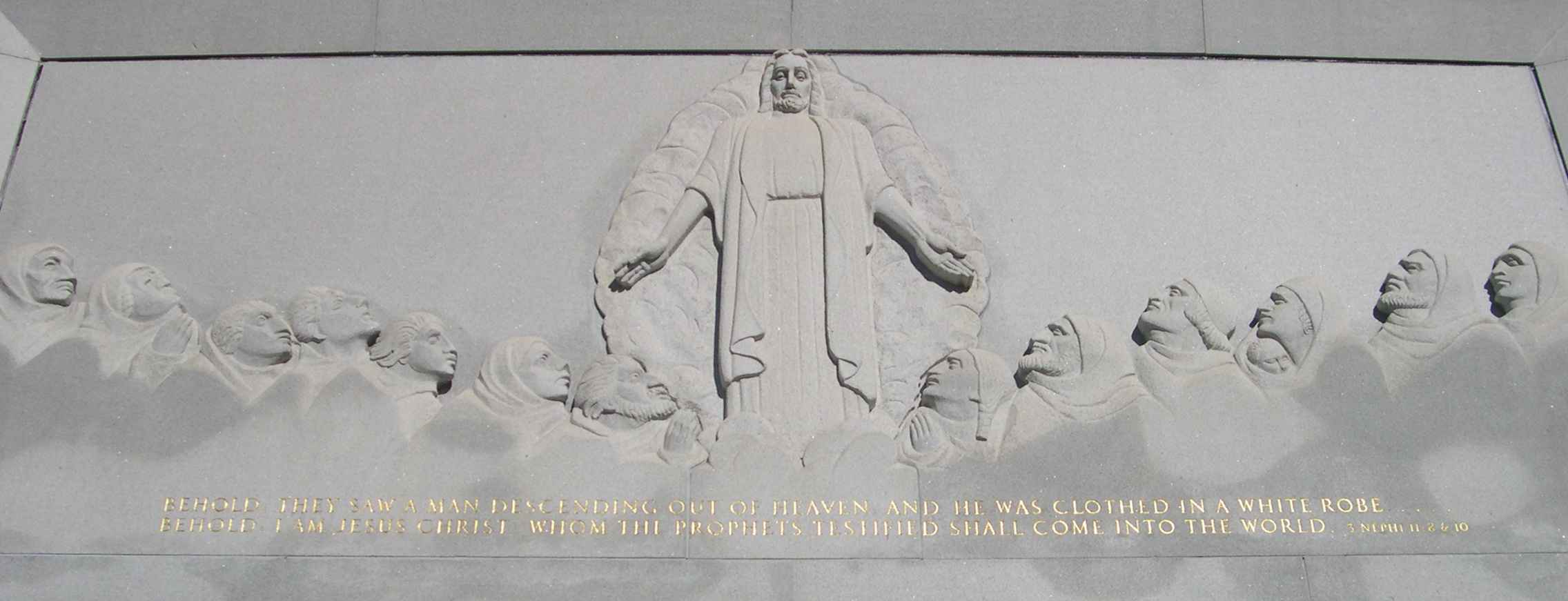
The Oakland California Temple has 2 large granite sculptures on the north (main entry) and south sides of the temple. The sculpture on the north depicts Jesus teaching in the Holy Land. He is teaching a group of men, women, and children. The sculpture on the south shows the resurrected Jesus Christ appearing to the Nephites in the Americas.

Sao Paulo Brazil Temple

The next sculpture looks like a painting, but I classified it as a sculpture because it is a mosaic, and I already have plenty of paintings to write about. The Sao Paulo Brazil Temple baptistry has a mosaic sculpture of the baptism of Jesus Christ on the wall.

Newport Beach California Temple

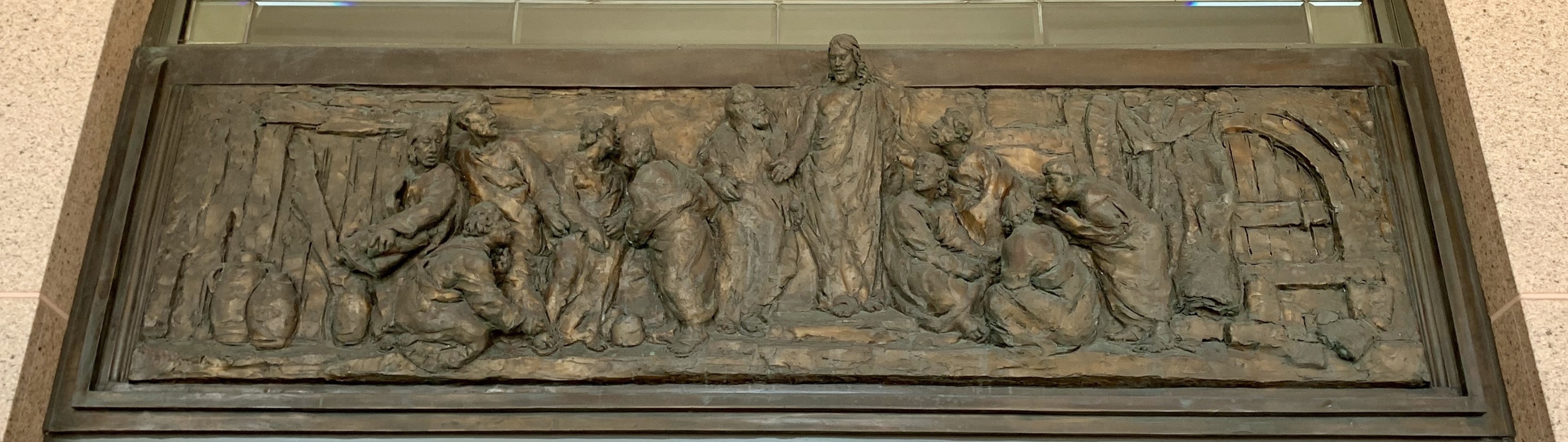
 Newer temples have included sculptures of Jesus as well. The Newport Beach California Temple has a bronze relief sculpture above the doors. This sculpture shows Jesus appearing to the apostles after his resurrection.

Indianapolis Indiana Temple

The Indianapolis Indiana Temple has a relief sculpture of the baptism of Jesus Christ in the baptistry.

Each of these sculptures adds to the focus on Jesus Christ which is so evident in latter-day saint temples. Sculptures as a part of temples, while still used, appear to be less common today than a hundred years ago. I suspect this is mainly because of the growing popularity of stained glass in temples. I do hope that we will continue seeing sculptures in temples, particularly sculptures of our Lord Jesus Christ.

Sunday, November 1, 2020

Salt Lake Temple Celestial Room Stained Glass Windows

I haven't written on this blog for years, mainly because I exhausted my ideas for new posts and also because I got married and had children and that has kept me quite busy and satisfied. But I still retain my love for temples and great temple architecture. I truly miss attending the temple due to the coronavirus limiting who can attend and hope I can go again soon. 

During the last few years I've been thrilled to see remodels of temples with historical preservation highlighted. President Nelson's announcement that the 4 pioneer temples will be renovated/restored to preserve their unique pioneer craftsmanship and character made me very happy. The Church of Jesus Christ of Latter-day Saints has shown some renderings of the Salt Lake Temple renovation and I am pleased to see the original colors, woodwork, etc returning to this temple. So far we haven't seen renderings of the baptistery, terrestrial room, celestial room, sealing rooms, holy of holies, assembly room, administration rooms, etc and that has got me wondering how the celestial room might be renovated. So I looked through old black and white photos of the celestial room and compared those to more recent color photos of the celestial room. Here are two of those photos:


I was looking at these photos noticing a bunch of differences. The base of columns was originally a painted faux marble (the Saints podcast pointed this out), the lower portion of the columns had an interesting four pointed star sort of pattern, sconces were attached to the columns, there was a patterned wallpaper on the vaulted portion of the ceiling, the walls weren't white or cream, only the doors and their moldings appear white. Then I noticed the stained glass windows. As far as I can tell, none of the stained glass windows in the celestial room are original.

The most obvious one is the stained glass window above the veil. It appears to have been added after the black and white photo was taken (1911 or 1912). Then I looked closer and noticed that the 8 semi-elliptical stained glass windows above the doors in the vaulted portions of the ceiling also appear to be missing in the black and white photo. The semi-elliptical space where the windows were added appears to just be wall originally. I suppose there may have been some on the other side of the room, but I haven't found photos to support that. I tried to find some information on when these were added, but I didn't find anything. I'm guessing these windows were added in the 1960s when the celestial room was repainted and the temple was renovated. These windows are a little peculiar because they tilt out. If you look carefully in other photos or when you are in the celestial room you can see that at least the interior windows have a gap at the top. I'm guessing these might actually have been added to conceal air conditioning vents, which i appreciate. These windows must have been carefully chosen because they seamlessly blend in with the original temple architecture so well that most people would have to carefully study old photos to realize they aren't from the 1890s.

I love having the pioneer temples preserved and restored. I hope respectful additions such as these stained glass windows in the celestial room are also kept in the renovated temple. I'd be surprised if they removed these for historical purposes as they appear to match other original art glass windows and enhance the incredible architecture of the Salt Lake Temple celestial room. If you look at the rendering of the grand staircase and hallway that the church has released and compare it to historical photos, it appears that they are adding a stained glass window on the landing of the grand staircase. That window is a similar style to these and makes me think they are keeping tasteful additions to the building. I like that.

Monday, August 4, 2014

The Newly Remodeled Ogden Temple - Part III

I have already written two posts about the newly remodeled Ogden Temple.  I'd like to give some more thoughts on this remodeled temple.

The remodeled temple is substantially nicer than the original temple.  The original building was built in a time of austerity for the church and while it was an offering to the LORD and a temple, it wasn't as nice as many others.  Frankly, it looked odd.  With time and close inspection I came to appreciate it, but I like that they completely remodeled it.  The remodel has changed the appearance of the Ogden Temple and it has also upgraded its quality in a way that wasn't practical during the original construction in the 1970s.  According to press releases and news reports, the temple has also been structurally upgraded to withstand earthquakes, had mechanical upgrades to increase energy efficiency, and has had significant upgrades to the temple grounds including underground parking and a remodel of the Ogden Tabernacle on the block.  I hope you can understand that the remodel of the Ogden Temple was more than just to make it more aesthetically pleasing (although it definitely has).  The upgrades made the building more efficient and safer and were necessary at some point.

The results of the temple remodel are spectacular.  I am just going to focus on the ordinance spaces here, but I did go into some more specific details in my previous posts.

Ogden Temple Baptismal Font
The baptistery is still laid out essentially as it was originally and is in the same location in the temple.  The main changes here are upgrading the wall coverings, carpet, lights, etc. and the addition of murals.  A baptistery chapel overlooks the font room with a glass wall between just as in the original temple (and others such as the Jordan River Utah Temple).  The font room has 3 original murals.  The side murals are of a river making it almost as if you are in the middle of a river while you are being baptized for the dead.  This river mural looks like it is probably the Ogden River or perhaps the Weber River.  On the front wall of the baptistery there is an interesting new mural of the baptism of Jesus Christ by John the Baptist.  I really like how the baptistery has been upgraded.   The lights in the baptistery are fairly simple, but really nice cylindrical chandeliers.  More on this later.  The confirmation rooms are still on the side of the baptistery chapel and appear to have been nicely redecorated.

Ogden Temple Ordinance Room
The endowment rooms are still laid out essentially as they were in the original temple.  There are six ordinance rooms on the top level with 3 on each side of the central celestial room.  I understand that you still spend all of your time in one ordinance room and then go into the celestial room.  The four ordinance rooms that are in the corners don't have exterior windows but they do have back-lit stained glass windows near the tops of the walls and along their ceilings.  The other two ordinance rooms are slightly larger and have stained glass also along the entire back walls which bring in a lot if natural light.  The altars are a pleasing mix of stone and wood with a design carved into the wood.  This same design is carved into the woodwork at the ends of each row of seats which nicely ties the altar to those seated.  This design is also carved into the columns on the walls and was on the original Ogden Temple.  You can read more in my first post.  Finally, the lights in the endowment rooms are really interesting.  They are cylindrical but they have a lot of interesting glass almost in petals.  They are more ornate versions of the baptistery chandeliers which is a great way to show progression in the temple.  I really like these endowment rooms.

Ogden Temple Celestial Room
The celestial room is still in the same location it was in the original temple at the center of the top floor.  Just as in the original temple there is a dome in its center only now it has been upgraded to an art glass dome that matches the stained glass on the walls.  Instead of having a central chandelier, the architects have placed four stunning chandeliers in the room.  These are very interesting art deco styled chandeliers with upper and lower crystals and I assume brass.  The chandeliers have a cylindrical profile and thus are similar to the baptistery and ordinance room chandeliers but more ornate.  I love them.  I also like the torchieres which are essentially chandeliers coming up from the ground or chandelier lamps.  You can read more about these in my previous posts.  There are also really nice hand carved stone pilasters with ornate capitals that I love as I discussed in my previous posts.  The furniture in the celestial room is really nice including a nicely carved table that has been custom made to match designs elsewhere in the temple.  I think some of the furnishings on the tables are from the original temple, although I am not certain about that.  I don't recall seeing any mirrors in the celestial room, which is unique.  I am fine with not having mirrors there.

Ogden Temple Sealing Room
The sealing rooms are on the second level as they were in the temple before it was remodeled. The arrangement of the sealing rooms has changed.  Several of the sealing rooms are on the outside of the temple with stained glass windows bringing plenty of light into the rooms.  The sealing rooms were originally fairly plain, but have been redone in a grand style complete with hand carved stone pilasters, stone altars, carved carpets, and extravagant gold leaf patterns.  The desert rose pattern is used throughout the temple and it works really nicely in the sealing rooms where it works as the symbol of love for those getting married.  The sealing room chandeliers are really exceptional.  They are more elaborate versions of those found in the celestial room.  Here four side clusters of crystal lights have been added.  I love these lights and I love how they symbolically show progression from room to room in the temple.  I love these sealing rooms.  They are some of my favorite ever.  Even the really small rooms that don't have windows are stunning.

As you can see, I love the newly remodeled Ogden Temple.  While the upgrades have significantly strengthened and improved the building from a practical standpoint, they have also improved it aesthetically and architecturally and brought it up to the standard of our finest temples.

I have a little more to write.  I think I will take a break for a few days and then write about the renovation of the temple block.

Saturday, August 2, 2014

The Newly Remodeled Ogden Temple - Part II - The Desert Blossoming as a Rose

Stained Glass in Ogden Utah Temple with Desert Rose
This week I had the wonderful opportunity to attend the Ogden Temple open house.  During my last post I discussed a few architectural features that relate to the original building.  Now I am going discuss some of my other impressions.

The main themes of this temple are the desert rose (pioneer rose), grass blades, a weave pattern (from the original temple) and a sunburst design.

The desert rose design is meant to remind us of the pioneers (it is also called the pioneer rose) and the scripture where Isaiah says the desert would blossom as a rose.  I like that the designers didn't just use any flower to decorate the temple, but chose one with symbolism.  I noticed that the roses in the glass, etc. have thorns.  It may seem odd to include depictions of thorns in the temple; however, they made me think of several things.  My first thought was of the crown of thorns placed on Jesus Christ's head just before his crucifixion.  Then I thought of the message to Adam and Eve as they were expelled from the Garden of Eden that part of the curse was thorns and thistles.  Since much of the temple is related to exploring the fall, how it relates to us, etc., having thorns present actually works in the temple.  The thorns also make me think about trials and the rose flowers at the top can be symbolic of blessings we receive with our trials.

I didn't really notice the grass design, but grass is very subtle, so that isn't too surprising.  I suppose grass could relate to the pioneers, since most of the valleys the pioneers settled were mainly filled with grass when the pioneers arrived.  I could discuss scriptural links, but honestly I haven't spent much time pondering them yet.

I like how these themes were used in the remodeled Ogden Utah Temple.  The stained glass, wall carvings, gold leaf, stone work, etc. were all beautiful.

Ogden Temple Sealing Room Chandelier Detail
Another thing I loved about the temple was all the art deco styling.  Ogden has a great variety of architecture.  Many buildings have art deco styling.  Because of this, the temple's art deco elements work really well.  Art deco is one of my favorite architectural styles, so I probably would have liked these elements either way, but knowing that they fit in is nice too.

Ogden Temple Torchiere
Probably my favorite art deco element of the temple is the chandeliers and the torchieres (these are like chandelier floor lamps - they are really cool).  They are full of crystals, many contained in a really decorative metal cage (I assume brass).  The lights are really interesting.  There is a cluster of crystals and lights at the top of the chandelier/torchiere and another larger set of crystals and lights towards the bottom.

Sealing Room Chandelier
The sealing room chandeliers also have 4 side clusters of lights that are impressive.  I like how the lights show a progression with more ornate versions of the lights in rooms used for higher ordinances.

The temple also has a lot of incredible carved details such as woodwork and stone, much of it hand-carved.  The woodwork is exceptional.  On the main floor, and somewhat elsewhere, there are carved wood capitals on the columns.  They have an interesting design that is also echoed in stone carving.  In some cases, such as at the recommend desk, the square dots on the capital are echoed in the stonework.  Elsewhere there are more elaborate stone details on capitals, etc., but more on that later.

Ogden Temple Column Capital
One detail I loved was that the dark wood furniture on the main level had a matching detail carved into it which was left stained light.  This means that much of the furniture in this temple is custom built to match the built in details.  In the ordinance rooms, a pattern is carved into the woodwork on the altars that matches a detail from the temple before it was remodeled (see my first post on the remodeled Ogden Temple).  This detail is also carved into the woodwork at the end of each row of seating in the ordinance rooms.  As I discussed in my previous post, I like that how this design connects the seats to the altars, symbolically making it like you are always at the altar.  There is also a pattern carved into the celestial room table woodwork.

Ogden Temple Sealing Room Carved Stone Detail
Even more detailed versions of the carved column capitals are found in the celestial room and the sealing rooms.  I think these are the most impressive stonework detail in the temple.  Here they are hand carved stone.  According to press releases, the Ogden Temple now has more stonework than any other temple (which seems incredible, considering the pioneer temples are made of stone).  I'm not sure if the press releases just mean the finished stonework inside or something else.  I find the hand carved stone column capitals in the sealing rooms to be the most impressive stone detail.  There is also a design detail from the original temple etched into the altars.  This detail is also carved into some pilasters in the endowment rooms, etc. You can read my previous post to find out more.

There is so much more that is great about the remodeled Ogden Temple.  The new art glass is incredible.  Stained glass is used extensively in the temple.  In many locations it has simple geometric patterns, but it often contains the desert rose pattern, grass patterns, etc., and is very beautiful.  The numerous windows make this a very bright temple.  The ordinance rooms have stained glass on their ceilings and the two largest endowment rooms have large stained glass windows along the back walls.  The Celestial room has a large art glass dome in the center.  One great improvement over the original temple is that now some of the sealing rooms have windows to the outside letting in natural light.  I love what the church has done with glass in this temple.

I could go on and on, but perhaps if I stop now I will be motivated to write another post about this temple.  I am very impressed with what has been done with it.

Tuesday, July 29, 2014

The Newly Remodeled Ogden Temple - Part I

Original Ogden Temple Windows
Link
This will be my first post on the newly remodeled Ogden Utah Temple.  I want to talk about a few details I liked from the original temple that are still present (in some form).

I want to highlight one detail used throughout the remodeled temple that artistically ties it to the original temple.

I have always liked the Ogden Temple more than the Provo Temple and this is largely because of a small detail.  While the Provo Temple has more detailed precast panels, the Ogden Temple had a decorative metal grille covering the windows.  They look dark in the image to the left, but they did have some metallic variation close up.  They were distinctive and beautiful.  Although the new Ogden Temple doesn't have these metal window coverings, I am delighted to see that the design has been integrated into the remodeled temple.

The exterior and interior stonework contains this pattern.  It is also in the stained glass windows.  In the collage I put together from the open house photos you can see on the left that this design is in the stonework. This stonework is on the sides of the windows and on the spire, etc.  The photo one in from the left shows a stained glass detail, which is not exactly the same design, but looks like it is inspired by the original detail.  The next three images show the detail in the ordinance room, first in the woodwork at the end of row of seats, next carved in the woodwork on the altar (I love that the seats and altar are linked so it is like you are symbolically at the altar even when you are in your seat), and then it is also in the stonework on the walls as part of the pilasters.  The photo on the bottom of the collage shows this pattern displayed horizontally carved into the stonework above the altar at the front of the room.  The image on the far right of the collage shows this pattern finely etched into the sealing room altars.  I love that this design detail from the original temple has made it into so many aspects of the remodeled Ogden Utah Temple.  You will also see the pattern in the celestial room dome art glass below.  (Thanks to the reader who pointed this out).

Ogden Temple Celestial Room Dome
There are two other details that I really liked about the original Ogden Temple than I notice have been included in the remodeled Ogden Temple.  The first is a mural in the lobby of Jesus Christ and Peter, James and John along with Moses and Elijah on the Mount of Transfiguration.  Thankfully this mural is still on display in the remodeled Ogden Temple.  The other detail I loved was that the Celestial Room contained a dome.  The new celestial room has a new dome made of art glass.

The remodeling of the Ogden Temple has significantly upgraded the building.  While so much detail and finery has been added to the temple, I am glad that some connections to the past have also been included.  I hope to write soon about my opinion about the remodeled temple as a whole (and maybe the Ogden Tabernacle and temple grounds).  In the meantime, you can attend the temple open house through the first week of September.

Sunday, May 19, 2013

Meridian Idaho Temple Rendering

I have been asked to give some of my thoughts on the newly released rendering of the Meridian Idaho Temple.  So here they are:
Meridian Idaho Temple Rendering

My first impression of this temple is strength.  The side towers look weighty and strong with small windows.  The double columns in the central mass between windows adds to the feeling of strength, as does the central tower without a spire.The base appears to be a slight pedestal, adding to the effect.

At the same time, I notice the finer details above windows, on columns, along the top edges, surrounding the octagonal pyramidal apex, etc.  These show the finer beauty of the temple and help to temper the look of strength.  I notice that many of the details are either copied from the Cardston Alberta Canada Temple, or modified from it (which I am fine with).  In fact, the overall look of the temple including the lack of a spire, appears to be based on the Cardston Alberta Canada Temple.  I like the finer details in the stonework or precast concrete that we are seeing in newer temples.  This rendering appears to show a precast concrete exterior.

Viewing this rendering, I wonder how the rooms will be arranged in the temple.  I would guess that some corner towers will have staircases.  I also assume that the central tower will house the Celestial Room, which would be nice because with windows on four sides light will flow into the room no matter where the sun is in the sky.

I like the octagonal pyramid.  I read reports saying that this was a dome, but it is clearly not, it is a shallow pyramid with 8 sides.  I like the gold on this pyramid.  I think it would have been cool to see the four corner towers topper with similar shallow pyramids, but the way it is rendered now works well.

I also like that there appears to be art glass, although until it is built it will be hard to tell what the glass looks like.

So I generally like the rendering of this temple and am excited to see the interior.  I am also interested to know what any of you think about it.


Sunday, April 28, 2013

Brigham City Utah Temple Art Glass

I went to the Brigham City Utah Temple yesterday.  I took some time to photograph the temple and particularly its art glass windows.  If you haven't been, the windows are very beautiful.  They are geometric with the exception of the peach blossom windows.  As I looked at the windows I noticed one detail that appears to be symbolic in ordinary looking windows.

On the first level the windows are all rectangular.  The photo of this door is an example.  Around the edge of the first level windows there is a border that has single small squares every so often.


One level up, on the second floor, there are circular peach blossom windows that go into the dressing rooms.  On the towers there are also some arched windows.  This already shows progressed from rectangular windows to arched and circular windows.  Otherwise the windows are very similar in style to the lower level, with one interesting variation - the decorative border glass now has 2 small squares together instead of one.  This is also true on the peach blossom windows.

Now go up to the top level of the temple and again you have arched windows with the same geometric art glass.  This time the decorative border glass has (as you've probably already guessed) 3 small squares together.


The pattern for the art glass appears to be that one square is used on the first level borders, 2 squares are used on the second level borders, and 3 squares are used on the third level borders.  There are several exceptions to this rule.  First, the front doors of the temple have 2 squares, probably because the doors are architecturally prominent.  Second, the large art glass window on the east side that goes into the Celestial Room has 2 squares on the bottom 1/3 of the window and 3 squares on the top 2/3 of the window.

So what do these squares mean.  Well, this is all speculation on my part, but I'll tell you what I see in it.  First, one, two and three squares probably signify the three heavens or degrees of glory.  Second, having more squares higher up on the temple implies progression.  Third, having 2 squares on the lower part of the main celestial room window and three squares higher up signifies progression in the celestial kingdom with various divisions in it (a similar thing was done in the Oquirrh Mountain Utah Temple using stars).

The one, two, and three theme is not exclusive to the art glass windows in the Brigham City Temple.  If you look carefully at the molding, tile, picture frames, etc. you will see dots used in the same way.  I had noticed this before when I was in a sealing room and thought the temple just used three dots.  Later I was using the restroom on the second level and noticed two dots in the tiles.  I assumed that they couldn't get three dot tile and had just used two dot tile to give the same dot pattern - until I looked closely at the exterior glass and realized that the two dots in the bathroom tile on the second level was probably intentional.

There are some of my thoughts and insights on the Brigham City Temple art glass and on the dot theme used in the temple.  If you would like to add anything, please comment.