Showing posts with label Laie Hawaii Temple. Show all posts

Saturday, December 26, 2020

Jesus In Latter-day Saint Temples - Sculptures

My wife was looking at Light The World posts and saw that someone was using that hash tag to claim that members of The Church of Jesus Christ of Latter-day Saints aren't christian because our temples don't have pictures of Jesus in them. The post was of course ridiculous (we have pictures of Jesus hanging everywhere in temples) and I think it is an internet troll trying to take the good that came from Light The World and twist it into evil. The claim was ridiculous as the temple ceremonies feature Jesus Christ and his teachings. As a response, I would like to highlight some art in temples that depicts Jesus Christ. I'll start with this post which shows Jesus in sculpture. Of course copies of The Christus, a statue of Jesus Christ are found in temple visitors centers and on the grounds of temples, but I'm going to highlight sculptures that are a part of the temples. 

Laie Hawaii Temple


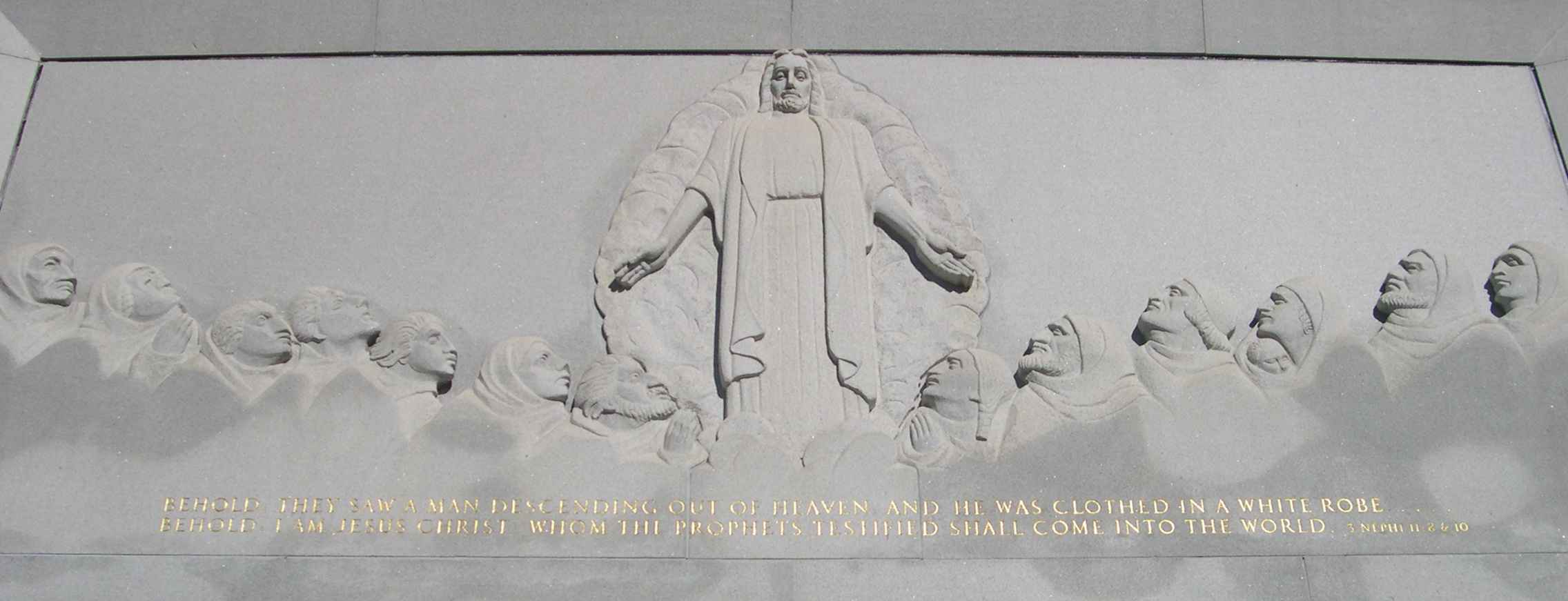
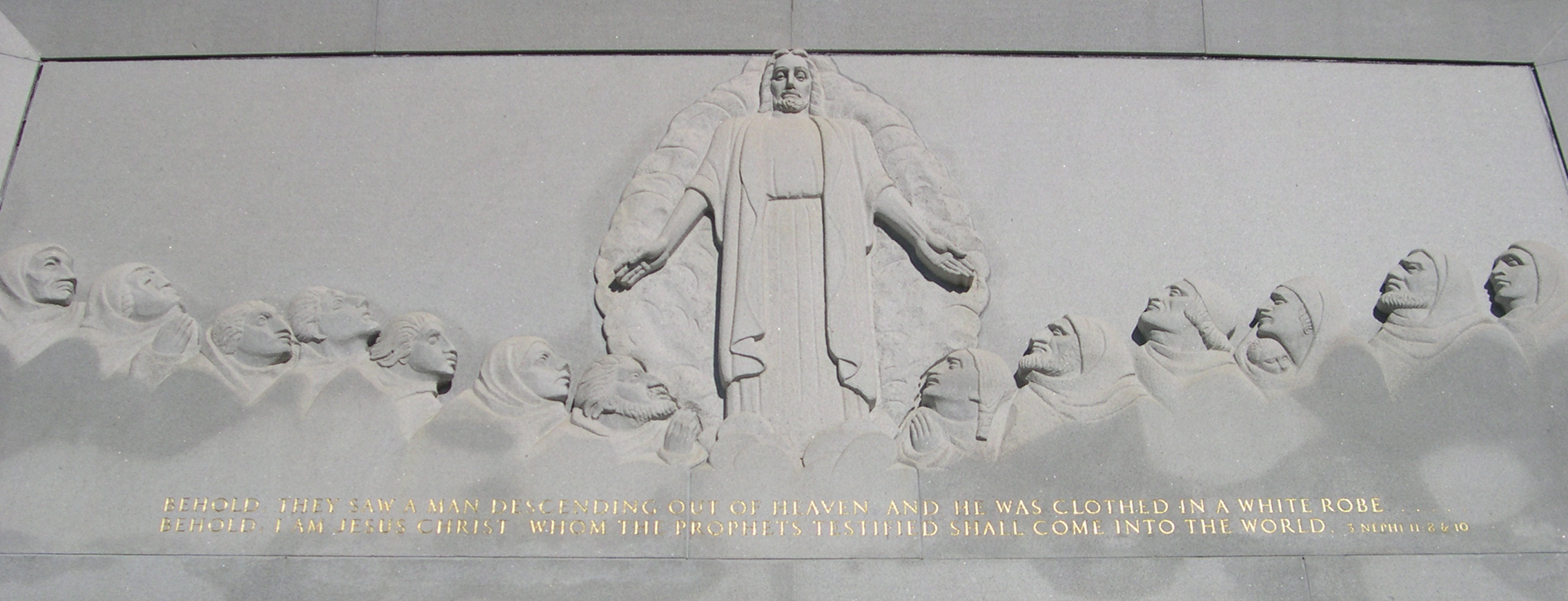
The Laie Hawaii Temple has relief sculptures on the 4 sides of the temple and smaller reproductions of these sculptures in the waiting area so patrons can have time to study and ponder the sculptures. These depict the Old Testament, New Testament, Book of Mormon, and Doctrine and Covenants / church history. I'm not sure if Jesus is shown in the Old Testament sculpture, but he is in the other 3. In the New Testament panel he is shown teaching and healing. Jesus is shown appearing to the Nephites after his resurrection in the Book of Mormon panel. Finally, in the Doctrine and Covenants panel, Jesus is shown next to God the Father in the First Vision. In each case Jesus Christ is shown in the center of the panel as the focus.

Cardston Alberta Temple

The Cardston Alberta Temple in Canada has a low relief sculpture of Jesus talking with the woman at the well. Originally this was at the temple entry, just outside the temple, but with additions it is now inside the temple.

Oakland California Temple

The Oakland California Temple has 2 large granite sculptures on the north (main entry) and south sides of the temple. The sculpture on the north depicts Jesus teaching in the Holy Land. He is teaching a group of men, women, and children. The sculpture on the south shows the resurrected Jesus Christ appearing to the Nephites in the Americas.

Sao Paulo Brazil Temple

The next sculpture looks like a painting, but I classified it as a sculpture because it is a mosaic, and I already have plenty of paintings to write about. The Sao Paulo Brazil Temple baptistry has a mosaic sculpture of the baptism of Jesus Christ on the wall.

Newport Beach California Temple

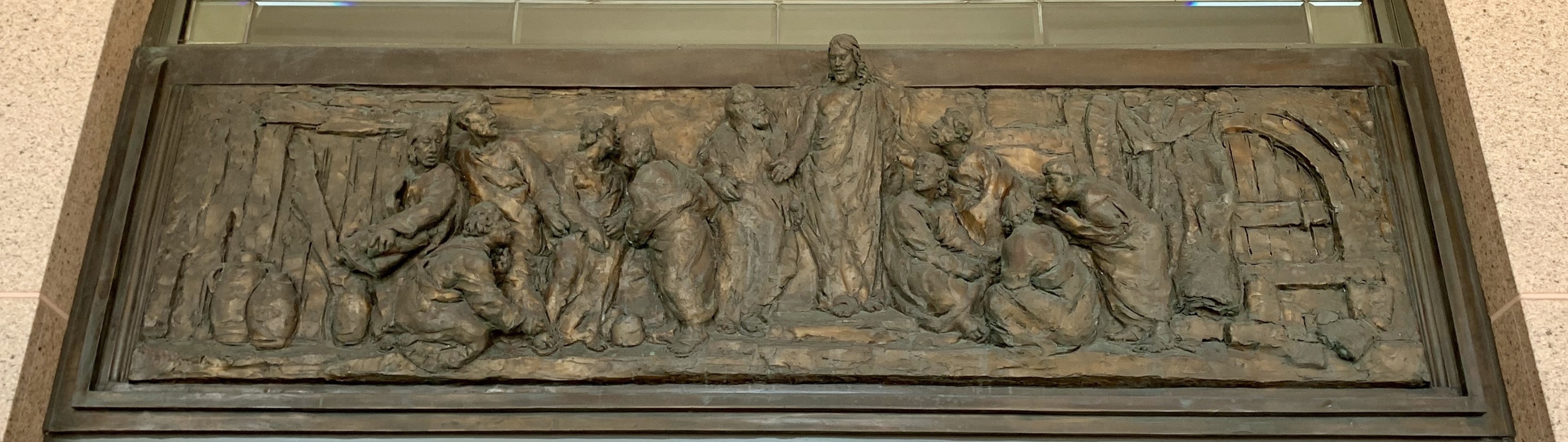
 Newer temples have included sculptures of Jesus as well. The Newport Beach California Temple has a bronze relief sculpture above the doors. This sculpture shows Jesus appearing to the apostles after his resurrection.

Indianapolis Indiana Temple

The Indianapolis Indiana Temple has a relief sculpture of the baptism of Jesus Christ in the baptistry.

Each of these sculptures adds to the focus on Jesus Christ which is so evident in latter-day saint temples. Sculptures as a part of temples, while still used, appear to be less common today than a hundred years ago. I suspect this is mainly because of the growing popularity of stained glass in temples. I do hope that we will continue seeing sculptures in temples, particularly sculptures of our Lord Jesus Christ.

Tuesday, March 29, 2011

Latter-day Saint Temple Murals - Pt 3 - The Spireless Temple Murals

This is a continuation of my posts on Latter-day Saint Temple Murals.  Part 1 can be found here and part 2 can be found here.
 
It took 20 years after the Salt Lake Temple was completed for another temple to start construction.  Ten years after that, the Cardston Alberta Canada Temple was finally completed.  In the meantime the Laie Hawaii Temple had been started and completed.  Four years later, the Mesa Arizona Temple was completed.  These three temples share a common floor plan and a lack of a spire or tower.  They are beautiful temples.  They also had murals which I will discuss briefly.  I have only been in the Mesa Arizona Temple so my insights on the other temple murals will be less detailed.  Please write in the comments and tell us about their murals if you know more.


The Laie Hawaii Temple has unique murals with a different style than those found in pioneer temples.  (Addition to the original post - the baptistery also includes murals) Here are pictures of the creation, garden, and world room murals.  I particularly like how the creation room mural has different panels for each day of creation instead of the one continuous mural painting seen in most temples. I also like how the wood brings warmth into the rooms.  LeConte Stewart painted the murals according to The Church of Jesus Christ of Latter-day Saints's news release after the latest remodel.
Laie Hawaii Temple Baptistery Murals
Laie Hawaii Temple Creation Room Mural

Laie Hawaii Temple Garden Room Mural

Laie Hawaii Temple World Room Mural
The Cardston Alberta Canada Temple was the next completed.  It has intricate woodwork throughout the temple that can be seen alongside the murals.  Also, murals are found in the baptistery, chapel, and terrestrial rooms and not just the creation, garden and world rooms.  I think this is the only temple with terrestrial room murals, although I could be wrong.  An ensign article found here talks about the Cardston Temple and gives this insight into the murals:
Latter-day Saint artists spanning three generations worked side by side on the murals of the temple. LeConte Stewart, in his late twenties, supervised the decorative work and painted the murals in the creation room. These murals were painted with small daubs of color, much like the pointillist style of some of the French impressionists. In the next room was Lee Greene Richards, a man in his early forties, who had been one of LeConte Stewart’s teachers. His garden room murals recalled some elements of art nouveau, including a sinuously curved tree and a graceful peacock. A. B. Wright, one of Richards’s contemporaries, was also at work on smaller paintings in the chapel and terrestrial rooms. Meanwhile, Edwin Evans, a well-established artist in his sixties, who had taught both Richards and Wright, painted scenes of the Alberta countryside in the world room.
I hope you noticed that pointillism and art nouveau were mentioned in regards to the creation room and garden room murals respectively.  The artistic liberties granted to the mural artists were perhaps a lot greater than those given artists today.  Today we stress strict realism in temple murals; in the past we allowed other artistic styles to have some expression.  Prints of the garden room murals are now on the walls of the Kyiv Ukraine Temple as well.  I like how in the Carston Temple garden room the front of the room has two trees painted on half cylindrical portions of the walls.  This seems to make them more tree like, in my opinion. Here are pictures of the various rooms with murals.  If any of you have been to the Cardston Temple and can give more details on what is in the murals, etc. then please comment.  I notice from the pictures that the murals take up a larger portion of each wall than the previous room's murals (with the possible exception of the terrestrial room) which adds to symbolic progression in the temple.
Cardston Alberta Canada Temple Font


Mural of Abraham Offering Sacrifice in Cardston Temple Baptistery
Cardston Temple Baptism of Christ Mural Detail
Cardston Alberta Canada Temple Chapel
Cardston Alberta Canada Temple Creation Room
Cardston Alberta Canada Temple Garden Room
Cardston Alberta Canada Temple World Room
Cardston Alberta Canada Temple Terrestrial Room
The Mesa Arizona Temple was has been called a Lamanite temple in that many Native Americans and Mexicans have historically attended the temple.  The murals reflect the Lamanite influences.  In the baptistery the murals show baptisms being performed in ancient America as well as the baptism of Joseph Smith and Oliver Cowdery.  In the upstairs hallway next to the grand staircase there is a mural of Joseph Smith Jr. preaching to the Lamanites (Native Americans).  The other rooms have typical murals of the creation, Garden of Eden, and world.  The world room presents a barren desert landscape as a symbol of this fallen world.  This is fitting as the Mesa Temple is in a very hot and dry desert.  The Snowflake Arizona Temple uses desert scenes differently and has murals capturing the beauty of the desert landscape instead of showing it strictly as a symptom of a fallen world.
Mesa Temple Baptistery with Mural
Mesa Arizona Temple Baptistery Mural
Mesa Arizona Temple Creation Room Being Painted

Mesa Arizona Temple Garden Room

Mesa Arizona Temple Garden Room
Mesa Arizona Temple World Room
Mesa Arizona Temple Staircase
Mesa Arizona Temple Mural of Joseph Smith Jr. Preaching to the Lamanites


I like that the murals in these three temples are unique.  They display different art styles unlike our current murals which seem to be all natural realism.  Also, I like that murals were worked into different places such as baptisteries, chapels, halls, and terrestrial rooms.  When the endowment was presented using film, the need, and unfortunately the desire, to have murals was lost.  Unfortunately this meant that a lot of good art was not produced for temples until recently when murals have begun to be used again in temples.  There is no reason why a temple using film cannot follow the example of the Laie, Cardston, and Mesa Temples and use murals in the baptistery and in hallways, lobbies, and chapels.  Actually some temples have done this, but that is for another post.  In my next post I plan to talk about the Idaho Falls and Los Angeles Temples and their murals.  They pushed mural progression even further forward with celestial room murals.

Please take the time to comment on these temples and their murals.  I'd love to hear your insights on these murals and how concepts present in these temples could be applied to new temples today.

Monday, November 1, 2010

Temple Statues (other than those of the Angel Moroni)

Most Latter-day Saint temples have statues of the Angel Moroni on their tallest spire, and I wrote about that a few posts ago.  I have also written about relief sculptures on temples.  I mentioned that there is only 1 temple I know of that had a non-Moroni sculpture on the temple.  In this post I’m going to talk about that temple’s sculptures and other statuary on LDS temple grounds.

The Salt Lake Temple is the only temple I know of that used to have statues other than of the Angel Moroni on the temple.  I wrote “statues” because there were 2 of them and I wrote “used to” because they have since been moved to elsewhere on temple square.  Have you ever noticed those little covered spaces just to the sides of the doors of the Salt Lake Temple (seen in the picture on the right of the door)?  Brides love to get pictures standing underneath them.  Well these aren’t just wedding picture locations, they are statuary niches.  The top covering would keep rain off statues, slowing corrosion while framing the statue at the same time.  While there are 4 places for statues, there were only ever 2 statues placed in them.  Originally bronze statues of the martyrs Joseph Smith Jr. and his brother Hyrum Smith were placed in the statuary niches on the east side of the Salt Lake Temple.

Some years after the completion of the Salt Lake Temple the church moved the statues to another spot on temple square south of the temple so you can still see them there.  I am confused why they did this.  Articles I’ve read discussing this say that the niches are loved by brides getting pictures, but the west niches never had statues so brides could still use those.  Also, these were in the temple design and are symbols of sacrifice, testimony, and priesthood (a prophet and patriarch) among other things.  I think they should be put back in the niches.  Maybe the reasoning was that having 2 of 4 niches empty was silly, but having 4 of 4 niches empty is even sillier in my opinion.  Maybe they wanted them to get noticed more on temple square; however, with the general public now allowed to walk right up to the doors this isn’t an issue.  Placing statues in the niches should also attract more attention.  Moving the statues would also be really easy and would provide more protection to them.

Well, this post isn't just about these statues of Joseph and Hyrum Smith on the Salt Lake Temple, but before I leave that topic I'd like to propose a discussion for the comments.  If the church put the statues back in the niches on the east side of the temple and they wanted to fill the two empty west statuary niches, who's statue would you place there?  I know a few of my nominations, but I'll save them for the comments.  There are a lot of factors to consider - the symbolism, importance of the people, how the statues will match the other two, etc.  PLEASE COMMENT

Other temples also have statues on their grounds.  Here is a list I've compiled (very incomplete):

Many temples have visitors centers with replicas of Thorvaldsen's Christus statue.  Although I really like this statue, I would like to see the church commission Christ statues or make replicas of other artist’s Christ statues for some variety.  I can always see the Christus replica when I visit Temple Square in Salt Lake.

Manti Utah Temple – this temple actually has a statue of the ancient American prophet Moroni, only not as an angel and not on the tower or temple itself.

Salt Lake Temple – Temple Square has many statues on the grounds.

Laie Hawaii Temple – Multiple statues by the Fairbanks brothers ore around the temple including:
  A fountain statue dedicated to motherhood with a mother holding a giant clam shell and pouring water over children as a symbol of mothers pouring love, hope and care on their children. 
  A statue of Joseph being blessed by his father.
  A statue of the The Book of Mormon prophet Lehi

Oakland California Temple – The courtyard has a sculpture of children (and a cute dog) and quotes 3 Nephi  17

Nauvoo Illinois Temple – Grounds to the west have a statue of Joseph and Hyrum Smith on horseback.

Rome Italy Temple – This planned temple has a plaza between the visitors center, stake center, patron housing, family history center and temple that includes statues.  You can clearly see in the rendering bronze statues showing the restoration of the Melchizedek Priesthood and the restoration of the Aaronic Priesthood.  In addition there are 2 other statues.  One looks like it has women, the other I’m not sure.

Winter Quarters Nebraska Temple – shares grounds with a pioneer cemetery with statues and bas-relief sculptures.

I also notice that the Manti Utah Temple has a bunch of empty statuary niches.  I don't think these were ever planned to contain statues.  In the Logan Utah Temple the same places have windows.

If you want to discuss other temple statues, talk about adding statues to future temples, or anything else, PLEASE COMMENT.
I personally think that one of the new 2 towered temples would look good with a statue of the Aaronic Priesthood restoration in front of the Aaronic Priesthood side (baptistery entrance) and a statue of the Melchizedek Priesthood Restoration in front of the Melchizedek Priesthood side (main entrance).  These could either be in niches above the doors or just have a path around them.  Bas-relief sculptures would also be an option.  Either way the art would strengthen temple themes and teach.
I also like the idea of putting other statues on temples.  For instance, John the Baptist would look great on a temple west spire.  He already shows up in a lot of temple baptistery paintings and stained glass.

-The following is an addition to the original post

My brother-in-law reminded me of a few statues inside the Salt Lake Temple.  In the celestial room, in front of a Tiffany glass window there is a statue of a woman with two babies on either side.  She is holding something, I think laurels or flowers, or another plant.  I have been unable to find the reference on this, but I thought the statue is supposed to represent something and not a specific person.  It represents love or innocence or some ideal like that.  I find several blog entries claiming it is Aphrodite which in 1890s neoclassicism means love, beauty and fetility.  I also have found some people who say it is the Virgin Mary (one even claimed the Catholic church had donated it to the LDS church) but I'm not sure about that because the statue is flanked by 2 children, not holding one infant Jesus.

There is also a statue of a Cupid or Eros or a cherub on a railing on a staircase that leads up to a sealing room where couples are married for time and all eternity.  The statue is only a foot or so tall and includes a quiver of arrows.  This is clearly a symbol of love.  Neoclassical statues like these were common in 1893 and even earlier.  Many cathedrals in Europe are filled with similar statues representing ideals or showing Greek and Roman gods in a symbolic Christian way (like having Cupid for love).  The other statues in the Celestial Room( if you want to call them statues) are a few birds and a lot of fruits and flowers carved into the walls and ceiling.

Saturday, October 30, 2010

Latter-day Saint Temple Relief Sculptures


This entry is about temple sculptures other than Angel Moroni statues or other statues.  There are or rather were 2 other statues I know of on one temple.   If you know what I’m talking about, feel free to post a comment.  Either way  I’ll get to that in another blog post about statues on temples and on temple grounds.  For this post I’, focusing on Friezes or bas-relief or any type of relief sculpture for that matter.  Although Nauvoo, Salt Lake and many other temples have sculptures of suns, moons, stars, trumpets, clouds, constellations, earths, tree of lifes, flowers, etc., this post isn’t about them.  I’m writing today about the Laie Hawaii Temple, Mesa Arizona Temple, Oakland California Temple, Newport Beach California Temple and the Cardston Alberta Temple although it is a little different.

 The first temple relief sculpture was on the Laie Hawaii Temple in 1919.  On the four sides of the temple there are friezes that are relief sculpture planned by J. Leo Fairbanks and  built by him and Avard Fairbanks, his brother.  These depict Christ in 4 dispensations, or perhaps more accurately in 4 scriptural periods.  These are:

West - Old Testament
South - New Testament
North - Book of Mormon
East - Latter-day Dispensation (Doctrine and Covenants)

If you live in (or visit) Utah you can see smaller bronze copies of these sculptures (by another artist, I can’t find his name but it was one of the big latter-day saint names, like Knaphus) in the lobby of the new Church History Museum.  During the recent renovation of the Laie Temple they added a waiting room with copies of the sculptures so patrons inside the temple could appreciate the scenes and not just those outside.

The next relief sculpture was at the Cardston Alberta Canada Temple in 1923.  I say “at” because I don’t think this relief is actually on the temple but just the grounds, although I am unsure.  It was originally in front of a pool which has since been removed.  The sculpture by Torlief Knaphus depicts Jesus Christ talking to the woman at the well and even quotes scripture.  If you live in Utah you can see a plaster casting of this sculpture in the lobby of the Provo Utah Temple (with added color!). 

With the previous 2 temples including relief sculptures, a relief frieze was included on the Mesa Arizona Temple in 1927.  This sculpture, also by Torlief Knaphus includes 8 panels, 2 on each corner of the temple, depicting the gathering of Israel from the 4 corners of the earth.  The panels depict gathering scenes of:

Early Latter-day Saints crossing the plains to the Salt Lake Valley
A ship landing with English, Welsh, Irish and Scottish immigrants
Handcart pioneers
Mexicans travelling to Zion
Native Americans gathering
Pacific Islanders (who actually aren’t travelling unlike every other panel)
French, Swiss,  Italians travelling
Continued with Germans and Dutch leaving their homes and heading to Zion

The Mesa Temple also has a lion head on the east side by the baptistery entrance.  It is a fountain.

After the Mesa Temple it took 37 years before the Oakland California Temple included relief sculptures in 1964.  It has a sculpture of Jesus teaching the people in and around Jerusalem during his mortal ministry on the north side of the temple.  On the south side of the temple there is a sculpture of Jesus Christ appearing to the Nephites in the Americas after his resurrection.  I can’t seem to find out who sculpted these scenes, but if you know please tell us in the comments on this post.  This temple also has tree of life sculptures, but they are more of an architectural detail so I might discuss them in a later post.

Most websites and articles say that the Oakland Temple is the last with relief sculptures, but they are simply wrong.  The Newport Beach California Temple built in 2005 has a relief sculpture of Christ appearing to 10 of the 12 apostles after his resurrection.  The sculpture looks like bronze and is above the front doors.  Although smaller than the other sculptures in this article, it is a welcome return to relief sculptures and I hope we see more scenes on new temples.  I don’t know who sculpted the Newport Beach Temple frieze and would really like to know.  LeRoy Transfield sculpted this beautiful sculpture.  If you know any information on this PLEASE COMMENT.

So there you have my discussion of relief sculpture on Latter-day Saint temples.  We have scriptural scenes (Laie Hawaii, Cardston Alberta, Oakland California and Newport Beach) and latter-day gathering (Mesa Arizona) represented in these fascinating works of art.

If you know of any other temple sculptures (not statues, I’ll deal with them later) please tell us in comments.

-The following is an addition to the original post
I noticed that although the Winter Quarters Nebraska Temple doesn't have relief sculptures on it (unless you count the doors), the grounds are shared with a pioneer cemetery with some nice relief sculptures of Christ, etc. in a style I really like.