Showing posts with label Newport Beach California Temple. Show all posts

Saturday, December 26, 2020

Jesus In Latter-day Saint Temples - Sculptures

My wife was looking at Light The World posts and saw that someone was using that hash tag to claim that members of The Church of Jesus Christ of Latter-day Saints aren't christian because our temples don't have pictures of Jesus in them. The post was of course ridiculous (we have pictures of Jesus hanging everywhere in temples) and I think it is an internet troll trying to take the good that came from Light The World and twist it into evil. The claim was ridiculous as the temple ceremonies feature Jesus Christ and his teachings. As a response, I would like to highlight some art in temples that depicts Jesus Christ. I'll start with this post which shows Jesus in sculpture. Of course copies of The Christus, a statue of Jesus Christ are found in temple visitors centers and on the grounds of temples, but I'm going to highlight sculptures that are a part of the temples. 

Laie Hawaii Temple


The Laie Hawaii Temple has relief sculptures on the 4 sides of the temple and smaller reproductions of these sculptures in the waiting area so patrons can have time to study and ponder the sculptures. These depict the Old Testament, New Testament, Book of Mormon, and Doctrine and Covenants / church history. I'm not sure if Jesus is shown in the Old Testament sculpture, but he is in the other 3. In the New Testament panel he is shown teaching and healing. Jesus is shown appearing to the Nephites after his resurrection in the Book of Mormon panel. Finally, in the Doctrine and Covenants panel, Jesus is shown next to God the Father in the First Vision. In each case Jesus Christ is shown in the center of the panel as the focus.

Cardston Alberta Temple

The Cardston Alberta Temple in Canada has a low relief sculpture of Jesus talking with the woman at the well. Originally this was at the temple entry, just outside the temple, but with additions it is now inside the temple.

Oakland California Temple

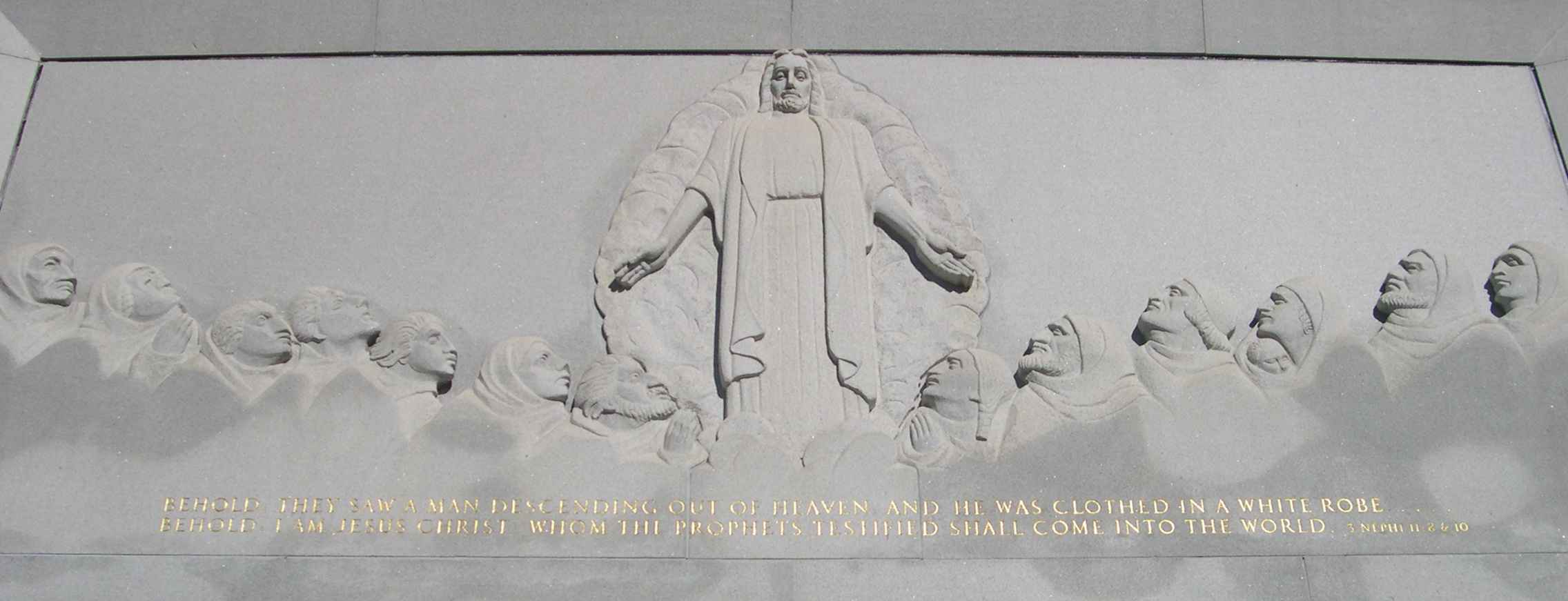
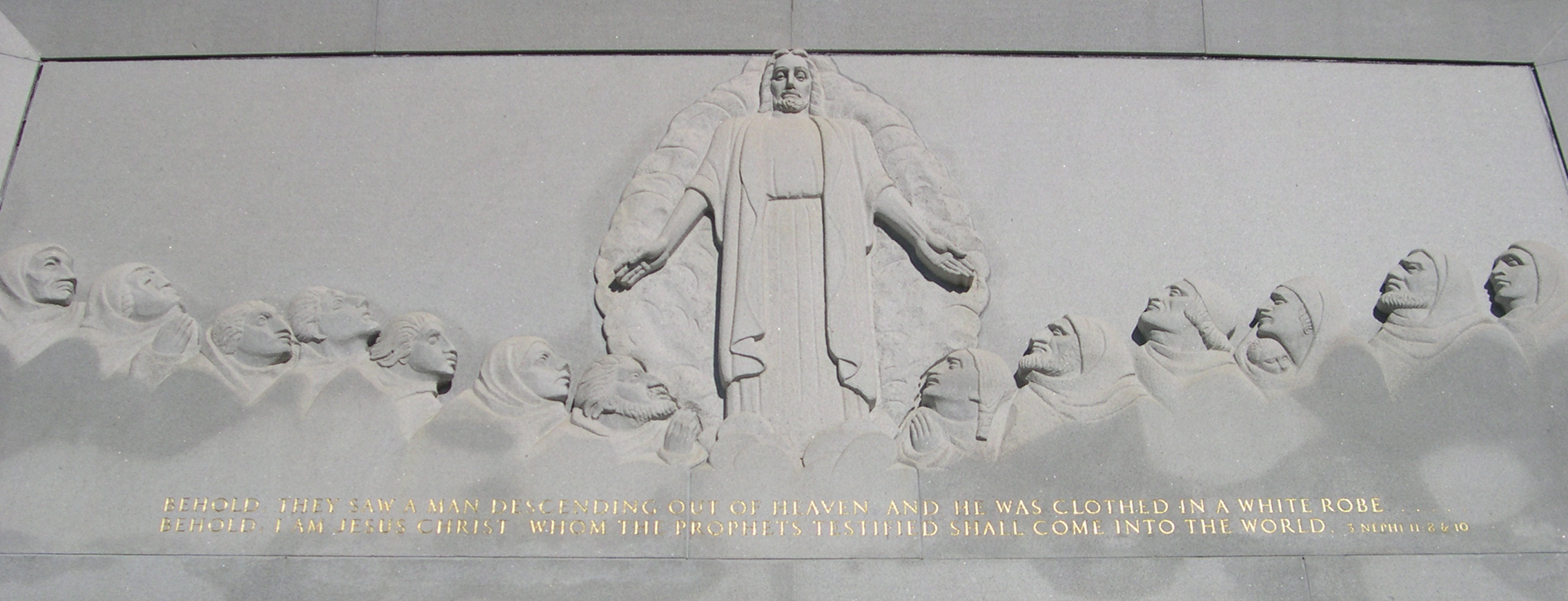
The Oakland California Temple has 2 large granite sculptures on the north (main entry) and south sides of the temple. The sculpture on the north depicts Jesus teaching in the Holy Land. He is teaching a group of men, women, and children. The sculpture on the south shows the resurrected Jesus Christ appearing to the Nephites in the Americas.

Sao Paulo Brazil Temple

The next sculpture looks like a painting, but I classified it as a sculpture because it is a mosaic, and I already have plenty of paintings to write about. The Sao Paulo Brazil Temple baptistry has a mosaic sculpture of the baptism of Jesus Christ on the wall.

Newport Beach California Temple

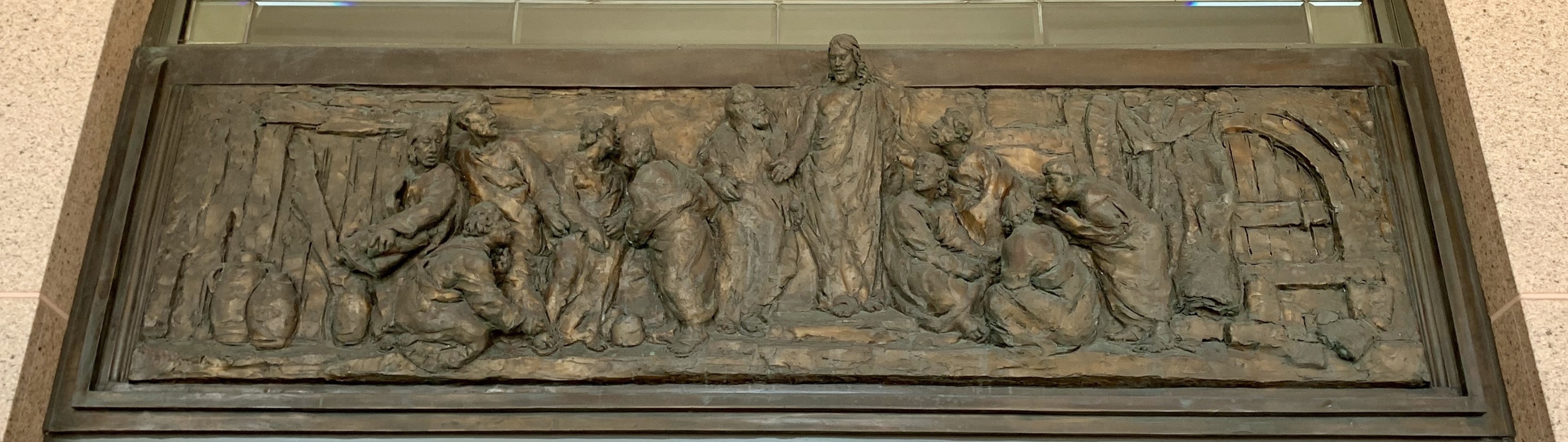
 Newer temples have included sculptures of Jesus as well. The Newport Beach California Temple has a bronze relief sculpture above the doors. This sculpture shows Jesus appearing to the apostles after his resurrection.

Indianapolis Indiana Temple

The Indianapolis Indiana Temple has a relief sculpture of the baptism of Jesus Christ in the baptistry.

Each of these sculptures adds to the focus on Jesus Christ which is so evident in latter-day saint temples. Sculptures as a part of temples, while still used, appear to be less common today than a hundred years ago. I suspect this is mainly because of the growing popularity of stained glass in temples. I do hope that we will continue seeing sculptures in temples, particularly sculptures of our Lord Jesus Christ.

Wednesday, May 4, 2011

Colorful Temple Exteriors

White has become so synonymous with the temples of The Church of Jesus Christ of Latter-day Saints that we seem to forget the examples of temples that aren't white or any color remotely close to white.

The Kirtland Ohio Temple
Currently the Kirtland Ohio Temple is white (and not owned by the church).  Originally it had sparkling blue walls, a red roof, and green doors (the doors are still green).  Our first temple was clearly not white, but instead quite colorful.

The Logan Utah Temple
Today the Logan Temple is made of a dark brown stone.  Originally it was painted white (much like the St. George Utah Temple which is actually red sandstone stuccoed white).  The paint on the Logan Temple didn't weather very well and soon it looked horrible.  A decision was made to let the paint finish wearing off and to not repaint it.  This is how the temple is now with its dark brown walls.  The stone is really a nice color and contrasts nicely with the white towers (which are now fiberglass and not the original wood, if you wanted to know).  This also explains why the Logan Temple stones are somewhat rough cut and irregularly shaped blocks.  The builders thought the stones would always be covered.  Other temples such as Manti and Salt Lake have neatly arranged, fine cut, smoothed stone blocks because they were never intended to be painted.

The Vernal Utah Temple
The Vernal Temple is remodeled from the Uintah Stake Tabernacle which was made out of red brick.  Because of this the current temple is red.  White towers contrast nicely and add a touch of the familiar white usually symbolizing holiness. 

The Copenhagen Denmark Temple
The Copenhagen Temple is another temple remodeled from an existing building - this time a chapel.  The chapel was red brick, so the completed temple is also red brick and looks nice.  The red also makes details such as the front columns stand out.  I think this temple works, and the fact that it is red helps the temple's appearance in my opinion.

I find that the red is a wonderful symbol of the blood of Christ and the atonement in general.  All this red brick might also remind us that the first endowments were given in the upper floor of Joseph Smith's Red Brick Store in Nauvoo, Illinois before the Nauvoo Temple was completed.  Either way, I think that red is a wonderful color for a temple.

The Johannesburg South Africa Temple is made of brown brick which gives it a different look.

The last really colorful temple is the Newport Beach California Temple which is a nice pink color.  I like the look.  The color was a concession to neighbors that thought a white temple would have been too bright.  The temple is still really light colored, so I hesitate to list it with the above temples.  I suppose that the Albuquerque New Mexico Temple is also a pinkish hue.  There are other temples with slight shades of this color or that.  I don't need to list them all.  Most are kept really light, so the temples listed above are really the colorful ones.

Several other temples have dark accents.  The Fukuoka Japan Temple, for instance, has some dark stone.  The Snowflake Arizona Temple also has its first floor made out of darker stone than the lighter second floor.

That is the list of colorful temples (or temples that aren't white or light colored).  I don't think there are any others.  I like having temples white or light colors.  It is nice symbolism and is a nice look for these holy edifices.  Even so, there is something neat about these bolder temples with dark colors.  Maybe it is because they are so rare and unique.  Maybe it is because the white details on the temple seem so much brighter with darker details adding contrast.  There are probably many reasons.  I like how unique these temples are and wouldn't mind seeing a few more colorful or dark temples, even though I'd still prefer most temples to be light.

Please comment and let us know what you think.

Saturday, October 30, 2010

Latter-day Saint Temple Relief Sculptures


This entry is about temple sculptures other than Angel Moroni statues or other statues.  There are or rather were 2 other statues I know of on one temple.   If you know what I’m talking about, feel free to post a comment.  Either way  I’ll get to that in another blog post about statues on temples and on temple grounds.  For this post I’, focusing on Friezes or bas-relief or any type of relief sculpture for that matter.  Although Nauvoo, Salt Lake and many other temples have sculptures of suns, moons, stars, trumpets, clouds, constellations, earths, tree of lifes, flowers, etc., this post isn’t about them.  I’m writing today about the Laie Hawaii Temple, Mesa Arizona Temple, Oakland California Temple, Newport Beach California Temple and the Cardston Alberta Temple although it is a little different.

 The first temple relief sculpture was on the Laie Hawaii Temple in 1919.  On the four sides of the temple there are friezes that are relief sculpture planned by J. Leo Fairbanks and  built by him and Avard Fairbanks, his brother.  These depict Christ in 4 dispensations, or perhaps more accurately in 4 scriptural periods.  These are:

West - Old Testament
South - New Testament
North - Book of Mormon
East - Latter-day Dispensation (Doctrine and Covenants)

If you live in (or visit) Utah you can see smaller bronze copies of these sculptures (by another artist, I can’t find his name but it was one of the big latter-day saint names, like Knaphus) in the lobby of the new Church History Museum.  During the recent renovation of the Laie Temple they added a waiting room with copies of the sculptures so patrons inside the temple could appreciate the scenes and not just those outside.

The next relief sculpture was at the Cardston Alberta Canada Temple in 1923.  I say “at” because I don’t think this relief is actually on the temple but just the grounds, although I am unsure.  It was originally in front of a pool which has since been removed.  The sculpture by Torlief Knaphus depicts Jesus Christ talking to the woman at the well and even quotes scripture.  If you live in Utah you can see a plaster casting of this sculpture in the lobby of the Provo Utah Temple (with added color!). 

With the previous 2 temples including relief sculptures, a relief frieze was included on the Mesa Arizona Temple in 1927.  This sculpture, also by Torlief Knaphus includes 8 panels, 2 on each corner of the temple, depicting the gathering of Israel from the 4 corners of the earth.  The panels depict gathering scenes of:

Early Latter-day Saints crossing the plains to the Salt Lake Valley
A ship landing with English, Welsh, Irish and Scottish immigrants
Handcart pioneers
Mexicans travelling to Zion
Native Americans gathering
Pacific Islanders (who actually aren’t travelling unlike every other panel)
French, Swiss,  Italians travelling
Continued with Germans and Dutch leaving their homes and heading to Zion

The Mesa Temple also has a lion head on the east side by the baptistery entrance.  It is a fountain.

After the Mesa Temple it took 37 years before the Oakland California Temple included relief sculptures in 1964.  It has a sculpture of Jesus teaching the people in and around Jerusalem during his mortal ministry on the north side of the temple.  On the south side of the temple there is a sculpture of Jesus Christ appearing to the Nephites in the Americas after his resurrection.  I can’t seem to find out who sculpted these scenes, but if you know please tell us in the comments on this post.  This temple also has tree of life sculptures, but they are more of an architectural detail so I might discuss them in a later post.

Most websites and articles say that the Oakland Temple is the last with relief sculptures, but they are simply wrong.  The Newport Beach California Temple built in 2005 has a relief sculpture of Christ appearing to 10 of the 12 apostles after his resurrection.  The sculpture looks like bronze and is above the front doors.  Although smaller than the other sculptures in this article, it is a welcome return to relief sculptures and I hope we see more scenes on new temples.  I don’t know who sculpted the Newport Beach Temple frieze and would really like to know.  LeRoy Transfield sculpted this beautiful sculpture.  If you know any information on this PLEASE COMMENT.

So there you have my discussion of relief sculpture on Latter-day Saint temples.  We have scriptural scenes (Laie Hawaii, Cardston Alberta, Oakland California and Newport Beach) and latter-day gathering (Mesa Arizona) represented in these fascinating works of art.

If you know of any other temple sculptures (not statues, I’ll deal with them later) please tell us in comments.

-The following is an addition to the original post
I noticed that although the Winter Quarters Nebraska Temple doesn't have relief sculptures on it (unless you count the doors), the grounds are shared with a pioneer cemetery with some nice relief sculptures of Christ, etc. in a style I really like.