Showing posts with label Copenhagen Denmark Temple. Show all posts

Friday, May 13, 2011

Temple Materials - Brick

This is another installment on materials used in temples built by The Church of Jesus Christ of Latter-day Saints.  This time we are discussing brick.

You might ask what my opinion is on brick.  As a building material I hate it.  As an architectural material, I often like it.  I hate it as a building material because it is brittle, heavy, and hard to reinforce (sometimes impossible).  This is really bad if you are in an area with seismic concerns.  Brick also can look less permanent than stone, but it often looks enduring.  I actually like the temples that use brick.

The temple endowment was first given in the upper assembly room of Joseph Smith's red brick store in Nauvoo, Illinois.  Joseph realized that the temple wouldn't be completed before his death so he gave the ordinances to a select few there.  Because of this, brick temples can remind us of where the ordinances were first given.

Original plans for the Salt Lake Temple called for it to be made from adobe, a kind of brick.  This seems odd, as Brigham Young saw the temple in vision. You would think he would have insisted on the granite it was later built out of.  Well, the adobe used at the time was apparently the same grey color as the temple, which makes his vision make sense.  In this case, I am glad granite was chosen.

Johannesburg South Africa Temple
The Johannesburg South Africa Temple was the first completed out of brick.  It is made of brown brick and is one of the six spire sloped roof temples.  I think the brick gives it an 80s look, but not in a bad way.  The brick (a veneer really) is carefully laid and gives a very orderly, nice, neat look.  I also like how the white spires springing from their brick bases seem all the whiter next to brown brick.


Vernal Utah Temple
The Vernal Utah Temple and Copenhagen Denmark Temple are both made out of brick, and both are remodeled from existing structures - Vernal was an old tabernacle and Copenhagen was an old chapel.  I like how both of them are red, making them uniquely colored temples and reminding us of Joseph Smith's Red Brick Store.  The Vernal Temple has yellow-orange stone details around the windows and doors.
Copenhagen Denmark Temple
The Copenhagen Denmark Temple has a very orderly, stately look.  It is quite simple and reminds me of the Temple of Solomon.  I like that the red brick makes the light columns stand out.  I also like how the red in these temples can remind us of Christ and his sacrifice for us.

Other temples have brick beneath the surface such as the London England Temple which, according to ldschurchtemples.com is made of reinforced concrete on a structural steel skeleton with brick walls covered in white Portland limestone.


Although not brick, other temples use CMU (Concrete masonry units) which are better known as cinder block.  I used to have a bad impressing of CMU; however, they are a good building material.  In most cases they should be stuccoed or otherwise covered for aesthetic reasons.  I understand that the Twin Falls Temple is CMU with precast concrete panels covering the exterior.  The Hamilton New Zealand Temple is also CMU and apparently just painted.  I think a few others are CMU, particularly temples built in the 1970s and 1980s.  In most, if not all, of these cases the CMU is covered with stone, stucco, or some other material.  To be clear, CMU is not brick.  Brick is clay masonry.  CMU is concrete masonry.  Stone masonry also exists and is what the pioneer temples are made out of.

I like that a few temples are made out of brick.  I like the variety.  Still, I hope this material is only occasionally used.  Given the current history of brick in temples, it will probably be very rarely used and mainly used when a building is remodeled into a temple.

Wednesday, May 4, 2011

Colorful Temple Exteriors

White has become so synonymous with the temples of The Church of Jesus Christ of Latter-day Saints that we seem to forget the examples of temples that aren't white or any color remotely close to white.

The Kirtland Ohio Temple
Currently the Kirtland Ohio Temple is white (and not owned by the church).  Originally it had sparkling blue walls, a red roof, and green doors (the doors are still green).  Our first temple was clearly not white, but instead quite colorful.

The Logan Utah Temple
Today the Logan Temple is made of a dark brown stone.  Originally it was painted white (much like the St. George Utah Temple which is actually red sandstone stuccoed white).  The paint on the Logan Temple didn't weather very well and soon it looked horrible.  A decision was made to let the paint finish wearing off and to not repaint it.  This is how the temple is now with its dark brown walls.  The stone is really a nice color and contrasts nicely with the white towers (which are now fiberglass and not the original wood, if you wanted to know).  This also explains why the Logan Temple stones are somewhat rough cut and irregularly shaped blocks.  The builders thought the stones would always be covered.  Other temples such as Manti and Salt Lake have neatly arranged, fine cut, smoothed stone blocks because they were never intended to be painted.

The Vernal Utah Temple
The Vernal Temple is remodeled from the Uintah Stake Tabernacle which was made out of red brick.  Because of this the current temple is red.  White towers contrast nicely and add a touch of the familiar white usually symbolizing holiness. 

The Copenhagen Denmark Temple
The Copenhagen Temple is another temple remodeled from an existing building - this time a chapel.  The chapel was red brick, so the completed temple is also red brick and looks nice.  The red also makes details such as the front columns stand out.  I think this temple works, and the fact that it is red helps the temple's appearance in my opinion.

I find that the red is a wonderful symbol of the blood of Christ and the atonement in general.  All this red brick might also remind us that the first endowments were given in the upper floor of Joseph Smith's Red Brick Store in Nauvoo, Illinois before the Nauvoo Temple was completed.  Either way, I think that red is a wonderful color for a temple.

The Johannesburg South Africa Temple is made of brown brick which gives it a different look.

The last really colorful temple is the Newport Beach California Temple which is a nice pink color.  I like the look.  The color was a concession to neighbors that thought a white temple would have been too bright.  The temple is still really light colored, so I hesitate to list it with the above temples.  I suppose that the Albuquerque New Mexico Temple is also a pinkish hue.  There are other temples with slight shades of this color or that.  I don't need to list them all.  Most are kept really light, so the temples listed above are really the colorful ones.

Several other temples have dark accents.  The Fukuoka Japan Temple, for instance, has some dark stone.  The Snowflake Arizona Temple also has its first floor made out of darker stone than the lighter second floor.

That is the list of colorful temples (or temples that aren't white or light colored).  I don't think there are any others.  I like having temples white or light colors.  It is nice symbolism and is a nice look for these holy edifices.  Even so, there is something neat about these bolder temples with dark colors.  Maybe it is because they are so rare and unique.  Maybe it is because the white details on the temple seem so much brighter with darker details adding contrast.  There are probably many reasons.  I like how unique these temples are and wouldn't mind seeing a few more colorful or dark temples, even though I'd still prefer most temples to be light.

Please comment and let us know what you think.

Saturday, April 9, 2011

Latter-day Saint Temple Murals - Pt 6 - Baptistery Murals

To see my other posts on Latter-day Saint temple murals click on the following links:
Part 1, Part 2, Part 3, Part 4, Part 5, Celestial room murals.
Some of those original posts have been updated.  For instance, baptistery murals are now included in the Laie Temple discussion and the Logan and Vernal Utah Temples' celestial room murals are also added to the celestial room murals post.

As a quick recap, I'll show some baptistery murals that were already dicussed:
Manti Temple Baptistery
Laie Hawaii Temple Baptistery
Laie Hawaii Temple Baptistery Murals
Cardston Alberta Temple Baptistery
Cardston Alberta Temple Baptistery Mural Detail

Mesa Arizona Temple Baptistery Mural

Mesa Arizona Temple Baptistery Mural
Idaho Falls Idaho Temple Baptistery
Los Angeles Temple Baptistery

Ok, now I'll move on to new material.

After the LA Temple was completed, murals were discontinued (until the last few years) in endowment rooms.  I've discussed some miscellaneous murals that were included in the meantime.  Baptisteries still occasionally included murals during this time, starting with the Hamilton New Zealand Temple (the first completed after LA).
Hamilton New Zealand Temple Baptistery
The Sao Paulo Brazil Temple has a tile mosaic mural in its baptistery:
Sao Paulo Brazil Temple Baptistery with Mosaic Mural
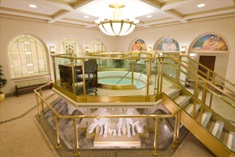
I think the next baptistery mural was in the Copenhagen Denmark Temple.  Copies of parts of this mural are used as murals in the baptisteries of the Curitiba Brazil Temple, Oquirrh Mountain Utah Temple, remodeled Mexico City Temple, and probably others.  I like the grand scale of this mural and the wonderful scene of the baptism of our Savior Jesus Christ.
Copenhagen Denmark Temple Baptistery

Copenhagen Denmark Temple Baptistery Mural

Many temples include some commonly used picture of the baptism of Jesus Christ.  I'm not going to list all of those, but yes, many temples include baptistery pictures, a few of which could be considered murals.  I like it when they are harmoniously worked into the rooms, and not just any old picture.

The Helsinki Finland Temple uses smaller murals near the top of the baptistery walls.  This reminds me of how murals were done in the Laie Hawaii, Cardston Alberta Canada, and Idaho Falls Idaho Temples.  In fact, if you look closely at these murals you can tell that they are prints of the murals in the Cardston Albeta Temple, so if you want to know what they look like in detail, look at these.
Helsinki Finland Temple Baptistery
Helsinki Finland Temple Baptistery Mural Detail 1
Detail 2
Detail 3


Helsinki Finland Temple Baptistery Mural Detail 4
 Please comment and let us know what you think of these murals and the possibilities for other baptistery murals in future temples.  Also, if I've missed any baptistery murals, let me know.  I have intentionally skipped over stained glass murals in baptisteries, although they are technically murals and are wonderful pieces of art work.

I'd like to see a temple baptistery with murals on the four walls.  I suggest: the baptism of Jesus Christ, the baptism of Joseph Smith and Oliver Cowdery, and the baptisms at the waters of Mormon in Mosiah in The Book of Mormon.  I'm not sure what to put on the forth wall.  It could depict the baptism of Adam so the Old Testament could be represented.  It could also depict other baptisms from The Holy Bible, The Book of Mormon, or the early days of the restoration.  Depictions of the restoration of the Aaronic Priesthood would also be fitting.

Another question is what sorts of murals would you place in a confirmation room?  Usually these just contain typical church paintings that are not necessarily linked to the ordinance of confirmation.

Please comment.