Showing posts with label Helsinki Finland Temple. Show all posts

Tuesday, April 12, 2011

Metal Clad Temple Towers, Domes, and Spires

The Church of Jesus Christ of Latter-day Saints' temple towers, spires, and domes have occasionally been clad in metal.  I want to talk a little about these.

Many historic Christian churches have metal clad spires.  Lead, Aluminum, Copper, Gold, and other metals have been used throughout history.  The metals serve a practical function of protecting the spire as they weather well.  Placing metals on churches was also a a way to make the church extra special, as many of the metals were hard to come by.


Orig. 1884 Salt Lake Temple Spire Sections
Truman Angel Sr.'s 1884 plans for the Salt Lake Temple had metal sheathed spires.  So the slanted portions of all six towers would have been covered in metal.  In 1887, Truman Angel Jr. changed the design to have the granite spires that the temple has today. (See Salt Lake Temple: A Monument to a People)  Today, the only metal on the spires are five copper finials and the gold leaf covered Angel Moroni statue.


The London England Temple has a metal spire.  You can see a photo here.  The spire is the most detailed portion of the temple's exterior and I like it.  I also served my mission in London so I'm biased.  According to ldschurchtemples.com
The original design of the London England Temple called for a spire of perforated aluminum, similar in appearance to the spires of the Oakland California Temple. The perforations were later removed from the design, however, in favor of a solid sheath of lead-coated copper.
The Oakland California Temple has five perforated gold colored spires.  They are apparently not metal, but rather reinforced concrete that is painted to look like metal.  I've read that the oriental look of the spires is not a coincidence, but rather was used because of the large number of Asian Americans in California and particularly the Bay Area.  You can see pictures of the spires here and here and here.  I love their complexity.  I also love how the lattice structure lets the spires glow.

The Ogden and Provo Temples were the next to have metal spires.  Theirs were originally an orange gold color seen here and here. They were meant to represent the pillar of fire by night that led the Israelites from Egypt.  The upper floors of the temple just below the spire was supposed to represent the cloud that led the Israelites by day.  This is neat symbolism with, in my opinion, horrible execution.  The temples ended up resembling rocket ships, birthday cakes, and other unintended things.  In the 2000s each temple had a statue of the Angel Moroni added (which was actually in the original plans, so we shouldn't think that destroyed the architectural vision of these temples).  At the same time, the spires were painted white, covering the original metal.

Next, the Washington D.C. Temple was built with 6 pointy metal spires.  Their length makes this temple the tallest temple.  The spires are made of steel overlaid with gold leaf.  Each spire has a lot more detail than you usually notice.

The Sao Paulo Brazil Temple was the next temple with a metal spire.  Originally the temple lacked an Angel Moroni statue, but made up for this with a detailed spire.

I think the Tokyo Japan Temple spire is metal.  The Stockholm Sweden Temple and Frankfurt Germany Temple also used metal on their spires.  Many have since used some metal in the spires.

The Houston Texas Temple uses a lot of copper to cover its prominent spire. I really like the style of this temple and feel that the weathered copper gives the modern classical architecture a dignified, mature look.

The Boston Massachusetts Temple was originally completed without a tower due to a lawsuit.  A few months after its dedication, a tower clad in metal was added to the temple.  I like the design.  It is modern, yet fits in with the New England architecture, partially due to the metal spire.

The Helsinki Finland Temple features a metal spire for the tower and a metal dome over the celestial room.

Orig. Oquirrh Mountain Temple Plan With a Copper Spire
The original plans for the Oquirrh Mountain Temple included a copper clad spire.  This would have been nice as Kennecott Copper donated the land for the temple and the Oquirrh Mountains have the largest copper mine (and largest open pit mine) in the world.  The final design has a stone clad tower.


A few temples have metal domes.  The Nauvoo Illinois Temple has a metal tower dome.  I think the Manti Temple towers are clad in metal, but they may use shingles. The Vernal Utah Temple has two copper domes.  The Newport Beach California also has two copper domes, one on the tower, the other above the celestial room.

Other temples have some metal cladding.  The Cochabamba Bolivia Temple was metal on top of its central and 4 side towers.  The Las Vegas Nevada Temple has a copper roof.  Other temples have metal used here and there.

I like metal spires, towers, and domes on temples.  They haven't been used as often as stone or fiberglass or painted spires.  That makes them unique and interesting.  Metal brings a certain dignity to these temples.  There are a wide variety of uses with numerous metals to choose from.  Different styles can and have been used such as perforating the metal, adding etchings, adding a textured pattern, using a smooth metal surface, using several metals, etc.  Metals can retain an untarnished glory or be allowed to develop a dignified patina.  The possibilities are great and so I expect to continue seeing metal temple spires, domes, and towers.  That is a good thing.

Please comment and let us know what you think.

Saturday, April 9, 2011

Latter-day Saint Temple Murals - Pt 6 - Baptistery Murals

To see my other posts on Latter-day Saint temple murals click on the following links:
Part 1, Part 2, Part 3, Part 4, Part 5, Celestial room murals.
Some of those original posts have been updated.  For instance, baptistery murals are now included in the Laie Temple discussion and the Logan and Vernal Utah Temples' celestial room murals are also added to the celestial room murals post.

As a quick recap, I'll show some baptistery murals that were already dicussed:
Manti Temple Baptistery
Laie Hawaii Temple Baptistery
Laie Hawaii Temple Baptistery Murals
Cardston Alberta Temple Baptistery
Cardston Alberta Temple Baptistery Mural Detail

Mesa Arizona Temple Baptistery Mural

Mesa Arizona Temple Baptistery Mural
Idaho Falls Idaho Temple Baptistery
Los Angeles Temple Baptistery

Ok, now I'll move on to new material.

After the LA Temple was completed, murals were discontinued (until the last few years) in endowment rooms.  I've discussed some miscellaneous murals that were included in the meantime.  Baptisteries still occasionally included murals during this time, starting with the Hamilton New Zealand Temple (the first completed after LA).
Hamilton New Zealand Temple Baptistery
The Sao Paulo Brazil Temple has a tile mosaic mural in its baptistery:
Sao Paulo Brazil Temple Baptistery with Mosaic Mural
I think the next baptistery mural was in the Copenhagen Denmark Temple.  Copies of parts of this mural are used as murals in the baptisteries of the Curitiba Brazil Temple, Oquirrh Mountain Utah Temple, remodeled Mexico City Temple, and probably others.  I like the grand scale of this mural and the wonderful scene of the baptism of our Savior Jesus Christ.
Copenhagen Denmark Temple Baptistery

Copenhagen Denmark Temple Baptistery Mural

Many temples include some commonly used picture of the baptism of Jesus Christ.  I'm not going to list all of those, but yes, many temples include baptistery pictures, a few of which could be considered murals.  I like it when they are harmoniously worked into the rooms, and not just any old picture.

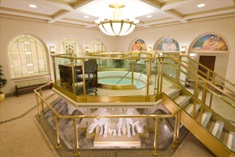
The Helsinki Finland Temple uses smaller murals near the top of the baptistery walls.  This reminds me of how murals were done in the Laie Hawaii, Cardston Alberta Canada, and Idaho Falls Idaho Temples.  In fact, if you look closely at these murals you can tell that they are prints of the murals in the Cardston Albeta Temple, so if you want to know what they look like in detail, look at these.
Helsinki Finland Temple Baptistery
Helsinki Finland Temple Baptistery Mural Detail 1
Detail 2
Detail 3


Helsinki Finland Temple Baptistery Mural Detail 4
 Please comment and let us know what you think of these murals and the possibilities for other baptistery murals in future temples.  Also, if I've missed any baptistery murals, let me know.  I have intentionally skipped over stained glass murals in baptisteries, although they are technically murals and are wonderful pieces of art work.

I'd like to see a temple baptistery with murals on the four walls.  I suggest: the baptism of Jesus Christ, the baptism of Joseph Smith and Oliver Cowdery, and the baptisms at the waters of Mormon in Mosiah in The Book of Mormon.  I'm not sure what to put on the forth wall.  It could depict the baptism of Adam so the Old Testament could be represented.  It could also depict other baptisms from The Holy Bible, The Book of Mormon, or the early days of the restoration.  Depictions of the restoration of the Aaronic Priesthood would also be fitting.

Another question is what sorts of murals would you place in a confirmation room?  Usually these just contain typical church paintings that are not necessarily linked to the ordinance of confirmation.

Please comment.