Showing posts with label Mesa Arizona Temple. Show all posts

Tuesday, April 5, 2011

Words as Temple Decoration

Several temples of The Church of Jesus Christ of Latter-day Saints use words to decorate the temple.  For example, at the entrance to the Cardston Alberta Temple there is this verse by Orson Whitney that I found here.  Here is the verse:

Where spreads a feast unknown to festive halls.
Freely partake, for freely God hath given
And taste the holy joys that tell of heaven.
Here learn of Him who triumphed o’er the grave,
And unto men the keys, the Kingdom gave;
Joined here by powers that past and present bind
The living and the dead perfection find.
 In other temples a verse of scripture is used.  In the Mesa Arizona Temple, above the celestial room doors (seen from the grand staircase) is part of D&C 93:36:
THE GLORY OF GOD IS INTELLIGENCE
I think it was also in the Mesa Temple (but may have been elsewhere) that the beatitude found in Matthew 5:8 is inscribed on a wall:

BLESSED ARE THE PURE IN HEART FOR THEY SHALL SEE GOD
The Idaho Falls Temple has  Habukkuk 2:20 on the wall in a foyer area:
BUT THE LORD IS IN HIS HOLY TEMPLE: LET ALL THE EARTH KEEP SILENCE BEFORE HIM.
Of course most temple exteriors contain the words:
HOLINESS TO THE LORD
THE HOUSE OF THE LORD
The Salt Lake Temple contains a scroll stone engraved with the words:
I AM ALPHA AND OMEGA
The original Nauvoo Temple had inscriptions in the lower assembly hall.  Above the Melchizedek Priesthood pulpits, following the arch of the ceiling in gilded letters were the words:
THE LORD HAS SEEN OUR SACRIFICE - COME AFTER US
Both the Kirtland Ohio and Nauvoo Illinois Temples had assembly halls with three initials on each of the 24 pulpits.  The Kirtland Temple had the Melchizedek Priesthood pulpits engraved with the following from top to bottom:

M.P.C. (Melchizedek Presiding Council)
P.M.H. (Presiding Melchizedek High Priesthood)
M.H.P. (Melchizedek High Priesthood)
P.E.M. (Presiding or Presidency Elders Melchizedek)
On the eastern Aaronic Priesthood side the initials are from top to bottom:

B.P.A. (Bishop Presiding over Aaronic Priesthood)
P.A.P. (Presiding or Presidency Aaronic Priests)
P.T.A. (Presiding or Presidency Teachers Aaronic Priesthood)
P.D.A. (Presiding or Presidency Deacons Aaronic Priesthood)
 This website claims that in the Nauvoo Temple the initials were, on the Melchizedek Priesthood side:

P.H.P. (President of the High Priesthood)
P.S.Q. (President of the Seventy Quorums)
P.H.Q. (President of the High priests Quorum)
P.E.Q. (President of the Elders Quorum)
 And on the Aaronic Priesthood side there were the initials:
P.A.P. (President of the Aaronic Priesthood)
P.P.Q. (President of the Priests Quorum)
P.T.Q. (President of the Teachers Quorum)
P.D.Q. (President of the Deacons Quorum)
The assembly hall in the Salt Lake Temple contains inscriptions above the pulpits on each end.  They are:
Aaronic Priesthood
and
Melchizedek Priesthood


The Manti Temple doorknobs contain what is claimed to be stylized Arabic (stylized to the point where the inscription cannot be interpreted today), a common art form used by Masons (the doorknob maker was a mason).  For more information, read the book The Manti Temple.  This book was printed to commemorate the centennial of the Manti Temple.

In Islam since images are often considered idol worship, their mosques and other buildings are often decorated with verses from the Koran, usually extremely stylized.  So using text to decorate religious architecture is not even unique to Christianity (which has many examples of using scriptures to decorate churches).  I also read a newspaper article a few years ago that featured an old Church of Jesus Christ of Latter-day Saints chapel with scriptures written on each of the roof trusses visible in the chapel.

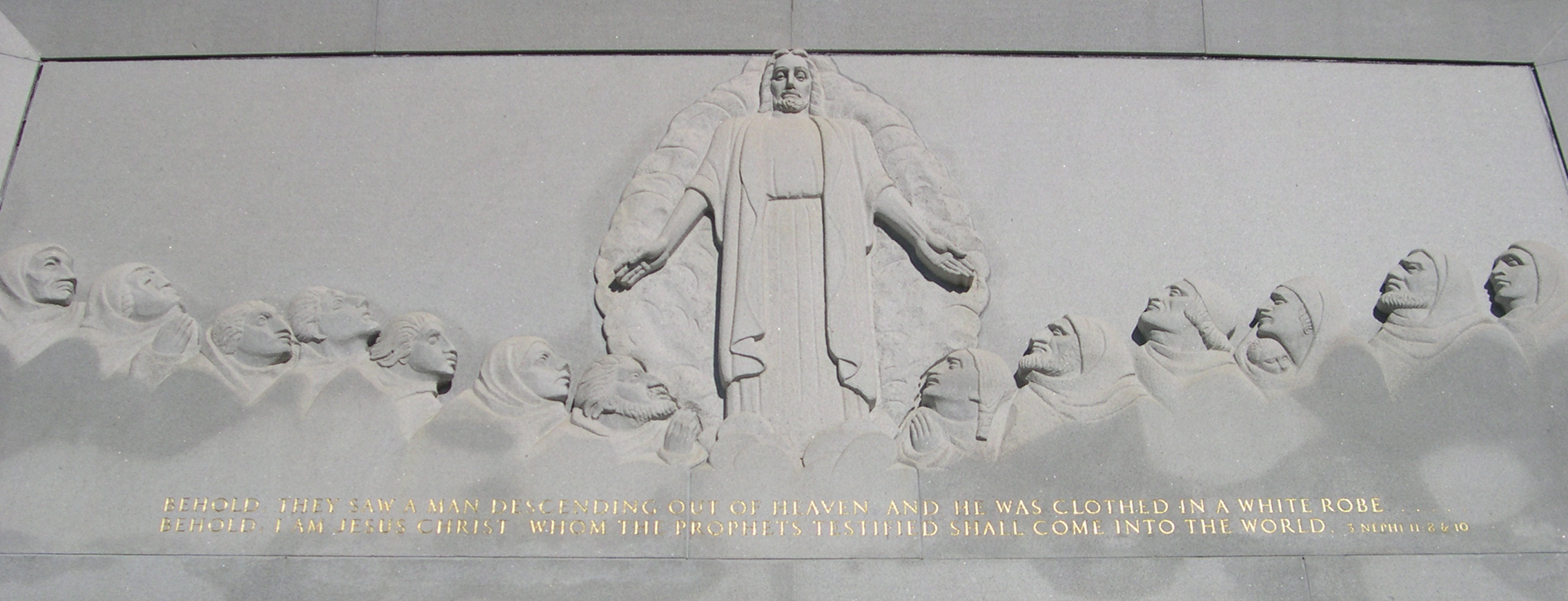
The Oakland California Temple has relief sculptures of Christ in the New Testament and The Book of Mormon on the temple exterior.  On the New Testament Side the inscriptions are:
BLESSED ARE THE PURE IN HEART FOR THEY SHALL SEE GOD -Matt 5:8
SEEK YE FIRST THE KINGDOM OF GOD AND HIS RIGHTEOUSNESS -Matt 6:33
On The Book of Mormon side it reads:
BEHOLD, THEY SAW A MAN DESCENDING OUT OF HEAVEN AND HE WAS CLOTHED IN A WHITE ROBE
BEHOLD, I AM JESUS CHRIST WHOM THE PROPHETS TESTIFIED SHOULD COME INTO THE WORLD- 3 Ne 11:2&10

There is also a large plaque quoting 3 Nephi 17 in the courtyard of the Oakland Temple.

Surely there are many more examples of words being used to decorate temples.  Words can remind of of scriptures and easily put us in the right frame of mind.  Also, they are easier to understand than the hidden symbols frequently used in temples.  Scriptures can bring the spirit and remind us of things we should be focused on.

Although not decorative, when the Logan Temple was gutted they found a wall full of engravings in the plaster hidden beneath the surface.  The inscriptions (with spelling errors galore) had names, mentioned that they were being persecuted, and gave other historical information.

I hope some of you know of engravings on temples and can add a comment telling us how words are used to decorate temples.  We can also discuss how words could be used in future temple architecture, or what you think of the inscriptions I have highlighted so far.  Please comment.

Tuesday, March 29, 2011

Latter-day Saint Temple Murals - Pt 3 - The Spireless Temple Murals

This is a continuation of my posts on Latter-day Saint Temple Murals.  Part 1 can be found here and part 2 can be found here.
 
It took 20 years after the Salt Lake Temple was completed for another temple to start construction.  Ten years after that, the Cardston Alberta Canada Temple was finally completed.  In the meantime the Laie Hawaii Temple had been started and completed.  Four years later, the Mesa Arizona Temple was completed.  These three temples share a common floor plan and a lack of a spire or tower.  They are beautiful temples.  They also had murals which I will discuss briefly.  I have only been in the Mesa Arizona Temple so my insights on the other temple murals will be less detailed.  Please write in the comments and tell us about their murals if you know more.


The Laie Hawaii Temple has unique murals with a different style than those found in pioneer temples.  (Addition to the original post - the baptistery also includes murals) Here are pictures of the creation, garden, and world room murals.  I particularly like how the creation room mural has different panels for each day of creation instead of the one continuous mural painting seen in most temples. I also like how the wood brings warmth into the rooms.  LeConte Stewart painted the murals according to The Church of Jesus Christ of Latter-day Saints's news release after the latest remodel.
Laie Hawaii Temple Baptistery Murals
Laie Hawaii Temple Creation Room Mural

Laie Hawaii Temple Garden Room Mural

Laie Hawaii Temple World Room Mural
The Cardston Alberta Canada Temple was the next completed.  It has intricate woodwork throughout the temple that can be seen alongside the murals.  Also, murals are found in the baptistery, chapel, and terrestrial rooms and not just the creation, garden and world rooms.  I think this is the only temple with terrestrial room murals, although I could be wrong.  An ensign article found here talks about the Cardston Temple and gives this insight into the murals:
Latter-day Saint artists spanning three generations worked side by side on the murals of the temple. LeConte Stewart, in his late twenties, supervised the decorative work and painted the murals in the creation room. These murals were painted with small daubs of color, much like the pointillist style of some of the French impressionists. In the next room was Lee Greene Richards, a man in his early forties, who had been one of LeConte Stewart’s teachers. His garden room murals recalled some elements of art nouveau, including a sinuously curved tree and a graceful peacock. A. B. Wright, one of Richards’s contemporaries, was also at work on smaller paintings in the chapel and terrestrial rooms. Meanwhile, Edwin Evans, a well-established artist in his sixties, who had taught both Richards and Wright, painted scenes of the Alberta countryside in the world room.
I hope you noticed that pointillism and art nouveau were mentioned in regards to the creation room and garden room murals respectively.  The artistic liberties granted to the mural artists were perhaps a lot greater than those given artists today.  Today we stress strict realism in temple murals; in the past we allowed other artistic styles to have some expression.  Prints of the garden room murals are now on the walls of the Kyiv Ukraine Temple as well.  I like how in the Carston Temple garden room the front of the room has two trees painted on half cylindrical portions of the walls.  This seems to make them more tree like, in my opinion. Here are pictures of the various rooms with murals.  If any of you have been to the Cardston Temple and can give more details on what is in the murals, etc. then please comment.  I notice from the pictures that the murals take up a larger portion of each wall than the previous room's murals (with the possible exception of the terrestrial room) which adds to symbolic progression in the temple.
Cardston Alberta Canada Temple Font


Mural of Abraham Offering Sacrifice in Cardston Temple Baptistery
Cardston Temple Baptism of Christ Mural Detail
Cardston Alberta Canada Temple Chapel
Cardston Alberta Canada Temple Creation Room
Cardston Alberta Canada Temple Garden Room
Cardston Alberta Canada Temple World Room
Cardston Alberta Canada Temple Terrestrial Room
The Mesa Arizona Temple was has been called a Lamanite temple in that many Native Americans and Mexicans have historically attended the temple.  The murals reflect the Lamanite influences.  In the baptistery the murals show baptisms being performed in ancient America as well as the baptism of Joseph Smith and Oliver Cowdery.  In the upstairs hallway next to the grand staircase there is a mural of Joseph Smith Jr. preaching to the Lamanites (Native Americans).  The other rooms have typical murals of the creation, Garden of Eden, and world.  The world room presents a barren desert landscape as a symbol of this fallen world.  This is fitting as the Mesa Temple is in a very hot and dry desert.  The Snowflake Arizona Temple uses desert scenes differently and has murals capturing the beauty of the desert landscape instead of showing it strictly as a symptom of a fallen world.
Mesa Temple Baptistery with Mural
Mesa Arizona Temple Baptistery Mural
Mesa Arizona Temple Creation Room Being Painted

Mesa Arizona Temple Garden Room

Mesa Arizona Temple Garden Room
Mesa Arizona Temple World Room
Mesa Arizona Temple Staircase
Mesa Arizona Temple Mural of Joseph Smith Jr. Preaching to the Lamanites


I like that the murals in these three temples are unique.  They display different art styles unlike our current murals which seem to be all natural realism.  Also, I like that murals were worked into different places such as baptisteries, chapels, halls, and terrestrial rooms.  When the endowment was presented using film, the need, and unfortunately the desire, to have murals was lost.  Unfortunately this meant that a lot of good art was not produced for temples until recently when murals have begun to be used again in temples.  There is no reason why a temple using film cannot follow the example of the Laie, Cardston, and Mesa Temples and use murals in the baptistery and in hallways, lobbies, and chapels.  Actually some temples have done this, but that is for another post.  In my next post I plan to talk about the Idaho Falls and Los Angeles Temples and their murals.  They pushed mural progression even further forward with celestial room murals.

Please take the time to comment on these temples and their murals.  I'd love to hear your insights on these murals and how concepts present in these temples could be applied to new temples today.

Saturday, October 30, 2010

Latter-day Saint Temple Relief Sculptures


This entry is about temple sculptures other than Angel Moroni statues or other statues.  There are or rather were 2 other statues I know of on one temple.   If you know what I’m talking about, feel free to post a comment.  Either way  I’ll get to that in another blog post about statues on temples and on temple grounds.  For this post I’, focusing on Friezes or bas-relief or any type of relief sculpture for that matter.  Although Nauvoo, Salt Lake and many other temples have sculptures of suns, moons, stars, trumpets, clouds, constellations, earths, tree of lifes, flowers, etc., this post isn’t about them.  I’m writing today about the Laie Hawaii Temple, Mesa Arizona Temple, Oakland California Temple, Newport Beach California Temple and the Cardston Alberta Temple although it is a little different.

 The first temple relief sculpture was on the Laie Hawaii Temple in 1919.  On the four sides of the temple there are friezes that are relief sculpture planned by J. Leo Fairbanks and  built by him and Avard Fairbanks, his brother.  These depict Christ in 4 dispensations, or perhaps more accurately in 4 scriptural periods.  These are:

West - Old Testament
South - New Testament
North - Book of Mormon
East - Latter-day Dispensation (Doctrine and Covenants)

If you live in (or visit) Utah you can see smaller bronze copies of these sculptures (by another artist, I can’t find his name but it was one of the big latter-day saint names, like Knaphus) in the lobby of the new Church History Museum.  During the recent renovation of the Laie Temple they added a waiting room with copies of the sculptures so patrons inside the temple could appreciate the scenes and not just those outside.

The next relief sculpture was at the Cardston Alberta Canada Temple in 1923.  I say “at” because I don’t think this relief is actually on the temple but just the grounds, although I am unsure.  It was originally in front of a pool which has since been removed.  The sculpture by Torlief Knaphus depicts Jesus Christ talking to the woman at the well and even quotes scripture.  If you live in Utah you can see a plaster casting of this sculpture in the lobby of the Provo Utah Temple (with added color!). 

With the previous 2 temples including relief sculptures, a relief frieze was included on the Mesa Arizona Temple in 1927.  This sculpture, also by Torlief Knaphus includes 8 panels, 2 on each corner of the temple, depicting the gathering of Israel from the 4 corners of the earth.  The panels depict gathering scenes of:

Early Latter-day Saints crossing the plains to the Salt Lake Valley
A ship landing with English, Welsh, Irish and Scottish immigrants
Handcart pioneers
Mexicans travelling to Zion
Native Americans gathering
Pacific Islanders (who actually aren’t travelling unlike every other panel)
French, Swiss,  Italians travelling
Continued with Germans and Dutch leaving their homes and heading to Zion

The Mesa Temple also has a lion head on the east side by the baptistery entrance.  It is a fountain.

After the Mesa Temple it took 37 years before the Oakland California Temple included relief sculptures in 1964.  It has a sculpture of Jesus teaching the people in and around Jerusalem during his mortal ministry on the north side of the temple.  On the south side of the temple there is a sculpture of Jesus Christ appearing to the Nephites in the Americas after his resurrection.  I can’t seem to find out who sculpted these scenes, but if you know please tell us in the comments on this post.  This temple also has tree of life sculptures, but they are more of an architectural detail so I might discuss them in a later post.

Most websites and articles say that the Oakland Temple is the last with relief sculptures, but they are simply wrong.  The Newport Beach California Temple built in 2005 has a relief sculpture of Christ appearing to 10 of the 12 apostles after his resurrection.  The sculpture looks like bronze and is above the front doors.  Although smaller than the other sculptures in this article, it is a welcome return to relief sculptures and I hope we see more scenes on new temples.  I don’t know who sculpted the Newport Beach Temple frieze and would really like to know.  LeRoy Transfield sculpted this beautiful sculpture.  If you know any information on this PLEASE COMMENT.

So there you have my discussion of relief sculpture on Latter-day Saint temples.  We have scriptural scenes (Laie Hawaii, Cardston Alberta, Oakland California and Newport Beach) and latter-day gathering (Mesa Arizona) represented in these fascinating works of art.

If you know of any other temple sculptures (not statues, I’ll deal with them later) please tell us in comments.

-The following is an addition to the original post
I noticed that although the Winter Quarters Nebraska Temple doesn't have relief sculptures on it (unless you count the doors), the grounds are shared with a pioneer cemetery with some nice relief sculptures of Christ, etc. in a style I really like.