Saturday, May 7, 2011

Alternatives to Angel Moroni Statues

I've already written a lengthy post about Angel Moroni statues on The Church of Jesus Christ of Latter-day Saints' temples.  This post is about other notable temple toppers.

The original and rebuilt Nauvoo Illinois Temple had(have) a bell tower on the top.  Yes, the original temple had a flying Angel Moroni weather vane and the rebuilt one has a statue of Moroni.  In addition to this, both temples contain(ed) a bell as the tower is a bell tower.  The tower in the completed temple can be seen in the picture on the left.  The original temple bell was taken with the saints from Nauvoo when they crossed the plains and settled in Utah.  It currently sits atop a tower at temple square, south and a little west of the Salt Lake Tabernacle.
I like the idea of a temple bell.  On my mission I remember being in Cambridge at Easter and hearing church bells ring out from Great St. Mary's Church.  It was impressive.  I would love to see a bell added to another temple, although I don't expect to see one.  This is mainly  because we like to build in neighborhoods and bells might annoy neighbors.  Also, now days we (all of society, not just the church) don't tend to use bells very often.

This brings up another temple topper, also from the Nauvoo Temple - a clock tower.  The Nauvoo Temple tower has clocks on all four faces.  This was mainly added because it was popular to add clock towers in the 1840s.  Also, at that time, most buildings were considered a community asset and would have many functions.  Adding a clock would provide one more community service.  You have probably also guessed that the Nauvoo Temple bell was installed for use with the clock.  To this day it chimes the hour at temple square.  It probably wasn't intended, but a clock can act as a symbol of time and eternity and of order.


Weather vanes are another temple topper that has been used a few times.  The Kirtland Ohio Temple was built with a weather vane (the current one is a replica).  The original Nauvoo Illinois Temple had a weather vane angel that would have helped people determine the wind direction (you'll notice that the Nauvoo Temple had a lot of practical features for the community).  The St. George Utah Temple was built next and has a weather vane on its tower.  Similar weather vanes top the Logan Temple east and west center towers.  Today one faces north and the other faces south.  I assume that they originally rotated with the wind, but have since been replaced when the towers were replaced with fiberglass replicas.  The weather vanes on these three temples are all arrows.

The Cardston Alberta Canada Temple has no tower or spire, however its gently sloping pyramidal roof has a light or lantern at its peak, a fitting topper to a temple.

The remaining temples have had some sort of finial or spire when they haven't had Angel Moroni statues but have had towers.

Please comment and let us know what you think about these unique temple features from before Angel Moroni statues became standard.  I like these unique features and hope we keep them intact.

Thursday, May 5, 2011

Crenelated Temples of The Church of Jesus Christ of Latter-day Saints

Perhaps you are wondering what a crenelation is.  It is a parapet with short segments cut out.  They are used in castles and fortress walls.  So I could have also labeled this post "Battlements on Latter-day Saint Temples" or "The Castellated Temple Style".  But crenelation is a fun word, so I'm going to use it.

A major feature of the temples Brigham Young built are the crenelations and other castle style architecture used.  The pioneers were trying to literally build the Kingdom of God and it showed in their architecture.  Even churches were made to resemble castles.  The defensive architecture was also used as a symbol of the protection faithfully living the gospel and attending the temple provided (temporally and spiritually).  It also reinforced the royal imagery of a church with the royal priesthood and as sons and daughters of God destined to be kings and queens.  It reminds us that the temple is the House of the Lord with Christ as the King of Kings, the Prince of Glory.  The castle look also visually unites the four pioneer temples despite their differences.

The St. George Temple was the first to look like a castle.  It is brilliant white and has buttresses and crenelations giving it a look of strength and nobility.


The Logan Temple was built next and it again features buttresses and crenelations or battlements.  The current dark stone seems to add to the fortress look of the temple (originally it was painted white).  The corner towers are also octagonal giving a turret look which makes the building look even stronger.


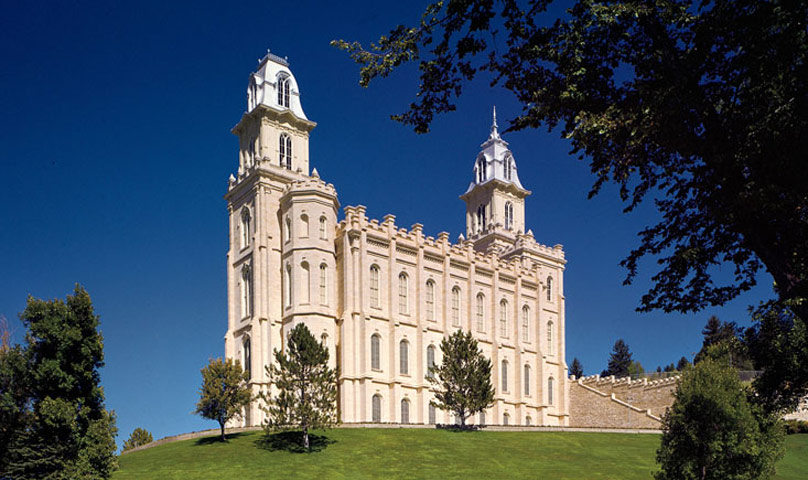
The Manti Temple continued to use castle features despite having towers with French revival influences.  Again buttresses and crenelations are found on the walls.  The middle towers also have pyramidal stones at the tops of the walls that make them look even more defensive.  Another feature is the large stone retaining wall which includes crenelations and adds to the fortified look.  The west end towers are octagonal giving a turret look, while the east towers are all square to make them visually appealing butting into a hill.  This also makes the east towers appear weightier and stronger and larger, which is fitting as they represent the Melchizedek Priesthood.

The Salt Lake Temple is of course covered with castle elements.  Its architecture is often called castellated gothic (I think the name isn't very fitting as the architecture isn't very gothic with no pointed arches or flying buttresses and relatively little glass).  The architecture is very well done and beautiful.  The temple really is a conglomeration of styles, but the crenelations, buttresses, and deeply set windows all give a feeling of strength and a castle look.  The use of normal arches and not pointed arches probably helps it look like a castle as well.  You might also notice that the buttresses extend above the crenelated parapet.  This is because at that level every other buttress is also a chimney.  You can see that half of them are open in this photo. The open ones are chimneys.

These four temples, the pioneer temples, are the only ones to use the castle style with crenelations.  Other temples have mimicked features of these temples including the Brigham City Utah Temple which is currently under construction.  That temple isn't using crenelations.  The San Diego Temple is often compared to a castle and it is beautiful and has a look of strength, but it is not crenelated.  The crenelated castle style is part of what makes the pioneer temples unique.  I would like to see it incorporated into a new temple, but if not, we still have four superb examples of the style.  I should also mention that using a crenelated castle style of church architecture is not unique to Mormonism - I saw many examples of it on my mission in England.

Wednesday, May 4, 2011

Colorful Temple Exteriors

White has become so synonymous with the temples of The Church of Jesus Christ of Latter-day Saints that we seem to forget the examples of temples that aren't white or any color remotely close to white.

The Kirtland Ohio Temple
Currently the Kirtland Ohio Temple is white (and not owned by the church).  Originally it had sparkling blue walls, a red roof, and green doors (the doors are still green).  Our first temple was clearly not white, but instead quite colorful.

The Logan Utah Temple
Today the Logan Temple is made of a dark brown stone.  Originally it was painted white (much like the St. George Utah Temple which is actually red sandstone stuccoed white).  The paint on the Logan Temple didn't weather very well and soon it looked horrible.  A decision was made to let the paint finish wearing off and to not repaint it.  This is how the temple is now with its dark brown walls.  The stone is really a nice color and contrasts nicely with the white towers (which are now fiberglass and not the original wood, if you wanted to know).  This also explains why the Logan Temple stones are somewhat rough cut and irregularly shaped blocks.  The builders thought the stones would always be covered.  Other temples such as Manti and Salt Lake have neatly arranged, fine cut, smoothed stone blocks because they were never intended to be painted.

The Vernal Utah Temple
The Vernal Temple is remodeled from the Uintah Stake Tabernacle which was made out of red brick.  Because of this the current temple is red.  White towers contrast nicely and add a touch of the familiar white usually symbolizing holiness. 

The Copenhagen Denmark Temple
The Copenhagen Temple is another temple remodeled from an existing building - this time a chapel.  The chapel was red brick, so the completed temple is also red brick and looks nice.  The red also makes details such as the front columns stand out.  I think this temple works, and the fact that it is red helps the temple's appearance in my opinion.

I find that the red is a wonderful symbol of the blood of Christ and the atonement in general.  All this red brick might also remind us that the first endowments were given in the upper floor of Joseph Smith's Red Brick Store in Nauvoo, Illinois before the Nauvoo Temple was completed.  Either way, I think that red is a wonderful color for a temple.

The Johannesburg South Africa Temple is made of brown brick which gives it a different look.

The last really colorful temple is the Newport Beach California Temple which is a nice pink color.  I like the look.  The color was a concession to neighbors that thought a white temple would have been too bright.  The temple is still really light colored, so I hesitate to list it with the above temples.  I suppose that the Albuquerque New Mexico Temple is also a pinkish hue.  There are other temples with slight shades of this color or that.  I don't need to list them all.  Most are kept really light, so the temples listed above are really the colorful ones.

Several other temples have dark accents.  The Fukuoka Japan Temple, for instance, has some dark stone.  The Snowflake Arizona Temple also has its first floor made out of darker stone than the lighter second floor.

That is the list of colorful temples (or temples that aren't white or light colored).  I don't think there are any others.  I like having temples white or light colors.  It is nice symbolism and is a nice look for these holy edifices.  Even so, there is something neat about these bolder temples with dark colors.  Maybe it is because they are so rare and unique.  Maybe it is because the white details on the temple seem so much brighter with darker details adding contrast.  There are probably many reasons.  I like how unique these temples are and wouldn't mind seeing a few more colorful or dark temples, even though I'd still prefer most temples to be light.

Please comment and let us know what you think.

Tuesday, May 3, 2011

Celestial Room Staircases

Here is another installment on staircases in temples built by The Church of Jesus Christ of Latter-day Saints.  This time I'll be discussing celestial room staircases.


In the celestial glory there are three heavens or degrees;
And in order to obtain the highest, a man must enter into this order of the priesthood [meaning the new and everlasting covenant of marriage];
Doctrine and Covenants 131:1-2
Putting a staircase in the celestial room in a temple is such a great way to visually remind us of this principle.  I've only seen a few such staircases.  The most interesting ones are grand staircases leading to upper levels in a celestial room.  I only know of two.  Here are pictures of them:
San Diego California Temple Celestial Room
Portland Oregon Temple Celestial Room Staircase
I've never been in the San Diego Temple, but I love all the pictures I've seen of it.  I like the balcony level and the interesting curves, particularly in the railing.  I have been inside the Portland Oregon Temple once and it has a very classy, sleek, modern, luxurious look and feel.  I like how the staircase uses glass (with an etched pattern).  This keeps the room bright and light.  The brilliant white stone also is stunning on the staircase.  You enter the celestial room by walking under the middle of the staircase.  You can enter the staircase on either side and they meet in the middle. The staircase leads to a mezzanine level with additional seating.  This level has a door leading to sealing rooms and the "chapel" which is essentially an assembly hall.

Other temples have less grand, but still really nice celestial room staircases.  Below are staircases in the St. George Utah Temple and Salt Lake Temple.  Each leads to a sealing room.  The Salt Lake Temple staircase has a statue of Cupid as a symbol of love on the bottom post.
St George Utah Temple (left) and Salt Lake Temple (right) Celestial Room Stairs
There are other celestial room staircases that are essentially just exits, or sometimes small entrances to the rooms.  These can be seen in the original Logan Temple, the Manti Temple, London England Temple, Bern Switzerland Temple, and probably a few others.
Manti Utah Temple Celestial Room
 Those are the celestial room staircases that I am aware of.  Please comment and tell us about others I don't know about.  I really love celestial room staircases.  I wish there were more like San Diego and Portland which have the best ones, or even just ones like the St. George and Salt Lake temples have.  Hopefully as more and more temples are built, staircases will be included in celestial rooms once again.

Monday, May 2, 2011

The Church of Jesus Christ of Latter-day Saints - Temple Grand Staircases

This is another installment in my Temple staircase series of posts.  Today I want to show some grand staircases in temples built by The Church of Jesus Christ of Latter-day Saints.

I'll start with the Salt Lake Temple where the endowment ceremony uses the grand staircase well.  You see it before entering the creation room.  When you leave the garden room you step onto the staircase, already a few steps up it on a small landing.  This emphasizes our choice in this fallen world, to ascend, or to fall further.  You then go up the staircase and get a brief view of the celestial room doors before turning and entering the world room.  The staircase itself is nicely built with fine woodwork.  Unfortunately, you can see from the three pictures below that at some point they have painted over the fine woodwork of the posts and part of the rail.  This is a shame as it was really fine handcrafted pioneer woodwork.  You paint cheap wood to make it look good.  You should never paint fine woodwork as it makes it cheaper.  Hopefully at some point someone will have the presence of mind to have the paint stripped off and the original beautiful wood restored.

The next grand staircase is found in the Mesa Arizona Temple where the endowment rooms were built with the staircase in mind so you climb it during the ceremony.  As you can see in the picture, the celestial room doors are at the top with the scripture "The Glory of God is Intelligence" written above them.  There is also a large mural of Joseph Smith preaching to the Lamanites (Native Americans in this case).  I also notice the fine stone or tile lining the sides of the staircase.
The Hamilton New Zealand Temple (below left) and Kyiv Ukraine Temple (below right) have similar main staircases seen in the picture below.  A similar staircase is in the London England Temple and I would guess the Bern Switzerland Temple as well.  I really like how the Kyiv Ukraine Temple staircase brings you close to the fine stained glass windows and particularly the interesting elliptical windows.
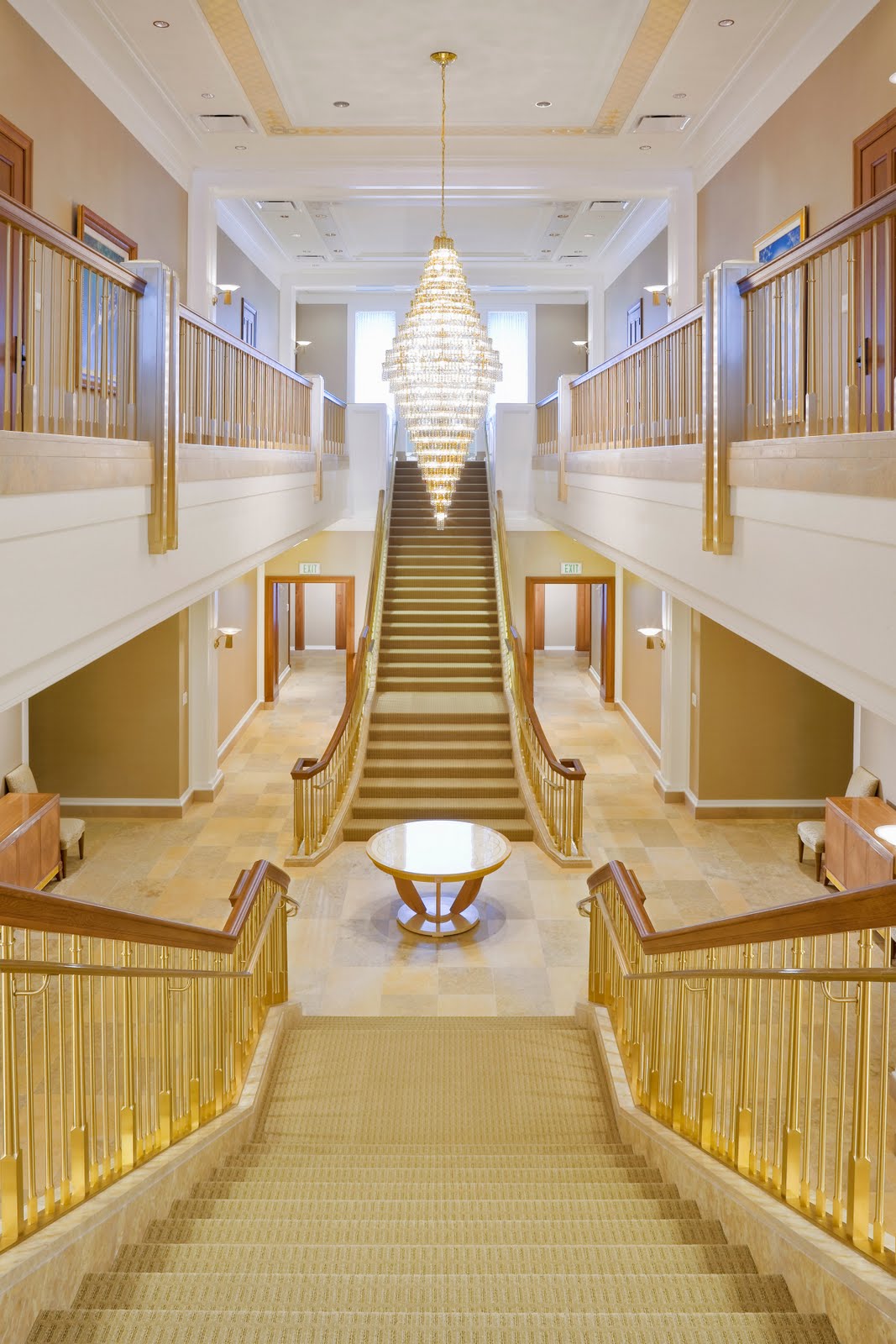
The new Oquirrh Mountain Utah Temple contains a double grand staircase in its center seen below.  The staircase has fine custom made brass railings and a stunning chandelier.  Light from both the celestial room and the chapel is carried into the heart of the temple where the staircase sits through glass walls.  Several temples use the same floor plan as this temple.  I've been to both the Boston Massachusetts Temple and the Preston England Temple and each has a single grand staircase in its center.  I recall Preston going up, reaching a certain level, and then splitting into two staircases perpendicular to the first (although it has been almost a decade since I was there last).  The Boston Temple is a very similar temple.  In Boston, the staircase starts as two curved staircases that meet midway up and continue as a single staircase.  In plan it would resemble a wishbone.  If you don't go on the staircase you can instead walk between the two and go to other parts of the temple.
The San Diego California Temple features a large, open-center, spiral grand staircase that can be seen below.  It occupies one of the towers and provides a great view up into the tower and good views of the art glass windows.

A lot of the newer small style temples include grand staircases.  Below from left to right are pictures of the staircases in the Curitiba Brazil Temple, Vancouver B.C. Canada Temple, and Panama City Panama Temple.  A similar staircase is found in the Twin Falls Idaho Temple.  I like the shape and general look of these staircases and am glad that even these very small temples can have nice grand staircases.
I'm sure there are other grand staircases in temples.  Please comment and tell us about them.  I learned at one point that grand staircases, particularly interesting ones such as spirals, were used in buildings to show the skill of those that built them and to make a place special.  Sure, a simple, ordinary staircase would have got people between floors, but a grand staircase, especially a complex one, said that the place was special enough to spend the money, time, and skill necessary to build such a staircase.  The House of the Lord is a special place and one way we can make it holy and honored and special for HIM is by including grand staircases.

Sunday, May 1, 2011

Holy of Holies in Temples of The Church of Jesus Christ of Latter-day Saints

The Holy of Holies is the most sacred part of a temple and is only really in one temple today - the Salt Lake Temple.  Little known is the fact that several temples have had Holy of Holies.

To start out I should point out that the term "Holy of Holies" comes from the Bible and referred to the most sacred part of the Tabernacle, Solomon's Temple, Zerrubbabel's Temple, and the Temple of Herod.  The term "Most Holy Place" is usually another name for the Holy of Holies.  The room contained the ark of the covenant and could only be entered by the High Priest once a year.  It was separated from "the holy place" by the veil of the temple.  In this way, our current temple celestial rooms are somewhat comparable to the Jewish Holy of Holies.  Still, the rooms are quite a bit different.  This should be expected as the Jewish temples were Aaronic Priesthood preparatory temples while ours are Melchizedek Priesthood higher law Christian temples.

The Holy of Holies in our temples have some similarities to their ancient counterparts.  They have limited access - the prophet and occasionally others can enter the room.  They are also used for heavenly visitations.  Anciently, the Holy of Holies was where Gabriel appeared and announced to Zacharias that his wife would give birth to John the Baptist.  In today's Holy of Holies, the prophet may receive similar heavenly visitations and directions on how to run Christ's church.

You might wonder what else "Holy of Holies" is used for.  Apparently it is used for the higher ordinances of the priesthood.  Apostle James E. Talmage said that it is "reserved for the higher ordinances in the priesthood relating to the exaltation of both living and dead".  See his book The House of the Lord for this information. There are several temple ordinances mentioned in the scriptures which aren't performed often or even talked about regularly.  I suspect that some of them might performed in the holy of holies.  Here is one such verse:
Therefore, verily I say unto you, that your annointings, and your washings, and your baptisms for the dead, and your solemn assemblies, and your memorials for your sacrifices by the sons of Levi, and for your oracles in your most holy places wherein you receive conversations, and your statutes and judgments, for the beginning of the revelations and foundation of Zion, and for the glory, honor, and endowment of all her municipals, are ordained by the ordinance of my holy house, which my people are always commanded to build unto my holy name.
D&C 124:39
Notice that this verse says "most holy places" which might mean "Holy of Holies".  I suspect that the "memorials for your sacrifices by the sons of Levi" may simply refer to the sacrament served during solemn assemblies.  In another place we read:

And he shall be received by the ordinance of the washing of feet, for unto this end was the ordinance of the washing of feet instituted.
And again, the ordinance of washing feet is to be administered by the president, or presiding elder of the church.
It is to be commenced with prayer; and after partaking of bread and wine, he is to gird himself according to the pattern given in the thirteenth chapter of John's testimony concerning me. Amen.                                 
D&C 88:139-141
This verse refers to the ordinance of washing of feet - particularly in relation to the School of the Prophets.  This ordinance was instituted by Jesus Christ just prior to his crucifixion and is a priesthood ordinance.  Christ gave this ordinance to his apostles and I highly suspect that the same ordinance is given to any apostle, although it is also apparently given to others as well.  It would not surprise me if the Holy of Holies was used for this ordinance, although it may be performed elsewhere in the temple.

Lets leave this chain of thought and instead get to the architecture of the Holy of Holies and when they have been used.

You can consider the Kirtland Temple to have included a Holy of Holies.  The assembly halls could be divided using curtains (essentially veils) and on April 3, 1836 the Melchizedek Priesthood pulpits were curtained off with Joseph Smith and Oliver Cowdery inside when Jesus Christ, Moses, Elias, and Elijah appeared to them, accepted the temple, and conferred priesthood keys and the sealing power.  For this reason, I think you could consider the pulpits in the Kirtland Temple as an early Holy of Holies.

The original Nauvoo Temple included a sealing room identified as the Holy of Holies.  This was room 1 or the clerk's office.  It was a sealing room, clerk's office, and Holy of Holies.  Apparently it was used so much for the higher ordinances that other rooms had to be used for sealings so the room could be used for the higher ordinances.  See this article for more details.  Here is a drawing of a sealing room in the original Nauvoo Temple from lds.org.  Details of how the room looked are probably guessed, but it gives you some idea of what the Holy of Holies may have looked like.

I don't know if the St. George Temple had a Holy of Holies, but I suspect it at least had a sealing room occasionally used for that purpose.

The Logan Temple used to contain a sealing room sometimes used as the Holy of Holies.  This was the Gold Room.  The room had gold directly applied to the plaster walls using a hot iron.  As you can see, intricate patterns were made on the walls.  The curtain is covering a doorway leading into the southeast tower spiral staircase.  Also, notice the stained glass window.  The windows were removed when the temple was gutted and remodeled in the 1980s.  You can see the windows in the Church History museum (and I think the Manti Temple cafeteria has some of them as well - they looked familiar last time I ate there). 
Logan Temple Gold Room - Sometimes a Holy of Holies

The Manti Temple also included a Holy of Holies.  This one is directly off the celestial room and is still in the temple.  It has its door left open so you can see the room and is now officially a sealing room, although one you can't use.  Apparently President Hinckley wanted the room kept special because of its history (according to temple workers at the Manti Temple who said the room is rumored to have been a Holy of Holies.  As you can see, the room is extremely ornate.  I particularly like the arched area above the altar and the intricate detailing used there.  Even small details such as the door handle and the hinges on the door are covered in symbolic details.  This really is a fitting Holy of Holies.
Manti Temple Sealing Room - Sometimes a Holy of Holies
The Salt Lake Temple is currently the only temple with a permanent Holy of Holies.  This room is accessed from the celestial room and is in between two sealing rooms that are also directly off the celestial room.  The room is round with a dome.  In fact, the room directly above the Holy of Holies is called the dome room because the dome ceiling of the Holy of Holies takes up the middle of the room.  As you can see, the room has numerous art glass windows in the dome (lights in the dome room light them up).  There is also an authentic Tiffany Glass window depicting the First Vision (which can be seen on the other side of the window from the sealing office).  The glass window says
IF ANY OF YOU LACK WISDOM LET HIM ASK OF GOD
THAT GIVETH TO MEN LIBERALLY AND UPBRAIDETH NOT
AND IT SHALL BE GIVEN HIM
                                     James 1-5v
THIS IS MY BELOVED SON       HEAR HIM
The room contains other nice architectural details.  Carved faces are found on the arches.  Vines are found on the columns.  Sconces, a chandelier(s?), and art glass windows bring a lot of light into the room.  You can also see that the room has intricate carvings.  Despite all of this, the room is remarkably restrained for a room with so many intricate details. In Talmage's book The House of the Lord he states that the Holy of Holies is
reached by an additional flight of six steps inside the sliding doors.  The short staircase is bordered by hand-carved balustrades, which terminate in a pair of newel-posts bearing bronze figures symbolizing innocent childhood; these support flower clusters, each jeweled blossom enclosing an electric bulb.  On the landing at the head of the steps is another archway, beneath which are sliding doors; these doors mark the threshold of the inner room or Holy of Holies. . . 
Talmage then describes the Holy of Holies:
The floor is of native hard wood blocks, each an inch in cross section.  The room is of circular outline, eighteen feet in diameter, with paneled walls, the panels separated by carved pillars supporting arches; it is decorated in blue and gold.  The entrance doorway and the panels are framed in red velvet with an outer border finished in gold.  Four wall niches, bordered in crimson and gold, have a deep blue background, and within these are tall vases holding flowers.  The room is practically without natural light, but it is brilliantly illuminated by a large electrolier and eight side clusters of lamps.  The ceiling is a dome in which are set circular and semicircular windows of jeweled glass, and on the outside of these, therefore above the ceiling, are electric globes whose light penetrates into the room in countless hues of subdued intensity. . .
Salt Lake Temple Holy of Holies
In many ways we only need the one Holy of Holies because a major function of the room is for the prophet to go and pray and receive revelation and heavenly visitations relating to how the church should be run.  Yet, it also has its function for higher ordinances and the prophet (or apostles) may wish to use a Holy of Holies when they are away from Salt Lake.  For these reasons, sealing rooms in temples are occasionally used as Holy of Holies.  I was told in the Preston England Temple that one of the sealing rooms in that temple is designated to be used for the prophet or apostles when needed.  When they need the room it is temporarily set apart for that purpose, so essentially it is occasional a Holy of Holies.  This may also explain why many temples have one small sealing room that is really nice, but impractical for large weddings.  It is probably used only for sealings for the dead and also rarely as a Holy of Holies.

I hope you found this interesting.  You may comment but remember that this is on the internet and these are sacred rooms, so let's be restrained in our comments on this one.

Here is a picture of the Dome Room, the room above the Holy of Holies in the Salt Lake Temple.  It is just used to access the ceiling lights above the Holy of Holies and has been used as a dressing room.
Dome Room Above Holy of Holies in the Salt Lake Temple
Talmage describes the Dome Room as follows:
. . . the large Dome Room, thirty nine by forty four feet.  On the south side are three oval windows, and opposite these on the north are semi-discs of pebbled glass looking down into the Celestial Room and set in the arches thereof.  In the center appears a large dome, fifty one feet in circumference at its base and seven feet high.  This is set with seventeen jeweled windows and may be readily recognized as the ceiling of the Holy of Holies . . . In each of these windows electric bulbs are placed, and it is from these the room below derives its beauty of ceiling illumination and coloring.  The walls are hung with portraits of Church authorities.  No specific ordinance work belongs to this apartment. . .
For more information, please read James E. Talmage's The House of the Lord first printed in 1912.

Saturday, April 30, 2011

Latter-day Saint Temple Murals - Part 7 - The Rebuilt Nauvoo Temple Murals

In recent years (the last decade or so) The Church of Jesus Christ of Latter-day Saints has begun using painted murals in temple endowment rooms.  The rebuilt Nauvoo Temple is an excellent example.  I suspect that gathering the artists for this project and having murals painted in a new temple was a catalyst that got the church to use murals in all new temples again.  I can't confirm it, but a lot of the details required for the Nauvoo Temple have started showing up in other temples including murals.

The original Nauvoo Temple lacked murals.  It was completed (with some parts only roughly done) shortly before the Saints fled Illinois and headed to Utah.  This, and the fact that murals didn't begin being used until the Logan Temple was built in 1884, meant that the temple didn't have murals.  The rebuilt Nauvoo Temple was decorated with grand details that the saints probably would have added given proper time and means.  I think the murals are well done and have some interesting aspects.

The artists intentionally emulated the Hudson River School of painting popular in the mid 1800s so the work would fit in with the historical nature of the temple (see this article).  At the same time, they clearly have created a fusion style as features such as nebulae viewed from the Hubble Space Telescope in the creation room murals would clearly not have been painted in any art in the 1800s.

Below is the creation room mural.  One notable feature is that the landscapes are based on east coast locations with New England shorelines representing the newly formed world.  This starts a pattern that is completed in the world room where the history of the church is played out by referencing notable locals.  Starting in New England, the church eventually made its way to the west.
Below is the garden room mural.  Beautiful depictions of the Tree of Life and Tree of Knowledge of Good and Evil are found in the front of the room.  I recall that the tree of life was covered in brilliant white fruit.  Notice that there are carved sheaths of wheat in the door frames (unrelated to this post, but symbolic):
Below is the world room mural.  I really like this interpretation of a world room and I would rank it as my second favorite, just below the current Manti Temple world room mural.  Several things are going on in this painting that you may not notice at first, but which add a lot of symbolism and interest to the painting.  First, the seasons exist in this temple and represent time and seasons as a feature of the fallen world.  This is also used to make the room lighter symbolizing progression.  Winter's white snows brighten the front of the room and make the area around the altar, and the way into the terrestrial room, the brightest part of the room.  The artists have also intentionally represented areas from church history in this mural.  It starts with spring in Vermont where Joseph Smith was born and follows church history locations such as New York, Ohio, Missouri and Illinois, and ends with winter in Utah's Wasatch Mountains.  In this way, the room symbolizes the journey through life as we follow the church and the path God lays out for us.
 I read somewhere that the Nauvoo Temple also includes celestial room murals.  This isn't true (I've been there twice and it does not).  It does include a nice painting of the world after the flood, and I think that is what is mistaken as a celestial room mural.  A small painting is not a mural.  But it is a nice addition to the Nauvoo Temple celestial room.

I would love to hear what you think about these murals, so please comment.