Showing posts with label Sealing Room. Show all posts

Sunday, April 18, 2021

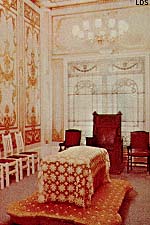
The Salt Lake Temple Sealing Room Angel Moroni Stained Glass


Salt Lake Temple Sealing Room

One of the original sealing rooms in the Salt Lake Temple has a stained window of the Joseph Smith getting the golden plates that he would translate into The Book of Mormon as the Angel Moroni talks with him. This is a beautiful stained glass, but it has always seemed odd for this particular stained glass window to be in a sealing room as it would appear to have nothing to do with marriage or family. As I read the first volume of The Church of Jesus Christ of Latter-day Saints new official history, Saints, I realized that this stained glass window actually has some significant meaning related to sealings.

When Joseph Smith went to get the plates from the hill he tried to pull the plates out but was unable to. The angel appeared and told Joseph that this was because he had not kept the commandments. He then instructed Joseph and then Joseph asked when he could have the plates. Moroni replied "The twenty-second day of September next, if you bring the right person with you." Then Joseph asked "Who is the right person?" and Moroni replies "Your oldest brother". This is significant for sealing rooms because Alvin was Joseph's oldest brother and he dies before the next September and Joseph cannot get the plates at that time. Joseph's family doesn't understand what happened to Alvin's soul since he died before the church was restored, but years later Joseph Smith has a vision where he sees Alvin in the Celestial Kingdom and is told that anyone who died without being able to join the church who would have accepted the gospel if given the chance were saved in the Celestial Kingdom of God. Later revelations would show that proxy ordinances such as baptisms for the dead and sealings for the dead (of husband and wife and of children to parents) is a part of the process that allows those who died to be able to enter God's kingdom. So this stained glass can remind us of Alvin and those who we are doing proxy sealings for. It can also remind us of the good influence that a family member such as a son or a brother can have in that apparently Alvin would have had a good enough influence on Joseph that he would have gotten the plates earlier had Alvin survived.

After Alvin's death, Joseph continued to be instructed by Moroni. Eventually the angel told Joseph Smith to bring someone with him the next year when he went to get the plates. Joseph asked, "Who is the right person?" and Moroni said "You will know". Joseph used a seer stone and asked the Lord who the right person was and he was shown that it was Emma Hale who he had been dating and wanted to marry. In the following year Joseph Smith married Emma and she came with him when he successfully obtained the plates and would help him stay on track for the rest of his life. I think this example is a wonderfully fitting reason for the sealing room to show Joseph obtaining the plates. He needed a wife who would help him be better so he could achieve his potential and only with her good influence was he able to become worthy to obtain the plates. It also reminds us that women have been and are immensely important in the work of God and can be a great influence for good. It reminds us that husbands and wives should work together in righteousness.

I hope sealers in this sealing room in the Salt Lake Temple tell some of these stories to patrons who are using this sealing room so they understand some of the deeper meanings of the room. Like Joseph Smith, we need to have strong families to strengthen us - siblings, spouse, etc. We should take our sealings seriously and strive to help our families grow in righteousness.

If you have any comments or insights about this stained glass window, please comment.

Sunday, March 13, 2011

The Church of Jesus Christ of Latter-day Saints - Temple Architecture Myths

As members of the church we often get a certain picture of what a temple should be like.  The architecture can be limited by preconceived notions of how a temple should be.  I wanted to dispel some temple architecture myths and highlight temples that are different. (By the way, a commenter on this blog was mentioning some of these and his comments led me to write this post.  Please comment, you may have a similar effect on me :)

Myth # 1: All temples must have an Angel Moroni statue.
This is blatantly false.  Many temples have been built without Angel Moroni statues.  Three didn't even have towers (Cardston Alberta, Laie Hawaii, and Mesa Arizona).  Others had towers, but were built before the Atlanta Georgia Temple when Angel Moroni statues became common (because a newspaper said the new temple wasn't to temple standards without one).  Until that point, only the Salt Lake, Los Angeles, Washington D.C., Seattle Washington, and Jordan River Utah Temples had Angel Moroni statues (the original Nauvoo Temple had an angel statue but it was not identified as Moroni).  Several have been built without the statue since, only to have the statue added later.  An Angel Moroni statue is a powerful symbol that we should be free to add to our temples for religious reasons, but is not essential for a temple to be a temple.


Myth # 2: Angel Moroni statues must face east.
This is false.  The Nauvoo Temple (and statue) face west.  The Dallas Texas Temple and statue face south, the Spokane Washington Temple recently had its Angel Moroni statue turned from east to west after President Hinckley didn't like how it looked.  The Seattle Washington Temple and statue face west, the Taipei Taiwan Temple and statue faces west, and the Manhattan New York Temple and statue faces southwest.  The myth developed because most Christian churches face east and so do most temples (this is a symbol of Christ coming from the east at the second coming) but is not essential.  Also, President McKay had the Moroni statue of the LA Temple turned to face east even though the temple faces southeast (I think).  This led to a conversion and spread the myth, even though the east facing statue was clearly for a specific reason.

Myth # 3: Sealing rooms must have facing mirrors, giving an eternal effect.
This type of mirrors is nice, but the St. George, Manti, and Salt Lake Temples have some sealing rooms that don't even have mirrors.  I'm sure other temples break this rule.  The fact is, eternal mirrors are a nice decorative feature to use, but not an essential part of the room.

Myth # 4: Temple baptismal fonts must be on the backs of 12 sculpted oxen and be in a basement.
Several temples were built without oxen supporting fonts (even the Tabernacle in the Old Testament lacked oxen, they were added for the Temple of Solomon) and other temples were built with only 6 oxen and a mirror to give the effect of 12 oxen.  During the design of the Ogden and Provo Temples, the design team looked in the necessity of the oxen and decided they were not essential (although those temples used oxen) and noted that in future temples oxen might not be used.  A lot of 70s and 80s temples (Atlanta, Sydney, and most pacific island temples) were then built without oxen (most, if not all have had oxen later added, and the plan was always to add oxen at a later date).  In these cases, a font similar to a meetinghouse font was used.  As for fonts being in basements, the Doctrine and Covenants reads: "the baptismal font was instituted as a similitude of the grave, and was commanded to be in a place underneath where the living are wont to assemble".  This means it needs to be underneath, but due to high water tables this doesn't necessarily mean in the basement, just on the lowest floor and if possible underground.

Myth # 5: Temples must get lighter as one progresses from room to room
Although light colors are the easiest way to express symbolic progression, light colors are not essential.  The Cardston Alberta Temple has rooms actually getting darker because the woodwork is getting finer and more expensive.  It turns out that the best woodwork is generally dark so the celestial room and sealing rooms in this temple are dark wood.  Windows still bring light in.  I like that this temple has a unique way to show that these rooms represent better and holier things and places.

There are some architectural myths I have identified relating to Latter-day Saints temples.  Please comment about these or point out others I've missed.

Sunday, February 20, 2011

Salt Lake Temple Symbolic Progression

One of the best parts of the older temples is the use of symbolic progression as one moves through the temple.  When you move from endowment room to endowment room the architecture of each room can be designed to compliment the endowment ceremony in meaningful ways.  I want to explain how some of this is achieved in the Salt Lake Temple.  Each room in the Salt Lake Temple is more than the previous room.  It symbolizes that as we progress in the gospel we become more.  We become better people, we gain more skills, we become more righteous and holy.  We become closer to God and we become more like Him.  I'm just going to show pictures of each endowment room and explain how it achieves this.

The Creation Room:
Salt Lake Temple Creation Room


Originally the creation room didn't even have murals (they were added many years later).  The lighting is very simple (newer lighting has been installed in the last few years, but it still has the simplest lighting).  There are no staircases and no natural light.  Also notice that there isn't even an altar in the room.  Although a nice, moving room, the creation room is very simple.  It is also the lowest in elevation (in the basement) and has the lowest ceilings of the endowment rooms.  This is the first endowment room in the temple.  It is our starting point - the creation of the earth and mankind.  The murals in the creation room also show progression from a disorganized world, to land and seas being formed, to plants being formed.  It is somewhat interesting that no animals are shown in the murals in the creation room despite the fact that animals were created during the creation.  This is used as a way to show progression in the garden room. 

The Garden Room:
Salt Lake Temple Garden Room


The next endowment room in the Salt Lake Temple is the Garden Room.  This room represents The Garden of Eden.  To get to the room, patrons go up a small rise from the creation room (a few feet).  The room is now larger and taller.  There are more lights are each is more ornate (in the picture they are slightly more involved, newly installed lights are really nice) and there is a large light at the top where the ceiling is recessed (recently upgraded with clear art glass incorporating sego lilies).  An altar is present, and although nice, is simpler than other altars in the temple.  3 staircases are now present although they are short and fairly simple.  Originally this would have had a small greenhouse behind the curtains that can be seen in the photo.  This would have brought natural light into the room.  Also notice that the door has glass on the top half and filling the arch above.  The murals now show the Garden of Eden in idyllic splendor with nice plants and animals all getting along.  Adding animals shows progression from the creation room.

 The Grand Staircase:

Grand Staircase, Salt Lake Temple
Upon leaving the garden room, patrons exit (if I recall correctly going down 1 step symbolizing the fall) onto a landing and then go up the grand staircase.  This is a fitting symbol of progression.  A stained glass window of Adam and Eve being expelled from the Garden of Eden is also seen. 


Grand Staircase, Salt Lake Temple
This staircase brings patrons to the first floor of the temple where they will enter the world room.  As they go up the staircase, the doors to the celestial room are visible before patrons turn to enter the world room.  This gives a glimpse of things to come. As a side note, Jesus Christ appeared to President Lorenzo Snow at the top of this staircase and told him he was to be the next prophet and to reorganize the first presidency.


 The Telestial or World Room:
Salt Lake Temple World Room

This room represents the fallen world that we all live in, yet at the same time it has to symbolize a progression.  The fallen state of the world is shown through fighting animals, trees competing for space or dying, a river eroding a hillside, etc.  The progression is shown in many ways.  Tall windows let natural light flood into the room.  In addition, the chandeliers are now clusters of ball lights instead of single lights.  The altar is more ornate.  The doors are taller.  The staircase is now more detailed and quite a bit taller.  The entire room is more spacious.  Also notice that the doors now have significantly more glass than in the garden room.  The color scheme is also slightly lighter than the garden room.  The murals also show progression because although representing a fallen world, they are more interesting than those in the garden room with more going on.  Notice that to leave this room one goes up a slight rise.

The Terrestrial Room:
Salt Lake Temple Terrestrial Room (back)
Salt Lake Temple Terrestrial Room (front)

Patrons go straight from the world room to the terrestrial room.  This room represents the Terrestrial Kingdom of God (2nd highest of 3 heavens) or the better world we can experience while still alive if we follow God's commandments.  The room shows obvious progression with ornate chandeliers, moldings, columns, details window arches, a Tiffany art glass window, a nice altar, this time surrounded with a large platform.  A staircase is also present with intricate carvings on it.  The color scheme of the room is the brightest yet with pastel blue and pink and cream.  A large painting is hung in this room (the temple rotates which painting hangs here so I can't say which one), usually of Jesus Christ as a fitting symbol of the only way to attain this state and more even further in life and towards life with God.  Interestingly, the chandeliers were originally clusters of ball lights like those seen in the world room.  This made it so the lights followed one theme and got nicer.  Also, the windows used to let natural light in, but have since been blocked by the sealing room annex (a hallway is now on the other side of the windows).  The terrestrial room is taller, larger, and higher than previous rooms.  Like the other rooms, the architecture here shows us that as we progress in the gospel and follow God's plan we increase in every way.  You might also notice that above the stained glass window there is a detailed carving with flowers and I think fruit, a small hint of what is to come in the celestial room.

The Celestial Room:
Salt Lake Temple Celestial Room


The endowment ceremony always ends in the celestial room, no matter the temple.  In the Salt Lake Temple, the celestial room's architecture is used in an effective way to reinforce the teachings of the endowment.  The room is the largest, highest, tallest, and most ornate of the endowment rooms.  The lighting now consists of eight chandeliers with clusters of more ornate pointed lights (instead of spheres).  Windows and Tiffany art glass windows along the top are also used to bring in light.  Mirrors and glass are used a lot.  Columns, arches, etc. are all far more ornate than in the terrestrial room.  Also, along the ceiling there is a lot of carved fruit and flowers.  Vines, trophies, flowers, etc. are painted on the walls.  Birds are carved into the walls.  The color scheme is bright and glorious with gold details.  When I first went to the Salt Lake Temple I didn't know how the terrestrial room's architecture could be outdone (and I had seen pictures of the celestial room).  Then I stepped into the celestial room and saw how much nicer a room could get.  It is breathtakingly beautiful with so many intricate details.  It is a wonderful representation of the highest heaven where we can dwell with God the Father, Jesus Christ, and the Holy Ghost.  No picture does this room justice.

Although not endowment rooms, the sealing rooms and Holy of Holies in the Salt Lake Temple continue the theme of progression.  Notice that from the celestial room you can see (and walk into if you want) the sealing rooms.  To enter each you go up either 2 steps or up a short staircase.  The staircase has a cupid statue as a symbol of love.  Each sealing room is even more ornate than the celestial room, and two of them contain art glass windows.  The sealing rooms have the most ornate altars and have high ceilings.  This shows that as we are married for eternity in temples, and sealed together as eternal families, we grow, progress, fulfill God's plan, and become qualified to enter the highest part of the highest heaven.  In the photo, the second doorway from the right (next to the open sealing room) leads into the Holy of Holies.  This room is the most ornate of all with a short staircase leading from the doorway to another doorway into the room.  The room has a tall dome with art glass windows along the top and a stained glass window of the First Vision.  You can see a picture of it in my post on temple stained glass windows here

I love how the architecture of the Salt Lake Temple has been used to give a progression with patrons moving higher from room to more ornate/tall/spacious/bright/light/detailed/etc. room.  I love how the endowment feels when presented in this way.  Unfortunately, most temples have patrons in a single endowment room for the entire ceremony and then finally entering the celestial room.  This gives these temple their own unique ways to symbolize the progression (generally through the lights getting turned on brighter partway through the ceremony), but I think the temples with 4 endowment rooms before the celestial room are able to show this best.  In my opinion, the Salt Lake Temple does this best with the most areas of progression used.

Please comment and let me know what you think.  If there are details you noticed that I didn't mention, or other insights you had, please comment and let us all know.

Sunday, February 13, 2011

Unique Sealing Rooms

Today I'm just going to show some pictures and short commentary about what I consider are the most unique or interesting sealing rooms in Temples of The Church of Jesus Christ of Latter-day Saints.  These rooms are used for temple marriages where a man and woman are married for time and all eternity and where children can be sealed to them for eternity.

The pioneer temple sealing rooms:

The St. George Utah Temple has a number of unique sealing rooms.  One is up a small staircase in the celestial room (in the tower).  Most of the sealing rooms are on an upper floor and have a single round window going into each room.  To me, the round window just makes the room feel unique.

Orig. Logan Temple Sealing Rm
The original Logan Utah Temple interior had a sealing room (shown to the left) with gold leafed walls and a stained glass window.  It is extremely unfortunate that when the temple was remodeled the room and wall covering was lost.  I think the gold leaf was lost because it was applied to plaster walls and so it couldn't be removed and brought to the new temple (I know that is what happened to at least most of the Logan Temple murals).


Manti Temple Sealing Room
The Manti Utah Temple has many wonderful ornate sealing rooms.  My favorite is a small one off the celestial room (that isn't used any more).  I've been told that this room was the Holy of Holies until the Salt Lake Temple was completed.  Then it was a sealing room for decades.  Apparently President Hinckley wanted to preserve the room and thought it was extra special so he had the room stop being used for sealings.  This could be a rumor, although I think it was a sealer that told me this.  The room is beautiful with an arched ceiling and intricate gold patterns and detailed woodwork.  The door is left open, but roped off so you can see it but not go all the way in now.  It is also very small, with maybe room for 5 or 10 people to witness the sealing.

Salt Lake Temple SE Sealing Room
Salt Lake Temple SW Sealing Room
The Salt Lake Temple has many nice sealing rooms.  Originally it just had 3 sealing rooms.  Two were on either side of the Holy of Holies, just off the celestial room.  The last was up a small staircase on the east side of the celestial room.  The intricate craftsmanship in these rooms is wonderful to see.  The sealing rooms flanking the Holy of Holies have stained glass windows.  Still, my favorite of the three is at the top of the stairs off the celestial room, in the east center tower of the temple.  I love that the staircase leading to this room has a cupid statue on the bottom rail post.  This is a fitting symbol for the room where a man and a woman are married for time and all eternity.  These rooms definitely are unique.

The dark wood sealing rooms:

Cardston Alberta Temple Sealing Room
The Cardston Alberta Canada Temple is the first temple I know of with dark wood sealing rooms.  This temple used extensive woodwork with intricate inlays using woods imported from around the world.  As you progress in the temple the wood becomes more expensive, lush, an more intricately inlaid.  This means that the celestial room is covered in really nice dark woods.  The sealing rooms also end up dark with really involved inlays. I like this.  It is so different from the usual white sealing room, while still being nice.
Cardston Alberta Temple Sealing Room
I know of only one other temple with dark woodwork in the sealing rooms.  This is the Oakland California Temple.  At least one (although not all) of the Oakland Temple sealing rooms is done in dark wood as seen in the picture below.  I like the dark wood and think it would contrast nicely with the white clothing worn in the temple.  I also like how here the altar glows in a bright contrast to the darker walls.
Oakland California Temple Sealing Room
I have not been in any of the dark wood sealing rooms.  If any of you have, please comment and tell us what they are like and what you think of them.  Also, if you know of any dark wood sealing rooms that I haven't mentioned, please write and let us know about them.

San Antonio Texas Temple Tree of Life Sealing Room

I was going to write about barrel vaulted ceiling rooms, which would also include the Las Vegas Nevada Temple sealing rooms, but I decided to just focus on the best of the group.  The San Antonio Texas Temple sealing room with a stained glass window of the tree of life is inspiring.  The brightness and whiteness of the room seems to be enhanced by the colors of the tree of life window.  Utah artist Tom Holdman did the stained glass windows for the entire temple and did a wonderful job in my opinion.


Washington D.C. Temple Oval Sealing Room
Washington D.C. Temple Sealing Room
Since I am talking about unique sealing rooms I have to mention this sealing room in the Washington D.C. Temple.  I love the oval shape of the room, the metallic wall covering (wall paper or metallic paint or something) that makes the walls shine.  I also find the oval altar interesting.
Washington D.C. Temple Sealing Room (another view)
So that is my list of the most unique sealing rooms.  There are so many more nice sealing rooms that you can tell us about in the comments.  I'll leave you with a picture of one of the Hong Kong China Temple sealing rooms.  I like it mainly because it has elliptical windows, which is just cool.