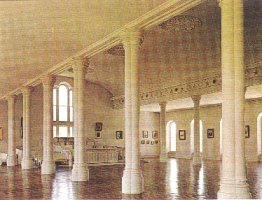
Today I want to write about assembly halls in Latter-day Saint temples. These are also known as solemn assembly halls, assembly rooms, priesthood assembly halls, priesthood assembly rooms, or priesthood rooms and were a part of the first 5 temples built and several built since.
 |
| Kirtland Temple Lower Court |
The Kirtland Ohio Temple (1836) was essentially two assembly halls, one on top of the other. The only other rooms were a few small ones in the attic area.
The lower room was designated for sacrament, preaching, fasting and praying.
The upper room was used for the school of the prophets, a school for Latter-day Saint apostles dealing with secular and religious subjects. Both assembly halls had very unique architecture. The rooms had pulpits in the front and back. One set was for the Melchizedek Priesthood leadership and the other was for the Aaronic Priesthood leadership.
The pulpits on each side consisted of 12 pulpits arranged in 4 rows of 3 pulpits. Each pulpit had three letter initials on it designating who sat there. The three pulpits on each row had the same initials. These initials on the western Melchizedek Priesthood side are from top to bottom:
M.P.C. (Melchizedek Presiding Council) – First Presidency of church or stake
P.M.H. (Presiding Melchizedek High Priesthood) – Quorum of 12 Apostles or Stake High Council
M.H.P. (Melchizedek High Priesthood) – High Priests Quorum
P.E.M. (Presiding or Presidency Elders Melchizedek) – Elders Quorum Presidency
On the eastern Aaronic Priesthood side the initials are from top to bottom:
B.P.A. (Bishop Presiding over Aaronic Priesthood) – Presiding Bishopric of the church or local Bishopric
P.A.P. (Presiding or Presidency Aaronic Priests) – Priest’s Quorum Reps
P.T.A. (Presiding or Presidency Teachers Aaronic Priesthood) – Teachers Quorum Presidency
P.D.A. (Presiding or Presidency Deacons Aaronic Priesthood) – Deacons Quorum Presidency
The bottom pulpits on both sides included collapsible sacrament tables so the sacrament could be administered.
In the Kirtland Temple the assembly halls were extremely important because they are where
Jesus Christ appeared, stood on the breastwork of a pulpit, and accepted the temple. Then Moses, Elias, and
Elijah came as angels and gave the priesthood keys of the gathering of Israel, the dispensation of the gospel of Abraham and “this dispensation”, and the sealing keys that allow ordinances to have power even beyond death allowing baptisms for the dead and eternal marriages to be performed, among other things.
See Doctrine and Covenants Section 110.
The Kirtland Temple assembly halls are also notable because each could be divided into 4 sections by dropping curtains allowing for 8 meetings to take place simultaneously. The pulpits could also be separated from the rest of the room by curtains, functioning as a sort of Holy of Holies. The seats were also reversible so the congregation could face either the Aaronic or Melchizedek Priesthood side depending on who was speaking or if the room was divided by curtains. About 900 to 1000 people could fit in the lower assembly hall. I’ve been in the Kirtland Temple and the craftsmanship is incredible. Some people notice that the pews have doors on the row ends. This isn’t unique to Latter-day Saints, but is actually a common feature of New England architecture. The doors cut down on drafts in the room in winter time.
 |
| Nauvoo Temple Assembly Hall |
The Nauvoo Temple (1846) was essentially a larger version of the Kirtland Temple, again with two assembly halls. The upper assembly room may not have ever been finished (In the rebuilt temple this floor is filled with the endowment rooms and celestial room). In the original Nauvoo Temple the endowment was presented in the attic level with the space divided into endowment “rooms” using curtains. Baptisms for the dead were performed in the basement font. The rebuilt Nauvoo Temple includes the first floor assembly hall, although it is a little smaller width wise. I’ve seen the assembly room in the Nauvoo Temple on my visits there and it is beautiful. The pulpits are very similar to those in Kirtland. The original assembly room could seat about 3,500 people, although in the rebuilt temple the room is smaller and seat less people. The words "The LORD Has Seen Our Sacrifice - Come After Us" were originally inscribed in gilded letters along the ceiling arch behind the east Melchizedek Priesthood pulpits on the first floor assembly hall. I've noticed that the new temple has transmitters in the ceiling like those used for headsets used to listen to the endowment in another language. I assume from this that meetings are broadcast to this temple with translations when needed.
 |
| St. George Temple Assembly Hall |
The St. George Utah Temple (1877) was constructed similar to the Nauvoo Temple with two assembly halls. Originally the lower hall was divided with curtains to make endowment "rooms". In 1938 the lower assembly room was converted with walls dividing the space into endowment rooms and a celestial room. The upper assembly hall is left intact and has Aaronic and Melchizedek Priesthood pulpits but instead of permanent pews it has removable chairs.
 |
| Logan Temple Assembly Hall |
The Logan Utah Temple (1884) was build with endowment rooms on the lower floors and a single assembly hall on the top floor. This one also has chairs instead of pews. Although the Logan Temple was gutted and a new steel frame temple was built inside the stone exterior destroying the original pioneer craftsmanship and layout, it is my understanding that the assembly hall was left intact during the remodel and still occupies the top floor. I know for a fact that you can see all the way through the temple on the top row of windows, so if they removed the assembly hall, they can't have replaced it with anything.
 |
| Manti Temple Assembly Hall |
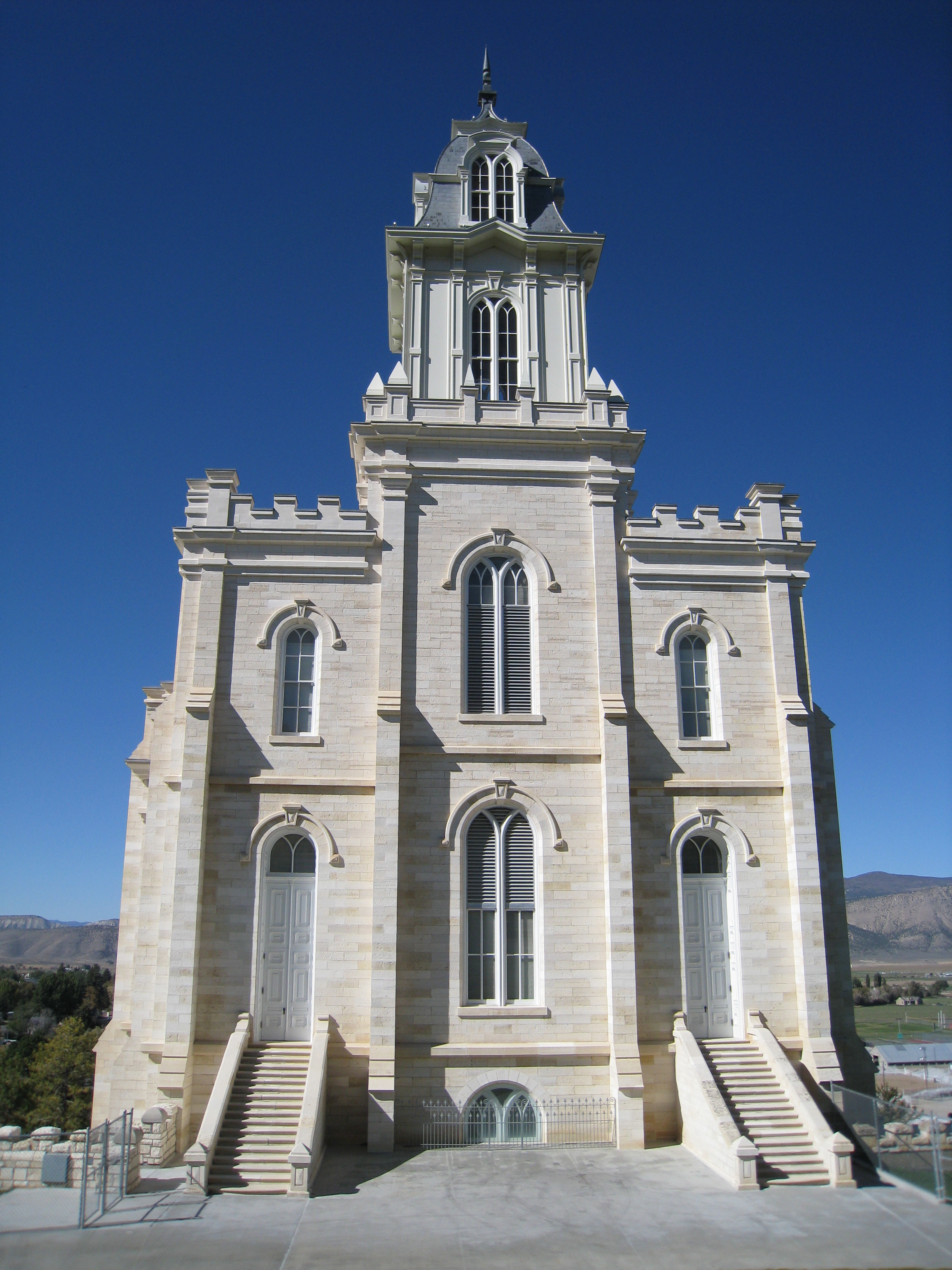
The Manti Utah Temple (1888) is similar to Logan with an assembly hall on the top floor. This time pews are present. The room has a seating capacity of 1,500 people according to the
Millenial Star volume 50 printed in 1888. Because the temple is on a hill, the
east doors of the temple lead into this room whereas the west doors enter the endowment and sealing section of the temple several floors below.
 |
| Salt Lake Temple Assembly Ha |
The Salt Lake Temple (1893) contains a large assembly hall on the top two floors which seats about 2,200 people. The top two rows of windows on the temple main body (an arched row and an elliptical row) give light to the room. The pulpit design breaks away from the Kirtland model (curved breastwork) and instead has podium style pulpits with 12 on each side. Above the pulpits there is a canopy labeled "Aaronic" and "Melchizedek" on the respective sides (I think it also says Priesthood). The hall also has a large balcony with spiral staircases. This room is regularly used for meetings of General Authorities of the church (every Thursday I’ve heard) as well as occasionally for special temple worker meetings and meetings for bishops, etc.. The assembly hall was also temporarily used as a studio to film the endowment when it was first converted to a film format for the Bern Switzerland Temple. Before the Missionary Training Center was built in Provo, missionaries were trained in Salt Lake City and had special devotionals usually led by an apostle or member of the first presidency in the temple assembly room before leaving on missions. Here's a cool picture of the room
under construction.
After the completion of the Salt Lake Temple, temples were built without assembly halls to save money as most temples don’t need them. This was new as every temple up to this point had an assembly hall. Another temple wouldn’t be built with an assembly hall for 63 years.
 |
| Los Angeles Temple Assembly Hall |
The Los Angeles California Temple (1956) was a very large temple with more square feet than the Salt Lake Temple at the time of its construction (additions have made Salt Lake larger) and it included a priesthood assembly hall (because WWII delayed the groundbreaking an assembly hall was added to the plans). The assembly hall has a very sleek modern design and is a very large room occupying the entire top floor of the temple. It is 300 ft long so the same length as a football field.
For 18 years after the LA Temple was completed temples were built without assembly halls.
 |
| Washington D.C. Temple Priesthood Room |
The Washington D.C. Temple (1974) again had a priesthood assembly hall. This one is a modern interpretation of the Salt Lake Temple priesthood assembly room with podium style pulpits. This temple calls the room "the priesthood room" and it is located on the top floor of the temple.
The Portland Oregon Temple (1989) was the next temple containing an assembly hall. According to ldschurchtemples.com the top floor contains an
assembly hall and sealing rooms. I’ve been in this temple and the celestial room has a staircase and upper level. The upper level has a door that apparently leads to the sealing rooms and assembly hall. I don’t know other details and
I don’t have any photos so I don’t know if it follows the Kirtland pattern of 24 pulpits like every other assembly hall.
 |
| Portland Temple Assembly Hall |
* addition - I have a picture of the assembly hall that I got from a
Friend Magazine from 1993. It labels the picture as the temple chapel; however, I've been to the temple and know the chapel is downstairs and has a flat roof and pews. This is clearly at the celestial room balcony level. Although it doesn't use the 24 pulpits, I like it.
The Boston Massachusetts Temple (2000) was originally designed as a much larger structure complete with an assembly hall. I talked with someone involved in the construction and was told that the plans were changed so the basement cafeteria rooms can be used as an assembly hall. I don’t think there are pulpits there (I’ve been in the cafeteria but haven’t seen all the rooms in it) so I assume this hall would simply have solemn assemblies broadcast from other temples with pulpits. I did notice that the cafeteria ceiling contained transmitters like those used for headsets used to listen to the endowment in another language, so I assume meetings are transmitted to the temple and translated if needed.
I should explain, temple assembly halls are used for solemn assemblies which are special meetings (usually priesthood meetings) held in the temple. Meetings are regularly held for general authorities in the Salt Lake Temple. I’ve heard that the church occasionally holds meetings in temple assembly halls for stake presidents or bishops around general conference and at other times, although I’m not sure how often these meetings are held. One reason to include assembly halls in temples would be to allow for these special meetings. Temple assembly rooms are also occasionally used for temple worker devotionals. These meetings are held about once a year but they don't necessarily have to be held in an assembly hall.
Technically any temple with a chapel could use the chapel as an assembly hall for meetings not requiring the 24 pulpits. With slight modifications these temples would allow for viewing solemn assemblies broadcast from other temple assembly rooms with the 24 pulpits. Endowment rooms in other temples could also be modified to allow solemn assembly broadcasts if needed. Also, although I love the symbolism involved with 24 pulpits showing the two priesthoods and the order in priesthood offices and presidencies, I’m not sure if there is any special ceremonial use of them during solemn assemblies or if a single pulpit would be acceptable.
Well I hope you've enjoyed this post. Please post a comment or any questions you have.
I love the usage of assembly halls in temples of The Church of Jesus Christ of Latter-day Saints. Although not necessary, they are great rooms with wonderful symbolism and I hope assembly halls are added in other temples from time to time. I notice that all the current halls are located in the United States, although they do go coast to coast. An assembly room in a foreign temple would be interesting. Based on the history of these rooms I wouldn't expect them to be added very often, so we might be waiting a while.