Saturday, April 9, 2011

Latter-day Saint Temple Murals - Pt 5 - Miscellaneous Murals

This is a continuation of my posts on Latter-day Saint Temple murals.  You can read the earlier posts by clicking on the links below:
Part 1, Part 2, Part 3, Part 4, Celestial Room Murals

After the LA Temple was completed, the endowment began to be presented on film, eliminating the need for murals in endowment rooms.  Because of this, murals stopped being used in endowment rooms until the 2000s.  Even so, between the 1950s and the early 2000s, a few temple murals were included.  These tended to be in hallways or lobbies.  Here is the list I was able to come up with:

The Washington D.C. Temple
Washington D.C. Temple Mural of the Second Coming of Jesus
The main lobby of this temple has a 30 foot long mural of the second coming of Jesus Christ.  The painting is probably familiar to you if you are a member of The Church of Jesus Christ of Latter-day Saints.  It shows Christ coming and welcoming the righteous (living and newly resurrected dead people are portrayed) on his right hand, while the wicked despair and hide on his left hand side.  The Washington D.C. Temple is also painted into the mural.

The Jordan River Utah Temple
In the main lobby of the Jordan River Temple there is a mural of the Garden of Eden based on the LA Temple garden room mural.  You can see the LA Temple garden room mural in part 4 of my temple murals posts.


The Mexico City Mexico Temple
Mexico City Temple Lobby with Mural of Jesus Christ in 3 Nephi 11
This temple has a print of a famous painting of Jesus Christ coming to teach the Nephites in the Americas after his resurrection as recorded in 3 Nephi 11 in The Book of Mormon.  The print is in the main lobby.

The Ogden Utah Temple
This temple had a mural of Jesus Christ and some apostles on the Mount of Transfiguration.  I'm not sure if it was a print or an original, but it was large and striking in the main lobby.  I hope it is kept in the temple after the current remodel is completed.  This mural was also effective because the Mount of Transfiguration has been linked to the temple and multiple people (prophets and apostles) have said that this is likely where Peter, James, and John received their endowments.

Salt Lake Temple Annex
The new (added in 1960s) Salt Lake Temple Annex includes a chapel with murals on both the front and rear of the room.

The Bountiful Utah Temple
Bountiful Utah Temple Chapel
The chapel in this temple includes a print of part of a painting of Jesus Christ's second coming.  This is technically a mural as the room is planned around the piece and the piece is permanently applied to the wall.


The Vernal Utah Temple
Vernal Utah Temple Celestial Room
The same painting of Jesus Christ's Second Coming is used as a mural in the Vernal Utah Temple Celestial Room.


Baptistery Murals
There are many temple that have baptistery murals, but I am going to cover those not already covered in a separate post.

There is my list of miscellaneous Latter-day Saint Temple Murals from 1960 to 2000.  Surely I have missed some.  Please comment and let us know what you think, tell us of other murals I didn't know about, and discuss murals you would like to see.  While I am thrilled that temples have begun using endowment room murals again, I also like seeing these murals in various places in the temple.  I love how each temple is different, with random murals adding interesting variety.  Please Comment

Friday, April 8, 2011

Bees and Beehives as Temple Symbols

One interesting symbol occasionally used in Latter-day Saint temples is the beehive (or bee).  Bees and beehives have become a temple symbol for several reasons.  Some early members were masons and apparently the masons like the symbol.  In addition, bees are seen as a symbol of industry and working together.  They are a wonderful symbol of the Law of Consecration.  Bees also are used because The Book of Mormon mentions them.  In Ether 2:3 we read:
And they did also carry with them deseret, which, by interpretation, is a honey bee; and thus they did carry with them swarms of bees, and all manner of that which was upon the face of the land, seeds of every kind.
That verse isn't overly significant, but it did lead to Utah's first name being the Territory of Deseret.  The early church members liked bees and their symbolism, liked the fact that they were mentioned by a special name in The Book of Mormon, and then used the symbol and name "deseret" a lot.  Today they are used in the names of the church's thrift store (Deseret Industries), welfare companies (Deseret Pasta), a name of a Young Women's class (Beehives), the church's temple clothing manufacturer (Beehive Clothing), a Latter-day Saint themed bookstore (Deseret Book), and is on the Utah state flag and is the symbol of Utah, the Beehive State, just to name of few of the symbol's uses today.  When the Conference Center was built, President Hinckley wanted symbols included, so beehives were etched onto the glass and carved beehives were attached to the pulpit.

As a symbol, bees can also remind us of Israel as a promised land of milk and honey in the bible (see verse 17).  It can also remind us that the manna that sustained the Israelites in the wilderness, a type of Christ (John 6:31-35) tasted like honey (see verse 31).  So, whether originally intended or not, bees can be a symbol of Christ.

Of course there is probably more symbolism dealing with bees, beehives, and honey.  But I want to get onto the architectural examples of this symbol in Latter-day Saint temples, so I'll move on.


The St. George Utah Temple
This was the first temple using beehives.  There are four, one on each side of two exterior staircases at the front of the temple.  You can see pictures here and here.

The Logan Utah Temple
Logan Temple Doorknob Bee
The original Logan Temple door knobs included a honeybee design.  The bee was on the plate below the doorknob.  In the picture you can see the bee on the right (and left) in the middle.


The Salt Lake Temple
Beehives are prominently featured in several spots in the Salt Lake Temple.  Doors throughout the temple have beehives on the doorknobs.  The main exterior doors contain more beehives and bees in the decorative grill work.  The new annex also includes the symbol on glass doors.  Interior doors throughout the temple also have beehives etched onto the frosted glass panels.

The Palmyra New York Temple
When I did a session in the Palmyra Temple two years ago I noticed that the celestial room chairs are upholstered with a fabric with honeybees on it.  Look for it when you go there.

The Manhattan New York Temple
Many symbols were worked into the Manhattan Temple.  The door handles were made to resemble the statue of liberty torches.  On the same doors, carved beehives were also included.

Those are the temples using beehive symbols that I know of.  Please comment and let us know where else they are used, or just what you think.

Addition to the original post-
  Recently, endowment room chairs have been replaced in the Logan Temple (and I think Salt Lake as well).  The chairs now have carved wood beehive medallions at the end of rows of seating.

The Church of Jesus Christ of Latter-day Saints Historical Temple Artifacts

While most Latter-day Saint temples have historical artifacts placed in their cornerstones, several temples built by The Church of Jesus Christ of Latter-day Saints have historical artifacts on display.

I was walking through the Ogden Temple one day and right by the clothing rental I noticed a copy of The Book of Mormon on display.  I believe it was a first edition, although it may have been a few years newer.  I assume they will keep it on display once the temple remodel is completed.

In the Manti Temple there are many neat things to see such as the spiral staircases.  One item that can be overlooked is a piece of temple clothing framed and hanging on a wall in a hallway.  If I remember correctly, the item was from the 1850s.  It is in the hallway leading from the recommend desk to the clothing rental.

The Nauvoo Illinois Temple was rebuilt in 2002.  Both times that I visited it I asked the workers to show me what they could.  They showed me the sealing rooms, baptistery, and assembly hall.  They also showed me the historical artifacts that are now in the temple.  In the recorder's office you can see a sword owned by Joseph Smith from when he led the Nauvoo Legion.  The sword is engraved by him with his name, and also with the names of each person who owned it through the years.  Eventually it was donated to the church and is now in the temple.  This isn't the only artifact.  The hallway north of the assembly hall contains several.  There is a framed set of original keys to the temple.  Several are replicas, but some keys in the set are the originals.  There are also several pieces of framed temple clothing dating to Joseph Smith's time.  I believe the first framed set belonged to Lucy Mack Smith, Joseph Smith Jr.'s mother.  There is another piece of temple clothing further down the hall.

These temple artifacts are nice to see.  I particularly like the old temple clothing as it allows me to compare how pieces were then to how they are now and determine what is merely style, and what is potentially significant and symbolic.  It also let me see a way something used to be.  I didn't realize we could use more white.  I won't say more on that.

Do you know of any historical artifacts on display in temples?  Please comment.

Wednesday, April 6, 2011

Temple Additions

At the request of The Tolmans who commented on my last post, I'm going to talk a little about temple additions.

The St. George Utah Temple had a stair addition on the rear of the temple.  This didn't alter the symmetry (as other temple additions have) and blends in fairly well with the temple.  It isn't a perfect addition.  Details such as window style give away that it is a 1970s addition.  There is also an annex with dressing rooms, etc. that is white, but otherwise doesn't match the original temple.

The Logan Utah Temple has been completely gutted and rebuilt on the inside.  At the same time a stair tower was added to the center of the north side.  Unfortunately, this ruins the original symmetry of the temple, and the windows don't match the original temple.  The stone is a fairly good match.  The temple originally jutted out slightly in the same location as the current stair tower (I'm not sure if this was from an earlier stair addition).  In that case, the extension had a circular window that looked nice.  The original annex also matched the stone of the main temple and was castellated.  I'm not sure why they replaced that annex with a cream 1970s style annex that obviously doesn't match the time period of the original temple.  But when the Logan Temple was remodeled in the 1970s, little, if any, attention was paid to historical details or matching styles.  This is painfully apparent on the inside which looks nothing like the exterior would suggest.

The Manti Temple used to have a drive through tunnel beneath the east towers.  This has been blocked off now and parts of it can be seen near the current women's dressing room.  Otherwise I am only aware of the current annex addition with dressing rooms.  In this case, it matches the temple stone and the annex interior matches the styles present in the rest of the temple.

The Salt Lake Temple has had a sealing room annex added (on the right side in this picture).  This addition is 2 stories tall and is found on the north side of the temple.  This ruins the symmetry of the original temple, and the windows don't quite match those found on the original temple.  Even so, this addition blends fairly well and was needed to increase the number of sealing rooms from 3 to 14.

The Boise Idaho, Chicago Illinois, and Dallas Texas Temples were overcrowded upon opening.  Each was remodeled within a few years.  The additions present some problems.  In at least Dallas and Boise you go to the chapel and then you go back through the dressing rooms to get to the endowment rooms.  This is awkward and obviously wasn't the original plan for the building.  Boise's addition isn't the most balanced.  I remember Dallas' addition doing a better job of preserving symmetry.  In addition, one of the formerly detached spires is now in a lobby with glass skylights providing a nice view.  I haven't been to the Chicago Temple, so I am not sure how the addition works there.

Currently, the Buenos Aires Argentina Temple is being remodeled.  Two wings are being added that match the original temple architecture and preserve the original symmetry.


The Monticello Utah Temple was originally built with just one endowment room, one sealing room, the celestial room, and a baptistery.  It was so small because it was a test small temple.  Shortly after completion, the temple was expanded and now looks like most other first style small temples, although the window elevations change along the building, giving away that there is an addition.  Similarly, the Anchorage Alaska Temple was originally built small and has since been expanded.  This gives it a different look.

I've surely missed some temple additions.  I've noticed that most additions haven't done the best jobs of preserving the original architecture (they ruin symmetry, windows don't match, rooms and corridors don't flow right afterwords). Still, most aren't overly offensive, and a few work.

Comment and let us know what you think.

Tuesday, April 5, 2011

Words as Temple Decoration

Several temples of The Church of Jesus Christ of Latter-day Saints use words to decorate the temple.  For example, at the entrance to the Cardston Alberta Temple there is this verse by Orson Whitney that I found here.  Here is the verse:

Where spreads a feast unknown to festive halls.
Freely partake, for freely God hath given
And taste the holy joys that tell of heaven.
Here learn of Him who triumphed o’er the grave,
And unto men the keys, the Kingdom gave;
Joined here by powers that past and present bind
The living and the dead perfection find.
 In other temples a verse of scripture is used.  In the Mesa Arizona Temple, above the celestial room doors (seen from the grand staircase) is part of D&C 93:36:
THE GLORY OF GOD IS INTELLIGENCE
I think it was also in the Mesa Temple (but may have been elsewhere) that the beatitude found in Matthew 5:8 is inscribed on a wall:

BLESSED ARE THE PURE IN HEART FOR THEY SHALL SEE GOD
The Idaho Falls Temple has  Habukkuk 2:20 on the wall in a foyer area:
BUT THE LORD IS IN HIS HOLY TEMPLE: LET ALL THE EARTH KEEP SILENCE BEFORE HIM.
Of course most temple exteriors contain the words:
HOLINESS TO THE LORD
THE HOUSE OF THE LORD
The Salt Lake Temple contains a scroll stone engraved with the words:
I AM ALPHA AND OMEGA
The original Nauvoo Temple had inscriptions in the lower assembly hall.  Above the Melchizedek Priesthood pulpits, following the arch of the ceiling in gilded letters were the words:
THE LORD HAS SEEN OUR SACRIFICE - COME AFTER US
Both the Kirtland Ohio and Nauvoo Illinois Temples had assembly halls with three initials on each of the 24 pulpits.  The Kirtland Temple had the Melchizedek Priesthood pulpits engraved with the following from top to bottom:

M.P.C. (Melchizedek Presiding Council)
P.M.H. (Presiding Melchizedek High Priesthood)
M.H.P. (Melchizedek High Priesthood)
P.E.M. (Presiding or Presidency Elders Melchizedek)
On the eastern Aaronic Priesthood side the initials are from top to bottom:

B.P.A. (Bishop Presiding over Aaronic Priesthood)
P.A.P. (Presiding or Presidency Aaronic Priests)
P.T.A. (Presiding or Presidency Teachers Aaronic Priesthood)
P.D.A. (Presiding or Presidency Deacons Aaronic Priesthood)
 This website claims that in the Nauvoo Temple the initials were, on the Melchizedek Priesthood side:

P.H.P. (President of the High Priesthood)
P.S.Q. (President of the Seventy Quorums)
P.H.Q. (President of the High priests Quorum)
P.E.Q. (President of the Elders Quorum)
 And on the Aaronic Priesthood side there were the initials:
P.A.P. (President of the Aaronic Priesthood)
P.P.Q. (President of the Priests Quorum)
P.T.Q. (President of the Teachers Quorum)
P.D.Q. (President of the Deacons Quorum)
The assembly hall in the Salt Lake Temple contains inscriptions above the pulpits on each end.  They are:
Aaronic Priesthood
and
Melchizedek Priesthood


The Manti Temple doorknobs contain what is claimed to be stylized Arabic (stylized to the point where the inscription cannot be interpreted today), a common art form used by Masons (the doorknob maker was a mason).  For more information, read the book The Manti Temple.  This book was printed to commemorate the centennial of the Manti Temple.

In Islam since images are often considered idol worship, their mosques and other buildings are often decorated with verses from the Koran, usually extremely stylized.  So using text to decorate religious architecture is not even unique to Christianity (which has many examples of using scriptures to decorate churches).  I also read a newspaper article a few years ago that featured an old Church of Jesus Christ of Latter-day Saints chapel with scriptures written on each of the roof trusses visible in the chapel.

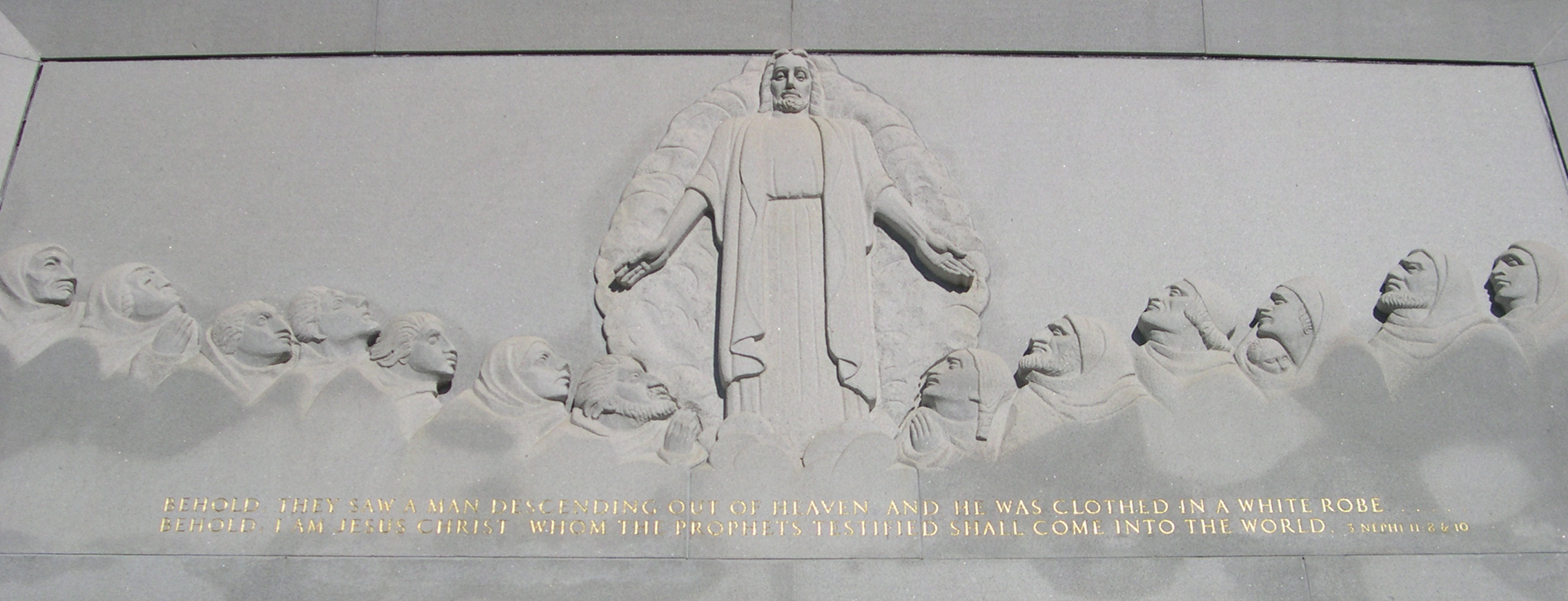
The Oakland California Temple has relief sculptures of Christ in the New Testament and The Book of Mormon on the temple exterior.  On the New Testament Side the inscriptions are:
BLESSED ARE THE PURE IN HEART FOR THEY SHALL SEE GOD -Matt 5:8
SEEK YE FIRST THE KINGDOM OF GOD AND HIS RIGHTEOUSNESS -Matt 6:33
On The Book of Mormon side it reads:
BEHOLD, THEY SAW A MAN DESCENDING OUT OF HEAVEN AND HE WAS CLOTHED IN A WHITE ROBE
BEHOLD, I AM JESUS CHRIST WHOM THE PROPHETS TESTIFIED SHOULD COME INTO THE WORLD- 3 Ne 11:2&10

There is also a large plaque quoting 3 Nephi 17 in the courtyard of the Oakland Temple.

Surely there are many more examples of words being used to decorate temples.  Words can remind of of scriptures and easily put us in the right frame of mind.  Also, they are easier to understand than the hidden symbols frequently used in temples.  Scriptures can bring the spirit and remind us of things we should be focused on.

Although not decorative, when the Logan Temple was gutted they found a wall full of engravings in the plaster hidden beneath the surface.  The inscriptions (with spelling errors galore) had names, mentioned that they were being persecuted, and gave other historical information.

I hope some of you know of engravings on temples and can add a comment telling us how words are used to decorate temples.  We can also discuss how words could be used in future temple architecture, or what you think of the inscriptions I have highlighted so far.  Please comment.

Sunday, April 3, 2011

3 New Temples Announced

At General Conference yesterday, President Thomas S. Monson announced that the church will be building temples in Fort Collins, Colorado; Meridian, Idaho; and Winnipeg, Canada.  I was glad to hear about these temples, although a little surprised at the announcement as President Monson had been developing a pattern of announcing 5 temples each year in the October General Conference and none in April.  So it was a pleasant surprise.  Meridian Idaho is really close to Boise, so the temple will only be minutes from the Boise Temple.  The Boise Temple was overcrowded the day it opened and almost immediately closed for an expansion project.  So it is not surprising that they need another temple so close.  Colorado only had one temple and a lot of members so a second temple is needed and not too surprising.  The Winnepeg Canada Temple will be the ninth in Canada and is a long distance from other temples.  I'm sure it is needed and appreciated.

I had expected that if we got a temple announcement, it would have been about a remodel.  I'm sure those announcements will come in the coming years.

I was going to have a post predicting likely places that temples would be announced before conference and hoped to get a lively discussion going.  I decided to hold off until October.  Perhaps I'll still do a post like that then.  For now, I am just thrilled that we are getting three more temples!

Distinctively "Mormon" Church of Jesus Christ of Latter-day Saints Temples

While researching about the Cardston Alberta Canada Temple I cam across this article.  In it, the author praises the Cardston Temple as his favorite temple; however, he adds this statement:
Despite my Prairie-School love, I am not even completely comfortable with the Cardston temple. After all, it is a fine work derivative of a larger tradition. Its primary aesthetic is not distinctively Mormon.                                   (emphasis added)
 This made me think about what is distinctively Mormon architecture and what temples meet this criteria.  I want to note that the term "Mormon" is slang for The Church of Jesus Christ of Latter-day Saints and its members. Latter-day Saint is a term for the members and I will use that term from here on. Let me be clear from the start, I don't think a temple has to have distinctively Latter-day Saint architecture to be a good temple or great architecture.  Some of my favorite temples are in styles common to the rest of the world.  We are supposed to take what is good in the world and apply it to us.  At the same time, using architecture that is distinctively Latter-day Saint has great benefits.  It allows a temple to be recognized as a temple, and not just by using an Angel Moroni statue.  Distinctively Latter-day Saint architecture also is usually filled with symbolism.  Also, our architecture was often a conglomeration of various styles brought by immigrants from around the world.  The resulting eclectic styles contained a history of the gospel going to all nations and of the gathering of Israel.

I'd like to see some discussion on what you think is distinctively Latter-day Saint temple architecture, how it has been used, and how it is being used in newer temples.  I'll begin the discussion by focusing on what I see as distinctively Latter-day Saint architecture.

Six Towered (or spired) Temples
While the interiors of the Kirtland, Nauvoo, and St. George Temples contained unique architecture, their exteriors borrowed heavily from architectural precedents and weren't really distinctly Latter-day Saint on a macro level.  The Logan (1884), Manti (1888), and Salt Lake Temples (1893) introduced the highly symbolic 6 tower style that I see as being distinctively Latter-day Saint.  This and the castellated style (also present in St. George) make these temples easily identified as Latter-day Saint, despite the fact that two of them lack statues of the Angel Moroni.  The towers represent the Aaronic and Melchizedek Priesthoods with 3 towers on each side.  The west three towers represent the Presiding Bishopric, or any bishopric in the church.  These are the leaders of the Aaronic Priesthood.  The east towers represent the First Presidency of the church, the leaders of the Melchizedek Priesthood.  Priesthood is an important principle of The Church of Jesus Christ of Latter-day Saints and is inseparably connected with the temple and is woven firmly into the ordinances of the temple,

Visually, the six tower architectural style makes these temples look unlike any other religious buildings I know of.  Chapels and cathedrals throughout Christendom use single spires and sometimes two spires on one end.  The six spire architecture used in Church of Jesus Christ of Latter-day Saints Temples is a unique style.

The Washington D.C. Temple (1974) was built to visually echo the iconic Salt Lake Temple's architecture.  One way it accomplished this was through the use of six towers (three on each side).  Even though the Washington D.C. Temple is very modern and sleek in its design, I think it is also distinctively Latter-day Saint in its architecture.  It is a successful fusion of styles that keeps the priesthood symbolism intact on the macro scale.

In the 1980s the church began to build numerous six towered temples.  These are often referred to as the six spire sloped roof temples (or sometimes derogatorily as the six spire meetinghouse temples).  I personally really like this style and think it succeeds in being uniquely Latter-day Saint.  The following temples used this style:


I have placed an asterisk next to the Frankfurt Germany Temple because it uses the same style, but actually only has one spire.  Two other temples look similar the these temples with six spires.  These temples used a different, larger floor plan and have a lot more detail on the spires, use sun, moon, star, and earth stones, etc.  These are the:


Each of these temples from Boise to Las Vegas has architecture the looks distinctively Latter-day Saint to me.  The multiple spires and their symbolic arrangement sets these buildings apart from other religious buildings in the world as LDS Temples.  I have been to the grounds of the Boise Temple and have attended the Dallas, Portland, and Las Vegas Temples.  I like how each is, although the Portland and Las Vegas Temples excel in their internal architecture.  I like the interior of the Dallas Temple as well, but it isn't as well executed., mainly due to a necessary addition.  That and the endowment room seats have a hideous pattern on them, in my opinion.

I've heard and read that the church has tried to build temples with six spires since the 1980s but has been unsuccessful, mainly due to protests from neighbors and burdensome local building codes and planning committees.  This is unfortunate because using six spires is a way that LDS Temples display their identity and symbolically teach important principles through sacred architecture.  The Brigham City Utah Temple  (currently under construction) was the first temple in a long time to have six towers (counting the corner spire-less towers)
The Brigham City Utah Temple
Two Towered Temples
The San Diego California Temple (1993) has two main towers (although additional towers bring the total to 10) and the Vernal Utah Temple, (1997) created by extensively remodeling the Uintah Stake Tabernacle, also has two towers.  In the last few years, the church has begun building more two towered temples.  This is a creative way to symbolically represent the priesthood, while using only two towers.  These temples echo the Logan and Manti Temples which had six towers, but only two prominent ones.  Several Temples use this style, including the aforementioned Brigham City Temple which actually has six towers.  Currently, the church is building the Kansas City Missouri Temple and Rome Italy Temple using two towers,  It has been reported that the Philadelphia Pennsylvania Temple will have two towers.  Other temple(s) now in the planning stages also use the two tower style.  I really like these styles.  The two towered style brings symbolism and strength to the temples.  It also looks distinctively uniquely Latter-day Saint to me.  I think this is especially helped by keeping the towers on opposite ends of the temples.
Kansas City Missouri Temple
Rome Italy Temple
Having either six towered or two towered temples is one way I think our temples become distinctively Latter-day Saint.  They look different from other architecture on the macro level, even while borrowing from many types of common architecture.  I hope the church continues to build two towered temples and I also hope that we resume building six towered temples as well.

I've only covered a small part of what I think is distinctively Latter-day Saint temple architecture.  Please comment and let us know what you see as being distinctively Latter-day Saint architecture and how it is - or can be - applied to temples.