Saturday, October 30, 2010

Latter-day Saint Temple Relief Sculptures


This entry is about temple sculptures other than Angel Moroni statues or other statues.  There are or rather were 2 other statues I know of on one temple.   If you know what I’m talking about, feel free to post a comment.  Either way  I’ll get to that in another blog post about statues on temples and on temple grounds.  For this post I’, focusing on Friezes or bas-relief or any type of relief sculpture for that matter.  Although Nauvoo, Salt Lake and many other temples have sculptures of suns, moons, stars, trumpets, clouds, constellations, earths, tree of lifes, flowers, etc., this post isn’t about them.  I’m writing today about the Laie Hawaii Temple, Mesa Arizona Temple, Oakland California Temple, Newport Beach California Temple and the Cardston Alberta Temple although it is a little different.

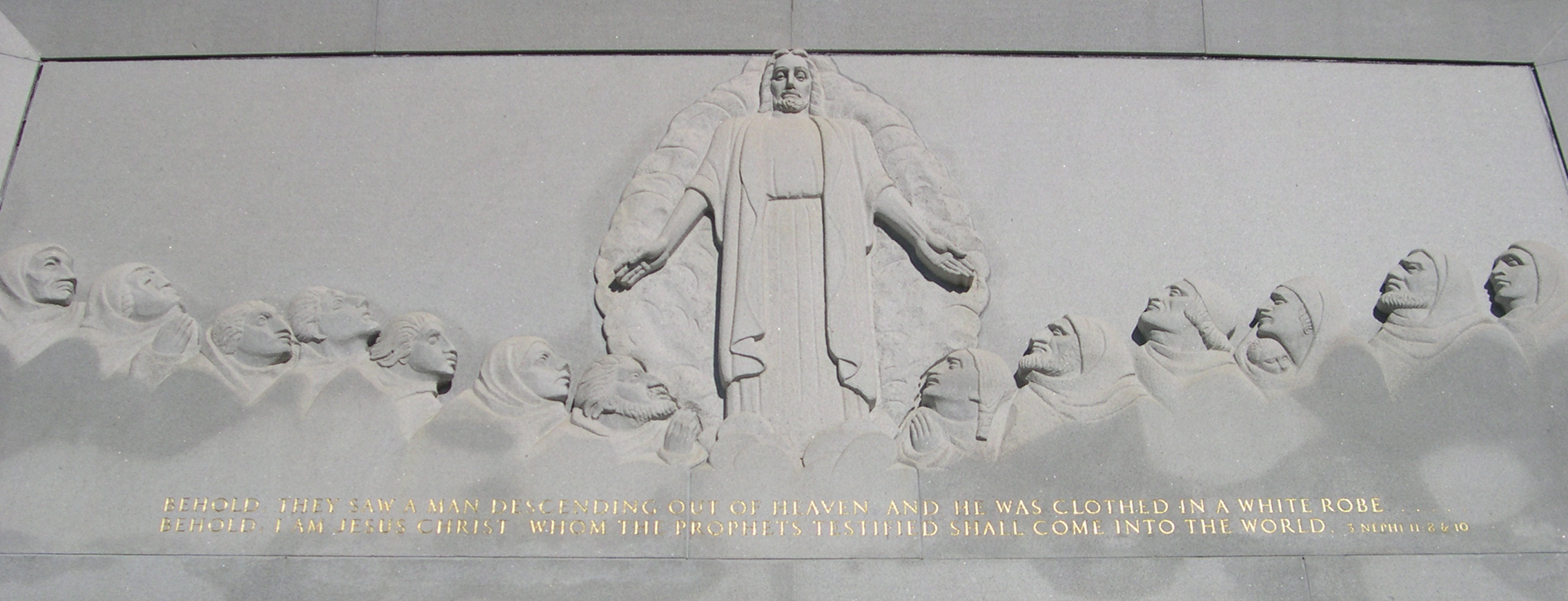
 The first temple relief sculpture was on the Laie Hawaii Temple in 1919.  On the four sides of the temple there are friezes that are relief sculpture planned by J. Leo Fairbanks and  built by him and Avard Fairbanks, his brother.  These depict Christ in 4 dispensations, or perhaps more accurately in 4 scriptural periods.  These are:

West - Old Testament
South - New Testament
North - Book of Mormon
East - Latter-day Dispensation (Doctrine and Covenants)

If you live in (or visit) Utah you can see smaller bronze copies of these sculptures (by another artist, I can’t find his name but it was one of the big latter-day saint names, like Knaphus) in the lobby of the new Church History Museum.  During the recent renovation of the Laie Temple they added a waiting room with copies of the sculptures so patrons inside the temple could appreciate the scenes and not just those outside.

The next relief sculpture was at the Cardston Alberta Canada Temple in 1923.  I say “at” because I don’t think this relief is actually on the temple but just the grounds, although I am unsure.  It was originally in front of a pool which has since been removed.  The sculpture by Torlief Knaphus depicts Jesus Christ talking to the woman at the well and even quotes scripture.  If you live in Utah you can see a plaster casting of this sculpture in the lobby of the Provo Utah Temple (with added color!). 

With the previous 2 temples including relief sculptures, a relief frieze was included on the Mesa Arizona Temple in 1927.  This sculpture, also by Torlief Knaphus includes 8 panels, 2 on each corner of the temple, depicting the gathering of Israel from the 4 corners of the earth.  The panels depict gathering scenes of:

Early Latter-day Saints crossing the plains to the Salt Lake Valley
A ship landing with English, Welsh, Irish and Scottish immigrants
Handcart pioneers
Mexicans travelling to Zion
Native Americans gathering
Pacific Islanders (who actually aren’t travelling unlike every other panel)
French, Swiss,  Italians travelling
Continued with Germans and Dutch leaving their homes and heading to Zion

The Mesa Temple also has a lion head on the east side by the baptistery entrance.  It is a fountain.

After the Mesa Temple it took 37 years before the Oakland California Temple included relief sculptures in 1964.  It has a sculpture of Jesus teaching the people in and around Jerusalem during his mortal ministry on the north side of the temple.  On the south side of the temple there is a sculpture of Jesus Christ appearing to the Nephites in the Americas after his resurrection.  I can’t seem to find out who sculpted these scenes, but if you know please tell us in the comments on this post.  This temple also has tree of life sculptures, but they are more of an architectural detail so I might discuss them in a later post.

Most websites and articles say that the Oakland Temple is the last with relief sculptures, but they are simply wrong.  The Newport Beach California Temple built in 2005 has a relief sculpture of Christ appearing to 10 of the 12 apostles after his resurrection.  The sculpture looks like bronze and is above the front doors.  Although smaller than the other sculptures in this article, it is a welcome return to relief sculptures and I hope we see more scenes on new temples.  I don’t know who sculpted the Newport Beach Temple frieze and would really like to know.  LeRoy Transfield sculpted this beautiful sculpture.  If you know any information on this PLEASE COMMENT.

So there you have my discussion of relief sculpture on Latter-day Saint temples.  We have scriptural scenes (Laie Hawaii, Cardston Alberta, Oakland California and Newport Beach) and latter-day gathering (Mesa Arizona) represented in these fascinating works of art.

If you know of any other temple sculptures (not statues, I’ll deal with them later) please tell us in comments.

-The following is an addition to the original post
I noticed that although the Winter Quarters Nebraska Temple doesn't have relief sculptures on it (unless you count the doors), the grounds are shared with a pioneer cemetery with some nice relief sculptures of Christ, etc. in a style I really like.

Friday, October 29, 2010

Angel Moroni Statues

Wow, I have not written on this blog in a long while. This is mainly because nobody ever commented on my posts. So please comment on my posts and if you like the content in this blog, link it to your web pages/ blogs, it helps get more readers here.

So today's post is about Angel Moroni statues. The Angel Moroni was an angel who appeared to Joseph Smith Jr., founder of The Church of Jesus Christ of Latter-day Saints (commonly referred to as the Mormon or LDS church).  To quickly summarize, the angel gave Joseph Smith the record that The Book of Mormon is translated from  For a complete account click here.  Verses 30 on in particular deal with the Angel Moroni.  These statues are on most Latter-day Saint temples as a symbol that revelation still exists, the gospel of Jesus Christ has been restored, and of the angel mentioned in Rev 14:6.  Eight temples don't Angel Moroni statues because they lack a spire (Laie Hawaii, Cardston Alberta Canada, Mesa Arizona) or because they were built before the statues were traditional (St. George Utah, Logan Utah, Manti Utah, Hamilton New Zealand, Oakland California). Originally the Idaho Falls Idaho, Bern Switzerland, London England, Ogden Utah, Provo Utah, Sao Paulo Brazil, Tokyo Japan, and Freiburg Germany Temples lacked statues, but have since had them added. The Boston Massachusetts Temple and Manhattan New York Temple both had spires added shortly after their dedications (due to a court case for Boston).

The image at the top of this post shows 5 Moroni statues and a proto-Moroni weather vane. This shows some of the diversity in Moroni statue design. The first picture shows how the angel weather vane on the Nauvoo Temple would have originally looked. This was the only flying angel statue on a temple and wasn't specified as Moroni. Notice that he is holding a book and not gold plated. This may imply that he was a general angel and not Moroni specifically, or that he was someone such as Joseph Smith (as one institute teacher of mine theorized). Regardless of the intended identity, this weather vane represented the angel in Revelation 14:6

The next temple with an angel was the Salt Lake Temple. Originally it was planned to have 2 angel weather vanes (Nauvoo style) with one on the east center tower and one on the west center tower (scroll down in the link for the drawing). By the time the temple was completed 40 years later in 1893, styles had changed and statues were more common on the tops of buildings (think U.S. capitol building). So Cyrus E. Dallin was commissioned to make a standing angel statue, now identified as Moroni. This is the second picture on the image above (from the left).

63 years after the dedication of the Salt Lake Temple, the Los Angeles Temple was the next temple with an Angel Moroni statue. This statue (3rd from left in above picture) is quite unique
because Moroni is Native American and dressed in Mayan clothing. Also, this is one of the few Moroni statues holding gold plates and not just a trumpet. The Washington D.C. Temple also has an Angel Moroni statue holding plates and replicas of this statue are found on the Jordan River Utah (pictured 4th from left), Seattle Washington and Mexico City Mexico Temples. These are the only temples with Angel Moroni statues holding plates.

As all temples began to include Angel Moroni statues several styles have been used. When the small temples first began to be built, the Monticello Temple was given a white Angel Moroni statue holding a trumpet and a scroll. Unfortunately the white statue disappeared in the clouds so it was replaced with a gold leafed one shortly thereafter and now all Moroni statues are gold leafed. Five temples have Moroni with a scroll (5th from left in picture). These are the Anchorage Alaska, Bismarck North Dakota, Columbus Ohio, Kona Hawaii, and Caracas Venezuela Temples.

It should also be noted that Angel Moroni statues are not exclusive to Temples. The Washington D. C. ward chapel had a replica of the Salt Lake Temple Moroni sculpted by Torlief Knaphus (this replica is now in the Church Museum of History and art and castings of it were added to the Idaho Falls Idaho Temple and Atlanta Georgia Temple (since replaced)).  The Hill Cumorah Monument (far right in picture) also has a Moroni Statue without a trumpet, but with gold plates (and a beard!).

I also want to note that there is a lot of lore about Angel Moroni statues having to face east. This simply isn't true. While most do, because many (not all) temples face east, at least the following do not face east: Seattle Washington (west), Dallas Texas (South), Nauvoo Illinois (West), Spokane Washington (West, although originally East), Taipei Taiwan (West), and Manhattan New York (Southwest).

Thank you for reading this post. I hope you've learned something. Please post a comment to encourage me to keep this blog up to date. Also if you know any interesting Angel Moroni Statue trivia, please comment.

Due to comments I am adding the following:

Well there have been 5 sculptors (6 if you count LaVar Wallgren as distinct from Quilter). Read Ensign Jan 2010 article

The sculptors and corresponding Angel Moroni statues are:

Cyrus Dallin - Salt Lake, Copper, 12'5"

Torlief Knaphus - SL replica for D.C. Chapel, hollow Aluminum (now in the Church Museum of History and Art). Fiberglass castings of this statue by LaVar Wallgren were placed on the Atlanta Georgia (later replaced) and Idaho Falls Temples. Knaphus Also did the Hill Cumorah Moroni (10'4" bronze) He also helped Avard Fairbanks do the Laie Hawaii Temple Font and he sculpted the oxen for the Cardston Alberta, Mesa Arizona and Idaho Falls Temple Fonts.

Millard F. Malin - L.A., 15'5" Aluminum

Avard Fairbanks - Washington D.C. (18ft bronze) and 15'2" bronze castings of the same sculpture for Jordan River, Seattle Washington, and Mexico City Temples.

Karl Quilter - 1978 commission for a 10ft and 7ft Moroni. The originals were then cast in fiberglass by LaVar Wallgren and used on many temples. Quilter got a 1998 commission to make a 6'10" Moroni for small temples. Although the article doesn't mention it, he would have had to have made the Moroni w/ scroll used on 5 temples and then the Moroni w/ open hand used on all future temples. Fiberglass castings of these are used on many temples. Over 100 Karl Quilter/LaVar Wallgren Moroni statues are on temples. Quilter also made L.A. font oxen. Wallgren makes Moroni statues in his Kearns, UT studio.

LaVar Wallgren has generally worked with Karl Quilter and may be considered a sixth sculptor of Angel Moroni statues.  He did a casting of the Washington D.C. Chapel Angel Moroni statue that was used on the Atlanta Georgia Temple for a while and may have done other statues without Quilter, although I am not certain if Quilter was or was not involved with Wallgren on all of Wallgren's Mornoni statues. 

Addition to the original post (added 18 March 2011)
Here are articles on Angel Moroni statues if you want to read more here and here:

Thursday, February 11, 2010

Kansas City Temple design

I recently found an architectural rendering of the Kansas City Missouri Temple on ldschurchtemples.com (a wonderful site). The picture was just removed from the site today for some reason, but you can probably find it elsewhere.

The temple design showed a two towered (2 steeple) structure. I was very happy to see this. A lot of temples have the East side represent the Melchizedek Priesthood and the West side represent the Aaronic Priesthood. The Salt Lake Temple started this pattern, having 3 towers on the East and 3 on the West. Logan and Manti look like they have 2 towers (technically they have 2 smaller towers with staircases on either side of each main tower). The San Diego California Temple was the next two ended temple (technically 10 towered, but there are two main towers with 4 smaller towers around each main tower). Then the Vernal Utah Temple was made with 2 towers (I believe the original tabernacle the temple was made from had the two towers).

Recently the church has been building temples with a tower on one side and a small dome on the other end. I have thought that they should just add a second tower. I know building codes don't always allow two spires, but when possible, why not? I think two towers make a temple seem like a special building, not just a fancy church. It adds to the uniqueness of the architecture and adds symbolism.

The KC Temple design isn't perfect, but I like it. It reminds me of the Logan temple in several ways, with the 2 towers being the main one. I look forward to having it built

Monday, January 11, 2010

Temple Baptisteries

My brother and I have been going to a lot of different temples to do baptisms for the dead recently. I want to discuss some of my feelings about their architecture.

Ogden, Provo, Jordan River and Logan have essentially the same design with a chapel overlooking the font and confirmation rooms on the left hand side. I think Ogden and Provo work best, probably due to the obvious addition of stone tile flooring, light wallpaper, geometric ceiling designs and in the case of Provo small crystal chandeliers and sconces in the confirmation rooms. Jordan River has a lot of potential, although it is a bit dark due to off-white wallpaper and dark woodwork which I think could be redone while preserving the original architecture. Also, the confirmation rooms are cramped and feel like closets which isn't very fitting for a room set apart for an important ordinance. As for Logan, the baptistery has natural light but is essentially a clone of the other temples, including the font. I think this is a shame as we have the original temple font in the Church Museum of History and Art so I don't know why it isn't placed in the temple.

The Bountiful and Mount Timpanogos temples both have nice baptisteries. I prefer Bountiful but that is due to my tastes. I like that in these baptisteries there are two semicircular rows of pews on top of the oxen immediately next to the font.

The Salt Lake Temple baptistery has a wonderful font. The confirmation rooms are small and out of the way which is a downside. Also the entrance is hidden and the tunnels leading into the baptistery have a 60s or 70s feel. Still, I like this baptistery.

Utah's two newest temples, Draper and Oquirrh Mountain have wonderful baptisteries. Draper has stained glass behind the font letting light flood in. The confirmation rooms have glass doors making the rooms for this ordinance seem important and not an afterthought. Oquirrh Mountian has the best baptistery as a whole in my opinion. There the chapel has glass on all 4 sides. The front overlooks the font (with glass on 3 sides) and behind are the confirmation rooms with glass doors and wall. This allows the confirmations to be seen from the font and chapel and definitely makes the rooms for this ordinance important.

In general I liked tiled baptisteries better than carpeted ones because carpet (especially in locker rooms) tends to mildew causing a bad smell.

I love the variety in temple baptismal fonts listed here and others I have seen and hope to see many more.

Thursday, October 29, 2009

Preston England Temple Sunstones Moonstones and Starstones


I served a mission in London, England from 2002-2004. This meant that I went to the Preston England Missionary Training Center which is a part of the Preston England Temple complex. We went to the temple 3 times while I was in the MTC. It is a really nice temple. The floor plan is very similar to the Oquirrh Mountain Utah Temple.

One unique feature of the Preston England Temple, that I have never seen in any other temple, is its distinctive sunstones, moonstones, and starstones shown above. What I find unique is that they are laid out horizontally and clearly represent the 3 degrees of glory and eternal progression.

In the picture at the top of this post (showing the north side of the temple) the left side is closest to the temple entrance and the right side is closest to the celestial room. Notice that the stones begin on the left with a starstone, then 4 moonstones and finally a sunstone. The same pattern is on the south side of the temple but reversed so the sunstone is still nearest the celestial room. I find this fitting because as we enter the temple and progress through the endowment rooms (there are two sets of two endowment rooms and you move from one room to another at this temple) and finally into the celestial room you are gaining light and progressing from this world to a celestial world.

Another thing I like about these stones is that they also show the cycles of the moon. Notice that the starstone is really a star with a new moon in the center and the sunstone is really a sun with a full moon in its center. So these stones also go around the temple in the phases of the moon. This is a symbol of time. The endless lunar cycles are a nice symbol for eternity on a building where eternal families are made.

I enjoy the fact that 2 or more interpretations of these symbols are present and the depth that they bring to the Preston England Temple experience. I hope to discover other unique details in Latter-day Saint temples I visit.

Wednesday, October 28, 2009

Brigham City Temple Site Announcement

The Brigham City Temple site has been announced. It will be built across the street from the Brigham City Tabernacle on the West side of Main Street.
I think this is a great site for the temple. The Brigham City Tabernacle is one of my favorite buildings and the Temple will pair well with it. I hope that the temple design echos the design of the Tabernacle with buttressing and numerous spires. It would also be nice if interior architectural details matched styles used in the Tabernacle. It doesn't have to, but since the Brigham City Tabernacle is such an attractive building I don't know why you wouldn't want to. Also, the church usually tries to make Temples nicer than the buildings around them. Basing the temple on the Tabernacle architecture would help make the temple not be overdone by the Tabernacle.
Whatever is done, I think this site is a wonderful place for the Brigham City Temple.

Tuesday, October 27, 2009

Temple Doorknobs


I like the ornate doorknobs used in the oldest temples. I recently toured the Museum of Church History and Art across the street from temple square and noticed the original door hardware from the Logan Utah Temple (The first and second pictures in this post). The hinge plates and other hidden door plates had flowers and birds cast in them. They truly were beautiful and showed the sacrifice of the saints in the late 1800's. They had very little and yet they put such ornate details everywhere in the temples. This temple was dedicated in 1884.
The third picture is of the doorknobs in the Manti Utah Temple (dedicated 1888). I've been in the temple and they look like bright gold colored brass and are incredibly ornate with Egyptian and other symbols worked in.
The fourth picture is of the Salt Lake Temple (dedicated 1893). These are also ornate.
The last picture is of a door handle in the newly built Sacramento California Temple (dedicated 2006). This shows that ornate door handles are again becoming a part of temples. I am really happy about this. I think every detail of the temple should be meaningful and detailed. They should always be our best work. In the 1800's when we had nothing we managed to create very detailed temples, so today in our relative wealth we should be able to still create very detailed temples. Detailed doors are just one aspect of this that I enjoy seeing again.
The Logan Utah Temple was remodeled in the 1970's removing the original craftsmanship. Today's doorknobs are not ornate. They are very simple and plain and frankly boring. I think this is highly disappointing. We have the original doorknobs. We should either use them on the new doors or have replicas made and installed. At the very least we should replicate the design in an altered doorknob. Hopefully the Logan Utah Temple will one day be restored to its original beauty and detail much like the Nauvoo Temple. That will probably take some large donations from members for the restoration. I hope I can see that someday. In the meantime I am glad we are again adding detailed door hardware in modern temples.